
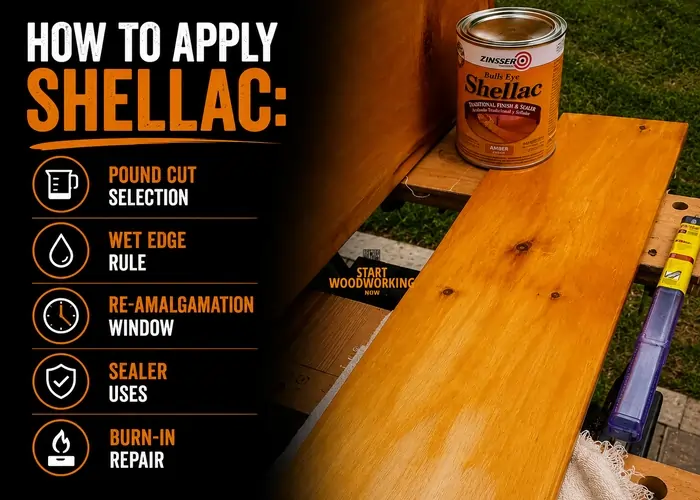
How to Apply Shellac: Pound Cut Selection, Wet Edge Rule, Re-Amalgamation Window, Sealer Uses, and Burn-In Repair
Shellac is the fastest-drying brushed wood finish available — touch-dry in 5–15 minutes, recoatable in 30–45 minutes, and buildable to a full finish in a single day. It is also the most forgiving in one specific way: because it re-dissolves in denatured alcohol regardless of age, every subsequent coat chemically welds to the previous one, and damage can be repaired invisibly by dissolving fresh shellac into the scratch. These properties make shellac the preferred finish for production furniture, period restoration, and as a universal sealer under finishes that would otherwise fail to bond.
Navigate to your question
→ Which alcohol and which cut do I need? → Solvent selection and pound cuts by use ↓
→ How do I mix shellac from flakes? → Calculations, quantities, shelf life ↓
→ How do I apply it — brush or cloth? → Wet edge rule and step-by-step protocol ↓
→ How many coats and do I need to sand between them? → Re-amalgamation window and sanding rules ↓
→ Can I use shellac under polyurethane or water-based finish? → Sealer, primer, and compatibility uses ↓
→ My shellac is tacky or streaky — what went wrong? → Failure diagnosis and fixes ↓
This guide is part of the complete wood finishing guide. For shellac definition and chemistry: What Is Shellac? →
The most common application failures — permanently tacky finish, streaky lap marks, or a finish that flakes under topcoat — each have a specific, identifiable cause. Tacky finish that never hardens almost always means either expired pre-mixed shellac or the wrong alcohol (70% isopropyl will not cure shellac). Lap marks mean the wet edge rule was violated. Topcoat failures mean waxed shellac was used where dewaxed was required.
⚠ Flammable Solvent — Denatured Alcohol
Denatured alcohol has a flash point of 13°C (55°F) — it ignites at room temperature near an open flame. Apply shellac away from open flames, pilot lights, and sparks. Do not use near heating elements or in enclosed spaces without ventilation. Containers of denatured alcohol and shellac solution should be sealed when not in use.
What Do You Need Before Applying Shellac — Which Alcohol and Which Pound Cut?
The solvent matters more than anything else in shellac application: denatured alcohol or 95% ethanol are the only compatible solvents. 70% isopropyl alcohol — the common pharmacy “rubbing alcohol” — does not dissolve shellac correctly. The 30% water content in 70% isopropyl disrupts the shellac resin emulsion, producing a milky white mixture that applies unevenly, clouds the film, and produces a finish that stays soft.
Shellac as a finish has different properties than shellac as a sealer beneath polyurethane — the polyurethane vs shellac comparison covering durability, repair, and use case.
The 70% Isopropyl Failure — Most Common Shellac Mistake
70% isopropyl alcohol (labelled “rubbing alcohol” at pharmacies) contains 30% water. Shellac is incompatible with water — water breaks down the shellac ester bonds and prevents proper film formation. A shellac solution made with 70% isopropyl looks milky-white rather than clear, applies with poor flow, and dries to a soft, hazy film that never fully hardens.
Compatibility test: Mix a small pinch of shellac flakes in a teaspoon of your alcohol. If the mixture remains clear and the flakes dissolve within 30 minutes — the alcohol is compatible. If the mixture turns milky or the flakes form a sticky residue — the alcohol contains too much water.
| Pound Cut | Mix Ratio | Use Case |
|---|---|---|
| ½ – 1 lb cut | 1 oz flakes : 16 oz alcohol | Wash coat: blotch prevention under stain; sealing alcohol-soluble dyes before water-based topcoat; de-nibbing first coat on very porous wood |
| 2 lb cut ← Standard | 2 oz flakes : 16 oz alcohol | Standard finish coats: furniture, cabinets, musical instruments. Best balance of body and flow. Recommended starting point for all brushed applications |
| 3 lb cut | 3 oz flakes : 16 oz alcohol | Fast build: filling open grain quickly, production use, sealing knots and resin pockets before painting. Harder to apply without brush marks — experienced applicators only |
| 4 lb cut (canned) | Pre-mixed (Zinsser, etc.) | Needs thinning: standard canned shellac at 4 lb is too thick for finishing. Thin 1 part shellac to 2 parts denatured alcohol to achieve a 1.3 lb working cut for most applications |
Dewaxed vs waxed shellac — which to buy: Dewaxed shellac (Zinsser SealCoat, Liberon Shellac Sanding Sealer) has the natural wax removed during processing. Use dewaxed whenever shellac will receive a topcoat (polyurethane, lacquer, water-based). Use waxed shellac only as a standalone finish with no topcoat — the surface wax provides tactile warmth and a traditional appearance. Full explanation of waxed vs dewaxed →
How Do You Mix Shellac From Flakes and What Is the Shelf Life?
Mix by weight, not volume. Weigh the flakes on a kitchen scale and add to the measured alcohol in a glass jar. Stir, cap, and allow to dissolve — typically 2–4 hours for fine flakes, up to 12 hours for coarse flakes. Shake or stir periodically to accelerate dissolution. Strain through a paint strainer or cheesecloth before use to remove undissolved material and insect debris that comes with natural shellac flakes.
Shelf Life — The Problem with Pre-Mixed Shellac
Pre-mixed shellac (Zinsser BIN, SealCoat) has a manufacturer shelf life of approximately 3 years from the production date. After this point, the shellac ester bonds begin to break down — the dissolved shellac reacts slowly with moisture in the air and undergoes hydrolysis. A shellac finish made from expired pre-mixed product dries to the touch but never fully hardens. It stays permanently tacky under pressure and can be scratched with a fingernail days after application.
Finding the production date on Zinsser cans: The Julian date code is stamped on the bottom of the can. The first digit = year, next three digits = day of year. Example: 3245 = day 245 of 2023 = September 2023. Add 3 years for the use-by date.
Quick test for expired shellac: Apply a small amount to a piece of glass or non-porous surface. Within 30 minutes at room temperature, the shellac should dry completely hard — you should not be able to dent it with a fingernail. Any softness, tackiness, or fingerprint impression after 30 minutes = expired product. Discard and mix fresh from flakes. Shellac flakes stored dry last indefinitely.
Colour selection: Blonde/clear shellac (Platina or Ultra Blonde flakes) adds minimal colour — appropriate for light species (maple, birch, pine) where warm toning is undesirable. Orange/amber shellac adds a warm honey tone — enhances walnut, cherry, mahogany, and oak. Garnet shellac adds a deeper reddish-brown tone used in period furniture restoration. All colours are available in dewaxed form.
How Do You Apply Shellac to Wood Step by Step?
The wet edge rule governs everything in shellac application. Because shellac re-dissolves in alcohol, the juncture where fresh shellac meets partially dried shellac (the dangerous zone from 2–10 minutes after application) produces a visible, raised lap mark that is permanent. You must either complete each section before the first strokes skin — typically within 3–5 minutes — or ensure you are applying fresh to fully wet surface only.
The Dangerous Zone — 2 to 10 Minutes After Application
Within 3–5 minutes of application, the surface alcohol begins to evaporate and the shellac starts to skin. The surface appears almost dry but is not fully set. If fresh shellac touches this skinning surface, the alcohol in the new coat partially dissolves the skinning film — creating a raised, irregular lap mark with a sharply defined edge.
Solution: Work in sections small enough to complete within 3 minutes. For a large tabletop — work in individual board widths from one end to the other. Complete each strip fully before starting the next. Do not go back to any section once you have moved forward.
- Sand bare wood to 180–220-grit and remove all dust. Shellac does not require 150-grit like penetrating oils — it does not need pore-penetration, and finer sanding produces a smoother first coat. Wipe with a tack cloth, then a clean cloth dampened with denatured alcohol to remove any residual oils.
- Load a natural-bristle brush or Taklon synthetic brush to half the bristle length. Taklon brushes (sold for watercolour painting) are the professional choice for shellac — their fine synthetic bristles distribute shellac with minimal drag marks. Do not use foam brushes — the alcohol deteriorates foam rapidly and the brush disintegrates.
- Apply in long strokes with the grain, working from dry wood into the wet edge. Start each stroke 5–10 cm from the near end of the board and brush outward — this prevents finish piling at the start edge. Maintain a wet edge by keeping the brush wet and completing each section before moving to the next.
- Apply generous coverage — shellac thins on contact with the wood. A pooled appearance on application is normal; the alcohol evaporates rapidly and the coat thins to the correct film weight. Do not apply dry or sparingly — thin application produces an uneven film with sheen variation.
- Tip off with a nearly-dry brush in a single continuous pass. After completing the section, unload the brush and drag the bristle tips lightly the length of the surface to unify the film and remove brush marks. Complete this pass within 2 minutes of application — after 3 minutes, tipping-off re-dissolves the skinning surface unevenly.
- Leave it — do not touch until the coat is fully dry. Shellac is touch-dry in 5–15 minutes but needs 30–45 minutes before the next coat is safe to apply. Any brush contact between 5 and 30 minutes will produce permanent marks.
📝On a Victorian walnut bookcase I restored over six sessions, the shellac application took three coats per panel applied with a 1.5″ Taklon brush using a 2 lb cut of orange shellac flakes in denatured alcohol. The re-amalgamation between coats meant each new coat dissolved slightly into the previous one and the finish built as a single integrated film rather than separate layers. The result — after 0000 steel wool and a paste wax topcoat — was a surface indistinguishable from the original Victorian shellac under raking light.
How Do You Recoat Shellac and When Do You Sand Between Coats?
Shellac’s re-amalgamation creates two safe recoating windows: within 30–45 minutes (pre-set) or after 2+ hours (post-set, with 320-grit). The dangerous window to avoid — 45 minutes to 2 hours — is when the shellac is partially cured but not yet hard enough to sand cleanly or re-dissolve evenly.
How many coats: 2 lb cut — 3–4 coats for furniture with light use; 4–5 coats for surfaces with daily handling. 1 lb cut (wash coat) — 1–2 coats before stain or as sealer, then the film finish topcoat provides the build.
Final coat finishing: Allow 24–48 hours before final buffing. For satin sheen: rub with 0000 steel wool in grain direction. For semi-gloss: 0000 steel wool then paste wax. For high gloss: wet-sand with 400-grit, then 600-grit, then automotive finishing compound.
The Burn-In Repair — Shellac’s Unique Repair Property
A scratch or chip in a shellac finish can be repaired invisibly by flowing fresh shellac into the damaged area. The alcohol in fresh shellac re-dissolves the existing film around the scratch, the new shellac fills the depression, and the two merge into a single surface without a visible boundary.
Protocol: Load a small pointed brush (size 0 artist’s brush) with 2 lb cut shellac. Touch the tip to the deepest point of the scratch and let the shellac flow into it by capillary action — do not brush back and forth. One or two drops is usually sufficient. Allow to cure 2 hours, then level with 400-grit if the repair is slightly proud of the surface. This technique is impossible with polyurethane, varnish, or catalyzed finishes.
Limit: Do not overwork the repair. More than 2–3 touches to the same area dissolves too much of the surrounding film, creating a shallow depression that is harder to repair than the original scratch.
How Do You Use Shellac as a Sealer, Primer, and Problem Solver?
Dewaxed shellac bonds to virtually any surface and accepts virtually any topcoat — a property no other finish shares. This universal compatibility makes it the professional solution for five specific problems where other finishes fail.
The dewaxed shellac sealer system is the standard professional combination beneath lacquer topcoats — the shellac vs lacquer chemistry covering the dewaxed mandatory rule.
Why Waxed Shellac Prevents Topcoat Adhesion — The Mechanism
Natural shellac resin contains 3–5% wax secreted by the lac insect. As the shellac film cures, this wax migrates through the film to the surface — a process called blooming. The surface wax layer creates a release barrier that prevents topcoats from forming a mechanical bond.
Test: Water beads immediately on a waxed shellac surface. Water wets and spreads on a dewaxed shellac surface. If water beads — do not apply topcoat over this shellac. Use Zinsser SealCoat (specifically marketed as dewaxed) or mix from dewaxed flakes.
Why Is My Shellac Tacky, Streaky, or Not Hardening?
Tacky shellac that won’t harden is almost always expired pre-mixed shellac — the Julian date check on the can is the diagnosis — the comprehensive oil and shellac finish drying failure protocol.
Frequently Asked Questions
Can you apply shellac over polyurethane?
No — this is the wrong order. Shellac can go UNDER polyurethane (as a sealer or problem-solving coat), but shellac over cured polyurethane will not bond reliably. The alcohol in shellac does not dissolve cured polyurethane, so the shellac sits on top of a non-receptive surface and peels. If you need to re-shellac a piece that already has polyurethane: strip the polyurethane first, then apply shellac to bare wood. Check finish compatibility →
Do you need to clean the brush after using shellac?
Not immediately. Shellac is one of the few finishes where you can let the brush harden and re-dissolve it later. Allow the brush to dry completely after use (leave it flat or hanging). When ready to use again, soak the brush in denatured alcohol for 15–30 minutes — the hardened shellac re-dissolves completely and the brush returns to its original condition. Do not use water to clean a shellac brush — it will swell and distort the bristles and will not dissolve the shellac.
Is shellac water-resistant enough for furniture?
Shellac is water-sensitive — sustained water contact produces white rings (water marks) and softens the finish. A glass of water left on a shellacked surface for 30 minutes will leave a visible mark. This makes shellac unsuitable as the sole finish for dining tables, kitchen furniture, or any surface with regular water contact. Shellac is appropriate for: decorative pieces not subject to moisture, musical instruments, antique restoration where original shellac is being matched, and as a sealer under a water-resistant topcoat. For water-resistant furniture finishes: polyurethane, conversion varnish, or hardwax oil are the correct choices.
Can you apply shellac over oil-based stain?
Yes — with correct timing. Oil-based stain must be completely dry before shellac is applied. Test: press clean white cloth firmly on stained surface — zero colour transfer confirms the stain is dry. Minimum 24 hours for standard oil stain; 72 hours in cold or humid conditions. Dewaxed shellac over fully dried oil stain is an excellent adhesion coat before water-based topcoat. Do not apply shellac over oil stain that is still wet or shows colour transfer — the mineral spirits in the stain will prevent the shellac from bonding correctly.
What is the difference between Zinsser BIN and Zinsser SealCoat?
Both are shellac products. BIN is a white-pigmented shellac (contains titanium dioxide) designed for stain-blocking, priming, and knot sealing — it is opaque white, not a clear finish. SealCoat is clear dewaxed shellac in a 2 lb cut formulation, intended for use as a clear sealer, de-nibbing coat, and wood finish. For wood finishing where the grain must show through, use SealCoat. For priming, stain blocking, and surface isolation before painting, use BIN. Both are shellac in denatured alcohol and share the same compatibility and application properties.