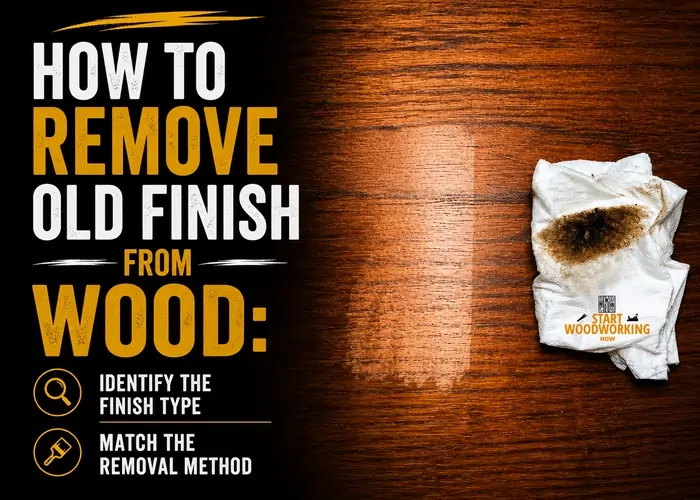
How to Remove Old Finish from Wood: Identify the Finish Type, Match the Removal Method
Removing an old finish from wood is a three-variable problem, not a one-step job. The first variable is finish type — polyurethane, varnish, lacquer, shellac, oil, or wax — because each chemistry responds to a specific solvent at a specific dwell time, and the wrong stripper on the wrong finish produces zero result regardless of contact time or effort. The second variable is finish age: alkyd varnish and oil-based polyurethane continue cross-linking for years after application, and a five-year-old oil-based polyurethane coat requires 20–30% longer NMP gel contact than a one-year-old coat of the same product on the same surface. The third variable is surface construction: solid hardwood tolerates chemical stripping followed by sanding at 80 grit. Plywood veneer — which covers most flat-pack furniture, pre-war pieces, and anything with a consistent grain pattern across the full panel — has a decorative layer 0.6–3mm thick. Sand through it and the piece is destroyed. Carved profiles and turned legs require gel formulations that cling without running — no mechanical sanding in the recesses is physically possible. Getting the finish type wrong wastes one or two hours and some product. Getting the surface construction wrong destroys the piece. The identification step takes under 10 minutes and eliminates both failure modes.
This guide covers the finish condition assessment that determines whether full stripping is necessary or whether a lighter intervention is appropriate, the surface construction check before any removal method is chosen, the age factor on removal difficulty and how to adjust dwell times, the complete removal protocol for each finish type with exact values, the lead paint protocol for pre-1978 pieces, and the post-stripping preparation sequence before any new finish is applied.
→ Hub: How to Remove Wood Finishes — Complete Guide
→ Identify your finish (interactive tool): Wood Finish Identifier — 5-Step Sequential Solvent Test
→ Choose the right stripper: How to Choose a Chemical Stripper for Wood
→ After stripping: How to Refinish Wood After Stripping
How Do You Remove Old Finish from Wood?
- Identify the finish type before touching any stripper. The sequential solvent test (blade scrape → mineral spirits → denatured alcohol → lacquer thinner → acetone) identifies any wood finish in under 10 minutes. Use the interactive Wood Finish Identifier tool at startwoodworkingnow.com/how-to-identify-wood-finish/ — it asks 4 questions about the solvent response and maps the answers to the correct finish type and removal guide. Do not skip this step. Applying NMP gel to a lacquer finish takes 90 minutes and produces poor results. Lacquer thinner removes the same finish in 30 seconds.
- Assess the finish condition before deciding on full strip vs. lighter intervention. Run the cross-hatch adhesion test: cut a 2 × 2 cm grid through the finish with a utility knife, apply masking tape firmly, peel sharply. Zero lift = adhesion intact — screen-and-recoat may be possible without full stripping. Any lift with the tape = adhesion failure — full strip is required. Peeling or bubbling anywhere on the surface = full strip, no exceptions.
- Confirm the surface construction before choosing mechanical vs. chemical removal. Examine edges and corners. A thin coloured layer above a plywood core at the edge = veneer. Veneer means chemical stripping only — no sanding past 220 grit for inter-coat smoothing. Solid wood: full chemical + sanding sequence safe. Carved or turned profiles: gel formulations only, no sanding in recesses.
- Check for lead paint on pre-1978 pieces before any sanding. Test with a commercial lead paint swab (3M LeadCheck) — swab turns red on contact with lead. If positive: chemical stripping only (NMP gel), HEPA vacuum, nitrile gloves, N100 respirator. No dry sanding of lead paint under any circumstances.
- Apply the correct stripper with plastic film cover — adjust dwell for finish age. All dwell times on product labels are for relatively recent finish. Add 25–50% to the stated dwell for finish over 5 years old. Add 50–75% for finish over 15 years old. Cover all gel strippers with plastic film immediately — exposed gel loses its water carrier within minutes and stops working.
- Confirm bare wood with three tests before refinishing. Blade scrape test: blade shaves clean wood fibres with no film lifting ahead. Water drop test: drops spread and absorb within 30 seconds — beading means wax, oil, or silicone contamination still present. Raking light: hold a lamp at a low angle across the stripped surface — remaining finish reflects differently from bare wood and is visible as sheen in grain valleys under overhead-invisible light.
Step 1 — Identify the Finish: Use the Interactive Tool, Not a Guess
The finish type is the most consequential variable in old finish removal. Every subsequent decision — which stripper, what dwell time, whether re-amalgamation is possible, which sanding grit to start — depends on knowing the finish chemistry. Old pieces compound the identification challenge: the original finish may have been repainted, recoated, or stripped and re-finished multiple times.
A yellowed surface that looks like old varnish is sometimes shellac under a wax buildup. A hard, clear surface that looks like polyurethane is sometimes water-based lacquer that responds to isopropyl alcohol in 10 seconds.
One critical note for old pieces with unknown finish history: the test identifies the topmost layer only. After the first layer is removed, run the test again on the exposed layer — it is very common for old furniture to have two or three incompatible finish layers applied over decades. A Victorian chair may have original shellac (1890s), a lacquer topcoat (1960s), and a recent wax application. Each layer requires its own treatment.
Step 2 — Assess Finish Condition: Strip, Recoat, or Repair?
Full stripping is not always necessary. The condition of the existing finish determines the correct intervention — not the finish age, not the appearance, not the owner’s preference for a fresh start. A well-adhered 30-year-old polyurethane that is merely dull does not require stripping. A poorly adhered 2-year-old coat that lifts at the cross-hatch test requires full stripping before anything else is applied.
Step 3 — Check Surface Construction: What Removal Methods Are Safe
Applying the correct chemical to the wrong surface construction can destroy the piece even when the chemistry is right. This check takes two minutes and determines whether mechanical sanding is safe, how aggressive the scraping can be, and whether gel formulations are required over liquids.
Step 4 — The Age Factor: How Old Finish Changes Dwell Times
Every stripper label provides a dwell time — the time the product needs to remain in contact to soften the finish for removal. These times are established by manufacturers testing against relatively fresh finish (typically 1–2 years old) under ideal conditions (20°C, 50% RH). Old finish requires longer dwell because the polymer network has continued to cross-link and densify over years. Applying the manufacturer’s stated dwell time to a 15-year-old floor and wondering why the finish barely softens is the most common error in old finish removal.
| Finish Type | Under 1 Year | 1–5 Years | 5–15 Years | Over 15 Years | Why Age Matters |
|---|---|---|---|---|---|
| Oil-based polyurethane | 60–75 min | 75–90 min | 90–110 min | 110–130 min, 2 applications likely | Alkyd component continues oxidative cross-linking for years. Each year adds density to the polymer network that NMP must penetrate. |
| Water-based polyurethane | 35–50 min | 50–65 min | 65–80 min | 80–95 min | Acrylic-urethane cross-linking largely complete within 30 days — less age-dependent than oil-based, but UV exposure hardens the film progressively. |
| Alkyd varnish | 45–70 min | 70–90 min | 90–120 min | 120–150 min, 2–3 applications on antique pieces | Same oxidative cross-linking mechanism as oil-based poly. Old varnish on antique furniture can be the most resistant film of all common finishes. |
| Nitrocellulose lacquer | 10–20 sec | 15–30 sec | 20–45 sec | 30–90 sec — still dissolves at any age | Thermoplastic — no cross-linking occurs. Lacquer re-dissolves in its own solvent at any age. Easiest old finish to remove regardless of age. |
| Shellac | 20–40 sec | 30–60 sec | 45–90 sec | 60–120 sec — wax buildup may add time | Old shellac may have wax buildup from years of paste wax applied over it. Mineral spirits first to remove wax layer, then denatured alcohol for shellac. |
| Oil finish (linseed, danish, tung) | Mineral spirits + sanding | Stripper + sanding | Sanding only | Sanding only — mineral spirits ineffective | Fully polymerised oil (over 5 years) becomes part of the wood cell structure. Indistinguishable from the wood itself by chemical means — only physical removal (sanding) works. |
Step 5 — Lead Paint on Pre-1978 Pieces: The Test That Changes Everything
Pre-1978 Furniture or Floors: Test for Lead Before Any Sanding
Any paint on wood manufactured or painted before 1978 (US), 1992 (UK), or equivalent year in your country may contain lead-based pigments. Lead paint is not identifiable by colour, finish type, or appearance. It is typically found in the oldest layer of a multi-coat build. The test takes 30 seconds and costs under £5.
Lead paint test is a non-negotiable step on any piece where the age and paint history are unknown. The test cost is under £5. Lead exposure from dry-sanding lead paint carries severe long-term health consequences — no time saving justifies skipping it.
The Complete Removal Protocols — By Finish Type
Step 6 — Post-Stripping Preparation: Confirm Before Refinishing
Stripping removes the finish. What remains on the bare wood surface — stripper residue, neutraliser traces, raised grain fibres, and potential contamination from the old finish chemistry — determines whether the new finish adheres correctly or fails within months. The post-stripping sequence is not optional. Skipping the neutralisation step is the cause of the most common refinishing failure: new finish that peels within 6–18 months because NMP residue prevented proper adhesion.
Water drop test: Apply 3–4 drops of water to the sanded surface. Drops spread and absorb within 30 seconds = clean bare wood, safe to finish. Drops bead = wax, oil, or silicone contamination present. Identify the source (wax: naphtha evaporation test; silicone: sand to 80 grit and retest; polymerised oil: additional sanding required).
Raking light test: Hold a lamp at a very low angle across the surface. Remaining finish in grain valleys reflects differently from bare wood — visible as a faint sheen that overhead lighting misses.
📝The most expensive mistake I see in old finish removal is skipping the identification step and applying a stripper based on what the finish looks like. A yellowed, slightly amber surface on a 1960s cabinet looked exactly like old oil-based polyurethane to every customer who described it to me before they started. It was almost always shellac — and lacquer thinner removed it in 30 seconds while they had been applying NMP gel for 90 minutes with minimal result. Running the denatured alcohol test (30 seconds, a drop on a cotton swab) would have answered the question immediately and saved two hours and a wasted can of gel stripper. The identification test is the most time-efficient step in the entire removal process — not because it takes long, but because it makes every subsequent step precise and eliminates the two-to-three-hour detour of trying the wrong product first.
Key Specifications for Old Finish Removal
| Entity / Variable | Attribute | Value and Detail |
|---|---|---|
| Cross-hatch adhesion test | Procedure and interpretation | Cut a 2 × 2 cm grid through the finish: 6 parallel lines in each direction, 3mm apart, scored through to wood with a sharp utility knife. Apply 25mm masking tape firmly across the grid, press down completely with thumbnail. Peel sharply at 90 degrees. Zero finish on the tape = adhesion intact (screen-and-recoat possible). Any squares of finish on the tape = adhesion has failed (full strip required). Additional automatic strip triggers regardless of cross-hatch result: peeling or bubbling visible anywhere on the piece; finish has worn through to bare wood in any area; more than two previous recoats on the same surface. |
| Multi-layer finish on antique pieces | How to handle incompatible layers applied over decades | Common historic combinations: original shellac (pre-1920) + lacquer application (1960s–70s) + polyurethane (recent). Or: original varnish + paint (mid-century) + wax. Each layer requires identification and its own removal protocol. Procedure: strip the topmost identified layer completely. Run the solvent identification test on the newly exposed layer before applying any stripper. Do not assume the layer below is the same chemistry as the layer above — on any piece with unknown history, each exposed layer must be tested fresh. Budget for 2–3 separate stripping cycles on pieces with more than 40 years of unknown refinishing history. |
| Shellac over oil finish (common pre-1900 combination) | Protocol for the two-layer system found on antique furniture | Pre-1900 furniture standard finishing: boiled linseed oil as grain filler + shellac topcoat. The oil is fully polymerised at this age — it is part of the wood cell structure and not removable by chemical means. Protocol: denatured alcohol removes the shellac layer completely. After shellac removal, the bare wood surface contains polymerised oil in the grain structure. New finish applied directly over this surface may have adhesion issues due to the oil. Required preparation: sand at 80 grit to remove the oil-saturated surface layer and expose clean grain. Do not attempt to apply new finish over the oil-containing surface without sanding — adhesion will be poor regardless of the finish chemistry chosen. |
| Wax over polyurethane (common recent combination) | How wax contamination prevents new finish adhesion | Many owners apply paste wax to polyurethane floors and furniture to add sheen — this creates a wax layer over the intact polyurethane. The wax is not visible and may not be suspected. A screen-and-recoat over wax-contaminated polyurethane produces fish-eye in the new coat. Identification: naphtha evaporation test on the surface before any recoating. If naphtha leaves a ring or slow-absorbing area = wax present. Removal: mineral spirits 2–5 passes, naphtha evaporation test to confirm clean. Only then is screen-and-recoat safe. This is the single most common cause of unexpected fish-eye in polyurethane recoat projects. |
| Confirming bare wood after stripping — three tests in sequence | Why all three are needed and what each catches | Blade scrape: confirms no film remaining above the wood surface. Catches residual film in pores that is invisible under overhead light. Water drop: confirms no wax, oil, or silicone contamination in the surface layer. Each contaminant produces beading — the test does not distinguish between them. If beading occurs: naphtha evaporation test (distinguishes wax from oil — naphtha dissolves wax, not fully polymerised oil). Raking light: catches remaining finish in grain valleys that both above tests miss. Hold a lamp at 5–10 degrees to the surface. All three tests must pass before applying any new finish. A single confirming test is insufficient — each catches failure modes the others do not. |
📝The second failure pattern I see consistently is veneer destruction during sanding. The piece arrives with 1960s teak veneer furniture — a sideboard or bookcase with immaculate veneer in good structural condition but a tired finish. The owner used an orbital sander at 150 grit for “just a few minutes” to smooth the surface before recoating. In those few minutes the orbital went through the veneer in the corners and along edges where the veneer is thinnest. Chemical stripping with NMP gel and a plastic scraper, followed by 220-grit hand-sanding in the grain direction, would have produced a perfect bare veneer surface ready for new finish. The surface construction check takes two minutes at any edge — it determines which tools are safe for the next two hours of work.
Frequently Asked Questions About Removing Old Finish from Wood
How do you know when the old finish is completely removed?
Three tests confirm complete finish removal, run in sequence. First, the blade scrape test: run a sharp blade flat along the surface — it should shave clean wood fibres with no transparent film lifting ahead. If film lifts, finish remains in the pores and requires another application of the appropriate stripper or additional sanding. Second, the water drop test: apply three drops of water to the sanded surface. The drops must spread and absorb within 30 seconds. Beading means contamination — wax, polymerised oil, or silicone — is still present. Third, the raking light inspection: hold a lamp at a very low angle, 5–10 degrees, across the surface. Remaining finish in grain valleys reflects differently from bare wood and is visible as a faint sheen that overhead lighting misses entirely. All three tests must pass. A surface that passes two out of three tests is not fully stripped.
Can you apply new finish over old finish without stripping?
Yes, if and only if two conditions are met. The existing finish must pass the cross-hatch adhesion test — zero finish lifting with masking tape. And the new finish must be chemically compatible with the existing finish — water-based over water-based, oil-based over oil-based, or a tested cross-system application with the required cure wait and deglossing. If both conditions are met: screen the existing finish at 150 grit to create mechanical adhesion, clean thoroughly, and apply the new topcoat. This is screen-and-recoat — it is faster and less disruptive than full stripping and produces correct results when adhesion is intact. If the adhesion test fails, if the finish has worn through to bare wood in any area, or if the chemistries are incompatible: full stripping is required. There is no shortcut to stripping a failed or incompatible finish — applying new finish over it produces a new layer that fails by the same mechanism.
Why does new finish peel or fish-eye after applying over stripped wood?
Two causes account for almost all new-finish failures after stripping. Peeling within months of application: NMP stripper residue was not neutralised before sanding, or the stripper was not given 24 hours to fully evaporate before the new finish was applied. NMP residue creates a barrier layer that prevents proper film adhesion. Fix: strip the failed finish again, neutralise with white vinegar 1:1, allow 24h dry, confirm with the water drop test, then refinish. Fish-eye on the first coat: wax, silicone, or oil contamination remains in the surface that the stripping did not fully address. Wax is invisible but present in pores — the naphtha evaporation test identifies it. Silicone contamination from caulk, furniture polish, or silicone sprays requires sanding to 80 grit to physically remove the contaminated surface layer. Fish-eye cannot be corrected by additional coats — the contamination is in the wood, not in the finish above it.
Summary — Key Values for Old Finish Removal
Three variables determine every decision: finish type (use Wood Finish Identifier tool — sequential solvent test), finish age (adjust all dwell times: +25–50% over 5 years, +50–75% over 15 years), and surface construction (solid wood: chemical + sanding safe; veneer: chemical only, 220 grit maximum, gel formulations preferred over liquid; carved profiles: gel + brushes, no orbital sanding).
Condition assessment before stripping: cross-hatch test — zero lift = screen-and-recoat possible; any lift = full strip required; peeling/bubbling anywhere = full strip. Pre-1978 pieces: lead test mandatory before any sanding — chemical method only if positive.
Plastic film cover over all gel strippers is mandatory — exposed gel loses activity as water carrier evaporates. Multi-layer finish on old pieces: identify and strip each layer separately — re-test after each layer is removed. Age adjustments: lacquer (thermoplastic) = re-dissolves at any age, fastest old finish to remove.
Oil-based poly over 15 years = 110–130 min NMP gel, 2 applications likely. Fully polymerised oil over 5 years = sanding only, no chemical effective. Post-stripping sequence: neutralise (white vinegar 1:1 for NMP; baking soda for methylene chloride) → 24h dry → sand correct grit sequence → three-test confirmation (blade scrape + water drop + raking light). All three tests must pass before new finish. Fish-eye after new finish: wax or silicone contamination — naphtha evaporation test (wax) or 80-grit sand + water bead test (silicone). Peeling after new finish: NMP residue not neutralised or insufficient dry time before sanding.
→ Identify finish type: Wood Finish Identifier — Interactive Sequential Solvent Test
→ Choose stripper: How to Choose a Chemical Stripper for Wood
→ After stripping: How to Refinish Wood After Stripping
→ Refinish furniture: How to Refinish Furniture — Complete Project Guide
→ Hub: How to Remove Wood Finishes — Complete Guide