
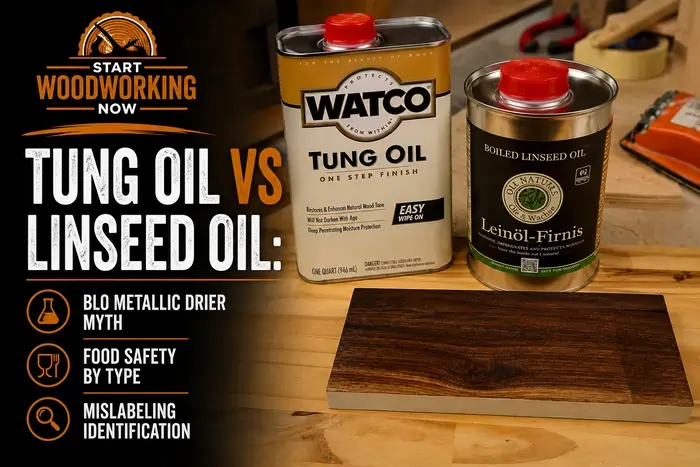
Tung Oil vs Linseed Oil: BLO Metallic Drier Myth, Food Safety by Type, and Mislabeling Identification
Tung oil and linseed oil are both drying oils that cure by oxidative polymerization rather than solvent evaporation — they absorb oxygen from the air and cross-link their fatty acid chains into a solid polymer network within the wood fibres. Their performance difference — tung oil is harder, more water-resistant, and non-yellowing; linseed oil is softer, cheaper, and progressively amber — traces back to a single structural difference in their dominant fatty acid: tung oil contains alpha-eleostearic acid with a conjugated triple-bond arrangement, while linseed oil contains linolenic acid with a non-conjugated arrangement. This one chemical distinction determines every practical difference between them.
This guide is part of the complete wood finishing guide. Related comparisons: Danish Oil vs Tung Oil → and Danish Oil vs Linseed Oil →
Navigate to your question
→ Why does tung oil outperform linseed oil on water resistance? → The conjugated fatty acid difference ↓
→ Why did my linseed oil / tung oil stay gummy? → Oxygen starvation — the thick coat failure mechanism ↓
→ Is “boiled” linseed oil actually boiled? → The BLO myth — metallic driers, not heat ↓
→ Which is food safe — and which is not? → Food safety by oil type ↓
→ How do I know if my “tung oil” is real? → The viscosity and smell test ↓
→ Which should I use for my project? → Decision matrix by use case ↓
⚠ Spontaneous Combustion — Both Oils, Higher Risk With BLO
Rags saturated with tung oil or linseed oil (especially BLO) generate heat through oxidative curing and can ignite without external flame. BLO carries a higher risk than pure tung oil because its metallic driers accelerate the exothermic oxidation reaction. Spread rags flat outdoors on a non-combustible surface until fully cured, or submerge in a sealed metal container filled with water before disposal. Never pile or fold oil-saturated rags.
Why Does Tung Oil Outperform Linseed Oil on Water Resistance — What Is the Chemical Difference?
The performance gap between tung oil and linseed oil is not a matter of degree — it is a matter of molecular structure. Tung oil’s dominant fatty acid (alpha-eleostearic acid, ~77% of total composition) has a conjugated triple-bond arrangement. Linseed oil’s dominant fatty acid (linolenic acid, ~57%) has a non-conjugated arrangement. This single structural difference produces three separate performance consequences.
Conjugated vs Non-Conjugated: What the Difference Means
Conjugated bonds are double or triple bonds that alternate with single bonds in a continuous sequence (C=C–C=C=C). This arrangement allows electrons to delocalize across the entire conjugated system, making the bonds extremely reactive with oxygen. When alpha-eleostearic acid in tung oil contacts atmospheric oxygen, all three conjugated bonds react together in a coordinated, rapid cross-linking reaction — forming a dense, three-dimensional polymer network.
Non-conjugated bonds (methylene-interrupted: C=C–CH₂–C=C) have single CH₂ groups between the double bonds, breaking the electron delocalization. Each bond reacts with oxygen independently, more slowly, and less completely. The polymer network formed by linolenic acid in linseed oil is less dense, less cross-linked, and more permeable to water molecules.
| Property | Tung Oil (alpha-eleostearic acid, conjugated) | Linseed Oil (linolenic acid, non-conjugated) |
|---|---|---|
| Fatty acid content | ~77% alpha-eleostearic acid | ~57% linolenic acid |
| Cross-linking speed | Slower (pure tung oil) | Faster (BLO, with metallic driers) |
| Cross-linking completeness | High — dense 3D network | Lower — less dense network |
| Water resistance | High — hydrophobic dense polymer | Moderate — more permeable to water |
| Film hardness | Harder — dense cross-links | Softer — fewer cross-links |
| Yellowing over time | Minimal — colorless polymer | Progressive — chromophoric by-products |
| Cost | Higher — specialty crop | Lower — widely available |
Why Tung Oil Doesn’t Yellow and Linseed Oil Does
Tung oil’s alpha-eleostearic acid cross-links into a stable, colorless polymer. The conjugated bond reaction is clean and complete — it does not produce significant oxidation by-products that absorb visible light.
Linseed oil’s linolenic acid cross-links through a slower, less complete reaction that produces aldehydes and ketones as oxidation by-products. These carbonyl compounds are mildly chromophoric — they absorb blue light and appear progressively yellow-amber over months and years. This is why linseed oil darkens on light species like maple and ash over time, while tung oil on the same species remains colour-neutral. On species already warm-toned (walnut, cherry), the progressive amber shift of linseed oil may be aesthetically acceptable or even desirable.
Both are penetrating oils with limited durability — if you need more protection, compare them directly against a film finish in the finish comparison tool.
Why Did My Oil Finish Stay Gummy — and Why Thick Coats Always Fail?
The most common failure with both tung oil and linseed oil is a permanently soft or gummy surface that never fully cures. The cause is always the same: too thick a coat. The mechanism — oxygen starvation — explains why this failure is not a product defect but a violation of the physics of oxidative polymerization.
Oxygen Starvation — Why Thick Coats Never Cure
Drying oils do not cure by evaporation. They cure by reacting with atmospheric oxygen. Oxygen must reach the oil molecules to trigger cross-linking — and oxygen can only reach them from the surface inward, one thin layer at a time.
When a thick coat is applied, the outer surface cures normally as it contacts the air. As the outer surface cross-links and hardens, it forms a sealed barrier that prevents further oxygen penetration to the layers beneath. The oil below the cured skin remains liquid or semi-liquid indefinitely — cut off from the oxygen it needs to complete polymerization.
The result: a permanently gummy finish with a skin that wrinkles as the outer layer continues to move while the inner oil shifts beneath it. This failure cannot be reversed by waiting longer or applying more product — the only fix is to remove the failed coat entirely with mineral spirits or a chemical stripper, allow the wood to dry completely, and restart with correct thin coat application.
Both oils can produce a permanently sticky finish if applied too thick — oxygen starvation is the universal cause — the full oil finish drying failure protocol with the mineral spirits stripping rescue.
❌ Thick Coat — What Happens
Oil pools on the surface rather than soaking in. Outer skin cures in 24-48h. Inner layers remain liquid. Surface feels soft, shows fingerprints, wrinkles when pressed. Worsens over weeks, not improves.
Fix: Mineral spirits saturated cloth, work in grain direction, remove all soft oil. Dry 24h. Restart with thin coats.
✅ Thin Coat — Correct Application
Apply oil liberally, allow 15-20 min penetration, then wipe ALL excess off — zero wet oil remaining on surface. Every molecule of oil on the surface must have access to atmospheric oxygen.
Rule: If it’s still wet on the surface after wiping — wipe again. Cure in ventilated space 24-48h before next coat.
Pure tung oil’s progressive dilution protocol with citrus solvent or mineral spirits differs from linseed oil application — the step-by-step pure tung oil protocol with the 80% saturation test.
Is “Boiled” Linseed Oil Actually Boiled — and Why Does It Matter?
No — modern “boiled” linseed oil is not boiled. The name is a historical misnomer that persists from 19th-century manufacturing, when linseed oil was genuinely heated to reduce water content and improve viscosity. Modern BLO is raw linseed oil with metallic drying agents added at room temperature.
Why This Matters — The Metallic Drier Safety Issue
The metallic driers in modern BLO are classified by IARC as Group 2B (cobalt and certain cobalt compounds) — possible carcinogens in certain industrial exposure contexts. This classification applies primarily to occupational inhalation exposure during manufacturing, not typical DIY finishing applications. However, the presence of these metallic compounds means BLO is not food-safe even when fully cured. The full regulatory framework for food-contact finishes is in food-safe wood finishes.
Raw linseed oil contains no metallic additives and is food-safe when fully cured. Pure tung oil contains no additives and is food-safe when cured. Most products labelled “danish oil” use BLO as their base — they carry the same drier compounds and the same food-safety limitations. The full danish oil safety profile is covered in the what is linseed oil guide →
Which Is Food Safe — Pure Tung Oil, Raw Linseed Oil, or BLO?
| Product | Food Safe? | Reason | Condition |
|---|---|---|---|
| 100% pure tung oil | ✅ Yes | No additives, no metallic driers. Cross-links to inert polymer. | Fully cured (minimum 72h, ideally 7 days). Allergen note: tree nut origin. |
| Raw linseed oil (no additives) | ✅ Yes (when cured) | No metallic additives. Used in food preparation historically. | Fully cured. Impractical: raw LO takes weeks to cure each coat. |
| Boiled linseed oil (BLO) | ❌ No | Contains metallic driers (cobalt, manganese). Not food-contact approved. | Avoid on cutting boards, salad bowls, any food contact surface. |
| “Tung oil finish” products | ❌ Usually no | Most contain varnish resins, metallic driers, and petroleum solvents. | Verify label: “100% pure tung oil” only is food-safe. |
| Danish oil | ❌ No | BLO-based with alkyd varnish and solvents. Same metallic driers as BLO. | Avoid on food contact surfaces. |
For cutting boards, salad bowls, and all food contact surfaces: 100% pure tung oil is the correct oil finish choice. Raw linseed oil is technically food-safe but its weeks-long drying time per coat makes it impractical for most applications. The full food-safe cutting board finishing protocol is in How to Finish a Cutting Board →
How Do You Know If Your “Tung Oil” Is Actually Tung Oil?
Most products labelled “tung oil” at hardware stores contain little or no actual tung oil. The label “tung oil finish,” “tung oil blend,” or just “tung oil” without “100% pure” typically indicates a product that is primarily mineral spirits-diluted alkyd varnish or linseed oil with trace tung oil added for marketing purposes. All the performance characteristics of pure tung oil — water resistance, food safety, non-yellowing — do not apply to mislabelled products.
✅ 100% Pure Tung Oil — Identification
Viscosity: Thick, viscous — similar to olive oil or slightly thicker. Does not pour like water.
Smell: Mild, slightly earthy or nutty. Very low solvent odour at room temperature.
Drying time: Slow — 24–72 hours for the first coat at room temperature (no metallic driers to accelerate).
Label: States “100% pure tung oil” with no other oil listed.
Requires: Dilution with citrus solvent (d-limonene) or mineral spirits for first coats — pure tung oil is too viscous to penetrate adequately without dilution.
❌ Mislabelled “Tung Oil” — Identification
Viscosity: Thin — pours freely like water or light oil. No resistance when tilted.
Smell: Strong mineral spirits or petroleum solvent odour. Dominant chemical smell.
Drying time: Fast — dry to touch in 4–8 hours. (Contains metallic driers and/or pre-diluted with fast-evaporating solvents.)
Label: Says “tung oil finish,” “tung oil blend,” or lists other ingredients alongside tung oil.
Common products in this category: Minwax Tung Oil Finish, most own-brand “tung oil” at DIY stores.
Tung Oil vs Linseed Oil — Which Should You Use?
Choose Pure Tung Oil When
✅ Food contact surfaces — cutting boards, salad bowls, wooden utensils. Only pure tung oil is food-safe AND practical to apply.
✅ Light species where colour neutrality matters — maple, birch, ash, light oak. Tung oil remains stable; linseed oil progressively darkens.
✅ Higher moisture exposure — bathroom furniture, outdoor furniture (sheltered), boat interior wood. Tung oil’s denser polymer network resists water better than linseed oil.
✅ Long-term colour stability required — any piece where the current colour must be maintained over years.
Choose Linseed Oil (BLO) When
✅ Budget is the primary constraint — BLO costs 40–60% less than pure tung oil per litre and produces an acceptable penetrating finish for most interior applications.
✅ Warm amber tone is desirable — walnut, cherry, dark oak, antique pine all benefit from linseed oil’s progressive amber enhancement.
✅ Interior furniture, tools, and implements (not food contact) — BLO provides adequate protection for tool handles, interior furniture, and decorative pieces where food safety is not required.
✅ As the base for danish oil — most danish oil products are BLO + alkyd varnish. Understanding BLO is understanding most of what danish oil does. Danish Oil vs Linseed Oil →
Frequently Asked Questions
Can you mix tung oil and linseed oil together?
Yes — both are drying oils with compatible chemistry and can be mixed in any proportion. The resulting blend will have intermediate characteristics between the two: more water-resistant and harder than linseed oil alone, less so than pure tung oil. The blend will also dry faster than pure tung oil (linseed’s cure kinetics contribute) but slower than BLO alone. There is no chemical incompatibility. Practical note: there is little cost benefit to blending since pure tung oil is more expensive than BLO — the blend primarily reduces performance relative to pure tung oil while reducing cost.
How many coats of tung oil or linseed oil does wood need?
Apply coats until the wood stops absorbing oil — typically 3–5 coats for most hardwoods, 5–7 for porous or end-grain surfaces. The saturation test: apply a coat, wait 15–20 minutes. If the oil has been fully absorbed (no wet sheen visible), the wood can absorb another coat. If oil sits on the surface, that area is saturated — wipe off excess and move on. After saturation, additional coats build negligible additional protection. For application protocol with exact dilution ratios: How to Apply Tung Oil →
Can tung oil or linseed oil be used on outdoor wood?
Pure tung oil provides better outdoor performance than linseed oil due to its higher water resistance and superior UV stability. However, neither oil alone provides adequate protection for fully exposed outdoor wood subject to direct rain, standing water, or intense UV. For outdoor wood: pure tung oil is suitable for sheltered outdoor furniture and boat interiors; for fully exposed applications, an exterior oil-based varnish (spar varnish) provides significantly better protection. BLO on outdoor wood without additional topcoat tends to support mould growth in humid climates — the less complete cross-linking leaves more sites available for biological degradation.
How long does pure tung oil take to dry compared to BLO?
Pure tung oil: 24–72 hours between coats at 20°C and 50% RH. In cooler or more humid conditions, 48–96 hours. BLO: 24 hours between coats (metallic driers accelerate oxidation). The drying time gap is significant for project planning — a 5-coat tung oil finish can take 2 weeks; the same coat count with BLO takes 5 days. Tung oil drying can be accelerated by applying in a warm, well-ventilated space (30°C, moving air). Pre-diluting first coats with citrus solvent (50:50) also improves penetration and speeds cure by reducing film thickness.
Is polymerized tung oil better than pure tung oil?
Polymerized tung oil has been heat-treated (genuine heat polymerization, not the BLO “boiled” misnomer) to pre-start cross-linking, increasing viscosity and reducing dry time to 4–12 hours per coat. The cured film is slightly harder and builds more quickly than pure cold-pressed tung oil. For most woodworking applications, polymerized tung oil is a genuine improvement: same food safety, same non-yellowing, faster cure. The tradeoff is higher cost and slightly reduced penetration depth (higher viscosity slips less deeply into grain). For dense hardwoods where surface protection is more important than deep penetration: polymerized tung oil is the better choice.
