
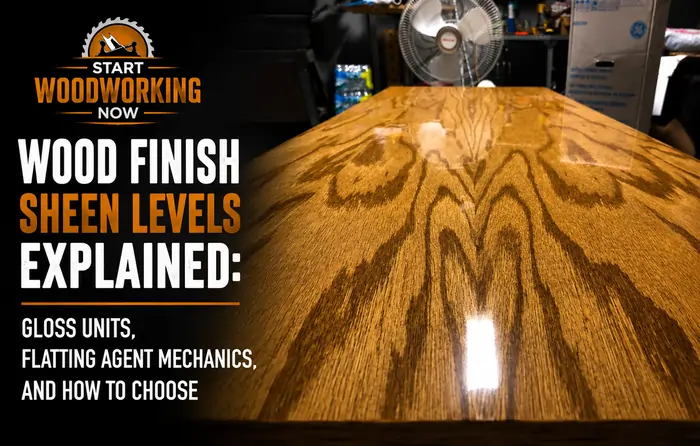
Wood Finish Sheen Levels Explained: Gloss Units, Flatting Agent Mechanics, and How to Choose
Sheen in a wood finish is not a property of the topcoat formula alone — it is the result of how the cured film surface reflects light, which is determined by surface micro-texture at a scale invisible to the naked eye. A gloss finish and a matte finish can contain identical polymer chemistry; the difference between them is the concentration of flatting agent particles distributed through the film that disrupt specular reflection. Understanding how sheen is created and measured — and what flatting agents actually do at the surface — explains why matte finishes behave differently in service from gloss finishes, why sheen can change over time on high-traffic surfaces, and how to change sheen level through wet-sanding technique.
This article is part of the wood finish curing guide — covering cure mechanisms, polymer types, yellowing chemistry, and finish behaviour in service.
Navigate to your question
→ What are the sheen levels — matte, satin, semi-gloss, gloss? → Sheen terminology and what the names actually mean ↓
→ How is sheen actually measured? → Gloss units, measurement angles, and why 60° ≠ 85° ≠ 20° ↓
→ How do flatting agents create a matte finish? → Silica micro-texture, light scattering, and the burnishing problem ↓
→ Which sheen should I choose for my project? → Application-by-application sheen selection guide ↓
→ Does sheen affect how durable or easy to clean a finish is? → Micro-texture vs cleaning, defect visibility, and burnishing in service ↓
Sheen Levels — What the Terms Actually Mean
The naming conventions for sheen levels — gloss, semi-gloss, satin, eggshell, matte, flat — are not standardised across finish manufacturers. The same product can be labelled differently by different brands, and the sheen level perceived in a specific installation depends on lighting conditions, viewing angle, and substrate texture in addition to the finish itself. Despite the lack of naming standardisation, gloss units (GU) provide a quantitative measurement that makes comparison possible.
| Sheen Name | Typical GU Range (60°) | Reflection Character | Common Uses |
|---|---|---|---|
| Gloss / High Gloss | 70–100 GU | Sharp mirror-like reflection; objects clearly visible | Piano finish, lacquer on decorative pieces, high-end cabinets |
| Semi-Gloss | 35–70 GU | Visible reflection but with some diffusion | Kitchen cabinets, trim, furniture |
| Satin | 20–40 GU | Soft sheen; light source visible but blurred | Floors, furniture, general woodwork |
| Eggshell | 10–25 GU | Very low sheen; light barely perceivable | Furniture with natural look, low-sheen floors |
| Matte / Flat | <10 GU | No perceivable reflection; completely diffuse | Antique furniture, theatrical props, naturalistic finishes |
The GU ranges above are approximate and represent common industry conventions, not mandatory standards. A product labelled “satin” by one manufacturer at 35 GU may appear visually similar to another manufacturer’s “semi-gloss” at 40 GU — the sheen names are marketing descriptors that map loosely to GU ranges rather than rigidly defined categories. When sheen precision matters, specify by GU rather than by name and confirm the measurement angle used.
How Sheen Is Measured — Gloss Units and Measurement Angles
Sheen is measured with a gloss meter — an instrument that shines a light beam at a surface at a defined angle and measures the percentage of light reflected at the specular (mirror) angle. The result is expressed in gloss units (GU), where polished black glass (the reference standard) measures 100 GU and a perfectly diffuse white surface measures near 0 GU.
Why Three Different Measurement Angles Exist
Gloss meters measure at one of three standard angles: 20°, 60°, or 85° from the surface normal (perpendicular). The choice of angle is determined by the expected sheen range of the surface being measured, and the reason is rooted in the physics of specular reflection.
-> 60° geometry is the standard for mid-range sheens (10–70 GU). At 60°, the instrument captures a moderate cone of reflected light around the specular angle — broad enough to distinguish the full range from eggshell through semi-gloss without saturating the sensor on very high-gloss surfaces or losing discrimination on very low-sheen ones.
-> 20° geometry is used for high-gloss surfaces (above 70 GU at 60°). At high sheen levels, the 60° measurement cannot distinguish between a 90 GU surface and a 95 GU surface — both are very close to the polished glass reference and differences in specular angle narrowness are too subtle to capture at 60°. The 20° geometry measures at a shallower angle where the reflected light cone is narrower, making it more sensitive to the differences in surface micro-waviness that distinguish different high-gloss levels. A piano-gloss finish that reads 95 GU at 60° might read 85 GU at 20°, revealing subtle surface texture that the 60° measurement could not detect.
-> 85° geometry is used for very low-sheen matte surfaces (below 10 GU at 60°). At grazing angles — 85° is nearly parallel to the surface — even a matte surface shows measurable specular reflection because the shallow angle increases the effective reflectivity of any surface. The 85° measurement distinguishes between a true matte (3 GU) and a near-matte (7 GU) that both read near zero at 60°.
DOI — Distinctness of Image vs Gloss Units
Gloss units measure the quantity of specular reflection — how much light returns at the mirror angle. DOI (Distinctness of Image) measures the quality of that reflection — how clearly a reflected object can be distinguished. A surface can have high GU but low DOI: this is the orange peel phenomenon, where a high-gloss finish has micro-waviness that reflects light at a measurable level (high GU) but distorts the reflected image (low DOI). Orange peel on a painted car panel is this exact combination — the finish looks glossy in diffuse light but shows distorted reflections when you look at a sharp object reflected in it.
For woodworking, DOI becomes relevant in high-gloss lacquer and polyurethane finish work. A spray-applied finish with good atomisation and proper distance produces high DOI — sharp, clear reflections. A finish with brush marks, dust nibs, or improper film levelling produces low DOI despite potentially high GU at the meter.
Wet-sanding with progressively finer grits followed by polishing compound removes the micro-waviness that causes low DOI, increasing both GU and DOI simultaneously. The wet-sanding protocol that achieves this — grit progression, lubricant, and polishing compound — is covered in the wet sanding polyurethane guide covering the grit sequence for mirror finish.
How Flatting Agents Create a Matte Finish
The most important misconception about matte finishes is that flatting agents work by absorbing light. They do not. A matte finish and a gloss finish made from the same polymer system transmit virtually identical total light energy — the difference is in the direction that reflected light travels.
The Micro-Texture Mechanism
Flatting agents — typically amorphous silica particles or aluminum stearate — are dispersed through the liquid finish at concentrations that increase with decreasing target sheen. During cure, as the film forms and solvents evaporate, the flatting agent particles migrate toward the film surface. Because the particles are larger than the polymer matrix around them, they protrude slightly above the cured film surface, creating a micro-texture invisible to the naked eye but measurable in surface profilometry (typically Ra surface roughness values of 0.5–3 microns for satin finishes, compared to <0.2 microns for high-gloss).
This micro-texture disrupts specular reflection. An incoming light ray at a smooth (high-gloss) surface reflects at exactly the specular angle — the angle of incidence equals the angle of reflection, and all reflected energy returns in one direction.
The same light ray hitting a silica particle protruding from a matte surface is scattered: the particle’s curved surface reflects at a slightly different angle from the surrounding flat surface, and the statistical distribution of particle orientations produces reflected light scattered across a wide range of angles rather than concentrated at the specular angle. The gloss meter, measuring only the specular angle, receives a lower reading. The total reflected light energy is nearly unchanged — it is simply distributed over more directions rather than concentrated in one.
Flatting Agent Concentration and the Sheen Gradient
The sheen level of a finish is controlled by the concentration of flatting agent in the formulation. More silica = lower GU; less silica = higher GU. Manufacturers produce a range of sheen levels from the same base formula by varying flatting agent loading. This means the polymer, durability, and chemical resistance of a satin and a gloss version of the same product are nearly identical — the only relevant difference is flatting agent content and the surface micro-texture it creates.
One practical implication: mixing sheen levels within the same product line is additive and predictable. Mixing one part gloss with one part matte from the same manufacturer typically produces approximately the satin intermediate. Mixing products from different manufacturers or different product families does not produce predictable results because the flatting agents and polymer systems may be incompatible.
Burnishing — Why Matte Finishes Go Shiny in Service
The flatting agent particles that create matte finish sheen are physically present at the film surface and are vulnerable to mechanical abrasion. Under foot traffic, furniture sliding, or repeated cleaning with abrasive cloths, the silica particles that protrude above the film surface are progressively polished down to be flush with the surrounding film surface. As particles are levelled, the micro-texture decreases and specular reflection increases — the surface sheen rises toward the gloss level of the underlying polymer without any additional flatting agent.
This is why matte and low-satin floors develop shiny paths along high-traffic routes over time. The polishing is not finish wear — the polymer is still intact — but the flatting agent micro-texture has been burnished away at the wear paths while remaining intact in lower-traffic areas.
The effect is particularly pronounced under chair casters, in doorway approaches, and along primary walking routes. The only correction is a full recoat of the matte finish to restore flatting agent particle density at the surface — wet-sanding alone raises sheen further rather than restoring it, because sanding removes more polymer than flatting agent.
Which Sheen Level to Choose
Sheen selection is a function of three considerations: the visual effect desired, the visibility of surface defects in the specific lighting environment, and the maintenance implications of the sheen level.
Defect Visibility and Raking Light
Higher sheen amplifies the visibility of surface defects under raking light (light at a low angle to the surface, as from a window or a pendant light). Every brush mark, dust nib, grain irregularity, and film waviness becomes visible as a shadow or highlight in specular reflection on a high-gloss surface. On a matte surface, the diffuse reflection from the micro-texture masks these defects — they are still present but not visible because the surface scatters light from all angles equally rather than concentrating it from the specular direction.
The practical consequence: high-gloss finishes require significantly more preparation and application skill to look acceptable than satin or matte. Brush marks visible under raking light on a high-gloss polyurethane finish are invisible on the same surface finished with satin — not because the marks are not there, but because the matte micro-texture scatters the light that would otherwise reveal them. For woodworkers applying finish by brush or roller, lower sheen levels are more forgiving of application imperfections. The polyurethane brush mark visibility relationship is discussed in the polyurethane brush marks guide covering technique and sheen-specific visibility.
Application-Specific Sheen Selection
Sheen Selection Guide
→ Hardwood floors (residential): Satin (25–35 GU). Conceals wear and minor scratches; resists burnishing better than matte; easier to clean than true matte.
→ Kitchen cabinets: Semi-gloss (40–55 GU). Easier to wipe clean than satin; grease and food marks visible and removable. Gloss is too revealing of door surface imperfections for most DIY application.
→ Furniture (dining tables, work surfaces): Satin to semi-gloss (25–50 GU). Satin reads as warmer and more natural; semi-gloss as more formal and contemporary.
→ Antique and period furniture restoration: Matte to eggshell (<15 GU). High sheen reads as modern restoration rather than period-appropriate finish.
→ High-end decorative lacquer (piano finish): Gloss (>85 GU at 60°, >70 GU at 20°). Requires spray application, sealer coats, and wet-sanding/polishing sequence to achieve high DOI.
→ Outdoor wood: Satin or lower. High-gloss exterior finishes show checking and weathering marks more prominently; satin hides early weathering better.
For the full polyurethane application protocol including sheen choice for floors and furniture, see the polyurethane application guide.
Does Sheen Affect Durability or Ease of Cleaning?
Durability — Same Film, Different Surface Texture
The durability of a finish — its scratch resistance, chemical resistance, and abrasion resistance — is determined by the polymer system and crosslink density, not by the sheen level. A satin polyurethane and a gloss polyurethane from the same product line have identical Taber abrasion resistance because the polymer is identical. The flatting agent particles do not contribute to or detract from the polymer’s mechanical properties.
The burnishing behaviour described earlier can create a perception of differential durability — a matte floor that develops shiny paths looks “worn” even though the polymer is intact. This is a surface optical change, not a mechanical failure, but it requires refinishing to correct and can be mistaken for finish wear-through.
Cleaning — Where Sheen Does Make a Difference
The micro-texture that creates matte sheen does affect cleanability. The silica particles and the micro-valleys between them create surface area that traps dust, fine particulate, and liquid residue more effectively than the smooth surface of a high-gloss film. Matte and low-satin floors require more aggressive cleaning to remove embedded dirt from the micro-texture than high-gloss floors where the same dirt sits on a smooth surface and is removed by wiping.
For kitchen surfaces specifically, this is a relevant selection factor: a semi-gloss or gloss cabinet finish is easier to clean thoroughly of grease, cooking residue, and food splatter than the equivalent matte finish. The micro-texture of matte finishes traps grease in the silica particle valleys, requiring more surfactant action to remove rather than simple wiping. This is one reason semi-gloss is the standard recommendation for kitchen cabinets rather than satin or matte — not just aesthetic, but functional cleanability in a high-contamination environment.
The sheen level also determines how visible cleaning marks and water spots are after wiping. High-gloss surfaces show water spots and cleaning streaks prominently under specular light; matte surfaces diffuse this reflection and hide the marks. For surfaces frequently wiped with wet cloths — bar tops, kitchen counters, bathroom vanities — this trade-off between easy cleaning and visible water spotting is a real selection consideration.
Frequently Asked Questions
Can I change the sheen of a finish after it’s applied?
Yes, in both directions. To increase sheen (make shinier): wet-sand with progressively finer grits (400–2000 grit) followed by polishing compound. This levels the micro-texture by removing the protruding flatting agent particles and smoothing the film surface to increase specular reflection. To decrease sheen (make more matte): apply a coat of lower-sheen finish over the cured surface, which re-deposits flatting agent particles on the new surface layer. You can also use a single application of matte topcoat over a fully cured gloss base — a common production technique for achieving flat finishes with a durable gloss base layer.
Why does my satin floor have shiny spots near the door?
This is burnishing — the mechanical polishing of flatting agent particles in high-traffic areas. The silica particles that create the satin micro-texture are worn flush with the film surface by foot traffic at the door approach, increasing specular reflection locally. The polymer film is intact and still protecting the wood; only the surface micro-texture has changed. The fix is a recoat of satin finish over the worn area (after light sanding for adhesion), which restores flatting agent particle density at the surface.
Is matte polyurethane less durable than gloss?
No — the polymer is the same. Matte and gloss versions of the same polyurethane product have identical chemical and mechanical properties. The flatting agent adds inert filler that does not weaken the film. The perception of matte being “less durable” often comes from the burnishing effect — matte floors develop visible shiny spots with use while gloss floors remain visually consistent, giving the impression that the matte finish is failing when it is actually the flatting agent micro-texture changing rather than the polymer degrading.
Why does my water-based satin look glossier than the oil-based satin I used before?
At identical GU ratings, water-based finishes tend to read visually slightly glossier than oil-based because the surface characteristics of the two polymer systems produce different visual perception at the same measured gloss level. WB finishes have a higher refractive index contrast with their flatting agents than OB finishes, and their smoother base surface (before flatting agent disruption) makes the same GU reading feel perceptually brighter. If switching from OB to WB poly, choose a WB product rated 5–10 GU lower than your preferred OB sheen to achieve similar visual appearance.