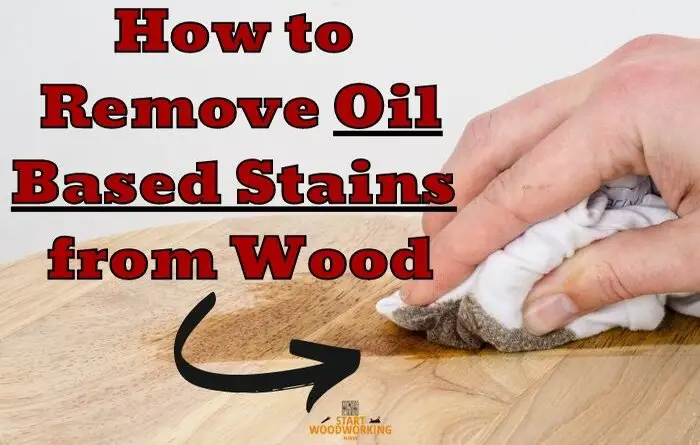
How to Remove Oil-Based Stain from Wood: Solvents, Sanding, and Surface-Type Guide
Oil-based wood stain is a penetrating colorant suspended in a solvent carrier — typically mineral spirits or naphtha — that absorbs into the wood grain and binds with the wood fibres as the solvent evaporates. Removing oil-based stain from wood requires dissolving the bound colorant with a solvent such as mineral spirits or paint thinner, followed by sanding to remove the stained surface fibres when the stain has fully cured into the grain. Fresh stain applied within the last 2–4 hours responds to solvent wiping alone; fully dried stain requires progressive sanding from 80 grit to remove the stained wood layer completely before refinishing.
This guide covers solvent removal, sanding sequences, surface-specific methods for furniture and hardwood floors, and the conditions under which each approach is appropriate — with exact contact times, grit sequences, and product types for each scenario.
How Do You Remove Oil-Based Wood Stain?
→ For removing accidental cooking oil or grease spills from wood surfaces, see: How to Remove Stains from Wood
→ For a complete overview of all finish removal methods, see: How to Remove Wood Finishes and Stains
What Are the Key Specifications for Removing Oil-Based Stain from Wood?
The table below centralises the entity–attribute–value pairs that determine the correct removal method for each scenario. Stain age, wood species, surface type, and whether a topcoat finish is present are the four variables that change the process most significantly.
| Scenario | Attribute | Value |
|---|---|---|
| Fresh oil-based stain (under 4 hours) | Solvent contact time | 5–10 minutes |
| Partially dried stain (4–24 hours) | Solvent contact time | 15–20 minutes + scrubbing |
| Fully dried stain (24+ hours) | Removal method | Solvent pre-treatment + sanding from 80 grit |
| Mineral spirits | Primary solvent for oil-based stain | Apply undiluted; contact time 5–20 min |
| Paint thinner / naphtha | Alternative solvent (faster acting) | Apply undiluted; contact time 5–10 min; higher fume output |
| Denatured alcohol | Effective on | Freshly applied gel stains and alcohol-based stains only — not oil-based |
| Sandpaper — initial pass (dried stain) | Starting grit | 80 grit |
| Sandpaper — intermediate pass | Grit | 120 grit |
| Sandpaper — final pass | Grit | 180 grit |
| Stain under polyurethane or varnish topcoat | First step required | Remove topcoat with chemical stripper before addressing stain |
| Open-grain hardwood (oak, ash) | Stain penetration depth | Deep — requires 80-grit starting pass; may need 2 solvent cycles |
| Close-grain hardwood (maple, cherry) | Stain penetration depth | Shallow — solvent alone may suffice on fresh stain |
| Post-solvent surface wash | Drying time before sanding | 30–60 minutes minimum |
| Cotton rag type | Recommended material | 100% cotton lint-free; replace frequently |
| Ventilation requirement | Minimum for mineral spirits | Open windows + fan; KN95 mask recommended |
What Is the Difference Between Oil-Based Stain and an Oil Stain on Wood?
Oil-based wood stain and an accidental oil stain on wood are two different substances that require different removal approaches. Confusing them leads to using the wrong solvent and damaging the wood surface.
Oil-based wood stain is a finishing product — a pigment or dye suspended in a mineral spirits or naphtha carrier — deliberately applied to colour wood before a topcoat finish. Common brands include Minwax Wood Finish, Varathane Premium Stain, and Cabot Wood Stain. Removing this type of stain requires dissolving the bound pigment with mineral spirits or sanding through the stained wood layer.
An accidental oil stain is a food-source or petroleum-source oil — cooking oil, engine oil, linseed oil, or furniture oil — that has contacted the wood surface unintentionally. These require absorbent materials, degreasers, and different solvent chemistry. This guide covers oil-based wood stain removal only.
Which Removal Method Is Right for Your Oil-Based Stain Situation?
The correct method depends primarily on how long the stain has been on the wood and whether a protective topcoat finish is present over the stain. The table below maps each scenario to the correct first step.
| Situation | Correct First Step | Full Method |
|---|---|---|
| Fresh stain, no topcoat (under 4 hours) | Mineral spirits on cotton rag — 5–10 min contact | Solvent only — no sanding required |
| Partially dried stain (4–24 hours) | Mineral spirits — 15–20 min + stiff brush scrubbing | Solvent + scrubbing; light 120-grit pass if residue remains |
| Fully dried stain, no topcoat | Mineral spirits soak — 20 min, then 80-grit sanding | Solvent pre-treatment + full grit sequence 80–120–180 |
| Stain under polyurethane or varnish | Strip topcoat with chemical stripper first | Chemical strip → solvent → sanding as required |
| Stain on open-grain wood (oak, ash, walnut) | Mineral spirits — 20–30 min before scrubbing | Extended solvent contact + 2 scrubbing cycles + 80-grit start |
| Stain on hardwood floor | Mineral spirits on spot — 15 min, scrub and dry | Solvent spot treatment; if persists — floor sander 80 grit on full area |
| Stain on veneer or engineered wood | Mineral spirits only — no sanding | Solvent only; veneer too thin for sanding |
| Overapplied stain (blotchy, uneven) | Mineral spirits — full surface application while still wet | Solvent flood and immediate wipe; re-stain with conditioner applied first |
📝 In my workshop, I always reach for odourless mineral spirits over paint thinner when working with oil-based stain on beechwood — the slower evaporation gives me more control on the dense, close-grain surface where the stain sits shallow and responds quickly. On a beech dining table I refinished, a 15-minute mineral spirits application removed two-day-old stain almost completely without any sanding, which surprised me given how saturated the colour looked when dry. The only area that needed a 120-grit pass was around the end grain where the pigment had wicked deeper into the open fibres.
How Do You Remove Fresh or Partially Dried Oil-Based Stain from Wood with a Solvent?
Solvent removal is effective on oil-based stain that has not fully cured into the wood grain — typically stain applied within the last 24 hours.
Mineral spirits is the correct solvent; it dissolves the oil carrier in the stain formulation and lifts the suspended pigment out of the grain without damaging the wood fibres.
Do not use acetone or denatured alcohol on oil-based stain — these solvents are not effective on oil-based carriers and can raise or discolour the wood grain.
STEP 1 – Act immediately on fresh stain — do not allow it to dry
Oil-based stain begins bonding to wood fibres within 15–30 minutes of application as the solvent carrier evaporates. On fresh stain, wipe immediately with a clean lint-free cotton cloth to remove the surface layer before it penetrates further. Work in the grain direction. This step alone is sufficient on dense, close-grained wood species such as maple or cherry where penetration is shallow.
STEP 2 – Apply mineral spirits and allow contact time
Pour odourless mineral spirits onto a clean cotton cloth until saturated. Apply to the stained area using straight strokes in the grain direction. For fresh stain (under 4 hours), allow 5–10 minutes contact time. For partially dried stain (4–24 hours), allow 15–20 minutes. Do not allow the mineral spirits to evaporate completely before scrubbing — the dissolved pigment must remain in a fluid state to be extracted from the grain.
On large flat surfaces such as tabletops, apply mineral spirits with a natural-bristle brush across the entire stained area rather than wiping section by section. This ensures even penetration and prevents tide marks from forming where the solvent boundary dries unevenly.
STEP 3 – Scrub with a stiff brush or coarse cloth
After the contact time, scrub the surface with a stiff natural-bristle brush or a coarse cotton cloth to extract the dissolved pigment from the wood grain. Work in the grain direction with firm, consistent pressure. Replace the cloth or rinse the brush frequently — a tool saturated with dissolved pigment re-deposits colour rather than removing it.
For open-grain woods such as oak, walnut, or ash where pigment settles deeply into the visible pores, use a stiff brush rather than a cloth. Brush in the grain direction with short, firm strokes to dislodge pigment from inside the pores. Follow immediately with a clean cloth wipe to remove the extracted material before it re-settles.
STEP 4 – Wipe clean and assess
Wipe the entire surface with a clean, dry cotton cloth to remove all dissolved pigment and residual mineral spirits. Inspect in raking light — a lamp held at a low angle near the surface — to check for any remaining colour variation or stain residue in the grain. On lighter wood species, hold a clean white cloth against the surface and press firmly; any pigment transfer indicates stain still present.
If stain residue remains after two solvent applications, the stain has cured sufficiently that solvent alone cannot extract it. Proceed to the sanding method below.
How Do You Remove Fully Dried Oil-Based Stain from Wood by Sanding?
Fully dried oil-based stain — applied more than 24 hours ago — has cured into the wood grain through oxidative polymerisation of the oil carrier. Solvent treatment alone cannot extract it; sanding is required to physically remove the stained surface layer of wood fibres. Always apply a mineral spirits pre-treatment before sanding to soften the stain layer and reduce sandpaper clogging.
STEP 1 – Pre-treat with mineral spirits to reduce sandpaper clogging
Apply mineral spirits to the entire stained surface and allow 20 minutes contact time. This softens the dried oil carrier in the stain and reduces the amount of resinous material the sandpaper must cut through on the first pass. Without pre-treatment, 80-grit sandpaper clogs within 2–3 passes on fully cured oil-based stain and must be replaced repeatedly.
STEP 2 – Sand through the correct grit sequence
| Grit | Stage | Purpose |
|---|---|---|
| 80 grit | Initial pass | Removes stained surface wood fibres; cuts through cured oil-pigment layer; reveals unstained wood beneath |
| 120 grit | Intermediate pass | Removes 80-grit scratch marks; further smooths the exposed wood surface |
| 180 grit | Final pass | Prepares the surface for new stain or finish application; produces open grain without deep scratches |
Sand in the grain direction at all stages on flat surfaces. On furniture with curved elements, use a sanding block rather than a power sander to maintain control and avoid sanding through edges. Wipe the surface with a tack cloth between each grit change to remove all dust before the next pass.
STEP 3 – Confirm full removal before refinishing
After the 120-grit pass, wipe the surface with a mineral spirits-dampened cloth. If the cloth shows any colour transfer matching the original stain, oil pigment remains in the grain — repeat the 80-grit pass on those areas before continuing. A completely clean cloth after the mineral spirits wipe confirms the stain has been fully removed and the surface is ready for the 180-grit final pass and refinishing.
How Does Surface Type Affect Oil-Based Stain Removal?
Furniture — flat panels and carved profiles
On flat furniture panels, the solvent + sanding method described above applies directly. Use an orbital sander with a 125 mm pad for surfaces larger than 0.5 m².
For carved profiles, mouldings, and turned elements where a sander cannot reach, apply mineral spirits with a stiff brush and use #0000 steel wool in the grain direction to abrade the stained surface layer without sanding. Steel wool at this grade removes stain without cutting deeply into the wood profile the way sandpaper wrapped around a block would.
Hardwood floors
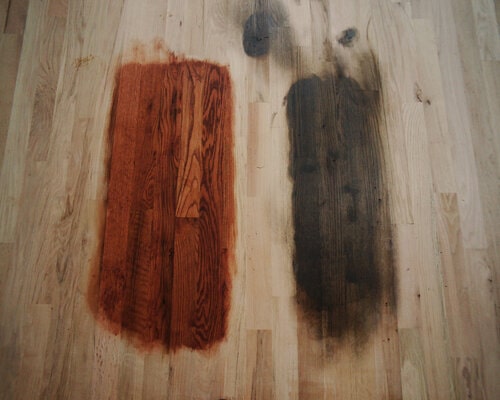
Spot removal of oil-based stain from hardwood floors requires matching the removal area to the affected boards — sanding a spot smaller than one full board width creates a visible depression and colour variation against the surrounding floor.
The correct approach is to treat the affected board or boards as a complete unit: mineral spirits on the stained area for 15–20 minutes, scrub, assess, and if sanding is required, sand the full board length at 80 then 120 then 180 grit using an edge sander for board-level work or a drum floor sander if multiple adjacent boards are affected.
After stain removal and sanding on a floor, the exposed bare wood will be lighter than the surrounding finished boards. Re-stain to match the surrounding colour, then apply matching topcoat finish. Matching existing floor stain colour requires testing on an offcut or inconspicuous area before committing to the full board.
Engineered wood and veneer surfaces
Do not sand engineered wood or veneered surfaces to remove oil-based stain. The veneer layer is typically 0.6–2 mm thick — a single 80-grit pass removes 0.3–0.5 mm of material and can sand through the veneer entirely on a second pass.
Use mineral spirits only, applied for a maximum of 20 minutes contact time, with a plastic scraper and cotton cloth for mechanical extraction. If the stain does not respond to two solvent treatments, the veneer cannot be stripped — refinishing the surface with a coloured finish that incorporates the existing stain colour is the practical alternative.
📝 The most careful removal job I’ve done with oil-based stain was on a walnut-veneered wardrobe door where the client had applied stain over the entire surface trying to even out a colour variation, then changed their mind the same day. Because the veneer was under 1 mm, sanding was completely out of the question — one pass with 80 grit and the veneer would have been gone. I applied mineral spirits twice with 20-minute contact each time, scrubbing gently with a cotton cloth in the grain direction, and both applications together lifted enough pigment to restore the natural walnut colour without touching the surface with abrasives. The key was acting the same day while the oil carrier hadn’t fully evaporated.
How Does Wood Species Affect Oil-Based Stain Removal?
Wood porosity and grain structure determine how deeply oil-based stain penetrates and how many removal cycles are required. The table below maps species type to expected penetration depth and removal difficulty.
| Wood Type | Species Examples | Stain Penetration | Removal Difficulty |
|---|---|---|---|
| Open-grain hardwood | Oak, ash, walnut, mahogany | Deep — large pores absorb pigment rapidly; stain visible in pore channels | High — solvent requires 20–30 min contact; 80-grit starting pass essential; may need 2 solvent cycles |
| Close-grain hardwood | Maple, cherry, beech, birch | Shallow — dense grain limits penetration; stain sits at surface layer | Medium — solvent effective within 15 min on fresh stain; 80-grit start for dried stain |
| Softwood | Pine, spruce, fir | Variable and uneven — resin pockets absorb unevenly creating blotching | Medium — solvent effective but blotching may remain; 80-grit pass required for even result; use wood conditioner before re-staining |
| Oily tropical hardwood | Teak, rosewood, padauk | Shallow — natural oils partially resist pigment penetration | Low to medium — solvent effective quickly; wipe with acetone before mineral spirits application to open surface |
| Veneer (all species) | Any species as engineered veneer | Shallow — veneer is thin; pigment in surface layer only | Solvent only — no sanding; one to two mineral spirits applications usually sufficient |
Frequently Asked Questions About Removing Oil-Based Stain from Wood
Does mineral spirits remove oil-based stain from wood completely?
Mineral spirits removes fresh oil-based stain completely when applied within 4 hours of the stain application, before the oil carrier has fully evaporated and the pigment has bonded to the wood fibres. On partially dried stain (4–24 hours), mineral spirits removes the majority of the stain but a light 120-grit sanding pass is usually required to fully clean the grain. On fully dried stain (24+ hours), mineral spirits softens the surface but sanding from 80 grit is required to remove the stained wood layer completely.
Can you remove oil-based stain without sanding the entire surface?
Spot removal of oil-based stain without sanding the full surface is possible using mineral spirits on fresh stain within the first 4 hours. On dried stain, spot-sanding is technically possible but almost always creates a visible lighter patch against the surrounding stained wood — the repair requires re-staining the spot to match, which is difficult to achieve exactly. On furniture, spot removal followed by re-staining the full panel is more reliable than attempting an invisible spot repair. On floors, the minimum treatment unit is one full board length.
What is the difference between removing oil-based stain and water-based stain from wood?
Oil-based stain requires mineral spirits or paint thinner for solvent removal — water and water-based cleaners do not dissolve the oil carrier and are ineffective. Water-based stain responds to warm water and light scrubbing when fresh, because the carrier is water-soluble. Both types require sanding when fully dried, but oil-based stain penetrates deeper on open-grain wood species and typically requires a lower starting grit (80) than water-based stain, which sits more at the surface and can often be removed starting at 100 or 120 grit.
How do you remove oil-based stain from wood without damaging the surface?
Remove oil-based stain without surface damage by using mineral spirits only — no sanding — on veneer surfaces, engineered wood, and antique pieces where the wood layer is too thin for abrasion. Apply mineral spirits for 15–20 minutes contact time, scrub gently with a cotton cloth in the grain direction, and repeat if needed. On solid wood, sand with the grain only — never cross-grain — starting at 80 grit. Use a sanding block on flat surfaces to maintain even pressure and prevent dips. Never use steel wool coarser than #0000 on finished wood surfaces.
Summary: Key Values for Removing Oil-Based Stain from Wood
Removing oil-based stain from wood requires matching the method to stain age and wood construction. Fresh stain under 4 hours responds to mineral spirits applied for 5–10 minutes followed by scrubbing with a lint-free cotton cloth. Partially dried stain (4–24 hours) requires 15–20 minutes mineral spirits contact and stiff-brush scrubbing, with a 120-grit pass if residue remains.
Fully dried stain requires mineral spirits pre-treatment for 20 minutes to reduce sandpaper clogging, then progressive sanding from 80 to 120 to 180 grit in the grain direction. Confirm full removal with a mineral spirits wipe test — a clean white cloth with no colour transfer confirms the surface is ready for refinishing. Never sand veneer or engineered wood surfaces — use solvent treatment only. Stain under a polyurethane or varnish topcoat requires chemical stripping of the topcoat before any stain removal can begin.
→ Related: How to Remove Linseed Oil from Wood
→ Related: How to Remove Polyurethane from Wood
→ Hub: How to Remove Wood Finishes and Stains — Complete Guide