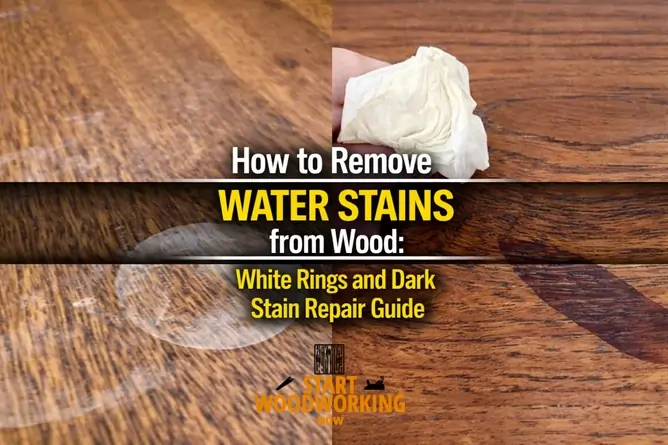
How to Remove Water Stains from Wood: White Rings and Dark Stain Repair Guide
Water stains on wood fall into two chemically distinct categories that require different repair methods: white rings and cloudy patches form when moisture becomes trapped inside the finish film, causing light scattering without reaching the wood grain — these are finish-level damage repaired by heat or oil displacement. Dark brown or black stains form when water penetrates past the finish into the wood grain, where it triggers oxidation of the wood’s natural tannins and extractives, producing permanently bound dark pigmentation — these require oxalic acid bleaching or sanding to remove. Applying the method for white stains to dark stains produces no result; applying the method for dark stains to white stains removes the finish unnecessarily.
This guide covers the diagnosis test to identify which stain type you have, the correct repair method for each finish type, exact temperatures and contact times, and the oxalic acid protocol for dark stains on bare wood — so you can resolve the stain permanently rather than masking it temporarily.
→ For a complete overview of all wood stain and finish removal: How to Remove Wood Finishes and Stains
→ Related: How to Remove Alcohol Stains from Wood
How Do You Diagnose Whether You Have a White Stain or a Dark Stain?
The visual appearance of the stain tells you exactly where the damage is and which method will work. Use this diagnosis panel before selecting any treatment.
White / Cloudy / Milky Stain
Dark Brown / Black / Grey Stain
Quick diagnosis test: Press a fingernail lightly into the centre of the stained area. If the wood feels solid and the stain is only visible, it is likely a white finish-level stain — the wood structure is intact. If the wood feels soft, spongy, or compresses under light pressure, water has penetrated deeply and structural damage may be present alongside the stain — professional assessment before repair is advisable.
What Are the Key Specifications for Removing Water Stains from Wood?
| Method | Attribute | Value |
|---|---|---|
| Clothes iron (white stain, heat method) | Temperature setting | Lowest setting — silk/synthetics; no steam |
| Clothes iron | Cloth layer between iron and wood | Single dry cotton cloth only |
| Clothes iron | Movement pattern | Continuous circular or back-and-forth — never stationary |
| Clothes iron | Check interval | Every 10–15 seconds — lift cloth and inspect |
| Hair dryer (white stain) | Distance from surface | 15–20 cm; low-medium heat |
| Hair dryer | Treatment duration per session | 5–10 minutes maximum; rest 10 minutes if surface feels hot |
| Petroleum jelly / mayonnaise (oil displacement) | Contact time | Minimum 4 hours; overnight for best result |
| Oxalic acid wood bleach (dark stain) | Concentration | 60 g oxalic acid crystals per 1 litre warm water |
| Oxalic acid wood bleach | Contact time | 15–20 minutes; check at 10 minutes |
| Oxalic acid wood bleach | Neutralisation after treatment | Baking soda solution — 1 tbsp per 500 ml water; wipe and rinse |
| Oxalic acid | Drying time before sanding | 24 hours minimum |
| Sandpaper (after oxalic acid on bare wood) | Starting grit | 120 grit — then 180 grit final pass |
| #0000 steel wool + paste wax | Use case | Light white stain residue on polyurethane after heat treatment |
| Denatured alcohol (shellac finish only) | Use case | White stain on shellac — dissolves and re-fuses shellac film |
| Tannin-rich species (oak, walnut, chestnut) | Dark stain severity | Higher — tannin oxidation produces more intense black-brown discolouration |
Why Do Mayonnaise, Toothpaste, and Vinegar Fail on Dark Water Stains?
Most commonly recommended home remedies — mayonnaise, petroleum jelly, toothpaste, baking soda, vinegar and olive oil — work exclusively on white finish-level stains and have no chemical mechanism for removing dark water stains that have penetrated the wood grain.
Mayonnaise and petroleum jelly work on white stains by displacing the water micro-droplets trapped in the finish film with oil, which restores the finish’s uniform light transmission and eliminates the cloudy appearance. They cannot reach dark stains because the damage is in the wood grain below the finish — not in the finish itself.
Toothpaste and baking soda work on white stains by mild mechanical abrasion of the finish surface, which re-levels minor finish disruption. They cannot reverse the tannin oxidation that causes dark stains — they are surface abrasives with no bleaching chemistry.
Vinegar has no mechanism for reversing tannin oxidation. It is mildly acidic (pH 2.5) and can dissolve some surface mineral deposits, but the dark pigmentation in water stains is caused by iron-tannate compounds bonded to wood fibres — not by mineral deposits on the surface.
The only agents that chemically reverse tannin oxidation are oxalic acid (which converts dark iron-tannate compounds back to colourless iron oxalate), hydrogen peroxide at higher concentration (6–9%), or physical removal by sanding through the stained wood fibre layer.
How Do You Remove White Water Stains from Wood Using Heat?
Heat removes white water stains by evaporating the moisture micro-droplets trapped inside the finish film and allowing the disrupted finish polymers to re-fuse into a uniform layer. This is the same mechanism used to remove alcohol stains from shellac and lacquer.
The method works on polyurethane, lacquer, varnish, and shellac finishes — but the temperature and contact time must be matched to the finish type to avoid heat damage.
STEP 1 – Place a single dry cotton cloth over the stain
Lay one layer of clean, dry 100% cotton cloth flat over the white stain — no paper towels, no synthetic fabrics. A single cotton layer transmits enough heat to re-fuse the trapped moisture without concentrating heat on the finish surface. Paper towels can leave texture marks in softened finish under heat; synthetic fabrics can melt onto the finish at iron temperatures.
STEP 2 – Apply iron on lowest setting — continuous movement, no steam
Set the iron to its lowest heat setting (silk or synthetics) and disable the steam function completely. Place the iron on the cloth and move it in slow, continuous circular strokes over the stained area.
Never hold the iron stationary — even at low settings, stationary contact concentrates heat and can blister or scorch the finish within seconds. Make passes of 10–15 seconds, then lift the cloth and inspect the stain. The white mark should begin to fade as the trapped moisture evaporates and the finish re-fuses. Continue until the stain has cleared.
STEP 3 – Alternative — hair dryer at 15–20 cm, low-medium heat
The hair dryer method is safer than the iron on delicate or antique finishes where concentrated iron heat is a risk. Hold a hair dryer at 15–20 cm from the stain surface and direct the warm air over the stain in a slow circular pattern for 5–10 minutes. The gentler, more diffuse heat of the hair dryer reaches the trapped moisture more gradually.
If the finish surface becomes slightly tacky or soft under the heat, stop immediately and allow to cool before continuing — this indicates the finish temperature has exceeded the softening point and further heat will damage rather than repair it.
STEP 4 – Apply paste wax and buff after heat treatment
After the stain has cleared, apply a thin coat of paste wax to the treated area and the surrounding surface and buff with a clean cloth. Heat treatment slightly dehydrates the finish film — the wax restores moisture and sheen and prevents the stain from recurring in the same spot if the surface is exposed to moisture again.
How Do You Remove White Water Stains from Wood Using the Oil Displacement Method?
The oil displacement method works by applying a petroleum-based or plant-based oil to the stained area and allowing it to penetrate the finish film overnight. The oil molecules fill the micro-voids left by the displaced moisture, restoring the uniform refractive index of the finish and eliminating the cloudy white appearance. This method is slower than the heat method but is safe on all finish types including shellac, antique finishes, and oil finishes.
Petroleum jelly (Vaseline) is the most effective oil for this method — its molecular weight and viscosity allow it to penetrate finish films slowly and completely over an extended contact time. Mayonnaise works by the same mechanism (it contains oil and water) but is less effective than pure petroleum jelly because the water content partially counteracts the oil penetration.
STEP 1 – Apply petroleum jelly directly to the white stain — generous layer
Apply a generous, visible layer of petroleum jelly directly onto the white stain using a fingertip or a soft cloth. Cover the entire stained area and extend 1–2 cm beyond the stain edge. The petroleum jelly needs to be in thick contact with the finish surface to penetrate effectively — a thin smear evaporates too quickly.
STEP 2 – Leave for 4–8 hours minimum — overnight preferred
Leave the petroleum jelly undisturbed for a minimum of 4 hours, or ideally overnight (8–12 hours). Do not cover the jelly — the evaporation of lighter oil fractions is part of the penetration process. Check at 4 hours — if the stain has lightened significantly, the method is working. If no change is visible after 8 hours, the stain is likely too old or too deep for oil displacement and requires the heat method or, if on bare wood, the oxalic acid method.
STEP 3 – Wipe clean and assess
Remove the petroleum jelly with a clean dry cloth. The stain should have faded substantially or disappeared. If a faint haze remains, apply a second petroleum jelly treatment for another 8 hours before assessing again. After the stain is gone, clean the surface with a damp cloth to remove petroleum residue, dry immediately, and apply paste wax to restore the finish surface.
How Do You Remove White Water Stains from Shellac-Finished Wood?
Shellac is an alcohol-soluble finish — denatured alcohol re-dissolves and re-fuses the shellac film, which allows the disrupted finish molecules to re-flow into a uniform layer and eliminate the white cloudy appearance. This is safer than heat on shellac and more complete than the oil displacement method.
Dampen a cotton pad with denatured alcohol and wipe it lightly over the white stain with a single pass in the grain direction. The shellac will soften and re-flow within seconds of alcohol contact — do not rub repeatedly.
Allow 30 seconds for the shellac to re-solidify, then inspect. If the stain remains, make one more light wipe. Do not apply pressure or rub back and forth — the goal is to re-fuse the finish with minimal material removal. After the stain clears, apply a thin coat of paste wax and buff to restore sheen.
How Do You Remove Dark Water Stains from Wood Using Oxalic Acid?
Oxalic acid is the correct chemical treatment for dark water stains on bare or oiled wood. It works by reacting with the iron-tannate compounds responsible for the dark brown and black discolouration — converting them to iron oxalate, which is colourless and water-soluble, and can be rinsed away.
Oxalic acid does not bleach the wood itself in the way that chlorine bleach does — it selectively targets the oxidised tannin-iron compounds without significantly lightening the surrounding natural wood colour.
STEP 1 – Strip or sand the finish to bare wood over the stained area
Oxalic acid cannot penetrate polyurethane, lacquer, or varnish films — it must reach the bare wood directly. On furniture with a clear finish over the stained area, apply chemical stripper to the affected section to remove the finish before oxalic acid treatment. On bare or oiled wood, proceed directly to the application step.
STEP 2 – Dissolve oxalic acid crystals in warm water
Dissolve 60 g of oxalic acid crystals (available from hardware stores as “wood bleach”) in 1 litre of warm water. Stir until completely dissolved — undissolved crystals can leave concentrated spots on the wood surface. Wear chemical-resistant gloves, safety glasses, and ensure good ventilation — oxalic acid is toxic by inhalation and a serious skin and eye irritant.
STEP 3 – Apply the solution and allow 15–20 minutes contact time
Apply the oxalic acid solution generously to the stained area using a brush or sponge, wetting the wood thoroughly. Allow 15–20 minutes contact time — check at 10 minutes. The dark stain should visibly lighten as the iron-tannate compounds are converted. For very dark or old stains (black rings from prolonged water contact on oak or walnut), a second application after allowing the surface to dry partially may be needed.
STEP 4 – Neutralise with baking soda solution and rinse
After the stain has lightened sufficiently, neutralise the oxalic acid immediately — do not allow it to dry on the wood. Mix 1 tablespoon of baking soda in 500 ml of water and wipe the treated area thoroughly with this solution to neutralise the acid. Rinse with clean water and wipe dry. Allow 24 hours minimum drying time before sanding or applying any new finish — oxalic acid treatment raises the wood grain and the surface must be fully dry for sanding to produce an even result.
STEP 5 – Sand with 120 then 180 grit and refinish
After the 24-hour drying period, sand lightly with 120 grit in the grain direction to level the raised grain, then with 180 grit for final preparation. Wipe with a tack cloth. Apply the matching finish — oil, wax, or polyurethane — to the stripped and bleached area. If the treated area is noticeably lighter than the surrounding wood after bleaching, apply a matching wood stain before the clear finish coat to restore colour uniformity.
Why Do Dark Water Stains Appear More Severe on Oak, Walnut, and Cherry?
The severity of dark water stains varies significantly by wood species depending on the natural tannin content of the wood. Tannins are polyphenolic compounds present in varying concentrations in different species — when water carries dissolved iron (from metal objects, pipes, or hardware fittings) into wood with high tannin content, the iron reacts with the tannins to form intensely dark iron-tannate complexes. This is the same chemical reaction that makes oak barrels darken wine.
| Wood Species | Tannin Content | Dark Stain Severity | Oxalic Acid Response |
|---|---|---|---|
| Oak (all species) | Very high | Severe — near-black staining common | Excellent — 1–2 applications usually sufficient |
| Walnut | High | Severe — dark brown to black | Good — may require 2 applications |
| Chestnut | Very high | Severe — similar to oak | Excellent |
| Cherry | Medium | Moderate — medium brown staining | Good — usually 1 application |
| Mahogany | Medium | Moderate | Good |
| Pine, spruce, fir | Low to medium | Light — grey-brown discolouration | Good — 1 application typically sufficient |
| Maple, beech | Low | Light — faint grey staining | Excellent — rapid response |
| Teak | Medium + natural oils | Variable — natural oils partially resist staining | Moderate — wipe with mineral spirits first |
Iron source identification: If the dark stain has a concentrated centre corresponding to a specific object — a plant pot base, a metal tray, a cast iron pan, a hardware fitting — the staining is almost certainly iron-tannate. Remove the iron source, apply oxalic acid treatment, and ensure no bare metal contacts the wood surface in future. A felt pad or rubber buffer under metal objects prevents iron-tannate staining entirely.
📝 In my restoration workshop, oak furniture accounts for the majority of severe dark water stain cases — the high tannin content means that even a relatively brief water contact from a metal object produces near-black staining that surprises clients who assumed the damage was superficial. On a 19th-century oak sideboard I restored, two oxalic acid applications at 60g per litre were needed before the staining lightened sufficiently to match the surrounding grain. After bleaching, a light walnut stain was needed to bring the treated area back to the correct tone before the shellac topcoat — the oxalic acid had lightened it slightly below the natural oak colour.
How Does the Wood Surface Type Affect Water Stain Removal?
| Surface Type | White Stain Method | Dark Stain Method | Key Constraint |
|---|---|---|---|
| Polyurethane finish | Iron method (lowest setting) or hair dryer; petroleum jelly overnight | Strip finish → oxalic acid → sand → refinish | Heat at low settings safe; do not exceed finish softening point |
| Lacquer finish | Hair dryer preferred over iron; petroleum jelly safe | Strip finish → oxalic acid → sand → refinish | Lacquer more heat-sensitive than polyurethane — use hair dryer only |
| Shellac (antique furniture) | Denatured alcohol wipe — single pass; petroleum jelly overnight | Denatured alcohol strip → oxalic acid → re-shellac | Never use iron or steam on shellac |
| Wax finish | Petroleum jelly overnight; re-wax after treatment | Strip wax with mineral spirits → oxalic acid → re-wax | Heat removes wax layer; use petroleum jelly method only |
| Oil finish | Hair dryer at 15–20 cm; re-oil after treatment | Oxalic acid directly — oil finish does not need stripping first | Re-apply matching oil after any treatment |
| Bare / unfinished wood | Hair dryer; allow to dry fully; apply finish after | Oxalic acid directly; sand 120–180 grit; refinish | Tannin content of species determines stain severity and number of applications needed |
| Hardwood floor (sealed) | Iron method on sealed areas; hair dryer for worn spots | Strip locally → oxalic acid → re-sand board → re-finish full board | Spot repair requires full board refinishing to avoid visible colour variation boundary |
| Veneer | Petroleum jelly only — no heat, no sanding | Oxalic acid cautiously — test on inconspicuous area; no sanding | Veneer too thin for sanding; heat risks delamination of adhesive |
📝 The most straightforward white water stain removal in my experience is on well-maintained polyurethane-finished dining tables — the iron method at the lowest setting under a single cotton cloth resolves glass condensation rings in 2–3 passes in almost all cases. The petroleum jelly overnight method I reserve for antique or shellac-finished pieces where heat is not safe, and it consistently works on fresh white stains within one 8-hour application. On a shellac-finished 1950s walnut coffee table with multiple white rings from years of glass use, two overnight petroleum jelly treatments followed by a denatured alcohol wipe removed all visible marks without disturbing the original shellac finish.
Frequently Asked Questions About Removing Water Stains from Wood
Why do water stains appear white on some pieces of furniture and dark on others?
White water stains form when moisture becomes trapped inside the finish film — above the wood surface. The micro-droplets of water scatter light within the finish, creating the cloudy white appearance. The wood itself is undamaged. Dark water stains form when water penetrates past the finish into the wood grain, where it reacts with the wood’s natural tannins and any dissolved iron to produce dark iron-tannate compounds bonded to the wood fibres. The colour difference directly indicates the location and severity of the damage — white means finish-level, dark means wood-level.
Can you remove dark water stains from wood without sanding?
Yes — oxalic acid wood bleach removes dark water stains from bare wood without sanding by chemically converting the dark iron-tannate compounds to colourless iron oxalate. After treatment and neutralisation, the wood surface may only need a light 120–180 grit pass to level the raised grain before refinishing, rather than the aggressive sanding required to physically remove the stained wood layer. However, when dark staining has penetrated deeply — more than 1–2 mm — or when the stained area is still covered by an intact finish, stripping the finish before oxalic acid treatment and sanding after is the complete process.
Does the iron method damage wood finish?
The iron method at the correct settings — lowest temperature, no steam, single cotton cloth, continuous movement — does not damage polyurethane, lacquer, or varnish finishes when used correctly. The risk arises from incorrect technique: stationary contact concentrates heat and blisters the finish within seconds; high temperature settings scorch both finish and wood; steam introduces moisture that re-creates the problem being solved. On shellac finishes, avoid the iron method entirely — use the petroleum jelly or denatured alcohol method instead, as heat and steam damage shellac irreversibly.
How long does it take for a fresh white water stain to disappear on its own?
Fresh white water stains on modern polyurethane or lacquer finishes sometimes resolve without treatment as the trapped moisture evaporates through the finish over 24–48 hours, particularly if the room is warm and dry. Modern film-forming finishes are less permeable than older formulations, which means moisture that penetrated slightly can also escape.
If the stain is still visible after 48 hours in normal room conditions, it will not resolve on its own and requires treatment. On older furniture with aged, more porous finishes, spontaneous resolution is less likely because the finish allows deeper moisture penetration that cannot evaporate through the same pathway.
Summary: Key Values for Removing Water Stains from Wood
Water stain removal requires first identifying whether the stain is white (finish-level) or dark (wood-level), as these require entirely different treatments. White stains are repaired by re-fusing the finish film with a clothes iron on the lowest setting under a single dry cotton cloth in continuous motion, or by petroleum jelly applied overnight for a minimum of 4–8 hours.
On shellac finishes, a single denatured alcohol wipe re-fuses the finish without heat. Dark brown or black stains require oxalic acid wood bleach at 60 g per litre applied for 15–20 minutes, neutralised with baking soda solution, dried for 24 hours, then sanded with 120 and 180 grit before refinishing.
Mayonnaise, toothpaste, vinegar, and baking soda are effective only on white finish-level stains — they have no chemical mechanism for removing dark tannin-oxidation stains in the wood grain.
Dark stains are most severe on high-tannin species — oak, walnut, chestnut — because water-carried iron reacts with tannins to form intense iron-tannate compounds that require oxalic acid to convert back to colourless form.
→ Related: How to Remove Alcohol Stains from Wood
→ Related: How to Remove Grease from Wood
→ Hub: How to Remove Wood Finishes and Stains — Complete Guide