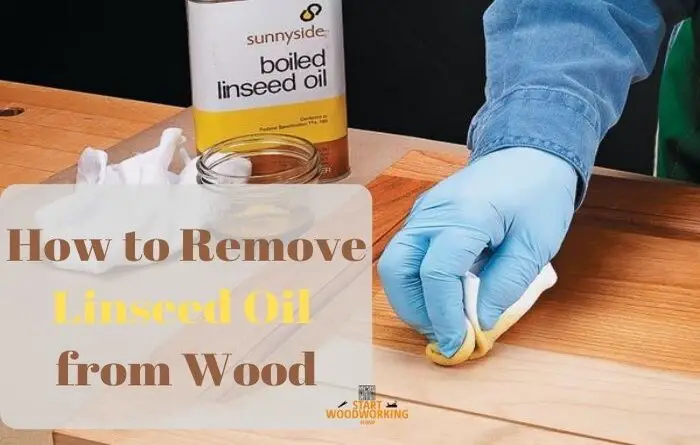
How to Remove Linseed Oil from Wood: Solvents, Sanding, and Heat Methods
Linseed oil is a penetrating wood finish derived from flaxseed that polymerises inside the wood pores as it cures, forming a solid, cross-linked layer within the grain rather than on the surface. Removing linseed oil from wood requires dissolving this polymerised layer with a solvent — turpentine or mineral spirits are most effective — followed by mechanical scrubbing or sanding to extract the dissolved residue from the open grain. Fresh or uncured linseed oil responds to solvent wiping alone within 20–30 minutes of contact time; fully cured linseed oil requires progressive sanding starting at 80 grit after solvent treatment to fully open the grain for refinishing.
This guide covers all four removal methods — solvent dissolution, sanding, heat softening, and orange oil — with exact product quantities, contact times, grit sequences, and the conditions under which each method applies.→ For a complete overview of all wood finish removal methods, see: How to Remove Wood Finishes and Stains
What Are the Key Specifications for Removing Linseed Oil from Wood?
The table below lists the entity–attribute–value pairs that determine the correct method and product selection for each linseed oil removal scenario. Review these before starting to avoid the most common mistakes: using the wrong solvent concentration, sanding too coarsely on the first pass, or applying heat to fully cured oil.
| Method | Attribute | Value |
|---|---|---|
| Fresh linseed oil (uncured) | Solvent contact time for dissolution | 10–20 minutes |
| Fully cured linseed oil | Solvent contact time before scrubbing | 20–30 minutes |
| Turpentine (pure gum) | Application method | Saturated cotton rag, circular motion |
| Mineral spirits (odourless) | Application method | Saturated cotton rag, with the grain |
| Sandpaper — initial pass | Starting grit (cured oil) | 80 grit |
| Sandpaper — intermediate pass | Grit | 120 grit |
| Sandpaper — final pass | Grit | 180 grit |
| Heat gun (uncured oil only) | Distance from surface | 8–12 cm |
| Heat gun | Temperature setting | Low to medium — do not exceed 200°C |
| Orange oil concentrate | Contact time before wiping | 10–60 minutes depending on curing stage |
| Orange oil concentrate | Sunlight requirement | No direct sunlight — reduces effectiveness |
| Post-removal surface wash | Agent | Warm water + wood-specific cleaner (no soap) |
| Drying time after water wash | Before sanding or refinishing | 2–4 hours minimum |
| Oily tropical woods (teak, rosewood) | Pre-treatment before solvent | Wipe with acetone first to open surface |
| Cotton rag type | Recommended material | 100% cotton, lint-free (old T-shirts work well) |
Why Is Linseed Oil Harder to Remove Than Surface Finishes?
Linseed oil is harder to remove than polyurethane or varnish because it does not form a surface film — it penetrates and polymerises within the wood pores themselves. When a film-forming finish like polyurethane degrades, it lifts away from the wood surface and can be stripped with a scraper. When linseed oil degrades, the solidified oil is locked inside the grain and must be dissolved out from within.
The degree of curing determines which removal method is effective. Fresh linseed oil — applied within the last 24–48 hours and not yet polymerised — remains soluble in turpentine and can be removed with solvent wiping alone.
Partially cured linseed oil (24 hours to 2 weeks after application) requires solvent treatment followed by mechanical scrubbing. Fully cured linseed oil — months or years old — has cross-linked so thoroughly that solvent alone cannot extract it. In this state, sanding is required after solvent softening to physically remove the oil-saturated wood fibres from the surface layer.
Which Linseed Oil Removal Method Is Right for Your Situation?
The correct method depends on the curing stage of the linseed oil, the wood surface type, and whether the piece will be refinished or left bare. The table below maps each scenario to the correct method.
| Situation | Best Method | Key Reason |
|---|---|---|
| Fresh / uncured linseed oil (under 48 hrs) | Solvent dissolution — turpentine or mineral spirits | Oil not yet cross-linked — dissolves without sanding |
| Partially cured (48 hrs – 2 weeks) | Solvent + scrubbing with coarse rag | Partially polymerised — solvent softens, scrubbing extracts |
| Fully cured (2+ weeks, solid layer) | Solvent soak + 80–120 grit sanding | Cross-linked oil requires physical removal of surface fibres |
| Large flat surfaces (floors, tabletops) | Solvent + orbital or drum sander | Hand sanding too slow; mechanical sanding ensures even removal |
| Carved or profiled wood | Orange oil + stiff brush + cotton rag | Conforms to irregular surfaces; no sanding risk to carved detail |
| Excess oil pooled on surface (not absorbed) | Heat gun (low setting) + scraper | Heat softens pooled unabsorbed oil for immediate scraping |
| Oily tropical wood species (teak, rosewood) | Acetone wipe first, then turpentine + sanding | Natural oils in these species resist solvent penetration without pre-treatment |
| Indoor work, poor ventilation | Odourless mineral spirits + sanding | Lower fume output than pure gum turpentine |
📝 In my workshop, I consistently reach for pure gum turpentine over odourless mineral spirits when dealing with linseed oil — the dissolving action is noticeably faster on oak, which I work with most frequently. On a heavily oiled oak workbench I restored a few years ago, mineral spirits alone barely touched the surface after 20 minutes, while turpentine had the oil visibly lifting within 10. The trade-off is the smell, which is why I always work with the garage doors fully open when using it.
How Do You Remove Linseed Oil from Wood Using a Solvent?
Solvent dissolution is the correct first step for all linseed oil removal, regardless of curing stage. Turpentine and odourless mineral spirits are both effective; turpentine has a stronger dissolving action on fully cured oil but produces more fumes, while odourless mineral spirits is safer for indoor use with limited ventilation.
Use pure gum turpentine rather than synthetic turpentine substitute — the natural terpene compounds in pure gum turpentine penetrate the polymerised oil layer more effectively.
STEP 1 – Wipe the surface and remove loose debris
Wipe the wood surface with a dry cloth to remove dust, dirt, and any surface debris. Do not use a damp cloth at this stage — moisture on the surface prevents the solvent from making direct contact with the oil-saturated grain.
STEP 2 – Saturate a cotton rag with turpentine or mineral spirits
Pour turpentine or odourless mineral spirits onto a clean 100% cotton cloth until the cloth is fully saturated but not dripping. Cotton is essential — synthetic fibres do not absorb the solvent-oil mixture as effectively and leave more residue on the surface. Old cotton T-shirts cut to A4-size pieces are ideal.
STEP 3 – Apply the solvent to the surface and allow contact time
Rub the saturated rag over the linseed oil surface using circular motions to work the solvent into the grain from multiple directions. Then switch to straight strokes following the grain direction to consolidate the dissolved oil at the surface.
Allow the solvent to remain in contact with the surface for 10–20 minutes for fresh oil, or 20–30 minutes for fully cured oil. Do not allow it to evaporate completely before moving to the next step — the dissolved oil must still be in liquid form to be removed.
STEP 4 – Scrub and remove the dissolved oil
Using a clean section of cotton rag or a stiff natural-bristle brush, scrub the surface in the grain direction to extract the dissolved oil from the wood pores. Replace the rag frequently — a rag saturated with dissolved oil re-deposits the oil back onto the surface rather than removing it. Continue until no more dark oil residue appears on the clean rag.
STEP 5 – Wash the surface and allow to dry
Once solvent scrubbing is complete, wash the surface with warm water and a wood-specific cleaner — not soap, which leaves a residue that interferes with refinishing adhesion. Allow the surface to dry for a minimum of 2–4 hours at room temperature before assessing or sanding.
How Do You Remove Fully Cured Linseed Oil from Wood by Sanding?
Sanding alone without prior solvent treatment is ineffective for linseed oil removal — the oil clogs sandpaper immediately and smears across the surface rather than being removed. Always use a solvent application first to soften and partially dissolve the cured oil, then sand to remove the oil-saturated wood fibres from the grain surface.
After the solvent treatment and surface wash have dried for 2–4 hours, sand through the following grit sequence:
| Grit | Stage | Purpose |
|---|---|---|
| 80 grit | Initial pass | Removes the oil-saturated surface layer of wood fibres; cuts through any remaining polymerised oil residue |
| 120 grit | Intermediate pass | Removes 80-grit scratch marks; further opens the grain |
| 180 grit | Final pass | Smooths the surface for refinishing; produces an open, clean grain ready to accept a new finish |
Sand in the direction of the wood grain at all stages. On flat furniture panels, an orbital sander with a 125 mm pad is sufficient. On floor surfaces larger than 4 m², use a drum floor sander starting at 80 grit for the main field area and an edge sander for the 20–30 cm perimeter zone near walls.
After each grit change, wipe away all sanding dust with a tack cloth before proceeding. Residual dust from the previous grit acts as an abrasive that creates uneven scratch depth in the next pass.
When Should You Use Heat to Remove Linseed Oil from Wood?
Heat is only effective for removing linseed oil that has not fully polymerised — specifically, oil that was applied too thickly and has pooled or remained tacky on the surface rather than absorbing into the grain. A heat gun or hair dryer softens this pooled, incompletely absorbed oil enough to scrape it away before it fully cures.
Heat does not work on fully cured linseed oil. Applying heat to old, solid linseed oil does not soften it — the cross-linked polymer chains are heat-stable at temperatures achievable with a domestic heat gun. Attempting to heat-strip fully cured linseed oil wastes time and risks scorching the wood surface.
STEP 1 – Set the heat gun to low or medium — do not exceed 200°C
High heat settings scorch wood fibres and can release toxic fumes if the linseed oil has oxidised over time. Keep the heat gun at low to medium setting throughout.
STEP 2 – Hold 8–12 cm from the surface and move continuously
Never hold the heat gun stationary over one spot — move it back and forth over a 10–15 cm area continuously. Stationary heat scorches the wood within seconds on a low setting. Work in small sections of approximately 20 × 20 cm at a time.
STEP 3 – Test with a plastic scraper while heating
After 20–30 seconds of heat application, press a plastic scraper against the surface. If the oil has softened sufficiently, it will move under the scraper. Scrape the softened oil immediately — it re-hardens within seconds of the heat being removed. Move to the adjacent section and repeat.
STEP 4 – Follow with solvent wipe
After heat scraping, the wood surface will have residual dissolved oil in the grain. Wipe immediately with a turpentine-saturated rag while the surface is still warm — warm wood absorbs the solvent faster and the residual oil is still in a partially fluid state, making extraction significantly easier.
How Does Orange Oil Remove Linseed Oil from Wood?
Orange oil concentrate — a natural solvent derived from orange peel containing d-limonene as the active ingredient — dissolves linseed oil by a similar mechanism to turpentine but with a lower fume output and no hazardous chemical classification. It is particularly effective on large floor surfaces oiled with raw or boiled linseed oil, and on carved or profiled wood where sandpaper cannot reach.
Orange oil works more slowly than turpentine and requires a contact time of 10–60 minutes depending on the curing stage of the linseed oil. It is not effective on fully polymerised, many-years-old linseed oil without repeated applications. Do not apply orange oil in direct sunlight — UV radiation and surface heat cause the product to dry and crystallise on the surface before it can penetrate and dissolve the oil underneath.
Application process for floor surfaces:
- Apply orange oil concentrate with a brush or mop across the floor in sections of 2–3 m²
- Allow contact time of 10–20 minutes for partially cured oil; 45–60 minutes for older, more solidified oil
- Work the surface with a coarse sponge or a polishing machine fitted with a scrubbing pad to extract the dissolved oil from the grain
- Collect all residue with a lint-free absorbent cloth immediately — do not allow the dissolved oil mixture to sit on the surface and re-absorb
- For older, thicker oil deposits: soak lint-free cloths in orange oil concentrate and lay them flat on the affected areas for up to 1 hour before scrubbing
- Allow the surface to dry for 24 hours before assessing — orange oil takes longer to evaporate than mineral spirits
- If oil residue is still present after drying, repeat the application; have spare scrubbing pads available as they clog quickly with dissolved oil
📝 I used the heat gun method once on a solid oak side table where the client had applied boiled linseed oil too thickly and it hadn’t cured after four days — the surface was still tacky and smearing. At low setting, 10 cm distance, the pooled oil softened enough to scrape within about 20 seconds of heat contact per section. The key adjustment I had to make was working in very small patches — no more than 15 cm at a time — because the oil re-hardened faster than expected once the heat moved away.
How Does Wood Species Affect Linseed Oil Removal?
The porosity, density, and natural oil content of the wood species determines how deeply linseed oil has penetrated and how many removal cycles are required to fully clean the grain.
| Wood Type | Species Examples | Linseed Oil Penetration | Removal Difficulty |
|---|---|---|---|
| Open-grain hardwood | Oak, ash, walnut | Deep — oil absorbs rapidly into large visible pores | High — requires solvent + 80-grit starting pass; may need 2 solvent applications |
| Close-grain hardwood | Maple, cherry, beech | Shallow — dense grain limits penetration depth | Medium — solvent + 120-grit starting pass usually sufficient |
| Softwood | Pine, spruce, cedar | Very deep — highly absorbent fibres drink in multiple oil layers | High — solvent alone rarely sufficient; always requires sanding to 80 grit minimum |
| Oily tropical hardwood | Teak, rosewood, padauk | Variable — natural oils compete with linseed oil penetration | Very high — pre-wipe with acetone required before turpentine treatment; natural oils resist solvent penetration |
Frequently Asked Questions About Removing Linseed Oil from Wood
Does turpentine fully remove linseed oil from wood without sanding?
Turpentine fully removes fresh or partially cured linseed oil without sanding when the oil was applied within the last 2 weeks and has not yet fully polymerised. On fully cured linseed oil — months or years old — turpentine softens the surface layer but cannot extract the cross-linked oil from deep within the wood grain. In this case, turpentine treatment must be followed by sanding starting at 80 grit to mechanically remove the oil-saturated wood fibres.
Can you paint or apply a new finish directly over linseed oil?
You cannot apply most water-based finishes directly over linseed oil — the oil prevents adhesion and the new finish will peel. Oil-based polyurethane can be applied over fully cured boiled linseed oil (minimum 72-hour cure) on some wood species, but this is unreliable and not recommended as a standard practice. The correct approach before any refinishing is to confirm full linseed oil removal using the mineral spirits wipe test: a clean rag with no yellow or brown discolouration confirms the surface is ready.
How do you remove linseed oil from wood floors without sanding the entire floor?
Spot removal of linseed oil from floors without sanding the entire surface is possible using concentrated orange oil or turpentine applied and left under a soaked cloth for 45–60 minutes on the affected areas only. After extraction, the treated spots will appear lighter than the surrounding floor and will need to be re-oiled or re-finished to match the surrounding surface. This approach works only when the affected area is clearly defined — if linseed oil was applied to the entire floor, the entire floor requires treatment.
How do you know if linseed oil has been fully removed from wood?
Perform a mineral spirits wipe test after the final sanding pass: dampen a clean white cotton cloth with odourless mineral spirits and rub it firmly over the sanded surface. If the cloth shows no yellow or brown discolouration, linseed oil has been fully removed. If discolouration appears, repeat the solvent treatment and sand again at 80 grit before retesting. The surface should also have a uniform, dull, open-grain appearance with no shiny spots or waxy feel when rubbed with a dry cloth.
Summary: Key Values for Removing Linseed Oil from Wood
Removing linseed oil from wood requires matching the method to the curing stage of the oil. Fresh oil (under 48 hours) responds to turpentine or mineral spirits applied with a saturated cotton rag for 10–20 minutes, followed by scrubbing and a warm water wash.
Partially cured oil requires 20–30 minutes of solvent contact and mechanical scrubbing.
Fully cured oil requires solvent softening followed by progressive sanding from 80 to 120 to 180 grit with a tack cloth wipe between each pass.
Heat works only on pooled, uncured surface oil held 8–12 cm from the surface on a low setting. Orange oil concentrate is effective on large floor surfaces and carved profiles at 10–60 minutes contact time, away from direct sunlight. On all surfaces, confirm complete removal with a mineral spirits wipe test before applying any new finish.
→ For the complete guide to removing all types of wood finish and stains, see: How to Remove Wood Finishes and Stains
→ Related: How to Remove Oil-Based Stain from Wood
→ Related: How to Remove Polyurethane from Wood