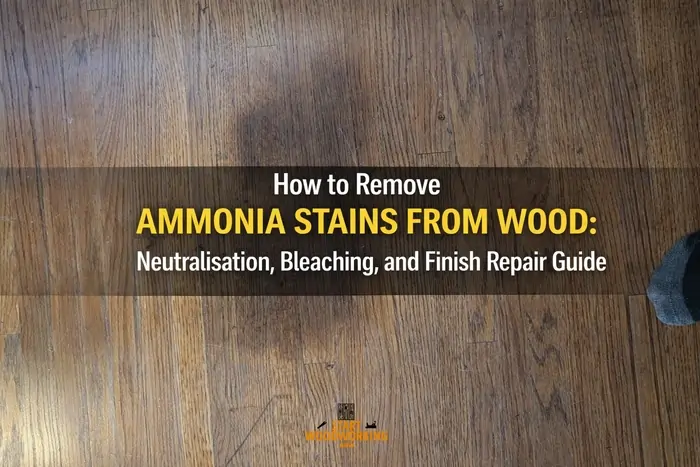
How to Remove Ammonia Stains from Wood: Neutralisation, Bleaching, and Finish Repair Guide
Ammonia stains on wood occur in three distinct scenarios that require different treatment protocols — because ammonia damages wood through different mechanisms depending on its source and concentration. A direct ammonia spill (from cleaning products, glass cleaners, or floor cleaners containing ammonia) creates a highly alkaline chemical reaction that darkens tannin-rich wood species and can blister or cloud finish films.
Pet urine stains contain ammonia from urea decomposition plus uric acid crystals that bind to wood fibres, requiring both neutralisation and oxidative bleaching. Repeated contact with ammonia-based cleaning products causes progressive finish degradation — the cloudiness and yellowing is finish damage, not wood staining. Each scenario requires a different primary treatment agent and sequence.
This guide covers the identification test for each scenario, the correct neutralisation chemistry (diluted white vinegar, not baking soda), hydrogen peroxide protocol for pet urine, oxalic acid for tannin darkening on oak and walnut, and finish repair after treatment.
→ For a complete overview of all wood stain removal: How to Remove Stains from Wood
→ Related: How to Remove Ash Stains from Wood (same alkaline neutralisation chemistry)
Which Ammonia Stain Scenario Do You Have?
Identify your scenario before selecting a treatment — the same chemical (ammonia) causes three different types of damage through different mechanisms, and the treatment agent changes accordingly.
Why Baking Soda Is Contraindicated for Ammonia Stains?
Baking soda (sodium bicarbonate, pH 8.3) is alkaline — the same chemistry as ammonia (NH₃ in solution, pH 10–12). Applying baking soda to an ammonia stain adds additional alkaline material to the wood surface rather than neutralising the existing alkalinity. This is a fundamental chemistry error that compounds the damage rather than reversing it.
The pH scale is logarithmic — a difference of one pH unit represents a tenfold difference in hydrogen ion concentration. Diluted white vinegar at 1:4 concentration achieves approximately pH 3.5–4.0, which is sufficient to neutralise ammonia residue (pH 10–12) without causing acid damage to the wood or finish at this dilution. Lemon juice (citric acid, pH 2–2.5) is more acidic than necessary and can etch or dull polyurethane and lacquer finishes with extended contact.
pH Reference for Ammonia Stain Treatment
Ammonia (household solution): pH 10–12 — strongly alkaline
White vinegar undiluted: pH 2.4 — acidic
White vinegar 1:4 diluted: pH 3.5–4.0 — correct neutralising agent for ammonia residue
Baking soda: pH 8.3 — mildly alkaline — NOT appropriate for ammonia neutralisation
Lemon juice: pH 2.0–2.5 — more acidic than needed; risks finish dulling
What Are the Key Specifications for Removing Ammonia Stains from Wood?
| Method | Attribute | Value |
|---|---|---|
| White vinegar (neutraliser) | Dilution for ammonia neutralisation | 1 part white vinegar to 4 parts water |
| White vinegar solution | Contact time | 2–3 minutes; wipe and rinse immediately after |
| Hydrogen peroxide (pet urine) | Concentration | 3% (standard pharmacy); 6% for deep staining on bare wood |
| Hydrogen peroxide (pet urine) | Contact time | Cover with plastic film; 2–8 hours depending on depth |
| Enzymatic cleaner (uric acid) | Use case | After hydrogen peroxide treatment — breaks down uric acid crystals causing residual odour |
| Oxalic acid (tannin darkening) | Concentration | 60 g per litre warm water |
| Oxalic acid | Contact time | 15–20 minutes on bare wood; neutralise with baking soda solution after |
| #0000 steel wool + paste wax (Scenario 3) | Use case | Progressive finish dullness from cleaner damage — micro-abrasion re-levels finish surface |
| Post-treatment drying time | Before sanding or refinishing | 24 hours minimum after any water-based treatment |
| Ammonia stain on oak, walnut, chestnut | Darkening severity | Severe — high tannin content produces intense black-brown tannate reaction |
| Ammonia stain on pine, maple, beech | Darkening severity | Light to moderate — lower tannin content; responds faster to vinegar neutralisation |
| Safety — direct ammonia spill | Ventilation | Open windows immediately; ammonia vapour is a respiratory irritant at concentrations above 25 ppm |
How Do You Remove a Direct Ammonia Spill from Wood?
A direct ammonia spill — from a glass cleaner, household ammonia solution, or multi-surface cleaner — must be addressed immediately. On sealed wood with an intact polyurethane or lacquer finish, the ammonia attacks the finish polymer film and causes cloudiness or blistering within minutes. On bare or oil-finished wood, the alkaline solution reacts with wood tannins and causes rapid darkening, particularly on oak, walnut, walnut, and chestnut.
STEP 1 Blot immediately — do not wipe or spread
Press a clean dry cloth onto the ammonia spill with straight downward pressure and lift straight up. Do not wipe laterally — ammonia spread across a larger surface area worsens the damage. Open windows immediately — ammonia vapour is a respiratory irritant. Remove as much liquid as possible before the alkaline solution penetrates the finish or reaches the wood grain.
STEP 2 Apply diluted white vinegar to neutralise alkaline residue
Mix one part white vinegar with four parts water. Dampen a clean cloth with this solution and wipe the spill area firmly in the grain direction. Allow 2–3 minutes contact time — the mild acidity of the diluted vinegar neutralises the alkaline ammonia residue. Do not use undiluted vinegar — concentration above this level can dull polyurethane and lacquer finishes.
STEP 3 Rinse with clean damp cloth and dry immediately
Wipe the neutralised area with a clean damp cloth to remove all vinegar residue. Dry immediately with a dry cloth — do not allow water to sit on any wood surface. Inspect the treated area: on sealed finishes, any remaining white cloudiness is finish damage (Scenario 3 protocol below). On bare wood, any remaining dark discolouration is tannin-oxidation damage (oxalic acid protocol below).
When darkening remains on bare wood — oxalic acid treatment
On high-tannin species (oak, walnut, cherry, chestnut), ammonia contact produces a dark iron-tannate reaction even after vinegar neutralisation. After the vinegar treatment and complete drying (minimum 2 hours), apply oxalic acid wood bleach at 60 g per litre with a brush to the darkened area.
Allow 15–20 minutes — the discolouration will lighten as the oxalic acid converts the dark iron-tannate compounds back to colourless iron oxalate. Neutralise with baking soda solution (1 tablespoon per 500 ml water), rinse, and allow 24 hours drying before sanding at 180 grit and refinishing.
Ammonia on oak and walnut — expect severe darkening: These species contain very high concentrations of tannins that react strongly with alkaline substances. A brief ammonia spill on bare oak produces intense black-brown staining that looks catastrophic but responds well to oxalic acid bleaching.
Two applications may be needed for deep or old stains. The vinegar neutralisation step must be completed before oxalic acid application — attempting oxalic acid on an un-neutralised high-alkalinity surface reduces its effectiveness.
📝 In my restoration workshop, the most common ammonia damage I encounter is on oak furniture where clients have used window cleaner (containing ammonia) directly on the wood rather than a dedicated wood cleaner. The high tannin content of oak produces intense near-black darkening even from brief ammonia contact — which the client invariably describes as a catastrophic stain. The protocol is consistent: diluted vinegar neutralisation first, then two oxalic acid applications at 60g per litre with 2 hours drying between them. The second application is almost always needed on oak because the iron-tannate reaction is deep in the grain. After bleaching and 24-hour drying, a 180-grit sand and matching danish oil restores the surface completely.
How Do You Remove Pet Urine Stains and Odour from Wood?
Pet urine creates a more complex stain than a direct ammonia spill because it contains three damaging components: urea (which decomposes into ammonia — alkaline damage), uric acid crystals (which bind permanently to wood fibres and cause the persistent odour that returns after cleaning), and urobilin pigments (which cause the yellow-brown colour).
Standard cleaning removes the water-soluble urea component but leaves the uric acid crystals intact — which is why pet urine areas smell again when they get wet after apparently successful cleaning.
Complete removal requires three sequential treatments: acid neutralisation, hydrogen peroxide oxidation, and enzymatic treatment for uric acid.
STEP 1 Absorb fresh urine immediately with dry absorbent material
Press paper towels or a clean cloth onto fresh urine with firm downward pressure and hold for 30–60 seconds. Replace with fresh material and repeat until no more liquid transfers.
On hardwood floors with an intact polyurethane finish, blot thoroughly — the urine is sitting on the finish surface and has not yet penetrated to the wood. On bare wood, penetration begins immediately and thorough blotting in the first 2–3 minutes significantly reduces the depth of staining.
STEP 2 Apply diluted white vinegar to neutralise ammonia (pH 10–12 → neutral)
Mix one part white vinegar with four parts water. Apply generously with a cloth to the stained area and allow 5 minutes contact time — longer than for a direct ammonia spill, because urine has typically partially dried and the alkaline compounds require more contact to neutralise fully.
Wipe clean with a damp cloth and dry immediately. On bare wood, allow 30 minutes drying before proceeding to hydrogen peroxide.
STEP 3 Apply hydrogen peroxide 3% to oxidise pigment and bacteria
Apply 3% hydrogen peroxide (standard pharmacy concentration) directly to the stained area using a cloth or sponge. On sealed wood floors, apply to the surface; on bare wood, apply generously to allow penetration.
Cover the treated area with plastic film to slow evaporation and maintain contact. Allow 2–4 hours for surface stains on sealed wood; 4–8 hours or overnight for deep staining on bare wood. The hydrogen peroxide oxidises the urobilin pigments that cause the yellow-brown colour and kills bacteria that contribute to the persistent odour.
Remove the plastic film and inspect. If yellow-brown colouration remains, apply a second hydrogen peroxide treatment for another 4 hours.
On high-tannin bare wood (oak, walnut), a dark grey-black residual stain may remain after hydrogen peroxide — this is iron-tannate from the urine’s ammonia component, not uric acid, and requires oxalic acid treatment at 60 g per litre for 15–20 minutes.
STEP 4 Enzymatic cleaner for residual odour
After hydrogen peroxide treatment and drying, apply an enzymatic pet urine cleaner (available from pet stores — products containing protease and urease enzymes specifically) to the area. Enzymatic cleaners break down the uric acid crystal bonds that standard cleaning cannot reach — this is the step that eliminates the odour rather than simply masking it.
Allow the enzymatic cleaner to dry completely rather than wiping it away — the enzymes continue working as the product evaporates. Do not apply enzymatic cleaner before hydrogen peroxide — the peroxide would deactivate the enzymes.
Hydrogen peroxide on finished wood floors: At 3% concentration, hydrogen peroxide is safe on polyurethane-finished floors at contact times of 2–4 hours. At 6% or higher concentration, it may lighten the polyurethane finish itself — use 3% only on finished surfaces. On bare wood, 6% is appropriate for deep staining but will bleach the wood slightly lighter than surrounding areas, requiring stain-matching before refinishing.
How Do You Repair Finish Damage from Repeated Ammonia-Based Cleaner Use?
Repeated application of ammonia-containing cleaning products — window cleaner sprayed on furniture, multi-surface cleaner applied to wood floors — causes cumulative chemical degradation of polyurethane and lacquer finish films.
Ammonia (pH 10–12) slowly hydrolyses the ester and urethane bonds in the polymer chain, causing the finish to become cloudy, chalky, or dull over time. This is chemical finish degradation, not a surface stain — the damage is in the finish polymer itself.
The repair approach depends on the severity:
Light finish dullness (early stage) — #0000 steel wool and paste wax
Apply a small amount of paste wax to the dull area and rub with #0000 ultra-fine steel wool in the grain direction with light pressure. The micro-abrasion re-levels the degraded finish surface and the fresh wax fills the voids left by ammonia attack. Wipe clean and apply a full-surface wax coat, buffing to uniform sheen. This restores appearance for light degradation where the finish film is still largely intact.
Moderate finish clouding — restorative finish product
For more significant cloudiness where steel wool alone is insufficient, apply a finishing restorer or tung oil-based product (Restor-A-Finish or equivalent) to the affected area with a fine steel wool pad.
These products partially re-amalgamate degraded finish surfaces and restore clarity. Test on an inconspicuous area first — not all products are compatible with all finish types.
Severe finish degradation — local stripping and refinishing
When the finish is extensively degraded across a large area — common when ammonia cleaners have been used for months or years — the most durable repair is to strip the finish locally or across the full surface and recoat with matching finish type and sheen level.
Strip with the appropriate stripper for the finish type (solvent gel for polyurethane; denatured alcohol for shellac), sand to 180–220 grit, apply matching stain if needed, and recoat with the same finish type at the same sheen level.
How Does the Wood Surface Type Affect Ammonia Stain Treatment?
| Surface Type | Ammonia Effect | Primary Treatment | Follow-up if Discolouration Remains |
|---|---|---|---|
| Polyurethane finish (intact) | Blistering or clouding of finish film; rare darkening of wood if finish was worn through | Diluted vinegar (1:4) neutralisation; #0000 steel wool + paste wax for finish cloudiness | Restorative finish product; local refinish if severe |
| Lacquer finish | Rapid cloudiness or blistering — lacquer more ammonia-sensitive than polyurethane | Diluted vinegar (1:4) neutralisation; lacquer-compatible restorer | Local lacquer thinner strip + recoat |
| Shellac finish (antique) | White or milky patches — ammonia damages shellac more rapidly than other finishes | Diluted vinegar wipe — 60 sec max; shellac is acid-sensitive at extended contact | Denatured alcohol strip + re-shellac with fresh dewaxed shellac |
| Wax finish | Wax layer dissolved; wood exposed to ammonia penetration | Diluted vinegar neutralisation; re-apply paste wax after | Oxalic acid if tannin darkening on bare wood below wax |
| Oil finish (bare grain) | Ammonia penetrates oil into grain; tannin darkening on high-tannin species | Diluted vinegar; oxalic acid for darkening; re-oil after | Sand 120–180 grit if oxalic acid insufficient; refinish |
| Bare / unfinished wood | Most severe — direct tannin reaction; deep penetration on porous species | Diluted vinegar; oxalic acid (60 g/litre, 15–20 min); sand 120–180 grit if needed | Two oxalic acid applications on oak/walnut; sand and refinish |
| Hardwood floor (sealed) | Pet urine: penetrates at worn areas or joins; cleaning product: finish degradation | Pet urine: vinegar + H₂O₂ + enzymatic per Scenario 2; cleaner damage: restore or refinish | Floor sander if deep pet urine penetration; full board refinish |
📝 The pet urine scenario is one I encounter regularly on antique hardwood floors — owners who have had pets for years but the floor shows progressive darkening in specific areas that did not respond to standard mopping. The key discovery that changed my approach was learning about uric acid crystals: standard cleaning removes the surface contamination but the crystals remain, releasing odour compounds when the floor gets wet. Since adding the enzymatic cleaner step — applied after hydrogen peroxide and left to fully dry overnight rather than wiped away — the persistent odour problem is resolved in a single treatment session in most cases.
Frequently Asked Questions About Removing Ammonia Stains from Wood
Why does baking soda make ammonia stains on wood worse rather than better?
Baking soda has a pH of 8.3 — it is a mild alkaline compound. Ammonia in solution has a pH of 10–12 — it is strongly alkaline. Applying baking soda to an ammonia stain adds more alkalinity to the wood surface rather than reducing it.
The correct treatment is a mild acid — diluted white vinegar at 1 part to 4 parts water achieves a pH of approximately 3.5–4.0, which neutralises the alkaline ammonia residue without damaging the wood finish at this dilution. This is the same chemistry used for ash stain removal where baking soda is also contraindicated for the same reason.
Why does pet urine smell return to wood floors after cleaning?
Urine contains uric acid crystals that bind to wood fibres after the liquid component evaporates. Standard cleaning products and vinegar remove the urea (which decomposes to ammonia) and urobilin pigment components, but do not break the uric acid crystal bonds — which is the primary source of the persistent odour.
The smell returns because the uric acid crystals re-release ammonia compounds when exposed to moisture. Complete odour removal requires an enzymatic cleaner containing urease enzymes, applied after hydrogen peroxide treatment and allowed to fully dry into the surface rather than being wiped away.
How long does it take for oxalic acid to remove ammonia-caused darkening on oak?
On oak with ammonia-induced tannin darkening, oxalic acid at 60 g per litre typically shows visible lightening within 10 minutes and achieves full lightening within 15–20 minutes of contact on fresh stains. Old stains — ammonia darkening that has been present for weeks or months — may require 20–25 minutes or two applications separated by 2 hours of drying time.
The dark iron-tannate compounds convert progressively to colourless iron oxalate rather than all at once — continuing to check at 5-minute intervals during the contact time allows you to stop the treatment as soon as the target lightness is reached rather than over-bleaching.
Can ammonia damage to a polyurethane finish be repaired without stripping and refinishing?
Light to moderate finish damage from ammonia — cloudiness, dullness, slight haze — can often be repaired without stripping by using #0000 steel wool with paste wax to micro-abrade and re-level the degraded finish surface, followed by a finishing restorer product.
Severe degradation where the finish has become completely opaque or is peeling requires stripping and refinishing. The distinction: if the cloudiness responds at all to the steel wool + wax treatment in a test area, the finish is repairable without stripping. If the cloudiness persists after steel wool treatment, the polymer degradation extends through the full finish film depth and stripping is the only complete repair.
Summary: Key Values for Removing Ammonia Stains from Wood
Removing ammonia stains from wood begins by identifying the scenario: direct ammonia spill, pet urine, or cumulative finish damage from cleaning products.
For direct ammonia spills, blot immediately then apply diluted white vinegar at 1:4 concentration for 2–3 minutes to neutralise the alkaline residue — never baking soda, which adds more alkalinity.
On bare high-tannin species (oak, walnut, chestnut), apply oxalic acid at 60 g per litre for 15–20 minutes after vinegar neutralisation to reverse the dark iron-tannate discolouration.
For pet urine, use vinegar neutralisation followed by hydrogen peroxide 3% for 2–8 hours under plastic film, then enzymatic cleaner for persistent odour from uric acid crystals.
For progressive finish damage from repeated ammonia-based cleaner use, repair with #0000 steel wool and paste wax for light damage or local refinishing for severe degradation. Lemon juice is too acidic for wood stain neutralisation; baking soda and lemon juice combined produce no meaningful effect on tannin-oxidation darkening.
→ Related: How to Remove Ash Stains from Wood (same alkaline neutralisation protocol)
→ Related: How to Remove Water Stains from Wood (oxalic acid protocol for tannin darkening)
→ Related: How to Remove Battery Acid Stains from Wood (opposite chemistry — acid neutralisation)