
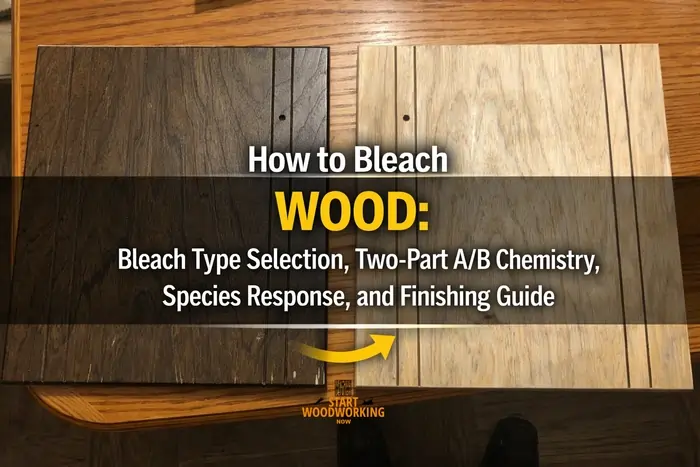
How to Bleach Wood: Bleach Type Selection, Two-Part A/B Chemistry, Species Response, and Finishing Guide
There are four bleach types used on wood, and each one solves a different problem — applying the wrong type produces no result regardless of how many coats are applied. Two-part A/B bleach (sodium hydroxide + hydrogen peroxide) is the only agent that removes the wood’s natural colour by oxidising lignin chromophores — it is the correct choice when the goal is dramatic lightening of the wood itself. Oxalic acid removes iron-tannin stains (rust marks, black rings around nails, grey weathering on teak and oak decks) but does not change the wood’s natural colour. Chlorine bleach (sodium hypochlorite) removes dye-based stains and surface mould but does not bleach raw wood. Hydrogen peroxide at 30% concentration removes blue mould stains on maple and can lighten high-tannin species when activated with ammonia, but does not produce the dramatic lightening that two-part bleach achieves. Each type requires a different neutralisation agent — and the wrong neutralisation on the wrong bleach actively damages the wood surface. All bleaching must be performed on bare, stripped, and sanded wood — no finish, no oil, no wax — or the bleach cannot penetrate to the wood fibres.
This guide covers the bleach type selection by objective, the chemistry of two-part A/B bleach, species response by tannin content, neutralisation protocol per bleach type, and the critical finishing considerations after bleaching — including tannin bleed-through prevention and non-ambering finish requirements.
How Do You Bleach Wood?
→ Related: How to Remove Water Stains from Wood (oxalic acid protocol)→ Related: How to Remove Rust Stains from Wood (iron-tannate chemistry)→ Related: How to Refinish Wood After Stripping→ Hub: How to Remove Wood Finishes — Complete Guide
Which Bleach Type Is Correct for the Objective?
The most consequential decision in wood bleaching is selecting the correct bleach type for the specific problem. All four agents act through oxidation, but they oxidise different substrates at different pH levels — making each one effective for specific stain or colour types and ineffective for others.
Applying oxalic acid when two-part bleach is needed, or chlorine bleach when oxalic acid is needed, produces no useful result regardless of concentration or application count.
Three common bleaching errors from incorrect agent selection: (1) Using oxalic acid to try to lighten the natural colour of walnut or oak — oxalic acid has no mechanism for lignin chromophore oxidation; it will remove any iron staining present but the wood’s natural dark colour is completely unaffected. (2) Using chlorine bleach (Clorox) to bleach furniture to a pale blonde colour — household bleach at 5–6% sodium hypochlorite does not have the pH or oxidising power to alter hardwood lignin. It will lighten pine slightly but will not produce the bleached-wood look. (3) Applying hydrogen peroxide from the pharmacy (3%) expecting bleaching effect — 3% H₂O₂ is too dilute to affect wood. The “B” component of two-part bleach is 30% H₂O₂ — ten times more concentrated.
What Are the Key Specifications for Bleaching Wood?
| Process | Attribute | Value |
|---|---|---|
| Two-part A/B bleach — mechanism | Chemical reaction | Part A (NaOH) raises surface pH to 12–13. Part B (H₂O₂ 30%) decomposes at high pH, releasing reactive oxygen radicals (•OH, •OOH). These radicals oxidise quinone and phenolic chromophore groups in lignin, converting coloured compounds to colourless forms. Cellulose structure largely intact — only lignin colour is destroyed. |
| Two-part A/B — application sequence | Part A then Part B or mixed simultaneously | Two approaches: (1) Apply Part A (NaOH) with synthetic brush, immediately apply Part B (H₂O₂) while Part A still wet — produces immediate foaming reaction. (2) Mix equal parts A and B in non-metal container, apply combined solution immediately — reaction lifespan approximately 20–30 minutes. Never use metal containers — NaOH reacts with many metals. Use glass or chemical-resistant plastic. |
| Two-part A/B — drying and repeat applications | Time between applications | Allow complete drying after each application — 4–8 hours in warm, low-humidity conditions; 12–24 hours in cool or humid conditions. Final colour is not reached until fully dry — wet bleached wood appears darker than the dry result. Repeat up to 3 applications for maximum lightening. Additional applications beyond 3 have diminishing returns and progressively weaken wood fibre structure. |
| Neutralisation — two-part A/B bleach | Agent and method | 50:50 white vinegar and water. Flood the surface generously, allow 5 minutes contact, wipe with clean cloth, rinse with plain water, dry. Vinegar (acetic acid, pH 2.5) neutralises the residual NaOH alkalinity. Do not skip — uncured NaOH residue in grain prevents finish adhesion and continues reacting with subsequent finishes. |
| Neutralisation — oxalic acid | Agent and method | Baking soda (sodium bicarbonate) solution — 2 tablespoons per litre of water. Apply, allow 5 minutes, rinse with clean water. Baking soda (mildly alkaline, pH 8.3) neutralises the residual acid. Oxalic acid residue left in grain forms irritating crystalline dust when sanding — wear dust mask when sanding after oxalic acid treatment regardless of neutralisation. |
| Neutralisation — chlorine bleach | Agent and method | Plain water rinse only. Sodium hypochlorite is neither strongly acid nor strongly alkaline at household concentrations. No chemical neutralisation required. Rinse thoroughly with clean water, allow overnight drying, sand 220 grit to remove raised grain. |
| Neutralisation — hydrogen peroxide 30% | Agent and method | No chemical neutralisation needed. H₂O₂ decomposes spontaneously to water (H₂O) and oxygen (O₂) — the decomposition products are benign and the reaction is self-limiting. Allow surface to dry completely (12–24 hours) before sanding or applying finish. |
| Grain raising after bleaching | Severity and grit to address | Two-part A/B: significant grain raising — all water-based applications raise grain, and NaOH solution particularly aggressive. Sand 180–220 grit after confirmed dry (24–48 hours). Do not sand aggressively on veneer after bleaching — bleached veneer fibres are weakened and sand-through risk is higher than on untreated veneer. Oxalic acid: moderate grain raising — 220 grit after drying. Chlorine/H₂O₂: mild grain raising — 220 grit. |
| Tannin bleed-through after two-part bleaching | Species affected and prevention | Oak, walnut, mahogany, and cherry are high-tannin species. NaOH in Part A activates tannin compounds and drives them toward the surface. When water-based finish is applied over bleached high-tannin wood without barrier coat, tannin migrates into the first finish coat — producing yellow, brown, or greenish discolouration visible under the clear finish within days to weeks. Prevention: apply two thin coats of dewaxed shellac (Zinsser SealCoat, not Bulls Eye) as barrier coat after neutralisation and sanding. Shellac blocks tannin migration and is compatible with water-based topcoats. |
| Finish selection after bleaching | Why non-ambering finish required | Oil-based polyurethane contains alkyd resin that yellows with UV exposure and age — within 6–12 months, oil-based poly makes bleached light wood appear caramel or honey-coloured, reversing the bleaching effect. Water-based polyurethane, pre-catalyzed lacquer, and conversion varnish are non-ambering. Use water-based poly (General Finishes Arm-R-Seal water-based or Minwax Polycrylic) or water-based lacquer for bleached wood. |
| Finish — blotch risk after bleaching | Cause and prevention | Two-part bleach partially disrupts cellulose crystallinity in the surface fibres, creating differential porosity in areas of higher and lower bleach penetration. This makes all species more susceptible to blotchy stain absorption after bleaching. Apply pre-stain conditioner before any penetrating stain on bleached wood. Test stain on a hidden area of the same bleached piece before committing to full application. |
| Oxalic acid — concentration for iron-tannin stains | Mixing ratio | Standard: 30 g oxalic acid crystals per litre of warm water (approximately 3% solution). For heavy staining: 60 g per litre (6% solution). Apply to clean, bare wood. Wet entire surface evenly — applying to isolated spots on unstained surrounding areas causes a lightened halo visible after drying. Let dry completely. If stain not fully resolved: re-apply once more. Rinse and neutralise after last application. |
How Do Different Wood Species Respond to Two-Part A/B Bleach?
Two-part A/B bleach does not produce uniform results across wood species. Tannin content, grain structure, and natural pigment chemistry all affect the degree of lightening achievable and the risks of uneven results. Testing on a hidden area or scrap of the same species before committing to the full surface is not optional — it is the only way to know the result before it is visible on the finished piece.
How Do You Bleach Wood with Two-Part A/B Bleach?
Two-part A/B bleach produces the most dramatic and controllable lightening of wood’s natural colour available to DIY woodworkers. The chemicals are genuinely hazardous — 30% hydrogen peroxide and concentrated sodium hydroxide both cause immediate skin burns — but the protocol is straightforward with the correct safety equipment. Work outdoors or with maximum ventilation.
PREP Strip all finish — confirm bare wood with water drop test
All finish, oil, wax, stain, and sealer must be removed before bleaching. Two-part bleach cannot penetrate through polyurethane, lacquer, or any film finish — it sits on the surface, reacts with the finish rather than the wood, and produces no useful lightening.
Strip using the appropriate method for the finish type (full protocols in the linked removal guides above). After stripping and neutralisation: apply 2–3 drops of water — if absorbed in under 30 seconds, the surface is bare and ready. If water beads, oil or wax residue remains.
SAFETY Neoprene gloves, goggles, and waterproof apron — minimum
Both Part A (NaOH) and Part B (30% H₂O₂) cause rapid skin and mucous membrane burns. Neoprene rubber gloves — not latex — with cuffs turned up to catch drips. Chemical splash goggles, not standard safety glasses. Waterproof apron. Work outdoors or next to an open window with cross-ventilation. Have a running water source immediately accessible for skin contact. Do not use metal containers for mixing — NaOH reacts with aluminium and zinc producing hydrogen gas; use glass, ceramic, or chemical-resistant plastic.
STEP 1 Apply Part A (NaOH) — even coat with synthetic brush
Apply sodium hydroxide solution (Part A) evenly across the entire surface using a synthetic-bristle brush (natural bristle brushes are damaged by NaOH). Work systematically across the grain in overlapping passes. Do not leave puddles or dry edges — the wood darkens immediately and uniformly on contact with NaOH as tannin compounds are activated. Work quickly on large surfaces to keep the Part A wet edge active before applying Part B.
STEP 2 Apply Part B (H₂O₂) immediately — while Part A is wet
Apply hydrogen peroxide (Part B) immediately over the NaOH-wet surface using a second synthetic brush or a second application with the same brush (wipe clean between uses). The surface will foam as the two components react — this is the visible indication that the bleaching reaction is underway. Work over the entire surface systematically. The foaming and immediate surface lightening confirms the reaction is active. Allow to dry completely without disturbing.
DRY Allow full drying — 4–24 hours before assessing colour
The wet bleached surface is significantly darker than the dry result. Do not assess the achieved colour until the surface is fully dry. In warm, low-humidity workshop conditions: 4–8 hours. In cool or humid conditions: 12–24 hours. For a second application: the surface must be completely dry before reapplication. Apply up to 3 coats total, with full drying between each, for maximum lightening. Beyond 3 applications, results diminish and wood fibre weakening increases.
NEUTRALISE 50:50 vinegar/water — flood surface, 5 minutes, rinse
Mix equal parts white distilled vinegar and water. After the final bleach application has dried, flood the surface generously with the vinegar solution and work it in with a sponge or cloth. Allow 5 minutes contact, then rinse with clean water and wipe dry. The vinegar neutralises residual NaOH alkalinity. This step is mandatory — NaOH residue in the grain prevents finish adhesion and continues chemically reacting with any subsequent stain or finish applied over it.
SAND 180–220 grit after 24–48 hours drying
After 24–48 hours of drying post-neutralisation, sand with 180–220 grit in grain direction. Bleaching raises the grain significantly — the combination of water and alkali swells wood fibres and leaves the surface rough. Sand until uniformly smooth. On veneer: hand sand only at 220 grit — bleached veneer fibres are weakened and sand-through is easier than on untreated veneer. Vacuum and tack cloth after sanding.
📝 The most instructive two-part bleaching project in my workshop was a matched set of red oak dining chairs where three chairs had been refinished years earlier with a darker stain than the original, making the set visually inconsistent. Rather than restaining all five to the darker tone, I bleached the three darker chairs with two applications of Zinsser two-part bleach — applying Part A, then Part B immediately while Part A was still wet. The foaming reaction on the oak surface was visible within seconds. After the first application dried overnight, the chairs had reached approximately 70% of the target lightness. A second application the following day brought them to within one tone of the original chairs. Critically, I encountered tannin bleed-through on the first test chair where I applied water-based polyurethane directly over the bleached and sanded surface — a yellow-green haze appeared under the finish within three days. Two coats of Zinsser SealCoat on the remaining chairs before the water-based poly prevented this completely.
How Do You Remove Iron-Tannin Stains Using Oxalic Acid?
Oxalic acid is the correct and only effective agent for black iron-tannin stains around nails, screws, and metal hardware on high-tannin species — the same chemistry covered in detail in the rust stain removal guide and the water stain removal guide.
The protocol requires 60 g of oxalic acid crystals per litre of water — use the calculator below to get the exact dose for your container size, plus the correct amount of baking soda for neutralisation after treatment.
Oxalic Acid Concentration Calculator
Exact doses for wood stain removal — acid, neutraliser, and contact times
The iron ions from corroding metal react with tannin in the wood to form ferrous tannate — a dark, intensely coloured compound insoluble in water. Oxalic acid forms a soluble complex with the iron ions, allowing them to be rinsed away. The stain disappears because the iron is chemically extracted, not bleached.
Protocol: mix 30–60 g oxalic acid crystals per litre of warm water. Apply the solution to the stained area with a brush — wet the entire board evenly to avoid lightened halos around treated areas. Allow to dry completely.
If the stain is not fully resolved, re-apply once more. After the final application is dry: apply baking soda solution (2 tablespoons per litre of water), allow 5 minutes, rinse with clean water. Dry 24 hours. Sand 220 grit. Water drop test before any finish application.
How Do You Finish Wood After Bleaching?
The finishing stage after bleaching has three specific constraints that do not apply to finishing unbleached wood — and getting any of these wrong either reverses the bleaching effect visually or causes finish adhesion failure. These constraints are completely absent from most bleaching guides.
Non-ambering finish is mandatory on bleached wood
Oil-based polyurethane contains alkyd resin that yellows progressively under UV exposure and with age. On bleached wood — especially pale blonde or near-white bleached oak or walnut — oil-based poly reverses the bleaching visually within 6–12 months, producing a caramel or honey-yellow cast that was precisely what bleaching was meant to eliminate.
Water-based polyurethane, pre-catalyzed lacquer, and conversion varnish do not amber. For bleached furniture, use water-based polyurethane (General Finishes High Performance, Minwax Polycrylic, Varathane Crystal Clear water-based) or water-based lacquer.
Dewaxed shellac barrier coat on high-tannin species
Oak, walnut, mahogany, and cherry contain tannin compounds that are activated and mobilised by the NaOH in two-part bleach. When water-based finish is applied directly over bleached high-tannin wood — even after neutralisation — the activated tannin migrates into the first finish coat and produces yellow, greenish, or brownish discolouration visible under the clear film within days.
Apply two thin coats of Zinsser SealCoat (dewaxed shellac — not Bulls Eye which contains wax) after sanding and before the water-based topcoat. The shellac barrier seals the tannin and is fully compatible with water-based finishes applied over it. Low-tannin species (birch, beech, ash) typically do not require this barrier coat.
Pre-stain conditioner on all bleached species before staining
If a stain is to be applied over the bleached surface — to achieve a specific colour tone while maintaining the lightened base — apply a pre-stain wood conditioner before the stain. Two-part bleach partially disrupts the cellulose crystallinity in surface fibres, creating differential porosity that makes all species more prone to blotchy stain absorption than they would be unbleached.
Apply conditioner per product instructions, allow the specified open window (typically 15–30 minutes), then apply stain. Test on a hidden area of the same bleached piece before full application — the bleached wood's stain response will differ from its pre-bleaching behaviour.
📝 The oil-based finish mistake on bleached wood is one I now warn every client about explicitly. A bleached walnut coffee table commissioned by a client was finished by a previous craftsman with oil-based satin polyurethane — an understandable default choice since oil-based poly is typically the most durable option. Within eight months, the table had developed a warm honey-amber cast that the client found unacceptable — the entire bleached effect had been visually reversed by the finish yellowing. Re-stripping and refinishing with General Finishes High Performance water-based topcoat, preceded by SealCoat on the walnut, maintained the pale blonde tone through a year of follow-up with the client.
Frequently Asked Questions About Bleaching Wood
Does household bleach (Clorox) lighten wood?
Household bleach (sodium hypochlorite at 5–6%) lightens softwood species such as pine slightly and is effective at removing surface mould and some dye-based stains. It does not alter the natural colour of hardwood species — oak, walnut, cherry, and maple show minimal colour change after multiple applications of household bleach. For dramatic lightening of hardwood, only two-part A/B bleach (sodium hydroxide + 30% hydrogen peroxide) is effective. The two products work through fundamentally different mechanisms: household bleach oxidises surface stains and mould at neutral pH; two-part bleach generates reactive oxygen at very high pH that directly oxidises lignin chromophores.
How many coats of two-part bleach does it take to bleach oak white?
Red oak typically reaches near-white (bone colour) in one to two applications of two-part bleach. White oak, which has different tannin chemistry, achieves dramatic lightening in one to two applications with the characteristic Scandinavian pale tone.
Each application must dry completely (4–8 hours in good conditions) before the next is applied — wet bleached wood appears much darker than the dry result, so allow full drying before assessing whether another coat is needed. Three applications is the practical maximum before diminishing returns and fibre weakening become concerns. Allow 24 hours after the final application before neutralisation.
Do you have to neutralise wood after bleaching?
It depends on the bleach type. Two-part A/B bleach: yes, neutralisation with diluted vinegar (50:50 water/vinegar) is mandatory — residual NaOH alkalinity prevents finish adhesion and continues reacting chemically. Oxalic acid: yes, neutralise with baking soda solution to prevent crystalline acid residue in grain that creates irritating dust when sanding.
Chlorine bleach: no chemical neutralisation needed — water rinse sufficient. Hydrogen peroxide 30%: no neutralisation needed — decomposes spontaneously to water and oxygen.
Can you bleach stained or finished wood without stripping?
No. Two-part bleach, oxalic acid, and all bleaching agents must contact bare wood fibres to be effective. Any finish — polyurethane, lacquer, oil, wax, or stain sealant — creates a barrier that prevents bleach penetration.
Applying bleach over a finished surface produces only surface reaction with the finish itself (possible damage or cloudiness) with no lightening of the wood beneath. The wood must be stripped to bare grain, stripper residue neutralised, and the surface confirmed open with the water drop absorption test before bleaching begins.
Summary: Key Values for Bleaching Wood
The correct bleach type is determined by the objective: two-part A/B bleach for dramatic natural colour lightening (the only agent that oxidises lignin chromophores); oxalic acid for iron-tannin stains and grey weathering (forms soluble iron-oxalate complex — does not change natural wood colour); chlorine bleach for mould, mildew, and dye stains; 30% hydrogen peroxide for blue-mould on maple or moderate lightening of high-tannin species. All bleaching requires bare, stripped, oil-free wood confirmed by water drop absorption test.
Two-part A/B: apply Part A (NaOH), apply Part B (H₂O₂) immediately while Part A wet, allow 4–24 hours drying, up to 3 applications, neutralise with 50:50 vinegar/water, sand 180–220 grit after 24–48 hours. Oxalic acid: 30–60 g per litre, apply evenly, dry, neutralise with baking soda solution, sand 220 grit.
Neutralisation by type: A/B = vinegar; oxalic = baking soda; chlorine = water only; H₂O₂ = nothing needed. Post-bleaching: non-ambering finish mandatory (water-based poly or lacquer); dewaxed shellac barrier coat on high-tannin species (oak, walnut, mahogany, cherry) before water-based finish to prevent tannin bleed-through; pre-stain conditioner before any stain on bleached surface.
→ Related: How to Remove Rust Stains from Wood (oxalic acid chemistry)→ Related: How to Remove Water Stains from Wood→ Related: How to Refinish Wood After Stripping→ Hub: How to Remove Wood Finishes — Complete Guide
→ Related: How to Prepare Wood for Staining


Comments are closed.