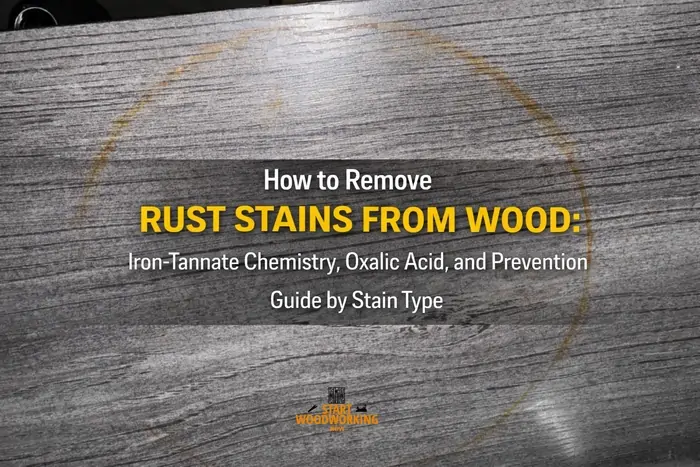
How to Remove Rust Stains from Wood: Iron-Tannate Chemistry, Oxalic Acid, and Prevention Guide by Stain Type
Rust stains on wood are caused by three distinct mechanisms that each require a different treatment approach. Iron-tannate stains — the most common type — occur when iron ions from metal hardware, tools, or fasteners react with tannin compounds in the wood in the presence of moisture, producing a dark grey-black discolouration that is chemically bonded to the wood fibres. These stains are invisible to scrubbing because the dark compound is not a surface deposit — it is a chemical reaction product inside the wood structure. Oxalic acid at 60 g per litre is the correct treatment: it converts the dark iron-tannate compound to colourless iron oxalate through a reduction reaction. Iron oxide deposits — red, orange, or rust-brown surface colouration from direct rust transfer — are partially mechanical and partially chemical; they respond to oxalic acid and light abrasion. Active corroding fasteners embedded in wood produce ongoing staining that returns within weeks of any treatment unless the source iron is removed or treated with a rust converter. Vinegar, baking soda, lemon juice, and potato do not contain chemistry capable of reversing the iron-tannate bond.
This guide covers the identification test for each rust stain type on wood, the role of wood tannin content in stain severity, the complete oxalic acid protocol with correct neutralisation, and the source treatment required to prevent recurrence.
→ Same iron-tannate chemistry: How to Remove Dark Water Stains from Wood→ Same oxalic acid protocol: How to Remove Ash Stains from Wood→ Hub: How to Remove Stains from Wood — Complete Guide
How Do You Remove Rust Stains from Wood?
What Type of Rust Stain Is on the Wood?
The stain type determines the treatment. Visual identification distinguishes the three types in under one minute.
Colour: Dark grey, blue-grey, grey-black, or blue-black — not brown or orange. The darker the wood’s natural tannin content, the more intense the stain colour.
Location: Around metal hardware (hinges, screws, nails, bolts), under wet cast iron or steel cookware, under metal furniture legs, where steel tools sat wet.
Scrub test: Does NOT transfer to a damp cloth when scrubbed firmly — the compound is chemically bonded inside the wood fibres, not sitting on the surface.
Affected species: Most intense on high-tannin species: oak, walnut, chestnut, cherry, mahogany, rosewood. Mild to absent on low-tannin species: maple, pine, beech.
15–20 min on bare wood
+ neutralise after
Colour: Red, orange, rust-brown, or reddish-brown — the colour of rust itself. May have a powdery or gritty texture on the surface.
Location: Under rusted metal garden furniture, plant pots on decking, corroded metal railings against wood, timber stained by rust-laden water runoff.
Scrub test: Partially transfers to damp cloth on the first wipe (the surface rust particles); a darker stain typically remains after surface rust is removed — this residual is iron-tannate.
Mechanism: Physical rust deposit on surface + partial iron-tannate reaction below.
then oxalic acid 60 g/litre
for residual tannate
Colour: Dark halo or ring around a nail or screw head; may extend in the grain direction as rust-laden moisture travels along the grain; colour range grey-black to black.
Location: Around every nail or screw in outdoor decking, fencing, or any wood exposed to moisture where non-galvanised steel fasteners were used.
Scrub test: Does not transfer; staining extends in grain direction indicating active moisture transport of iron ions.
Critical distinction: Oxalic acid removes the existing stain but the iron source continues producing new staining. Treatment without source removal = staining returns within weeks.
OR rust converter + seal
THEN oxalic acid
Why Does Wood Species Determine Rust Stain Severity?
The iron-tannate reaction requires two components: iron ions (from corroding metal in the presence of water) and tannin compounds (polyphenols naturally present in wood). The reaction produces ferrous tannate — a dark, intensely coloured coordination compound that is insoluble in water and most solvents. The stain is not rust on the wood — it is a new chemical compound formed in the wood structure.
The tannin content of the wood species determines how intense the stain becomes from the same iron source. High-tannin species produce dramatically darker and more extensive stains than low-tannin species from identical iron contact. This is why a wet cast iron pan left on an oak butcher block for 5 minutes produces an intense black ring, while the same pan on a maple surface for the same time produces almost no visible staining.
What Are the Key Specifications for Removing Rust Stains from Wood?
| Method | Attribute | Value |
|---|---|---|
| Oxalic acid (iron-tannate on bare wood) | Concentration | 60 g per litre warm water (40–50°C accelerates dissolution of crystals) |
| Oxalic acid | Contact time — first application | 15–20 minutes; keep surface visibly wet throughout; re-apply if evaporation occurs |
| Oxalic acid — second application | When required | Allow 24 hours drying after first application before second — more effective than extending first contact time beyond 20 minutes |
| Oxalic acid on sealed finish | Effectiveness | Minimal — must strip local finish to bare wood before applying; acid does not penetrate polyurethane, lacquer, or varnish |
| Oxalic acid neutralisation | Agent and concentration | Baking soda (sodium bicarbonate): 1 tablespoon per 500 ml water; apply after treatment, allow 5 minutes, rinse with clean water |
| Neutralisation — why mandatory | Consequence of skipping | Residual oxalic acid continues reacting with wood; may cause lightening of surrounding untreated wood; prevents even finish adhesion |
| Bar Keepers Friend vs. oxalic acid crystals | Comparison | Bar Keepers Friend contains oxalic acid at variable concentration plus abrasive fillers. Oxalic acid crystals dissolved at 60g/litre produce higher, consistent concentration. Crystals preferred for deep stains; BKF convenient for light surface staining on butcher block or bare wood. |
| Oxalic acid safety | Personal protection | Nitrile gloves and safety goggles; oxalic acid irritates skin and eyes on contact |
| Drying time before refinishing | After neutralisation and rinse | 24 hours minimum — water from rinse raises wood grain; sanding damp wood creates uneven surface |
| Sanding after treatment | Starting grit | 120 grit to level grain; 180 grit finish pass before stain or finish |
| Over-bleaching prevention | Risk on high-tannin species | Oxalic acid removes iron-tannate but can lighten the natural wood colour if applied too broadly or at extended contact. Apply only to the stained area with a 1–2 cm margin. Feather edges. |
| Active fastener treatment | Options | Replace non-galvanised fastener with stainless steel or hot-dip galvanised. Or: countersink existing fastener, apply rust converter (phosphoric acid gel), fill with wood filler, re-stain. |
| Staining recurrence timeline | Untreated active fastener | New iron-tannate staining typically visible within 2–6 weeks of treatment if corroding fastener remains in place |
Why Do Vinegar, Lemon Juice, and Baking Soda Fail on Rust Stains in Wood?
Iron-tannate is a coordination compound — a stable chemical bond between iron ions and tannin phenolics. Reversing this bond requires a reducing agent that can strip oxygen from the iron-tannate compound, converting it from the dark ferrous tannate to the colourless ferric oxalate. Oxalic acid performs this reduction. No other common household substance has this reducing chemistry at practical concentrations.
White vinegar (acetic acid, pH 2.5) is a mild acid but not a reducing agent. It can dissolve some surface mineral deposits and has mild cleaning properties, but it cannot break the iron-tannate coordination bond. The same applies to citric acid (lemon juice) — mildly acidic, not reducing, no mechanism for iron-tannate reversal.
Baking soda (sodium bicarbonate, pH 8.3) is an alkaline abrasive. It has no reducing chemistry and its mild alkalinity can actually intensify tannin oxidation on high-tannin species — the same mechanism as ash and ammonia staining. Applying baking soda paste to an iron-tannate stain on oak risks darkening the surrounding tannin and expanding the affected area.
Hydrogen peroxide at 3% has limited effectiveness on iron-tannate — it is an oxidising bleach (bleaches by oxidation) while iron-tannate requires reduction. At higher concentrations (6–12%), hydrogen peroxide can bleach iron-tannate partially by general oxidative bleaching, but oxalic acid is more selective and produces better colour matching to the surrounding wood.
How Do You Remove Iron-Tannate Rust Stains from Wood Using Oxalic Acid?
Iron-tannate stains on indoor furniture and finished wood require the local finish to be stripped before oxalic acid treatment — the acid cannot penetrate a sealed polyurethane, lacquer, or varnish film. On unfinished bare wood, countertops, outdoor decking, and sanded wood, apply oxalic acid directly.
STEP 1 Strip local finish before treatment if wood is sealed
On polyurethane or lacquer-finished furniture, strip the finish from the stained area and a 3–4 cm margin using the appropriate method — denatured alcohol for shellac, lacquer thinner for lacquer, or gel stripper for polyurethane.
The stripped area must be completely bare wood before oxalic acid is applied. Stripping 3–4 cm beyond the visible stain ensures the acid can treat any iron migration that has spread beyond the visible discolouration boundary.
STEP 2 Dissolve oxalic acid crystals at 60 g per litre warm water
Add 60 g (approximately 4 tablespoons) of oxalic acid crystals to 1 litre of warm water at 40–50°C — warm water accelerates crystal dissolution. Stir until fully dissolved. The solution is clear and colourless.
Wear nitrile gloves and safety goggles from this point — oxalic acid solution causes skin and eye irritation on contact. Prepare solution immediately before use — do not store mixed solution.
STEP 3 Apply oxalic acid to bare wood — keep wet for 15–20 minutes
Apply the oxalic acid solution with a brush or white cotton cloth to the stained area, extending 1–2 cm beyond the visible stain boundary. The surface must remain visibly wet throughout the contact period — re-apply solution if the surface begins to dry.
The dark iron-tannate discolouration will progressively lighten during contact — the reaction is visible. Most fresh iron-tannate stains on moderate-tannin species (cherry, mahogany) resolve in a single 15–20 minute application. Deep stains on high-tannin species (oak, walnut) and old stains may require a second application after 24 hours drying.
STEP 4 Neutralise with baking soda solution — then rinse
After 15–20 minutes contact, apply baking soda solution (1 tablespoon per 500 ml water) to the treated area and allow 5 minutes. This neutralises the residual oxalic acid in the wood fibres. Wipe clean with a damp cloth and rinse with clean water.
Do not skip the neutralisation step — residual oxalic acid in the wood continues the reduction reaction and can over-bleach the surrounding wood, creating a lighter halo around the treated area that is harder to match than the original stain.
STEP 5 Inspect after 24 hours — second application if needed
Allow the treated wood to dry completely for 24 hours before assessing the result — the wood colour in its wet state during treatment does not accurately reflect the dry result. Deep iron-tannate stains on oak and walnut often appear incompletely resolved while wet but show significantly better resolution at 24 hours.
If staining is still visible after full drying, a second application of oxalic acid at 60 g per litre for 15–20 minutes is more effective than a first application of longer duration. Allow 24 hours after the second application before final sanding.
STEP 6 Sand 120–180 grit — match stain if needed — refinish
After 24 hours drying (minimum) following the final neutralisation and rinse, the wood grain will be slightly raised from the water contact. Sand with 120 grit in the grain direction to level the raised grain, then 180 grit for finish preparation.
On high-tannin species where the treated area is lighter than the surrounding wood, apply a matching wood stain to the treated area and blend into the surrounding finish with a feathered edge before re-applying the topcoat finish.
How Do You Treat Rust Stains from Active Corroding Fasteners?
Rust stains from corroding nails, screws, or bolts in wood are a source-removal problem, not just a stain removal problem. Oxalic acid removes the existing iron-tannate stain but cannot prevent new staining from the ongoing corrosion of the same fastener. Any treatment applied without addressing the iron source will show new staining within 2–6 weeks as the fastener continues corroding and releasing iron ions into the wood grain.
The correct sequence for active fastener rust staining is: source treatment first, then stain removal.
Option 1 — Replace fastener (preferred for outdoor decking and fencing): Remove the corroding non-galvanised fastener. Replace with hot-dip galvanised, stainless steel 316, or ceramic-coated fastener of the same size. Apply oxalic acid treatment to the stained wood around the old fastener location after replacement.
Option 2 — Treat fastener in place (when removal would damage wood): Countersink the corroding nail or screw head by 3–4 mm. Apply a phosphoric acid-based rust converter (Hammerite Kurust, Jenolite, or equivalent) into the countersink cavity and allow to cure — rust converter converts active iron oxide to stable iron phosphate, stopping the corrosion reaction. Fill the cavity with exterior wood filler, sand flush, apply oxalic acid to surrounding wood staining, and refinish. The rust converter treatment is permanent if the wood is sealed from subsequent moisture — outdoor timber requires re-sealing every 1–2 years to maintain protection.
📝 The most instructive iron-tannate scenario in my workshop was an early Victorian oak writing table with intense black staining around all six brass escutcheon plates — the original mild steel screws beneath the brass had been corroding for over a century, producing iron ions that had reacted with the oak’s high tannin content to create deeply saturated grey-black halos extending 8–10 mm into the grain. Two oxalic acid applications at 60g/litre were needed before the staining resolved adequately. The second application after 24 hours was noticeably more effective than the first — confirming that the conversion product dissipation between applications allows better acid penetration to deeper unreacted material.
How Does the Wood Surface Type Affect Rust Stain Removal?
| Surface Type | Finish Strip Required | Oxalic Acid Protocol | Key Constraint |
|---|---|---|---|
| Polyurethane-finished furniture | Yes — strip local finish before treating; re-apply polyurethane after treatment and drying | 60 g/litre, 15–20 min on bare wood; neutralise; 24h dry; sand 120–180; stain match if needed; 2–3 coats polyurethane to match sheen | Oxalic acid cannot reach stain through sealed polyurethane — skipping strip step wastes acid and produces zero result |
| Oil-finished furniture or countertop | Oil finish is semi-porous — apply oxalic acid directly; re-oil after treatment | 60 g/litre, 15–20 min; neutralise; 24h dry; sand 120; re-apply matching oil | Re-oil after treatment — oxalic acid and water contact depletes surface oil layer |
| Bare / unfinished wood (workshop, butcher block) | No strip required | 60 g/litre directly on wood; 15–20 min; neutralise; 24h dry; sand; finish as desired | Most effective scenario — no barrier between acid and stain. Watch for over-bleaching at margins on high-tannin species. |
| Wax-finished furniture | Remove wax with mineral spirits before applying oxalic acid; re-wax after | 60 g/litre after wax removal; neutralise; 24h dry; sand 180; re-apply paste wax | Wax repels water-based acid solution — wax removal before treatment is mandatory |
| Outdoor decking (sealed) | Strip deck sealer if present; apply oxalic acid as deck brightener solution | 60 g/litre applied with deck brush; 15–20 min; rinse with garden hose; neutralise; 24h dry; re-stain and seal | Treat corroding nail/screw source simultaneously — replace with galvanised or stainless fasteners |
| Hardwood floor (sealed) | Sand local finish off with 80-grit orbital in small area; sand back after treatment | 60 g/litre with brush; neutralise; 24h dry; blend with surrounding floor using matching stain; 2–3 coats floor polyurethane | Colour matching is critical on floors — staining and sheen variation is visible across the room. Consider professional floor refinishing for large rust stain areas. |
📝 The clearest example of rust stain recurrence without source treatment was a pine workshop bench with non-galvanised wire nails that I treated with Bar Keepers Friend twice in one season before identifying the root cause. Each treatment resolved the staining for approximately 3–4 weeks before identical black rings reappeared around every nail head. After countersinking all nails, applying Jenolite rust converter, filling with wood filler, and resealing the bench surface, there was no recurrence over the following two winter seasons — confirming that source treatment, not repeated surface bleaching, is the correct permanent solution.
Frequently Asked Questions About Removing Rust Stains from Wood
Why does vinegar not remove rust stains from wood?
Rust stains in wood — specifically iron-tannate stains — are caused by a chemical reaction between iron ions and tannin compounds in the wood that produces a stable, dark coordination compound bonded to the wood fibres. Reversing this requires a reducing agent. Vinegar (acetic acid) is a mild acid but not a reducing agent — it has no chemical mechanism to break the iron-tannate coordination bond.
Oxalic acid performs this specific reduction: it converts dark ferrous tannate to colourless iron oxalate through electron transfer. No other common household acid (citric acid, acetic acid, phosphoric acid) performs this specific reduction on iron-tannate at practical concentrations.
What is the difference between iron-tannate staining and water staining on wood?
Dark water stains on wood and iron-tannate rust stains are caused by the same chemical mechanism — both produce dark iron-tannate compounds in tannin-rich wood species when iron ions and water contact the wood. The source of the iron differs: dark water stains are caused by iron ions naturally present in tap water or rainwater reacting with wood tannins.
Iron-tannate rust stains are caused by iron from corroding metal objects. Both are treated identically with oxalic acid at 60 g per litre — the same protocol resolves both stain types because the chemical compound being reversed is identical in both cases.
How long does oxalic acid take to remove rust stains from wood?
Fresh iron-tannate stains on moderate-tannin wood species (cherry, mahogany) typically resolve in a single 15–20 minute oxalic acid application. Deep or old stains on high-tannin species (oak, walnut) may require two applications with 24 hours drying between them.
Visible lightening of the stain begins within 5–10 minutes of application — if no lightening is visible after 10 minutes, either the wood surface is sealed (strip finish first) or the stain is not iron-tannate. Always allow 24 hours drying after the final application before assessing the complete result — the wood colour at treatment and at drying differ.
Why do rust stains from nails keep coming back after oxalic acid treatment?
Oxalic acid removes the existing iron-tannate stain but cannot stop a corroding fastener from releasing new iron ions into the wood. Non-galvanised steel nails and screws in outdoor or damp environments continue corroding and staining the surrounding wood within 2–6 weeks of any surface treatment. The stain recurs because the source was not addressed.
Lasting resolution requires either replacing the corroding fastener with galvanised or stainless steel, or treating the existing fastener in place with phosphoric acid rust converter to stop the corrosion reaction, before applying oxalic acid to the stained wood.
Summary: Key Values for Removing Rust Stains from Wood
Rust stains on wood occur in three types requiring different approaches: iron-tannate (grey-black, chemically bonded in wood fibres — oxalic acid 60 g/litre for 15–20 minutes on bare wood), iron oxide deposit (red-brown surface transfer — brush then oxalic acid), and active fastener staining (ongoing — treat source first).
Strip any sealed finish before applying oxalic acid — the acid does not penetrate polyurethane, lacquer, or varnish. Apply at 60 g per litre for 15–20 minutes keeping the surface wet, neutralise with baking soda solution, rinse, and allow 24 hours drying.
A second application after 24 hours is more effective than one extended contact time for deep stains. Vinegar, lemon juice, and baking soda have no reducing chemistry for iron-tannate reversal. For fastener staining, replace non-galvanised hardware with galvanised or stainless steel, or apply rust converter to the existing fastener before treating the wood — without source treatment, staining recurs within weeks.
→ Same iron-tannate chemistry: How to Remove Dark Water Stains from Wood→ Same oxalic acid protocol: How to Remove Ash Stains from Wood→ Same oxalic acid protocol: How to Remove Ammonia Stains from Wood→ Hub: How to Remove Stains from Wood — Complete Guide→ Hub: How to Remove Wood Finishes and Stains