How to Remove Nail Polish from Wood: Solvent Guide by Finish Type
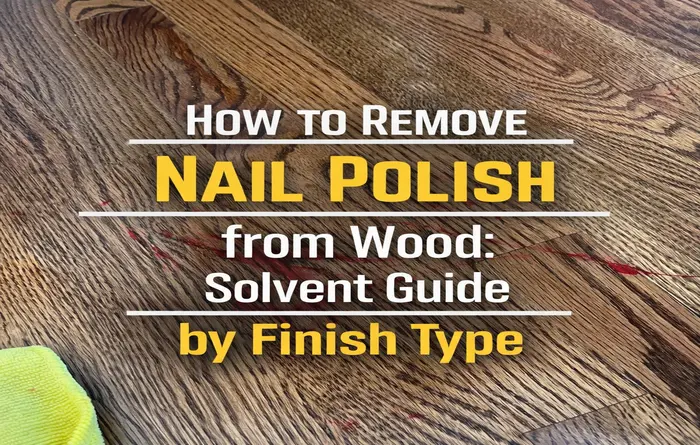
Nail polish is a film-forming coating composed of nitrocellulose or acrylic polymer dissolved in a solvent carrier — typically ethyl acetate and butyl acetate. When spilled on wood, the solvent carrier evaporates within 2–5 minutes and leaves the polymer film bonded to the wood surface or finish. Removing nail polish from wood requires dissolving this polymer film with a compatible solvent: rubbing alcohol (isopropyl alcohol at 70–99%) is the correct first-choice solvent for most sealed wood finishes; acetone dissolves nail polish faster but also dissolves lacquer, shellac, and many varnishes, making it safe only on polyurethane finishes and bare wood. Fresh nail polish — not yet fully dried — is removed by blotting and rubbing alcohol. Dried, cured nail polish requires plastic scraping first to remove the bulk film, followed by solvent treatment for residue.
This guide covers the correct solvent for each finish type, exact contact times, the scraping technique for dried polish, and the conditions under which each approach fully removes the stain without damaging the underlying finish.
How Do You Remove Nail Polish from Wood?
→ For a complete overview of all wood stain and finish removal: How to Remove Wood Finishes and Stains
Which Solvent Removes Nail Polish from Wood Without Damaging the Finish?
The choice of solvent is the critical decision in nail polish removal from wood. Acetone is the fastest and most complete nail polish solvent — but it also dissolves the finish on most wood surfaces.
Rubbing alcohol dissolves nail polish more slowly but is safe on polyurethane and lacquer finishes at short contact times. The cards below summarise each solvent’s effectiveness and finish compatibility.
Rubbing Alcohol (Isopropyl 70–99%)
Acetone-Free Nail Polish Remover
Acetone (Standard Nail Polish Remover)
📝In my restoration work, shellac-finished antique furniture is the most problematic surface for nail polish removal — clients often reach for nail polish remover as their first instinct, which strips the shellac finish along with the polish and creates a repair job significantly larger than the original stain. My standard approach on any piece I cannot immediately identify is the denatured alcohol test in an inconspicuous spot before touching the stain. If the finish dissolves in 30 seconds, I know it is shellac and switch immediately to mineral spirits after mechanical scraping.
How Do You Remove Fresh Nail Polish from Wood Before It Dries?
Fresh nail polish — spilled within the last 2–5 minutes before the solvent carrier has fully evaporated — is significantly easier to remove than dried polish. The polymer film has not yet fully cross-linked and can be blotted and dissolved without leaving a permanent residue. Acting within this window prevents the need for scraping and reduces solvent contact time on the finish.
STEP 1 – Blot immediately — do not rub or spread
Press a clean dry cloth or folded paper towel onto the nail polish spill using straight downward pressure. Do not wipe sideways — wiping spreads the liquid nail polish across a larger area of the finish and increases the surface that requires solvent treatment. Lift the cloth straight up after each blot and move to a clean section. Remove as much liquid polish as possible before it begins to dry.
STEP 2 – Apply rubbing alcohol with a cotton pad — blot, do not rub
Saturate a cotton pad or folded cotton cloth with rubbing alcohol (90–99% isopropyl preferred). Press it onto the remaining nail polish and hold for 60 seconds. Lift and check for polish transfer onto the cotton.
If polish is transferring, move to a clean section of cotton and repeat. If the finish is lacquer or shellac, reduce contact time to 30 seconds per application and use 70% isopropyl to reduce dissolving action on the finish.
STEP 3 – Work from the edge inward
Always work from the outer edge of the nail polish stain toward the centre. Working outward from the centre pushes dissolved polish into clean finish areas and creates a larger stained zone. Use a fresh section of cotton for each pass. The stain is fully removed when no colour transfers onto a clean white cotton pad pressed firmly onto the treated area.
STEP 4 – Wipe clean and restore finish
After the polish is removed, wipe the treated area with a clean damp cloth to remove alcohol residue, then dry immediately. On wax finishes, apply a thin coat of paste wax to the treated area and buff — alcohol removes the wax layer along with the nail polish. On polyurethane and lacquer, brief alcohol contact at these concentrations does not require finish restoration in most cases.
How Do You Remove Dried Nail Polish from Wood After It Has Cured?
Dried nail polish forms a hard, brittle polymer film bonded to the wood finish surface. Attempting to dissolve it with solvent alone without first removing the bulk of the film wastes solvent and extends finish contact time unnecessarily. The correct approach for dried polish is mechanical removal of the bulk film first, followed by solvent treatment for the thin residual layer.
STEP 1 – Soften the dried polish with a warm damp cloth
Lay a clean cloth dampened with warm water (50–60°C) over the dried nail polish and press flat. Leave in place for 60–90 seconds. The warm moisture softens the polymer film and makes it brittle enough to lift cleanly from the finish surface without excessive force. Do not use boiling water — thermal shock can crack aged lacquer or varnish finishes.
STEP 2 – Scrape the bulk film with a plastic scraper
Hold a plastic scraper at a very low angle — 10–15 degrees — to the surface and slide it under the edge of the softened polish film. The goal is to lift the film, not cut into it. Apply only light forward pressure — the softened film should come away in flakes or sheets without requiring significant force.
Do not use a metal scraper, knife, or fingernail — these scratch the finish. If the polish does not lift cleanly, re-apply the warm damp cloth for another 60 seconds before scraping again.
STEP 3 – Dissolve the remaining residue with rubbing alcohol
After the bulk film is removed by scraping, a thin stained residue remains in the finish surface micro-texture. Apply rubbing alcohol with a cotton pad — 90–99% isopropyl on polyurethane, 70% on lacquer and varnish with maximum 30–60 seconds contact — and blot in the grain direction.
The residue should dissolve within 1–2 applications. On shellac finishes, use mineral spirits on a cotton cloth instead of any alcohol-based solvent.
STEP 4 – Use #0000 steel wool for stubborn residue on polyurethane
If a faint coloured residue remains in the finish surface after two solvent applications on a polyurethane finish, apply a small amount of paste wax to the area and rub gently with #0000 ultra-fine steel wool in the grain direction.
This combination removes the surface residue by micro-abrasion while the wax lubricates to prevent scratching. Follow with a full wax coat buffed across the entire panel to ensure uniform sheen. Do not use steel wool on lacquer or shellac finishes — it scratches these softer films visibly.
How Does the Wood Surface Type Affect Nail Polish Removal?
| Surface Type | Polish Behaviour | Recommended Approach | Risk Level |
|---|---|---|---|
| Polyurethane (modern furniture, floors) | Polish bonds to finish surface — does not penetrate | Rubbing alcohol 90% — 1–3 min contact; scrape first if dried | Low — polyurethane resists brief solvent contact |
| Lacquer (cabinets, Asian furniture) | Polish partially dissolves into lacquer film | Rubbing alcohol 70% — 30 sec max contact; blot only | Medium — lacquer dissolves in extended alcohol contact |
| Shellac (antique furniture) | Polish bonds to shellac surface | Plastic scrape + mineral spirits for residue; NO alcohol | High — denatured alcohol dissolves shellac instantly |
| Wax finish | Polish sits on wax layer | Plastic scrape + mineral spirits; re-wax after | Low for wood — wax layer removed but easily replaced |
| Oil finish | Polish bonds to surface oil layer | Rubbing alcohol 70% — 2 min contact; re-oil after | Low — surface oil layer replaced easily after treatment |
| Bare unfinished wood | Pigment partially absorbs into grain — depth depends on porosity and time | Acetone or rubbing alcohol; 80-grit sand if pigment in grain | Low for finish — no finish to damage; pigment may require sanding |
| Hardwood floor (polyurethane sealed) | Same as polyurethane furniture | Rubbing alcohol 90% with cotton cloth; work inward from stain edge | Low — same approach as polyurethane furniture |
📝 The most common scenario in my workshop is dried nail polish on a polyurethane-finished dining table — left overnight by a client who was unsure how to treat it. The warm damp cloth for 90 seconds followed by plastic scraping removes 80–90% of the bulk film without any solvent contact on the finish. The residual thin stain responds to 90% isopropyl in one or two applications. I have never needed acetone on polyurethane — rubbing alcohol at this concentration is sufficient and carries no risk of finish damage at the contact times required.
Frequently Asked Questions About Removing Nail Polish from Wood
Why does acetone damage wood finishes when removing nail polish?
Acetone is a universal solvent for most organic polymers — it dissolves not only the nitrocellulose or acrylic in nail polish but also the resin components in lacquer, shellac, and varnish finishes. On these finishes, acetone contact removes the finish film alongside the nail polish, leaving a dull or bare patch that requires full refinishing to repair.
On polyurethane finishes, acetone causes less damage because polyurethane is a cross-linked thermoset polymer that resists acetone at brief contact times. On bare unfinished wood, acetone causes no damage — it evaporates before penetrating deeply and may raise the grain slightly.
Is hairspray effective for removing nail polish from wood?
Hairspray works on nail polish from wood only because it contains isopropyl or denatured alcohol as one of its components. The alcohol in hairspray dissolves nail polish polymer by the same mechanism as rubbing alcohol directly.
However, hairspray contains additional ingredients — resins, conditioning agents, fragrances — that can leave a sticky residue on the wood surface requiring additional cleaning. Using rubbing alcohol directly is more effective, requires fewer applications, and leaves no residue. Hairspray is an acceptable substitute only when rubbing alcohol is not available.
How do you remove nail polish from wood without damaging the finish?
Remove nail polish from wood without damaging the finish by using rubbing alcohol at 70–90% concentration with the shortest contact time that still removes the polish — typically 30–60 seconds on lacquer and varnish, up to 3 minutes on polyurethane.
Use a blotting rather than rubbing motion. On shellac finishes, avoid all alcohol contact and use only mineral spirits after plastic scraping. On wax finishes, use mineral spirits and re-apply paste wax after treatment. Always test the chosen solvent on an inconspicuous area before treating the visible stain.
What do you do if nail polish has soaked into bare wood grain and left a coloured stain?
When nail polish pigment has absorbed into bare or unfinished wood grain — which happens most quickly on open-grain species like oak and ash — solvent treatment alone is insufficient to fully remove the colour.
Apply rubbing alcohol or acetone for 2–3 minutes contact, scrub with a stiff brush in the grain direction, and wipe clean. If colour remains in the grain after two solvent applications, sand the stained area starting at 80 grit through 120 to 180 grit. Apply matching finish after sanding to restore protection.
Summary: Key Values for Removing Nail Polish from Wood
Removing nail polish from wood requires selecting the correct solvent based on the finish type present. Rubbing alcohol at 90–99% isopropyl is the correct first-choice solvent for polyurethane, lacquer, varnish, and oil finishes — with contact time limited to 30–60 seconds on lacquer and varnish, and up to 3 minutes on polyurethane.
On shellac finishes, all alcohol contact dissolves the finish — use only mineral spirits after plastic scraping.
On wax finishes, use mineral spirits and re-apply paste wax after treatment. Acetone is safe only on polyurethane and bare unfinished wood.
For dried nail polish, always soften with a warm damp cloth for 60–90 seconds and scrape the bulk film with a plastic scraper at 10–15 degrees before applying any solvent — this minimises finish contact time and reduces the risk of damage. Hairspray is a valid substitute for rubbing alcohol but less effective and leaves residue requiring additional cleaning.
→ Related: How to Remove Alcohol Stains from Wood
→ Related: How to Remove Hair Dye from Wood
→ Hub: How to Remove Wood Finishes and Stains — Complete Guide