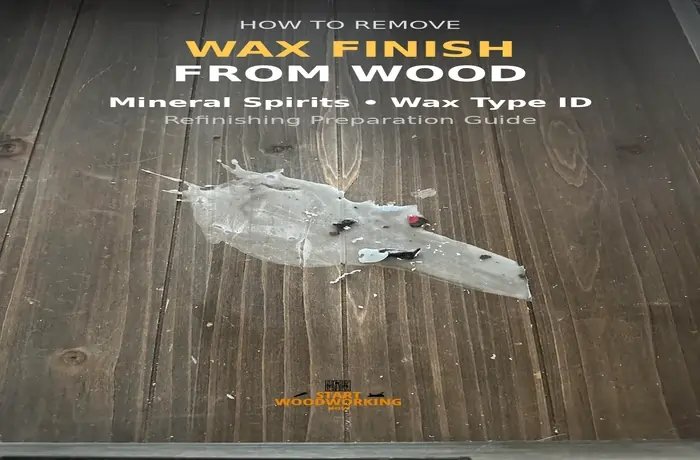
How to Remove Wax Finish from Wood: Mineral Spirits Protocol, Wax Type Identification, and Refinishing Preparation Guide
Furniture wax — paste wax, beeswax polish, carnauba-based wax — is a penetrating finish that dissolves completely in non-polar petroleum solvents: mineral spirits, naphtha, or turpentine. A single application of mineral spirits on a clean white cloth removes a fresh, single-coat wax finish from sealed or bare wood in 2–5 minutes per section. Wax buildup from years of reapplication requires 3–5 mineral spirits passes with fresh cloths, and confirmation with the naphtha evaporation test before any new finish is applied. The naphtha test is the only reliable method to confirm complete wax removal: naphtha applied to a wax-free surface evaporates completely within 10–15 seconds; naphtha applied to a surface with wax residue remains visibly wet for 30 seconds or more. Sanding before mineral spirits treatment is the most common mistake — sanding heat partially re-melts wax and forces it deeper into open pores, making subsequent solvent removal significantly harder. Wax must be removed before applying any new film-forming finish: polyurethane, lacquer, varnish, and shellac all fail adhesion over even microscopic wax residue.
This guide covers the identification test for four wax types, the mineral spirits removal protocol with application count by buildup level, the naphtha confirmation test, and the shellac barrier coat protocol for surfaces where complete wax removal cannot be confirmed.
→ Related: How to Remove Candle Wax from Wood (accidental deposit — different protocol)→ Related: How to Apply Beeswax to Wood→ Hub: How to Remove Wood Finishes — Complete Guide
How Do You Remove Wax Finish from Wood?
What Type of Wax Finish Is on the Wood?
The wax type determines the solvent strength required and the number of applications. The fingernail scratch test and visual inspection identify the type in under 30 seconds on any surface.
What Are the Key Specifications for Removing Wax Finish from Wood?
| Method | Attribute | Value |
|---|---|---|
| Mineral spirits (beeswax, carnauba) | Contact time per pass | 2–5 minutes per section; wipe while surface is still wet; replace cloth when yellow/brown wax residue appears |
| Mineral spirits | Number of passes — fresh single coat (under 2 years) | 1–2 passes for beeswax; 2–3 passes for carnauba paste wax |
| Mineral spirits | Number of passes — buildup wax (5+ years reapplication) | 3–5 passes minimum; some antique pieces with decades of wax require 6–8 passes; naphtha confirmation test after each pass from pass 3 onward |
| Naphtha confirmation test | Method and interpretation | Apply 3–4 drops to treated surface. Evaporates within 10–15 seconds = wax-free. Remains wet for 30+ seconds = wax residue present. Repeat mineral spirits before retesting. |
| Naphtha (microcrystalline wax) | Contact time | 5–10 minutes under cloth for microcrystalline; 2–3 passes minimum even with naphtha |
| Turpentine | Effectiveness vs. mineral spirits | Slightly more aggressive than mineral spirits on beeswax and soft paste wax. Longer drying time (2–4 hours). Lingering odour. Preferred by traditional restorers for antique beeswax; mineral spirits preferred for modern use. |
| Sanding before solvent | Effect | Frictional heat (80–120°C at sanding contact point) partially re-melts wax and drives it into pores opened by abrasion. Makes subsequent solvent removal significantly harder. Never sand before solvent treatment on waxed surfaces. |
| #0000 steel wool with mineral spirits | When used | For heavy buildup or textured/moulded profiles where cloth cannot reach. Mineral spirits on #0000 steel wool works into recesses. Caution: #0000 steel wool must be oil-free (e.g. Liberon brand) — standard steel wool is cut with machine oil which contaminates the surface. |
| Drying time after wax removal | Before new finish | 30–60 minutes after confirmed wax removal by naphtha test. Mineral spirits must fully evaporate before any finish application. |
| Shellac barrier coat | When required | When naphtha test cannot confirm complete wax removal (very old/thick buildup). Two thin “spit coats” of dewaxed shellac (Zinsser SealCoat, diluted 1:3 with denatured alcohol) seals any residual wax and provides adhesion base for polyurethane, lacquer, or varnish above. |
| Dewaxed shellac for barrier | Product specification | Must be dewaxed — Zinsser SealCoat specifically. Regular shellac (Zinsser Bulls Eye) contains wax and cannot be used as a barrier coat before polyurethane. |
| Dark wax pigment residual | Treatment agent | Oxalic acid 60g/litre for 10–15 minutes on bare wood if iron-oxide pigment (dark brown/amber residue) remains after mineral spirits wax removal on high-tannin species (oak, walnut, mahogany) |
| Polyurethane over wax residue | Failure mode | Adhesion failure — delamination within 6–18 months. Wax contamination prevents the polyurethane from forming hydrogen bonds with the wood surface. Even microscopic wax residue causes failure. Naphtha test confirmation is mandatory before polyurethane application. |
| Lacquer over wax residue | Failure mode | Fisheye defects — lacquer retracts from wax-contaminated areas, leaving circular depressions visible in the cured finish. Fisheye can be corrected with fisheye eliminator additive, but preventing it through complete wax removal is more reliable. |
How Do You Confirm a Surface Has a Wax Finish Before Removal?
Two tests confirm whether a surface has a wax finish — and which type — before any removal begins. Both tests take under 2 minutes and require only household materials.
Test 1 — Fingernail scratch test: Press a fingernail firmly into the surface at a 45-degree angle and drag slowly across 2–3 cm. Wax leaves a clear, white scratch mark and the fingernail lifts a slight curled shaving of material. The softer the wax, the more pronounced the scratch. Polyurethane, lacquer, and varnish film-forming finishes do not scratch easily with a fingernail — they require a coin or key to mark them. Oil finishes (linseed, danish oil) also do not scratch in this manner. Bare wood does scratch but does not produce a curled shaving.
Test 2 — Mineral spirits cloth test: Apply mineral spirits to a white cloth and wipe firmly over a small hidden area. If the cloth picks up a yellow or amber residue within 10–20 seconds, wax is present. A clean cloth with no residue after 30 seconds of firm wiping indicates no wax on the surface. This test also confirms wax removal during the treatment process — a clean white cloth after mineral spirits wiping confirms that pass is complete.
How Do You Remove Wax Finish from Wood Using Mineral Spirits?
Mineral spirits is the primary solvent for all wax types except microcrystalline. It dissolves paraffin, carnauba, and beeswax completely without affecting the wood surface or any finish beneath the wax layer. The process requires multiple applications and fresh cloths — recycling a saturated cloth redistributes dissolved wax rather than removing it.
STEP 1 Work in sections — do not attempt the whole surface in one pass
Divide the surface into 0.3–0.5 m² sections. Wax that is dissolved by mineral spirits and not immediately wiped can re-deposit on the surface as the solvent partially evaporates.
Working in small sections ensures the dissolved wax is captured on the cloth before re-deposition occurs. On a dining table, work across the surface in overlapping 40 cm sections.
STEP 2 Apply mineral spirits — allow 2–5 minutes contact
Dampen a white cotton cloth with mineral spirits and apply with firm, even pressure in the grain direction. The cloth should be saturated enough to visibly wet the surface but not dripping.
Allow 2–5 minutes contact time — the mineral spirits needs time to penetrate and dissolve the wax layer before wiping. For carnauba-based paste wax, extend to 4–5 minutes. For beeswax, 2–3 minutes is typically sufficient.
STEP 3 Wipe with firm pressure — replace cloth when saturated
After the contact time, wipe the section firmly in the grain direction using a clean section of the cloth. The cloth will pick up yellow or amber wax residue — this is the dissolved wax transferring from the surface. Fold the cloth to a clean section and continue wiping.
Replace the cloth entirely when no clean sections remain. Using a wax-saturated cloth for wiping redistributes dissolved wax back onto the surface rather than removing it.
STEP 4 Repeat — number of passes by buildup level
For fresh wax (applied within 2 years, 1–2 coats): complete 1–2 passes and check with mineral spirits cloth test — clean white cloth on the surface for 15 seconds should show no yellow transfer when wax is fully removed. For buildup wax (3–10 years of annual reapplication): 3–5 passes minimum.
For antique furniture with decades of wax (visible amber or brown coating, surface feels plastic-like when pressed): 5–8 passes may be required, alternating mineral spirits and naphtha from pass 4 onward for better penetration.
STEP 5 #0000 steel wool for profiles, mouldings, and carvings
Flat surfaces are accessible with a cloth. Carved details, mouldings, turned profiles, and recessed areas accumulate significant wax buildup that cloth wiping cannot reach. Apply mineral spirits to an oil-free #0000 steel wool pad and work into the recesses in the grain direction.
Do not use standard steel wool — it is manufactured with machine oil lubricant that contaminates the surface and interferes with subsequent finish adhesion. Use Liberon 0000 steel wool or equivalent oil-free grade.
Why sanding before mineral spirits treatment makes wax removal harder: Sanding generates frictional heat at the sandpaper-surface contact point reaching 80–120°C. At these temperatures, all wax types partially re-melt. The freshly abraded wood surface has newly opened pores with exposed fibres — the re-melted wax flows into these pores by capillary action and re-solidifies when the heat dissipates. This creates wax contamination in the freshly opened pores that was not there before sanding. Mineral spirits must then penetrate deeper to reach this newly embedded wax. The standard protocol is: solvent removal of all wax first → naphtha confirmation test → then sand if needed for surface preparation.
How Do You Confirm That All Wax Has Been Removed?
The mineral spirits cloth test confirms that visible wax has been removed. The naphtha evaporation test confirms that no residual wax remains at a microscopic level — the level that will cause adhesion failure in new finishes even when the surface appears clean to the eye.
Naphtha Evaporation Test — Wax Removal Confirmation
Apply 3–4 drops of naphtha (lighter fluid or hardware store naphtha) to the treated and dried surface. Observe for 30 seconds.
What If You Cannot Confirm Complete Wax Removal?
On antique furniture with several decades of wax applications, complete removal may not be achievable even after 6–8 mineral spirits passes. The wax has penetrated deeply into the wood pores over many years and some residue will persist regardless of solvent treatment intensity. Applying a new film-forming finish directly over this residue risks adhesion failure.
The professional solution is the shellac barrier coat protocol: apply two very thin “spit coats” of dewaxed shellac as a transitional layer between the residual wax and the new finish. Dewaxed shellac (Zinsser SealCoat, diluted 3 parts denatured alcohol to 1 part shellac) adheres to both wax-contaminated surfaces and film-forming finishes — it bridges the incompatibility.
Polyurethane, lacquer, or varnish applied over cured dewaxed shellac achieves full adhesion regardless of wax residue beneath.
The shellac must be dewaxed. Regular Zinsser Bulls Eye shellac contains its own wax — it cannot serve as a barrier coat before polyurethane and will cause identical adhesion failure. Zinsser SealCoat is dewaxed and is the specific product for this application.
Why dewaxed shellac bonds to both wax and polyurethane: Shellac contains shellac resin (a natural polymer secreted by the lac bug) dissolved in denatured alcohol. When the alcohol evaporates, the shellac resin forms a film that mechanically keys into both wax-contaminated surfaces (through micro-penetration) and provides a chemically compatible surface for oil-based and water-based film-forming finishes to bond to. This is the same principle used by painters who spray shellac over oil-based stains to allow water-based latex paint to adhere — shellac is one of the few universal adhesion promoters that works in both directions.
How Does the Wood Surface Type Affect Wax Removal?
| Surface Type | Wax Removal Protocol | Key Constraint |
|---|---|---|
| Solid hardwood furniture | Mineral spirits 2–5 min per section; 2–5 passes depending on buildup; naphtha confirmation test; sand 120–180 grit after confirmed removal. | High-tannin species (oak, walnut): dark wax pigment may stain grain — oxalic acid 60g/litre after mineral spirits if amber discolouration remains. |
| Veneer furniture | Mineral spirits on cloth — same protocol as solid wood but avoid pressure that could lift veneer edges. Do not allow mineral spirits to pool at veneer joins. | Pre-1950s furniture: veneer adhesive is hide glue — mineral spirits safe; excess solvent at edges can cause bubbling over time. Work with cloth, not soaking pad. |
| Hardwood floors (wax-finished) | Commercial floor wax stripper applied in sections with mop; 10–15 min dwell; scrub and extract. Mineral spirits is effective but labour-intensive for floor scale. Commercial strippers formulated for wax floors are more practical at this area. | Confirm wax finish vs. polyurethane before treating — mineral spirits on polyurethane floors has no effect but is safe. Naphtha confirmation test after stripping before applying new finish. |
| Wax over lacquer (maintenance wax on factory furniture) | Mineral spirits removes the maintenance wax layer. The lacquer beneath is intact and unaffected. 1–2 passes typical — maintenance wax is usually thin. | Confirm that lacquer is intact after wax removal before applying any new finish. Naphtha test applies equally to wax over lacquer as to wax over bare wood. |
| Wax over shellac (antique French polish) | Mineral spirits safe on shellac at brief contact times. Work quickly — wipe within 3–4 minutes of application to avoid extended solvent contact on shellac. | Isopropyl alcohol must not be used for wax removal on shellac — dissolves shellac finish. Mineral spirits only. |
| Carved profiles and mouldings | #0000 oil-free steel wool dampened with mineral spirits. Work into recesses in multiple passes. Wax buildup in carved details is often heavier than flat surfaces. | Use Liberon 0000 or equivalent oil-free steel wool — standard steel wool is cut with machine oil that deposits contamination in carved recesses. |
📝 The most instructive wax finish removal scenario in my restoration work was a 1920s English oak sideboard with continuous beeswax application since manufacture — estimated 80+ years of annual reapplication producing a wax layer visible as an amber-brown plastic-like coating 0.5 mm thick in recesses and carvings. Seven mineral spirits passes were required on the flat surfaces, with the naphtha test failing at passes 5 and 6 (remaining wet for over 45 seconds each time). After pass 7, naphtha evaporated within 12 seconds on all flat areas. The carved panel recesses required an additional two passes with #0000 Liberon steel wool dampened with mineral spirits before naphtha confirmed clean. Two spit coats of Zinsser SealCoat were applied as a precaution before the new oil-based varnish.
Frequently Asked Questions About Removing Wax Finish from Wood
Can you apply polyurethane directly over a wax finish?
No — polyurethane applied directly over any wax finish will fail adhesion and delaminate within 6–18 months. Wax prevents polyurethane from forming the hydrogen bonds with the wood surface that give the finish its mechanical adhesion. Even microscopic wax residue invisible to the eye is sufficient to cause delamination across the entire surface. The wax must be completely removed and confirmed with the naphtha evaporation test before polyurethane is applied. The only exception is the dewaxed shellac barrier coat protocol for surfaces where complete wax removal cannot be achieved.
What is the difference between removing wax finish and removing candle wax?
Candle wax is an accidental surface deposit — a thick, localized layer of solidified paraffin sitting on top of the wood surface or finish. It is removed mechanically first (cold cracking with ice, then scraping) before mineral spirits dissolves the thin residue. Furniture wax finish is an intentional, thin application distributed uniformly across the entire surface that penetrates the wood pores slightly. It has no mechanical bulk to remove — the entire removal process is chemical, using mineral spirits to dissolve the wax layer. The solvent and the general principle (non-polar solvent for non-polar wax) are the same; the application method and scale differ significantly.
How do you know when all the wax has been removed?
The mineral spirits cloth test — white cloth on the surface shows no yellow transfer — confirms visible wax removal. The naphtha evaporation test confirms microscopic residue: apply naphtha drops and if they evaporate within 10–15 seconds, the surface is wax-free. If naphtha remains wet for 30+ seconds, residual wax is present and additional mineral spirits passes are needed. The naphtha test is the only reliable method for confirming wax removal at the level required before new finish application.
Can you use vinegar to remove wax finish from wood?
Vinegar (acetic acid) is frequently recommended as a natural cleaning agent for wood. It has no dissolution mechanism for furniture wax — wax is non-polar and acetic acid is a polar molecule. The “like dissolves like” principle means only non-polar solvents (mineral spirits, naphtha, turpentine) dissolve wax. Vinegar may help remove water-soluble surface grime from the wax layer, but it does not dissolve the wax itself. For wax removal prior to refinishing, only petroleum-based solvents are effective.
📝 The most common client error I encounter with wax finish removal is sanding first — typically done by clients who attempted to refinish themselves before seeking professional help. In every case, the machine sanding had created a surface that tested positive on naphtha for 8–10 passes of mineral spirits rather than the 3–5 passes typically needed for carnauba paste wax. The friction heat had driven the wax into the freshly opened grain, extending the removal time significantly. One cherry dining table required the shellac barrier protocol after 9 mineral spirits passes because naphtha still showed slight wetness at 25 seconds — on the unsanded areas of the same table, 4 passes had produced a clean 12-second naphtha evaporation.
Summary: Key Values for Removing Wax Finish from Wood
Furniture wax — beeswax, carnauba-based paste wax, microcrystalline, and chalk paint wax — is dissolved by non-polar petroleum solvents: mineral spirits for beeswax and carnauba (2–5 passes depending on buildup), naphtha for microcrystalline wax. Never sand before solvent treatment — frictional heat re-melts wax and drives it into freshly opened pores. Work in sections of 0.3–0.5 m², allow 2–5 minutes mineral spirits contact, wipe with fresh cloths in the grain direction, replacing cloths when saturated with dissolved wax. Confirm complete removal with the naphtha evaporation test: naphtha that evaporates within 10–15 seconds indicates a wax-free surface; naphtha remaining wet after 30 seconds indicates residual wax requiring additional treatment. On surfaces where complete removal cannot be confirmed after 6–8 passes, apply two spit coats of dewaxed shellac (Zinsser SealCoat, not Bulls Eye) as a barrier before any new film-forming finish. Polyurethane, lacquer, varnish, and paint all fail adhesion over wax residue.
→ Related: How to Remove Candle Wax from Wood (accidental deposit)→ Related: How to Remove Chalk Paint from Wood (chalk paint wax as Step 1)→ Related: How to Remove Shellac from Wood→ Hub: How to Remove Wood Finishes — Complete Guide