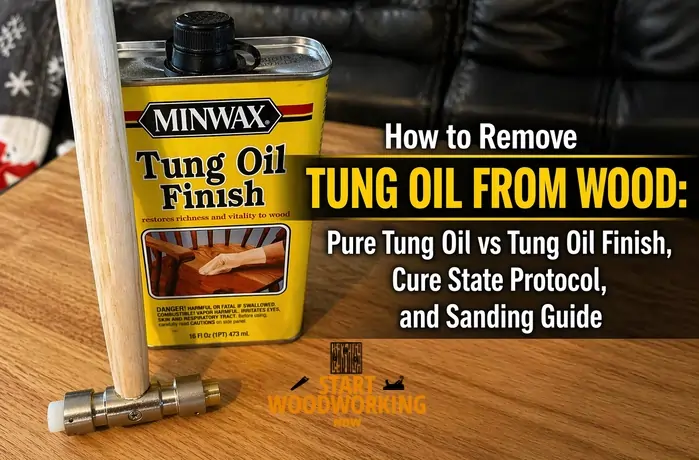
How to Remove Tung Oil from Wood: Pure Tung Oil vs Tung Oil Finish, Cure State Protocol, and Sanding Guide
The removal method for tung oil depends entirely on which product was actually applied — because most products labelled “tung oil” contain little or no real tung oil. Pure tung oil (Real Milk Paint, Hope’s 100%, Tried & True) is composed of 100% polymerised fatty acid triglycerides — primarily eleostearic acid — with no varnish fraction. Once fully cured after 14–30 days, it forms a three-dimensional cross-linked polymer network within the wood fibres that cannot be dissolved by turpentine, mineral spirits, or any common solvent. Sanding is the only effective removal method for fully cured pure tung oil. “Tung oil finish” products (Minwax Tung Oil Finish, Formby’s, Waterlox, General Finishes Tung Oil Varnish) are wiping varnishes or oil/varnish blends containing alkyd resin, petroleum solvent, and metallic driers — with little or no actual tung oil. Chemical gel stripper dissolves their varnish fraction effectively at any cure state, identical to the danish oil removal protocol. Applying solvents to fully cured pure tung oil and expecting dissolution — as recommended by every competing guide — is chemically incorrect for that product category and produces no result.
How Do You Remove Tung Oil from Wood?
- Identify the product first. Check the label for ingredients or apply the mineral spirits cloth test: dampen a white cloth with mineral spirits and rub firmly. If an amber or brown film transfers to the cloth within 30 seconds = tung oil finish (varnish blend) → chemical stripper protocol. If nothing transfers after 60 seconds of firm rubbing = pure tung oil → cure state test next.
- If pure tung oil — test cure state with fingernail. Presses dent into surface = uncured (under 4 hours) → turpentine wipe. Scratches without denting, surface slightly soft = partially cured (4 hours to 14 days) → naphtha with 15–30 min contact. No mark at all = fully cured (over 14 days) → sanding only, 80→120→150→180 grit. No solvent is effective on fully cured pure tung oil.
- If tung oil finish (varnish blend): apply chemical gel stripper (Citristrip or equivalent), 30–45 minutes dwell under plastic film, scrape with plastic scraper, neutralise, sand 120→180 grit. Same protocol as Danish oil removal.
- Dispose of rags immediately and safely. Pure tung oil rags carry higher spontaneous combustion risk than linseed oil rags — eleostearic acid oxidises more exothermically than linolenic acid. Lay rags completely flat outdoors to dry, or submerge in water in a metal container before disposal. Never fold or pile used tung oil rags.
This guide covers the product identification test for pure tung oil vs. tung oil finish blends, the cure state removal protocol, the sanding sequence for fully cured pure tung oil, spontaneous combustion precautions, and food-safe refinishing after removal from cutting boards and salad bowls.
→ Related: How to Remove Linseed Oil from Wood (similar drying oil chemistry)
→ Related: How to Remove Danish Oil from Wood (oil/varnish blend — same protocol as tung oil finish)
→ Related: How to Refinish Wood After Stripping
→ Hub: How to Remove Wood Finishes — Complete Guide
Is It Pure Tung Oil or a Tung Oil Finish Blend? (Determines the Entire Removal Protocol)
The label “tung oil” covers two chemically distinct product categories that respond to completely different removal methods. Identifying which product is on the wood is the single most important step — applying chemical stripper to fully cured pure tung oil wastes time and materials; applying solvents only to a varnish-blend finish when stripper is needed produces incomplete results.
Pure tung oil comes from pressing seeds of the Vernicia fordii (tung) tree. It consists almost entirely of eleostearic acid — a conjugated triene fatty acid with three consecutive double bonds that polymerise rapidly on exposure to oxygen, producing a very hard, water-resistant cross-linked film within the wood fibres.
Products labelled as pure tung oil include Real Milk Paint Pure Tung Oil, Hope’s 100% Pure Tung Oil, and Tried & True Original (which is pure linseed but processed identically — same removal protocol). These contain no varnish, no petroleum solvents, and no driers.
“Tung oil finish” products are fundamentally different. Minwax Tung Oil Finish, Formby’s Tung Oil Finish, Waterlox Original, and General Finishes Tung Oil Varnish are wiping varnishes or alkyd oil/varnish blends — some containing no measurable tung oil at all. They contain alkyd resin (a synthetic varnish), petroleum mineral spirits as carrier, and metallic driers (cobalt, manganese, or zirconium).
The alkyd varnish fraction is what creates the film-forming properties these products are known for — and it is also what chemical stripper dissolves. Their removal protocol is identical to danish oil: gel stripper for the varnish fraction, then sanding for the oil that has penetrated the grain.
Product Identification Test — mineral spirits cloth test
Dampen a clean white cloth with mineral spirits and rub firmly on the wood surface for 30–60 seconds.
If an amber, golden, or brown film transfers to the cloth = the finish contains a varnish or oil fraction still accessible to solvent = tung oil finish blend (chemical stripper protocol).
If the cloth remains completely clean after 60 seconds of firm rubbing on a properly finished surface = pure tung oil, competes cured = sanding protocol. For pure tung oil that is uncured or partially cured, the cloth will pick up a pale oily film within 30 seconds.
What Product Type and Cure State Is Present?
What Are the Key Specifications for Removing Tung Oil from Wood?
| Entity / Method | Attribute | Value |
|---|---|---|
| Product identification — mineral spirits cloth test | Method and result interpretation | Firm wipe with mineral spirits on white cloth, 60 seconds. Amber/brown transfer = tung oil finish (varnish blend) → chemical stripper. Clean cloth = fully cured pure tung oil → sanding only. Pale oily transfer = uncured or partially cured pure tung oil → turpentine or naphtha. |
| Turpentine on pure tung oil | When effective and mechanism | Effective only on uncured tung oil (under 4 hours from application). Alpha-pinene in turpentine has structural similarity to eleostearic acid chains, making it a better solvent for unpolymerised tung oil than aliphatic mineral spirits. Zero effect on fully cured pure tung oil — cross-linked polymer network cannot be dissolved. |
| Naphtha on partially cured pure tung oil | Contact time and effectiveness | Preferred solvent for partially cured pure tung oil (4 hours to 14 days). More aggressive than mineral spirits on oil in early polymerisation stages. Apply on cloth, 15–30 minutes contact, then scrub with Scotch-Brite grey pad. Multiple applications for material cured 7–14 days. No effect on fully cured (over 14 days) pure tung oil. |
| Chemical gel stripper on pure tung oil (fully cured) | Effectiveness | Minimal. Pure tung oil contains no varnish fraction for the stripper to dissolve. NMP-based and citrus strippers attack ester bonds in alkyd/polyester resins — eleostearic acid polymer cross-links are C–C bonds, not ester bonds. Gel stripper will remove any surface contamination but will not penetrate the oil layer within the wood fibres. |
| Chemical gel stripper on tung oil finish (varnish blend) | Effectiveness and dwell time | Highly effective. The alkyd varnish fraction dissolves within 30–45 minutes dwell under plastic film. Apply thick coat, cover immediately with plastic wrap to prevent evaporation, wait 30–45 minutes. Scrape with plastic scraper. Remaining oil in grain requires 120→180 grit sanding after stripping. Same protocol as Danish oil removal. |
| Sanding fully cured pure tung oil | Starting grit and sequence | Start 80 grit to cut through the hardened oil layer in the surface fibres. The oil-saturated fibres are harder than bare wood and dull sandpaper rapidly — change paper when cutting slows. Progress 80→120→150→180 grit, vacuum and tack cloth between grits. Final grit determines new finish compatibility: 150 for oil re-application, 180 for polyurethane, 220 for lacquer. |
| Sanding — detecting complete pure tung oil removal | Visual and tactile confirmation | Two indicators: (1) sanding dust colour shifts from dark amber/brown to the natural pale wood species colour — the oil-stained surface fibres have been removed; (2) water drop absorption test — 2–3 drops on sanded surface absorb in under 30 seconds = oil-free open grain. If water beads or takes over 60 seconds = oil residue in grain, continue sanding with 80–100 grit. |
| Spontaneous combustion risk — pure tung oil | Risk level vs. linseed oil and safe disposal | Higher risk than linseed oil. Eleostearic acid (pure tung oil) oxidises more exothermically than linolenic acid (linseed oil) during polymerisation. A folded wet tung oil rag in a confined space can reach ignition temperature in 1–3 hours. Disposal: lay rags flat in a single layer on a non-combustible surface outdoors until fully dry; or submerge in water in a metal container with lid before bin disposal. Never fold, bundle, or pile used rags. |
| Cure time — pure tung oil | By temperature and humidity | Standard: 14–30 days at 18–22°C, 40–60% relative humidity for full polymerisation. Cold conditions (under 10°C): cure time extends to 45–60 days. High humidity (over 75% RH): slows oxygen availability, extends cure time significantly. Fully cured = glass-hard surface, no fingernail mark, no colour transfer to mineral spirits cloth. |
| Food-safe refinishing after pure tung oil removal | Protocol for food-contact surfaces | Sand to 180 grit. Confirm oil-free with water drop test (under 30 sec absorption). New finish must also be food-safe: pure tung oil re-application, food-grade mineral oil, carnauba wax, beeswax, or water-based poly labelled food-safe when cured. Do NOT apply oil-based polyurethane on food-contact surfaces without food-safe certification. Do NOT apply dewaxed shellac barrier coat on food-contact surfaces — shellac contains denatured alcohol solvent. |
| Tung oil applied over existing finish — removal | Protocol and mechanism | Mineral spirits wipe with Scotch-Brite white or grey pad, 2–3 passes. Tung oil applied over lacquer, polyurethane, or conversion varnish cannot penetrate through the existing film finish — it sits on top as an unbound oil layer that has partially but incompletely polymerised. Mineral spirits dissolves this surface layer without requiring gel stripper. Uniform colour change after tung oil application (vs. patchy change) confirms the oil is on the surface, not in the wood. |
Which Removal Protocol Applies to the Cure State of the Tung Oil?
How Do You Remove Uncured or Partially Cured Pure Tung Oil Using Solvents?
Solvent removal is only applicable within the first 14 days of application. Acting promptly — within the first few hours for complete ease, or within the first week with more effort — preserves the solvent-removal option. After 14 days, sanding is the only effective protocol regardless of solvent effort.
STEP 1 Confirm cure state — fingernail and mineral spirits cloth tests
Before selecting a solvent, confirm the cure state as described above. For partially cured material (applied 4 hours to 14 days ago), apply a mineral spirits cloth test to confirm the oil is still partially accessible — visible pale oily transfer confirms partial polymerisation. If the cloth is completely clean, the oil has fully cured and sanding is required regardless of solvent attempts.
STEP 2 Select solvent — turpentine for uncured, naphtha for partially cured
Turpentine (genuine spirit of turpentine — alpha-pinene terpene) for uncured material applied within 4 hours. The structural relationship between alpha-pinene and eleostearic acid makes turpentine significantly more effective than mineral spirits on fresh tung oil.
For material cured 4 hours to 14 days: naphtha (VM&P naphtha or painter’s naphtha) — more aggressive than mineral spirits on oil in early polymerisation and penetrates the forming network more effectively than turpentine at this stage.
STEP 3 Apply and allow contact time — do not rub immediately
Saturate a cloth with the selected solvent and press onto the surface. For uncured material: 2–5 minutes contact, then firm wipe in grain direction. For partially cured material: 15–30 minutes contact — hold the cloth on the surface without rubbing.
The extended contact time allows the solvent to penetrate and swell the partially formed polymer network before mechanical action attempts to remove it. Premature rubbing on partially cured material smears the surface without removing oil from the fibres.
STEP 4 Scrub with Scotch-Brite — not steel wool on tannin-rich wood
After the contact period, scrub firmly in the grain direction using a Scotch-Brite grey (medium) pad. Steel wool is not appropriate on oak, walnut, cherry, or mahogany — iron particles from steel wool react with wood tannins to produce dark iron-tannate staining that is visible under any subsequent finish.
Scotch-Brite pads provide mechanical abrasion without iron contamination. Wipe clean, reapply fresh solvent, repeat 3–5 times for partially cured material.
STEP 5 Final mineral spirits wipe and drying
After solvent removal is complete, wipe with a clean cloth dampened with mineral spirits to remove solvent residue. Allow 24 hours drying minimum before applying any new finish — residual turpentine or naphtha in the grain interferes with new finish adhesion. Confirm readiness with water drop absorption test before any stain or topcoat.
How Do You Remove Fully Cured Pure Tung Oil by Sanding?
Sanding is the only effective method for fully cured pure tung oil. The cross-linked eleostearic acid polymer within the wood fibres is mechanically removed by abrasion — the oil-saturated surface fibres are cut away until oil-free wood is reached below.
This requires more sandpaper consumption than sanding bare wood because the oil-hardened fibres dull abrasive grits faster than untreated wood.
STEP 1 Start at 80 grit — change paper frequently
Pure tung oil produces a very hard surface layer within the top 0.1–0.3 mm of wood fibres. 80 grit aluminium oxide sandpaper cuts through this layer effectively, but the oil-saturated fibres load the paper rapidly — the cutting particles become clogged with removed oil and wood fibre within 3–5 minutes of sanding a typical furniture surface.
Change sandpaper as soon as cutting slows, not when it appears worn. Dull 80-grit paper generates heat rather than cutting, which can reflow residual oil into the grain.
STEP 2 Sand only with the grain — check dust colour to monitor progress
Every pass at every grit must be with the wood grain. Cross-grain scratches at 80 grit are deep and visible under the final finish. Monitor the colour of the sanding dust continuously: oil-saturated surface produces amber-brown dust.
When the dust colour shifts to the natural pale colour of the wood species (cream for maple, light tan for oak, pinkish-grey for walnut), the oil-saturated surface layer has been removed.
At this point, the 80-grit pass is complete — do not continue with 80 grit beyond this colour shift or excess wood is removed unnecessarily.
STEP 3 Progress 80→120→150→180 grit with vacuum and tack cloth between grits
Vacuum all sanding dust from the surface and from any open grain pores between each grit change. Wipe with a tack cloth. Residual coarser grit particles left on the surface scratch the wood more deeply than the next finer grit being applied — visible as bright cross-hatching lines under the final finish.
80-grit scratches removed by 120, 120-grit scratches removed by 150, 150-grit scratches removed by 180. Final grit: 150 for oil re-application, 180 for polyurethane over shellac barrier, 220 for lacquer.
STEP 4 Water drop absorption test — confirm oil-free grain
Apply 2–3 drops of water to the final sanded surface. Tung oil is highly water-resistant — one of its primary properties is a water contact angle over 90 degrees on the wood surface. If residual tung oil remains in the grain, water beads immediately and sits for over 60 seconds without absorbing.
Pass criterion: water absorbs completely in under 30 seconds. If water beads: continue sanding at 80–100 grit in the failing area until the water drop test passes, then repeat the full grit sequence.
📝On a maple cutting board finished with pure tung oil, the surface felt dry after 5 days but failed the water drop test (beading over 60 seconds), indicating incomplete cure. I used repeated mineral spirits wipes and light 220-grit sanding, then allowed additional curing; once water absorbed within ~30 seconds, it was ready for a food-safe topcoat.
📝On a walnut table labeled “tung oil finish,” the product was actually a varnish blend and fully cured. It required a benzyl alcohol gel stripper (75-minute dwell under plastic), and after neutralisation, the water drop test showed absorption within ~25 seconds, confirming clean removal.
How Do You Remove Tung Oil Finish (Varnish Blend) Using Chemical Stripper?
Tung oil finish products — Minwax, Formby’s, Waterlox, and similar varnish blends — respond to chemical gel stripper because their alkyd varnish fraction is soluble in the ester-bond-breaking solvents (NMP, d-limonene) that gel strippers contain. The protocol is identical to Danish oil removal, because the two products are chemically equivalent: oil/varnish blends with the same alkyd resin chemistry.
STEP 1 Apply gel stripper thick — cover with plastic film
Apply a thick, even coat of citrus gel stripper (Citristrip) or NMP-based gel stripper. Immediately cover the entire treated area with plastic cling film, pressed down firmly to exclude air.
This prevents solvent evaporation and maintains active stripper in contact with the finish throughout the dwell time. Without the plastic film cover, most strippers lose 40–60% of their active solvent within 10–15 minutes of application.
STEP 2 30–45 minutes dwell — check at edge before removing plastic
Allow 30–45 minutes minimum with plastic film in place. Check progress by lifting one corner of the plastic and testing the finish edge with a plastic scraper — it should offer little resistance and scrape away cleanly as a gel or soft solid. If still firm, replace the plastic and allow another 15 minutes.
For thick builds (3+ coats of tung oil finish), two stripper applications may be necessary: first application removes top coats, second application (after wiping first residue) penetrates deeper.
STEP 3 Scrape with plastic scraper — wipe with mineral spirits
Remove plastic film, scrape softened finish with a plastic scraper held at 30–45 degrees to the surface. Wipe the scraper blade clean between passes to avoid re-depositing dissolved finish.
After scraping, wipe the surface with a cloth dampened with mineral spirits to remove stripper residue and dissolved finish film. This mineral spirits wipe also removes any d-limonene oil residue (from citrus strippers) that would otherwise interfere with new finish adhesion.
STEP 4 Neutralise and sand 120→180 grit
Neutralise the stripper residue: for citrus strippers (pH 4–5), apply baking soda solution (1 tsp per litre water), wipe clean, allow 24 hours drying.
For alkaline strippers: diluted vinegar (1:10), same protocol. After drying, sand 120→150→180 grit to remove raised grain, remaining oil in pores, and stripper crust. Water drop test to confirm readiness. Full neutralisation and sanding protocol in the post-stripping guide linked above.
How Do You Refinish Food-Contact Wood After Removing Tung Oil?
Pure tung oil is one of a small number of wood finishes that is food-safe when fully cured — used extensively on cutting boards, salad bowls, wooden utensils, and food preparation surfaces.
When this finish needs to be removed — due to damage, contamination, or a change of surface use — the refinishing protocol has specific constraints that do not apply to non-food-contact surfaces.
After complete tung oil removal confirmed by the water drop test: sand to 180 grit with the grain. Vacuum all dust. Confirm the grain is fully open and oil-free. The new finish must also be food-safe after full cure.
Food-safe options in order of durability: food-grade mineral oil (indefinitely renewable, very low protection), carnauba paste wax (moderate protection, food-safe), beeswax (good protection, food-safe), pure tung oil re-application (excellent protection, 14–30 day cure), or water-based polyurethane specifically labelled food-safe when cured.
Do not apply oil-based polyurethane on food-contact surfaces without confirming food-safe certification — most standard oil-based poly contains metallic driers (cobalt, manganese) that are not food-safe until fully cured, and “fully cured” can take 30 days at room temperature. Do not use shellac on food-contact surfaces as a barrier coat — denatured alcohol solvent residue persists in shellac for several days after application.
📝On a walnut butcher block that had been previously treated with pure tung oil, I confirmed full removal after stripping and neutralisation using the water drop test — absorption occurred within ~25 seconds across all areas, indicating clean, open pores. I then applied a food-safe hard wax oil, which provided both moisture resistance and a repairable surface suitable for daily kitchen use.
In another case, a maple cutting board had been mistakenly finished with a non-food-safe polyurethane. It required complete re-stripping with gel stripper, followed by mineral spirits neutralisation and sanding; once the water drop test showed consistent absorption under 30 seconds, I refinished it with pure mineral oil and beeswax for safe food contact.
Frequently Asked Questions About Removing Tung Oil from Wood
Does turpentine remove tung oil from wood?
Turpentine removes uncured pure tung oil — applied within the last 4 hours — because the eleostearic acid in tung oil has not yet fully polymerised and the alpha-pinene in turpentine is structurally compatible with the unlinked fatty acid chains.
Turpentine does not remove fully cured pure tung oil (applied more than 14–30 days ago) because the cross-linked polymer network cannot be dissolved. For tung oil finish products (varnish blends like Minwax or Formby’s), turpentine provides partial cleaning but chemical gel stripper is more effective because it targets the alkyd varnish fraction directly.
What is the difference between pure tung oil and tung oil finish?
Pure tung oil is 100% pressed oil from tung tree seeds — primarily eleostearic acid — with no varnish, solvents, or driers. It penetrates deeply into wood fibres, cures slowly (14–30 days) by oxygen polymerisation, and is food-safe when fully cured. Removal of fully cured pure tung oil requires sanding only.
Tung oil finish products (Minwax Tung Oil Finish, Formby’s, Waterlox) are wiping varnishes containing alkyd resin, petroleum mineral spirits, and metallic driers — some contain no actual tung oil. They cure faster (2–4 days via drier-accelerated oxidation), produce a harder surface film, and are removed with chemical gel stripper. Applying the wrong removal method to the wrong product type is the most common tung oil removal failure.
How long does pure tung oil take to cure fully?
14–30 days at standard room temperature (18–22°C) and moderate humidity (40–60% RH) for the cross-linked polymer to reach full hardness. Cure time extends significantly in cold conditions (under 10°C: 45–60+ days) and high humidity (above 75% RH: slows oxygen availability at the oil surface).
The practical test for full cure is the fingernail test — zero mark at any pressure — combined with the mineral spirits cloth test — completely clean cloth after 60 seconds. Both tests must pass before sanding is confirmed as the only removal option.
Can you apply polyurethane over wood that previously had pure tung oil?
After confirmed complete removal of pure tung oil (sanding until water drop test passes and dust colour confirms natural wood), apply two thin coats of dewaxed shellac (Zinsser SealCoat, not Bulls Eye which contains wax) as a barrier coat before polyurethane.
Residual polymerised tung oil in deeper pores — even after the surface layer is removed — can cause fisheye in polyurethane. The shellac barrier coat seals the remaining oil in the deeper grain and provides a compatible surface for polyurethane adhesion. For pure oil re-application (new tung oil coat), no barrier coat is needed.
Summary: Key Values for Removing Tung Oil from Wood
Tung oil removal requires identifying the product type before selecting any method. Mineral spirits cloth test: amber transfer within 30 seconds = tung oil finish (varnish blend, Minwax/Formby’s/Waterlox) → gel stripper 30–45 min dwell under plastic film → scrape → mineral spirits wipe → sand 120→180 grit.
Clean cloth = pure tung oil → cure state determines protocol. Uncured pure tung oil (under 4 hours): turpentine wipe, 2–5 min contact. Partially cured (4 hours to 14 days): naphtha, 15–30 min contact, Scotch-Brite scrub. Fully cured pure tung oil (over 14–30 days): sanding ONLY — turpentine, mineral spirits, and chemical stripper have no effect on the cross-linked eleostearic acid polymer.
Sand 80→120→150→180 grit; confirm removal when sanding dust shifts from amber to natural wood colour and water drop absorbs in under 30 seconds. Tung oil rags carry higher spontaneous combustion risk than linseed oil — lay flat outdoors immediately after use or submerge in water. For food-contact surfaces: new finish must be food-safe (food-grade mineral oil, carnauba wax, beeswax, or pure tung oil). Dewaxed shellac barrier coat required before polyurethane over previously tung-oiled surfaces.
→ Related: How to Remove Linseed Oil from Wood
→ Related: How to Remove Danish Oil from Wood
→ Related: How to Refinish Wood After Stripping
→ Hub: How to Remove Wood Finishes — Complete Guide