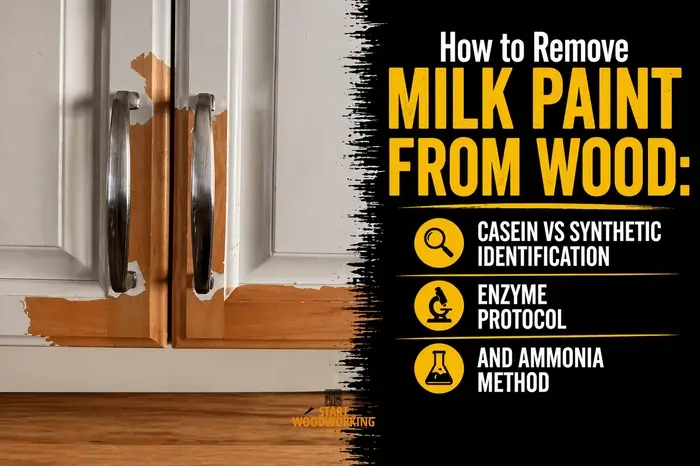
How to Remove Milk Paint from Wood: Casein vs Synthetic Identification, Enzyme Protocol, and Ammonia Method
There are two completely different products sold as “milk paint,” and they require opposite removal approaches. True casein milk paint — the historical formula — is made from casein protein, hydrated lime, and earth pigments. When cured, the casein binds with calcium from the lime to form calcium caseinate, an insoluble protein salt with peptide bond cross-links that standard chemical strippers cannot dissolve. NMP, methylene chloride, benzyl alcohol, and all common wood strippers lack any mechanism to break the CO-NH peptide bonds in a protein matrix — which is why “most modern strippers won’t touch milk paint.” Synthetic milk paint — products like Miss Mustard Seed’s Milk Paint, General Finishes Milk Paint, and most pre-mixed products sold as milk paint — are acrylic latex paints with chalk or calcium pigments. They respond normally to standard strippers and warm water. Applying the casein protocol to synthetic milk paint (or the reverse) wastes time and materials. The identification test — standard stripper on a hidden area for 30 minutes — resolves the question in one step: if the paint softens, it is acrylic synthetic; if completely unchanged, it is casein-based.
This guide covers the product identification test, the chemistry of casein paint and why standard strippers fail, the proteolytic enzyme method using biological washing detergent, the ammonia method, the penetration depth problem on bare unprimed wood, and the complete removal protocol by surface type.
How Do You Remove Milk Paint from Wood?
→ Related: How to Remove Chalk Paint from Wood (similar protocol for sealed synthetic milk paint)
→ Related: How to Choose a Chemical Stripper
→ Related: How to Refinish Wood After Stripping
→ Hub: How to Remove Wood Finishes — Complete Guide
True Casein Milk Paint vs. Synthetic “Milk Paint” — The Identification That Changes Everything
The single most important information gap in every milk paint removal guide is the failure to distinguish between two fundamentally different products that share the same name. Applying the wrong removal approach — standard stripper on casein milk paint, or enzyme treatment on acrylic synthetic — wastes time without result and can damage the wood through unnecessary soaking or chemical exposure.
How Do You Identify Which Type of Milk Paint Is on the Wood?
Three tests in sequence reliably distinguish casein milk paint from synthetic acrylic milk paint. Any one positive result is sufficient to confirm the type — all three are only needed if the first test is ambiguous.
True Casein Milk Paint — Test Results
Synthetic Acrylic Milk Paint — Test Results
The fastest identification: read the label or check the container
What Are the Key Specifications for Removing Milk Paint from Wood?
| Method | Attribute | Value |
|---|---|---|
| True casein milk paint — why standard strippers fail | Chemical mechanism | Calcium caseinate (the cured binder) has cross-linked peptide bonds (CO-NH) in a protein matrix. NMP and MCl attack ester bonds in alkyd/polyurethane; benzyl alcohol attacks similar polymer ester linkages. None have a mechanism for peptide bond hydrolysis. The strippers are correct for synthetic polymers; they simply encounter the wrong substrate chemistry in casein paint. |
| Biological (bio) washing detergent — enzyme method | Active enzyme and mechanism | Biological washing powders and liquids contain protease enzymes (subtilisin family) that specifically hydrolyse peptide bonds CO-NH in protein chains. Subtilisin cleaves casein into soluble amino acid fragments that disperse in warm water. Temperature optimum: 40–60°C. At 50°C with 30–45 minutes contact, the casein matrix is sufficiently hydrolysed to allow mechanical removal by scrubbing. |
| Bio detergent — product selection | Which products contain protease | “Bio” or “biological” washing products contain protease. In EU/UK: Ariel Bio, Persil Bio, Fairy Bio. In US: Tide with Enzymes, Arm & Hammer with Enzymes, Bio-Kleen. Check label: “contains enzymes” or “biological formula” confirms protease. Non-bio (enzyme-free) detergents contain only surfactants — insufficient for casein hydrolysis. The surfactant alone will not dissolve the protein binder. |
| Bio detergent — mixing ratio and temperature | Solution and application | 1 tablespoon bio washing powder per 500 ml water, heated to 50–60°C (hot but not scalding). Apply immediately while solution is warm. Cover with plastic film to retain warmth and prevent evaporation. 30–45 minutes contact minimum. Reheat solution or replace with fresh warm solution if surface cools before dwell is complete. |
| Ammonia — mechanism on casein | Why it works | Concentrated ammonia (NH₃, pH 11–12) denatures protein structure at high pH by disrupting hydrogen bonds and ionic bonds in the protein tertiary structure, converting the rigid calcium caseinate matrix to a softer, more workable state. Does not fully hydrolyse the peptide bonds (unlike enzymes) but softens the paint sufficiently for mechanical scrubbing and removal. Less complete than the enzyme method on thick, aged casein paint but faster on thin or recently applied layers. |
| Ammonia — concentration required | Minimum effective strength | Minimum 10% ammonia solution (hardware store “household ammonia” or “clear ammonia”). Pharmacy 3% ammonia has insufficient pH to denature casein effectively. Do not dilute. Apply full-strength to scrubbing pad or cloth. Work outdoors or with maximum ventilation — concentrated ammonia vapour is a strong respiratory irritant. |
| Ammonia — neutralisation after use | Why and method | Ammonia raises wood pH significantly. Uncured alkaline residue: (1) interferes with stain absorption uniformly — stain appears blotchy over high-pH areas; (2) can darken tannin-rich species (oak, walnut, cherry) by the same iron-tannate mechanism as alkaline strippers; (3) prevents finish adhesion. Neutralise with diluted white vinegar (1:10 in water), wipe, rinse with water, allow 24 hours drying. Full protocol in the post-stripping guide. |
| Ammonia on high-tannin species | Risk and mitigation | Oak, walnut, mahogany, cherry: ammonia activates tannin compounds, potentially causing grey-green or dark discolouration. Test on hidden area first. If darkening occurs after ammonia treatment: oxalic acid solution (30 g/litre) restores tannin colour after neutralisation. Enzyme method (bio detergent) is preferred over ammonia on high-tannin species — no pH change, no tannin risk. |
| Casein paint on bare unprimed wood | Penetration depth and removal implications | True casein milk paint applied to bare, unsealed, unprimed wood absorbs into wood pores to 0.1–0.3 mm depth. Calcium caseinate forms within the wood fibre structure — not just on the surface. Chemical protocols (enzyme, ammonia) remove the surface paint layer but cannot penetrate and dissolve casein bonded inside the wood fibres. Sanding 80–100 grit is required for complete removal. Water drop test after sanding confirms clean, open pores. |
| Casein paint on sealed/primed wood | Removal comparison | Casein applied over a primer, shellac, or previous sealed finish sits on top of the substrate rather than penetrating wood fibres. The enzyme or ammonia protocol removes the casein layer cleanly from the sealed surface — the underlying finish prevents penetration. Significantly easier removal than casein on bare wood. No sanding required for the casein layer itself, though the underlying sealed finish may still need stripping depending on the refinishing goal. |
| Behlen P.D.E. powder stripper | Composition and use | Powdered professional milk paint remover. Mixed with water to form paste, applied like a standard gel stripper. Reported effective at removing true casein milk paint where standard strippers fail. Not widely available — source through Behlen distributors or specialty finishing suppliers. For most DIY scenarios, bio detergent or ammonia is more accessible and achieves equivalent results on standard casein applications. |
| Oven cleaner (lye-based) | Effectiveness and risks | Lye (NaOH) in oven cleaner denatures casein protein by alkaline hydrolysis — similar mechanism to ammonia but stronger. Reported effective by DIY practitioners (nomilk.com, My Vintage Porch). Risk: NaOH darkens tannin-rich species (identical to caustic stripper risk) and is highly caustic to skin. Requires full neutralisation with vinegar solution. Not recommended on veneered furniture — high water content. Acceptable on solid softwood pieces where staining risk is low. |
How Do You Remove True Casein Milk Paint Using Biological Detergent?
The biological (bio) washing detergent method is the technically correct approach for true casein milk paint removal. It uses the same chemical mechanism as the body uses to digest milk protein — proteolytic enzyme hydrolysis — targeting specifically the peptide bonds that hold the calcium caseinate matrix together. It produces no pH change, no tannin risk, no veneer risk, and requires no neutralisation beyond a water rinse. It is also the method most completely absent from all competing guides.
STEP 1 Confirm it is casein milk paint — stripper test
Apply NMP gel stripper (or any standard paint stripper) to a 5 cm hidden area with plastic film cover for 30 minutes. If the surface is completely unchanged — no softening, no lifting at edges, paint feels as hard as before — casein milk paint confirmed. Proceed with enzyme method. If any softening is visible: synthetic acrylic milk paint — switch to the chalk paint removal guide.
STEP 2 Prepare enzyme solution at 50–60°C
Add 1 tablespoon of biological washing powder (labelled “bio” or “biological,” or “contains enzymes”) to 500 ml of water heated to 50–60°C. The enzyme (subtilisin) is active in this temperature range and denatures rapidly above 70°C — do not use boiling water. Mix until powder fully dissolves. Prepare fresh solution immediately before use — the enzyme activity declines over time at working temperature. For a larger surface, scale proportionally: 2 tablespoons per litre.
STEP 3 Apply warm solution, cover immediately with plastic film
Soak a cloth or scrubbing pad with the warm solution and apply to the painted surface. Immediately cover the treated area with plastic cling film pressed flat to retain warmth and prevent evaporation. The enzyme requires warm, wet contact to work — a surface that cools and dries during dwell has lost most enzyme activity. For large surfaces, work in sections and maintain warmth with a heat lamp or by placing the piece in a warm room.
STEP 4 30–45 minutes dwell — maintain temperature
Allow 30 minutes minimum at 50°C. Fresh casein milk paint (under 6 months): 30 minutes is usually sufficient. Aged casein paint (years or decades, especially on antique furniture): 45–60 minutes, or repeat the application.
The enzyme reaction rate slows as the solution cools — if the surface has cooled to room temperature during dwell, the effective contact time was only the first 10–15 minutes. Replace plastic film and re-warm the solution if needed for thick applications.
STEP 5 Scrub with grain direction — non-metallic abrasive
Remove the plastic film and scrub the surface firmly in the grain direction using a synthetic scrubbing pad (Scotch-Brite green or similar) or a stiff bristle brush. The hydrolysed casein will lift as a sludgy, off-white material.
Wipe clean with a damp cloth and reapply fresh warm solution for any remaining paint. Do not use steel wool on oak, walnut, or mahogany — iron particles from steel wool react with tannins to cause dark iron-tannate staining that is difficult to remove.
STEP 6 Rinse thoroughly and dry — water drop test
After all paint is removed, wipe the surface thoroughly with clean water to remove enzyme and dissolved casein residue. Allow to dry completely — 4–8 hours minimum. Perform the water drop test: if water absorbs in under 30 seconds, the pores are clean and open.
If water beads, casein residue remains in the pores — sand 120–150 grit to open the grain fully before refinishing. If the piece was painted on bare, unprimed wood: sand 80–100 grit regardless of the water drop test result to ensure the paint penetration layer within the fibres is removed.
📝The most instructive milk paint removal case in my workshop was a 1920s oak side table brought in by a client who had already attempted to strip it with Citristrip — three applications over two days with no result. The paint was powder-form Real Milk Paint, identified from the client’s records, and my NMP gel confirmation test at 30 minutes showed zero softening. I used the bio detergent method: one tablespoon Ariel Bio powder in 500 ml water at 55°C, covered with plastic film for 40 minutes. The casein lifted in a sludgy off-white layer with Scotch-Brite scrubbing. One repeat application cleaned the remaining surface paint. The oak required 80 grit sanding after — the water drop test at the green areas showed beading that confirmed casein penetration in the open grain before sanding, and confirmed clean absorption after.
How Do You Remove True Casein Milk Paint Using Ammonia?
The ammonia method is the historically documented approach for casein milk paint removal — referenced in the first written records of the problem in woodworking forums from the 1990s. It is faster than the enzyme method on thin or recently applied casein paint but less effective on thick, heavily aged, or multiple-coat applications where complete hydrolysis is needed. Ammonia denatures the protein structure without fully dissolving it — the paint becomes soft enough to scrub away rather than dissolving into solution.
STEP 1 Outdoor or maximum ventilation — ammonia vapour is a significant respiratory hazard
Concentrated ammonia (10%+) produces strong vapour that is a respiratory irritant at low concentrations and dangerous at higher exposures. Work outdoors or with a window-mounted fan creating continuous outward airflow.
Wear nitrile or neoprene gloves — ammonia is absorbed through skin and irritates mucous membranes. Safety glasses are required. This is not an indoor-only-with-window-open situation — genuine cross-ventilation is required.
STEP 2 Apply full-strength ammonia to scrubbing pad
Pour concentrated ammonia (hardware store household ammonia, 10% minimum) onto a Scotch-Brite pad or 0000 steel wool (on species without tannin risk) or a Scotch-Brite pad (on oak, walnut, mahogany). Do not dilute — the denaturing effect requires high pH. Apply to the painted surface and keep the surface continuously wet for 5–10 minutes by re-applying ammonia as it evaporates.
STEP 3 Scrub firmly — keep surface wet throughout
Scrub the surface firmly with the pad while keeping it saturated with ammonia. The paint will begin to lift and smear as the protein matrix is disrupted. Wipe away the lifted paint with a damp cloth and continue with fresh ammonia on remaining areas. For thick or old casein paint that has hardened significantly over decades: ammonia alone may not fully remove it — follow with the enzyme method for remaining residue, or proceed to sanding.
STEP 4 Rinse and neutralise — mandatory
Rinse the surface thoroughly with water, then apply diluted white vinegar (1:10 in water) and wipe clean. Allow 5 minutes vinegar contact, then rinse again with water. The vinegar neutralises the alkaline ammonia residue and restores the wood surface to near-neutral pH. Allow 24–48 hours complete drying before sanding, staining, or applying any new finish. Skipping neutralisation produces uneven stain absorption and can prevent finish adhesion on high-pH areas.
Ammonia on Oak, Walnut, and Cherry — Test Hidden Area First
If your goal is to return the piece to its natural wood colour, you must test a hidden area first. For these species, the enzyme (bio detergent) method is highly preferable because it operates at a neutral pH and carries zero tannin risk.
Why Is Casein Milk Paint on Bare, Unprimed Wood Particularly Difficult to Remove?
The difficulty with true casein milk paint is not just in the chemistry of the binder — it is in the physical location of the cured paint within the wood structure. The original recommendation for true milk paint is application to bare, unfinished wood because the casein penetrates the open wood pores as it is applied. On contact with the lime component, it cures as calcium caseinate within the wood fibres — not as a surface film sitting on top of the wood, but as a material integrated into the wood structure itself.
When casein milk paint is applied to sealed or primed wood, this penetration does not occur — the existing finish blocks the pores and the casein cures as a surface layer that the enzyme or ammonia method can reach and remove. Chemical protocols on casein-on-sealed-wood are effective and straightforward.
When casein milk paint is applied to raw, unprimed, porous wood (as it traditionally was and as the manufacturers recommend), the cured calcium caseinate exists 0.1–0.3 mm into the wood fibres. The enzyme solution and ammonia can remove the casein at and near the surface, but they cannot penetrate deep enough to reach all the calcium caseinate within the wood structure. The result after chemical treatment is a surface that appears clean but contains embedded protein residue in the pores that will interfere with stain absorption, cause blotchy staining, and prevent uniform finish adhesion.
For casein milk paint on bare wood: sand 80–100 grit after chemical treatment to remove the surface layer containing the penetrated casein. The sanding removes the top 0.1–0.3 mm of wood — taking the impregnated casein with it. Water drop test after sanding confirms the pores are clean. Progress 120→150→180 grit for finish preparation.
The penetration depth issue became clear to me on a pine farmhouse table with original milk paint — likely 70+ years old. After two enzyme applications that cleared the surface paint cleanly, I applied a water-based stain and got severe blotching: pale areas where the stain absorbed normally alternating with nearly unstained areas where casein calcium caseinate in the pores was blocking absorption. I had to sand 80 grit across the full tabletop — the dust in the first passes was visibly off-white from the casein residue. After sanding through to the 120 grit pass, the water drop test confirmed full absorption, and the pre-stain conditioner produced an even stain result on the second attempt.
📝The penetration depth issue became clear to me on a pine farmhouse table with original milk paint — likely 70+ years old. After two enzyme applications that cleared the surface paint cleanly, I applied a water-based stain and got severe blotching: pale areas where the stain absorbed normally alternating with nearly unstained areas where casein calcium caseinate in the pores was blocking absorption. I had to sand 80 grit across the full tabletop — the dust in the first passes was visibly off-white from the casein residue. After sanding through to the 120 grit pass, the water drop test confirmed full absorption, and the pre-stain conditioner produced an even stain result on the second attempt.
Complete Removal Protocol by Milk Paint Type and Surface
Frequently Asked Questions About Removing Milk Paint from Wood
Will chemical paint stripper remove milk paint?
Depends entirely on which type. Standard chemical strippers — NMP, methylene chloride, benzyl alcohol, citrus gel — have no mechanism to remove true casein milk paint. The cured calcium caseinate binder contains peptide bonds that require enzymatic hydrolysis or protein denaturing (ammonia) to break down. These solvents attack ester bonds in synthetic polymer binders and simply do not interact with protein chemistry. If the “milk paint” you are removing was sold as a pre-mixed liquid in a can, it is synthetic acrylic — standard gel stripper works normally. If it was sold as a dry powder: standard stripper will have no effect.
What is the difference between milk paint and chalk paint?
True milk paint is a protein-based paint (casein binder + lime) that requires enzymatic or alkaline removal. Chalk paint is an acrylic latex paint with chalk or calcium carbonate pigments — the name refers to the matte, chalky appearance and pigment content, not a protein binder. Chalk paint responds to standard strippers and warm water. Most products sold as “milk paint” in modern craft and DIY markets are actually acrylic chalk-style paints, not true casein milk paint. The reliable identifier: true milk paint is always sold as dry powder; chalk paint and synthetic milk paints are always sold pre-mixed as liquids.
Why is milk paint described as “virtually impossible to remove” on some surfaces?
This applies specifically to true casein milk paint applied to bare, untreated, porous wood. When casein paint is applied to unsealed wood, it absorbs into the wood pores and cures as calcium caseinate within the wood fibres — not as a surface film. No chemical agent can fully reach and dissolve the casein that has cross-linked inside the wood structure. The only complete removal from bare wood is mechanical: sanding 80–100 grit removes the impregnated surface fibres, taking the casein residue with them. On sealed or primed surfaces, the same paint sits on top of the existing finish and is removed by the enzyme or ammonia protocol without sanding.
Summary: Key Values for Removing Milk Paint from Wood
Identify milk paint type first: pre-mixed liquid = synthetic acrylic (standard chalk paint removal protocol — warm water, gel stripper, or mineral spirits depending on topcoat). Dry powder mixed with water = true casein milk paint (enzyme or ammonia protocol). Confirm with NMP gel stripper test 30 minutes — zero effect confirms casein. True casein removal: biological washing detergent (bio/enzyme formula, 1 tbsp / 500 ml water) at 50–60°C, 30–45 minutes under plastic film, scrub Scotch-Brite in grain direction, rinse, dry 24 hours. Ammonia (10%, concentrated, hardware store) as alternative: apply full strength, scrub 5–10 minutes, rinse, neutralise with vinegar 1:10. High-tannin species (oak, walnut, cherry): enzyme method preferred over ammonia — no pH change, no tannin darkening risk. Casein on bare unprimed wood: sanding 80–100 grit required after chemical treatment — calcium caseinate penetrates 0.1–0.3 mm into wood fibres and cannot be fully removed chemically. Water drop test after sanding confirms clean pores. Old/antique casein paint: multiple enzyme applications at 60°C, followed by sanding.
→ Related: How to Remove Chalk Paint from Wood (synthetic milk paint = same protocol)
→ Related: How to Refinish Wood After Stripping
→ Hub: How to Remove Wood Finishes — Complete Guide