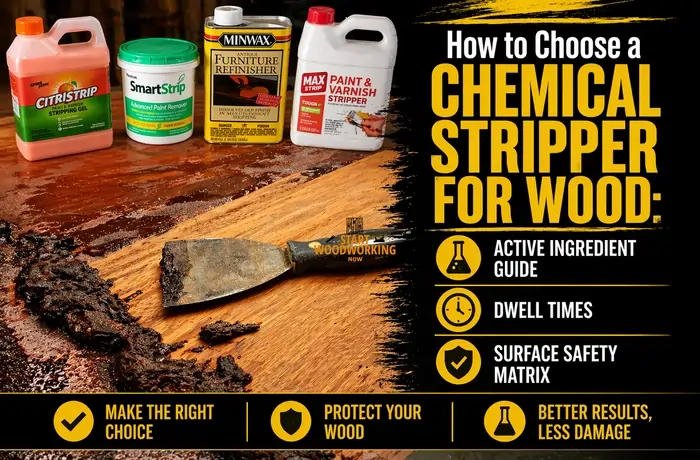
How to Choose a Chemical Stripper for Wood: Active Ingredient Guide, Dwell Times, and Surface Safety Matrix
Selecting a chemical stripper is a three-variable decision: the finish type determines which chemical can dissolve it; the surface construction determines whether a water-based formula is safe to use; and the workspace conditions determine how much dwell time and ventilation are available. Most product labels present stripper choice as a safety decision — methylene chloride vs. “safer alternatives” — without addressing these three variables. The result is that the most commonly purchased stripper (NMP-based gel, marketed as citrus-based) is applied to situations where it cannot work effectively: on multiple finish layers where NMP molecules are too large to penetrate through to the substrate; on veneered furniture where the water in NMP gel formulas lifts veneer and softens PVA joints; and on fully cured polyurethane where the 45–90 minute dwell time needed is not given because the label says “15–30 minutes.” Matching stripper to scenario is the primary driver of whether the job takes one application or four.
This guide covers the four active ingredient categories, the molecular size explanation for why some strippers work through multiple layers and others do not, the water-based veneer destruction risk, the temperature sensitivity of all chemical strippers, the dwell time matrix by finish type and active ingredient, and the scenario-based selection guide.
How Do You Choose a Chemical Stripper for Wood?
- Check the surface construction first. Veneered furniture, pieces with PVA glued joints, or furniture with plywood substrates: use solvent-based only (benzyl alcohol or methylene chloride). Any formula containing water — including NMP gel strippers — introduces moisture that lifts veneer and softens PVA joints. Solid hardwood: all formula types are safe.
- Match active ingredient to finish type. Shellac: denatured alcohol wipe — no gel stripper needed. Lacquer (nitrocellulose): lacquer thinner wipe — no gel stripper needed. Polyurethane/varnish: NMP gel (Citristrip) or benzyl alcohol gel, 45–90 minutes. Multiple coats (3+ layers): methylene chloride if available and ventilation is adequate, or benzyl alcohol at extended dwell under plastic film.
- “Citrus-based” and “soy-based” labels describe fragrance, not the active ingredient. Citristrip and most citrus-marketed strippers are 70–80% NMP with d-limonene added for scent. The active stripping work is done by NMP. Buying a “citrus stripper” when NMP is restricted in your area (California Prop 65, EU regulations) still exposes you to NMP.
- Apply plastic film over gel strippers. Immediately after applying any gel stripper, cover with plastic cling film pressed flat. This prevents solvent evaporation throughout the dwell period. Without plastic film, most strippers lose 40–60% of active solvent within 15 minutes — the “it didn’t work” experience is almost always a result of the stripper drying before dwell time is complete.
- Work above 15°C. Chemical strippers below 10°C slow to near-ineffective rates. The reaction between solvent and finish polymer depends on molecular mobility — cold conditions prevent the solvent molecules from diffusing through the finish film. At 5°C, a 45-minute dwell becomes a 4+ hour dwell. Move the piece indoors and warm the workspace to at least 18°C before applying any stripper.
→ Before choosing a stripper, identify your finish: How to Identify Wood Finish — Sequential Solvent Tests
→ After stripping: How to Refinish Wood After Stripping
→ Hub: How to Remove Wood Finishes — Complete Guide
What Is Actually in Chemical Strippers? The Active Ingredient Reality
Chemical stripper marketing consistently obscures the active ingredient. “Citrus-based,” “soy-based,” “eco-friendly,” and “biodegradable” describe either the fragrance source, a minor co-solvent, or the environmental fate of one ingredient — not the chemical that does the stripping. Understanding what is actually doing the work determines which product to buy for a specific scenario.
Why Does Methylene Chloride Strip Multiple Layers at Once When NMP Requires Multiple Applications?
This is the chemical explanation absent from every consumer guide — and the answer determines which stripper to choose for multi-coat renovation jobs.
Chemical strippers work by diffusing through the finish film, swelling the polymer chains, and breaking adhesion between the finish and the substrate. The rate of diffusion through a solid film depends directly on the size of the solvent molecule — smaller molecules diffuse faster and penetrate deeper in the same time period.
Methylene chloride (84.93 g/mol) has a molecular size small enough to diffuse through all layers of a multi-coat finish system in 10–20 minutes, reaching the substrate. When it reaches the substrate and breaks adhesion there, all the layers above lift simultaneously. This is why methylene chloride strips a 4-coat paint history to bare wood in one 20-minute application.
NMP (99.13 g/mol) and benzyl alcohol (108.14 g/mol) have larger molecules that diffuse more slowly through dense polymer films. As C&EN/TURI research confirms: these alternatives work one layer at a time. They can fully strip the top coat in one dwell period, but they do not reach the substrate simultaneously. A 4-coat system requires 3–4 applications with complete removal between each. This is not a product quality issue — it is a fundamental consequence of molecular size.
Once you have chosen the stripper, the next question is how long to leave it on — that depends on the finish, coat count, surface, and temperature, and is calculated in the dwell time reference.
The practical implication: for pieces with one or two coats of polyurethane or varnish, NMP or benzyl alcohol gel with adequate dwell time under plastic film is fully effective. For pieces with 3+ coats, unknown multi-generation finish history, or catalyzed industrial finishes, methylene chloride — where available and safe to use — is the only practical single-application option. Where MCl is not available or the workspace is not adequate for its use, benzyl alcohol at extended dwell (4–6 hours under plastic film) is the closest alternative for thick builds, accepting multiple applications.
Citristrip, Smart Strip, and most products sold with citrus branding contain NMP as the primary active ingredient at 70–80% of the formula. D-limonene (the citrus terpene) is added as a co-solvent that contributes secondary stripping activity and provides the orange scent — it is not the primary chemical doing the work.
The US patent for the NMP/d-limonene formula (US5478491A) describes it as an “NMP/d-limonene paint stripper” — the NMP component is listed first and at higher concentration. When selecting a stripper based on active ingredient, check the Safety Data Sheet (SDS) Section 3: if N-Methyl-2-pyrrolidone or 1-Methyl-2-pyrrolidinone appears in the composition at over 30%, the product is NMP-based regardless of citrus labelling.
Which Strippers Are Safe on Veneered Furniture and Glued Joints?
The most destructive mistake in furniture stripping is applying a water-based gel stripper to veneered furniture. This is a one-way operation — the veneer cannot be re-glued once it has swollen and lifted, and the delaminated veneer is typically too damaged and distorted to lay flat again.
The risk is not from the solvent itself but from the water content of the formula. Modern NMP gel strippers use water as a carrier to achieve gel consistency. That water penetrates around and under the veneer edges and softens the adhesive line between veneer and substrate — PVA glue softens above 50°C and when wetted with water. The gel’s extended dwell time (the feature that makes it effective) also gives the water maximum contact time with the veneer adhesive.
| Stripper Type | Water Content | Safe on Veneer? | Safe on PVA Joints? | Notes |
|---|---|---|---|---|
| Methylene chloride (solvent-based) | Zero | ✅ Yes | ✅ Yes | Solvent-only formula. Does not swell wood or soften water-sensitive adhesives. Risk is safety, not surface damage. |
| Benzyl alcohol (solvent-based) | Minimal to zero | ✅ Yes | ✅ Yes | Check SDS for specific product — most benzyl alcohol formulas are solvent-based. Back to Nature Multi-Strip confirmed safe on veneer. |
| NMP gel (Citristrip, Smart Strip) | Significant — water is carrier | ⚠️ Risk | ⚠️ Risk | PVA joints may soften at extended dwell. Thin modern veneer (under 0.6 mm) risk of lifting. Use on solid wood only. Short dwell (under 30 min) reduces but does not eliminate risk. |
| Caustic / lye-based | High — applied as solution | ❌ No | ❌ No | High water content. Also darkens tannin-rich woods. Not appropriate for furniture. |
| Lacquer thinner wipe (for lacquer) | Zero | ✅ Yes | ✅ Yes | Solvent-only. Lacquer thinner dissolves nitrocellulose lacquer in 2–5 minutes — faster than any gel. No water risk. |
| Denatured alcohol wipe (for shellac) | Zero | ✅ Yes | ⚠️ Mild risk at extended contact | Alcohol wets hide glue (common on antiques) at extended contact. Use short contact time (2–3 min per pass) on antique joints. |
What Are the Key Specifications for Chemical Stripper Selection?
| Entity / Variable | Attribute | Value |
|---|---|---|
| Methylene chloride (MCl) | Dwell time on single-coat oil-based polyurethane | 10–20 minutes. Surface bubbles and wrinkles as polymer lifts. Scrape immediately when lifting is visible — do not allow stripper to dry. |
| NMP gel (Citristrip) | Dwell time on single-coat oil-based polyurethane | 45–90 minutes minimum under plastic film. At 30 minutes (as many labels suggest), polyurethane will be softened but not fully lifted — requires more scraping effort. Under plastic film at 90 minutes: finish comes off in large sheets with minimal scraping. |
| NMP gel | Dwell time on water-based polyurethane (Polycrylic, water-based finish) | 30–60 minutes under plastic film. Water-based poly is less cross-linked than oil-based — responds faster to NMP. Test edge at 30 minutes: if lifting cleanly, proceed with scraping. |
| Benzyl alcohol (Back to Nature) | Dwell time on single-coat oil-based polyurethane | 60–120 minutes under plastic film. For thick coats or catalyzed finishes: extend to 3–4 hours under plastic. No harm in longer dwell — benzyl alcohol does not raise grain or damage wood at extended contact. |
| Lacquer thinner | Dwell time on nitrocellulose lacquer | 2–5 minutes per application — wipe with cloth, not scrape. Re-apply 3–4 times rather than extending single dwell. Lacquer thinner evaporates rapidly — plastic film not practical. Fast sequential wipes more effective than prolonged contact. |
| Denatured alcohol | Dwell time on shellac | 30–60 seconds per wipe for re-amalgamation (repair). For full removal: 3–5 minutes per pass with Scotch-Brite grey, wiping dissolved shellac between passes. 4–6 passes for full removal of thick shellac build. |
| Temperature — all chemical strippers | Minimum effective temperature | 15°C minimum for adequate reaction rate. At 10°C: dwell time approximately doubles. At 5°C: stripper is largely ineffective — molecules lack thermal energy to diffuse through finish film. For cold workshops: warm the piece with a heat lamp to 20°C before and during stripping, or move indoors. |
| Plastic film cover | Effect on dwell time and effectiveness | Without plastic film: solvent evaporates within 10–20 minutes of application, leaving partially-stripped finish that has dried out and re-hardened before full penetration occurs. With plastic film pressed flat: solvent retained at surface for full dwell period. A NMP gel without plastic film at 30 minutes produces the same result as NMP gel with plastic film at 10–15 minutes. Plastic film is not optional — it is what makes gel strippers work as specified. |
| Multiple coats — application count | NMP/benzyl alcohol on 3+ coat build | Two to four applications minimum for a 3–4 coat finish history, allowing full removal between each application. Applying second coat over partially-removed first coat reduces effectiveness — each application must be fully scraped and cleaned before the next is applied. MCl removes all layers in one application due to molecular penetration depth. |
| Scraping tool | Material by surface type | Plastic scraper: veneered furniture, antiques, and any surface where metal gouging is a risk. Steel scraper or putty knife: solid hardwood with flat surfaces where speed is a priority and the surface will be sanded after stripping. Brass-bristle brush: details, mouldings, carvings — avoids steel contamination on tannin-rich species. Never use steel wool or steel brushes on oak, walnut, or mahogany — iron particles cause dark iron-tannate staining. |
| Neutralisation after NMP gel | Agent and method | Mineral spirits wipe (removes d-limonene citrus oil residue that blocks stain and finish adhesion). Then baking soda solution (1 tsp per litre) to neutralise any mild acidity. Allow 24 hours drying. Full protocol in the post-stripping guide. |
| Neutralisation after caustic (NaOH) | Agent and method | Diluted white vinegar (1:10 in water) — neutralises alkaline residue. Wipe, allow 5 minutes, rinse with water. Mandatory — uncured NaOH residue prevents finish adhesion and continues darkening tannin species. |
| Lead paint — pre-1978 furniture | Stripper selection and safety | Dumond Peel Away 1 (lye-based) is specifically designed to encapsulate lead paint in the stripper residue for safe disposal — reduces airborne lead dust compared to sanding. Test with lead test kit before any sanding on pre-1978 pieces. Chemical stripping is safer than sanding with lead paint. |
Which Stripper for Which Scenario?
📝The most instructive stripper selection lesson in my workshop came from a 1970s oak veneer dining table — a piece the client had stripped themselves at home using Citristrip applied at 45 minutes and partially re-stripped three times without result. The problem was twofold: first, the NMP gel was lifting the veneer edges slightly on each application (visible at the corners) — a warning sign that was not recognised. Second, the workshop temperature was 8°C in November, which made even a 90-minute dwell inadequate. I moved the piece indoors at 20°C and used Back to Nature Multi-Strip (benzyl alcohol-based) at 90 minutes under plastic film — single application, complete removal of the alkyd varnish, no veneer movement.
How Do You Apply Gel Stripper Correctly?
The most consistent cause of gel stripper “failure” is application technique rather than product inadequacy. Three practices account for the majority of poor results: insufficient coat thickness, no plastic film cover, and inadequate dwell time.
STEP 1 Apply thick — minimum 3–4 mm coat, no brushing in
Apply gel stripper in a thick, uniform coat using a disposable paintbrush. Do not brush it in — the goal is to deposit a uniform reservoir of solvent on the surface, not to work it in.
Thin application means less total solvent per unit area, which means the solvent is consumed faster by the finish and less remains available for penetration. 3–4 mm minimum depth of gel is the correct working thickness. Apply to a manageable area at one time — 0.5–1 m² — rather than spreading over the entire piece before covering.
STEP 2 Cover immediately with plastic film — pressed flat
Immediately after applying stripper to a section, lay plastic cling film (food wrap or thin plastic sheeting) over the area and press flat with gloved hands. This traps the solvent vapour in contact with the finish surface and prevents evaporation during dwell.
Without plastic film: most gel strippers lose 40–60% of their active solvent within 15 minutes. The plastic film doubles or triples effective penetration within the same clock time. Press the edges down firmly — any gap allows vapour escape and creates a dry zone where the stripper will not penetrate.
STEP 3 Test at the edge before full removal
At the end of the specified dwell time, lift one corner of the plastic film and test the finish edge with a plastic scraper. The finish should lift cleanly with minimal pressure — it should feel like peeling a sticker from glass rather than scraping putty. If the finish still offers significant resistance: replace the plastic film and add 15–30 more minutes. Do not scrape a finish that has not fully lifted — forced scraping gouges the wood and creates an uneven surface that shows through any new finish.
STEP 4 Scrape in grain direction, wipe between passes
Remove lifted finish with a plastic scraper (veneered surfaces and antiques) or a steel scraper (solid hardwood flat surfaces). Hold the scraper at 30–45 degrees and work in grain direction. Wipe the scraper blade on a rag between each pass to avoid re-depositing dissolved finish on the clean surface. For detailed profiles, mouldings, and carvings: brass-bristle brush or wooden skewer, not steel tools.
STEP 5 Neutralise residue — mandatory before sanding or refinishing
After full removal: mineral spirits wipe (for NMP/citrus gel — removes d-limonene oil and NMP residue). Diluted vinegar 1:10 (for caustic strippers). Allow 24 hours drying. Full neutralisation protocol by stripper type in the post-stripping refinishing guide.
📝The plastic film discovery came from a comparative test on two identical chair seats — same finish (two coats Minwax Polyurethane), same Citristrip application thickness, same 60-minute dwell. One covered with plastic film, one uncovered. The uncovered seat showed partial lifting only and required a second application plus significant scraping effort. The plastic-covered seat lifted in complete sheets at 60 minutes with minimal scraping. The same amount of stripper, the same product, the same dwell time — the plastic film determined whether the job took one application or two. I now apply plastic film as an automatic step on every gel stripping job regardless of the product or surface.
Frequently Asked Questions About Choosing a Chemical Stripper
Is Citristrip the same as methylene chloride strippers?
No — they are completely different in both active ingredient and mechanism. Citristrip is primarily NMP (N-Methyl-2-Pyrrolidone) with d-limonene as a co-solvent. Methylene chloride is dichloromethane. NMP has a larger molecule than methylene chloride, which means it works one layer at a time with a 45–90 minute dwell, while methylene chloride penetrates multiple layers simultaneously in 10–20 minutes. NMP is banned at major retailers due to reproductive health concerns but is widely available online and through independent hardware stores. Methylene chloride is banned for consumer sale in the US (EPA 2019) but remains available through some channels for professional use.
Can I use Citristrip (NMP gel) on a veneered table?
Not recommended. NMP gel strippers use water as a carrier for the gel consistency. That water penetrates around veneer edges and under the veneer surface during the extended dwell time, softening the PVA adhesive that bonds the veneer to the substrate. Modern furniture veneer is typically 0.3–0.6 mm thick — once lifted by moisture, it cannot be re-glued flat. For veneered furniture: use benzyl alcohol-based gel (Back to Nature Multi-Strip) which is solvent-based without water, or the appropriate direct solvent (lacquer thinner for lacquer, denatured alcohol for shellac) if the finish type permits.
Why does my chemical stripper stop working in the winter?
Temperature is the primary variable. Chemical strippers depend on solvent molecules diffusing through the finish film — a process that requires thermal energy. At workspace temperatures below 10°C, molecular mobility drops significantly and the diffusion rate slows to near-ineffective levels. The stripper is not defective — the chemistry is being prevented by cold. Solution: warm the workspace to at least 15°C before applying stripper, or warm the piece with a heat lamp to bring the surface to 18–20°C. This is the most commonly misattributed “product failure” in furniture stripping.
How many applications of NMP gel stripper does it take to remove 4 coats of polyurethane?
Two to four applications, allowing complete removal between each. NMP’s molecular size prevents it from penetrating through multiple layers simultaneously — it works on the topmost accessible layer in each application. Complete scraping after each application removes that layer and exposes the next. Each successive layer typically responds faster than the first because it has been partially softened by solvent that penetrated through from the previous application. Budget 3–4 hours total for a 4-coat system at 60–90 minutes per application.
Summary: Key Values for Choosing a Chemical Stripper
Stripper selection is a three-variable decision: finish type, surface construction, and workspace. Methylene chloride (MCl): fastest (10–20 min), penetrates all layers simultaneously due to small molecular size (84.93 g/mol), banned for consumer use in US/EU, veneer-safe (no water), requires outdoor use. NMP gel (Citristrip, most “citrus-based” products): active ingredient is NMP — citrus is fragrance; works one layer at a time (45–90 min per application), reproductive toxin (Prop 65), banned at major retailers, contains water — veneer risk.
Benzyl alcohol (Back to Nature): safest mainstream option — non-carcinogenic, non-reproductive-toxin, solvent-based (veneer-safe), 60–120 min dwell, best for antiques and veneered furniture. Caustic/lye: fast on oil-based paint, darkens tannin species (no oak/walnut/mahogany), high water content (no veneer, no PVA joints).
Three universal rules: apply plastic film immediately after gel — doubles effectiveness; work above 15°C — cold stops all strippers; apply thick (3–4 mm) — thin application is depleted before penetration completes. Neutralise after stripping: mineral spirits wipe (NMP/citrus), vinegar 1:10 (caustic). Shellac and lacquer do not need gel stripper — denatured alcohol and lacquer thinner respectively are faster and cheaper.
→ Identify your finish first: How to Identify Wood Finish
→ After stripping: How to Refinish Wood After Stripping
→ Hub: How to Remove Wood Finishes — Complete Guide