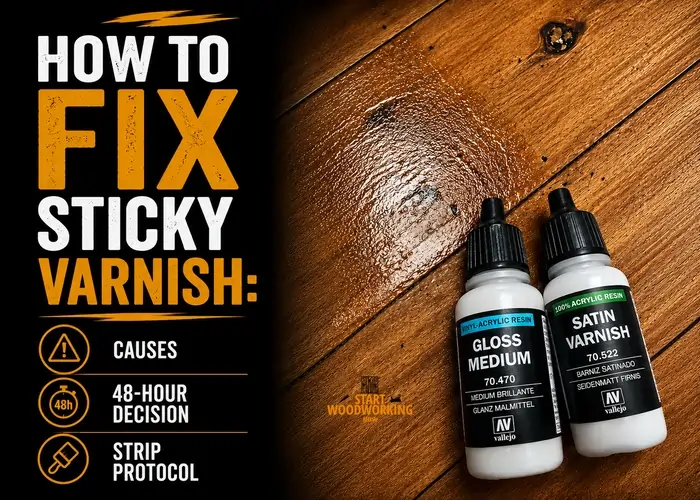
How to Fix Sticky Varnish: Causes, 48-Hour Decision, and Strip Protocol
Sticky varnish is almost always a curing problem, not a product problem — the varnish has been applied under conditions that prevent the alkyd polymer from completing its oxidative cross-linking reaction, or it has been applied in a coat thick enough that the surface has skinned over while solvent remains trapped underneath. Alkyd varnish (the most common type sold as “varnish” in hardware stores) cures in two stages: first, the mineral spirits carrier evaporates over 4–8 hours, then the alkyd polymer cross-links with atmospheric oxygen over the next 24–72 hours. Anything that interrupts either stage — humidity above 80%, temperature below 10°C, insufficient airflow, coat thickness above 100 microns, or contamination from silicone, wax, or oil — produces a film that remains tacky indefinitely. A coat of varnish that is still sticky at 48 hours has almost certainly failed to cure and will not self-resolve with more time. A coat sticky at 24 hours may only need better ventilation and another 24 hours. The diagnosis — determining which cause is responsible — determines whether the fix is to wait and ventilate, apply heat, or strip completely and restart. Applying a second coat over sticky uncured varnish compounds the problem: the new coat traps the uncured layer below and both remain permanently soft.
This guide covers the four stickiness types and how to distinguish them with a 30-second test, the exact temperature and humidity thresholds for alkyd varnish curing, the fix protocol for each cause, the 48-hour decision point between waiting and stripping, and the complete prevention protocol so the problem does not recur on the next application.
How Do You Fix Sticky Varnish?
- Diagnose the stickiness type first — the 30-second nail test: Press your thumbnail firmly into a hidden area of the tacky surface and hold for 3 seconds. Result A: nail leaves a clear indentation that remains = the varnish has not begun curing (cause: temperature/humidity/contamination). Result B: nail leaves a faint mark that partially springs back = varnish is curing but slowly (cause: low temperature or insufficient ventilation — give it more time with improved conditions). Result C: surface feels hard but slightly tacky to the touch with no nail indentation = surface skin formed over solvent-trapped interior (cause: coat too thick or second coat applied too soon).
- For slow curing (Result B) — improve conditions immediately: Move the piece to a warmer space (18–25°C minimum), increase ventilation with a fan directing air across the surface (not hot air — cool moving air is what drives solvent evaporation), and check humidity with a hygrometer — above 75% RH stops alkyd curing. Allow 24–48 additional hours under improved conditions before reassessing.
- For failed curing (Result A, or still tacky at 72 hours) — strip and restart: A varnish film that has not progressed toward curing at 72 hours under normal conditions will not self-cure. Applying additional coats over uncured varnish permanently traps the soft layer. Strip with NMP gel at 45–90 minutes, neutralise, sand at 120→150→180 grit, and identify the cause before reapplying.
- For trapped solvent (Result C) — the two options: If the surface skin is thin and the piece can wait: allow a minimum of 7 additional days at 20°C+ with strong ventilation — trapped solvent may slowly diffuse through the film. If the surface skin is thick (visible as a wrinkled or orange-peel texture) or after 7 days still soft underneath: strip completely — the solvent will not escape through a thick cured skin above it.
- For oil contamination from the wood — strip, treat, and re-seal: Oily tropical species (teak, rosewood, cocobelo, padauk, ipe) contain natural oils that migrate upward through varnish and prevent curing at the surface. Strip the varnish, wipe the bare wood with acetone or toluene to remove surface oils, allow 24 hours, then apply a shellac sealer coat (Zinsser SealCoat) before the varnish — shellac creates a barrier that prevents oil migration.
→ Hub: How to Remove Wood Finishes — Complete Guide
→ Remove varnish completely: How to Remove Varnish from Wood
→ Varnish types explained: What Is Varnish — Composition, Types, and Curing
→ Varnish vs polyurethane: Varnish vs Polyurethane — Curing Mechanism and Removal
Why Varnish Goes Sticky — The Curing Chemistry
Alkyd varnish cures through oxidative polymerisation — a chemical reaction where the alkyd polymer chains cross-link via oxygen from the atmosphere. This is a fundamentally different mechanism from the evaporation-only cure of lacquer or the moisture-activated cure of polyurethane. Understanding which stage of the two-stage cure has been interrupted identifies the correct fix.
The Four Causes of Sticky Varnish — Diagnosis and Fix
Temperature and Humidity Reference — Curing Windows for Alkyd Varnish
The most underestimated variable in varnish application is how dramatically temperature and humidity change the curing timeline. A varnish that cures in 24 hours at 22°C and 50% RH requires 96+ hours at 10°C and 70% RH — in a cold damp workshop, a second coat applied after “a day of drying” is almost always applied before the first coat has completed Stage 2 curing.
| Temperature | Humidity | Touch-dry (Stage 1) | Recoat-ready (Stage 2 partial) | Full cure | Status |
|---|---|---|---|---|---|
| 22–25°C | 40–60% RH | 4–6 hours | 18–24 hours | 5–7 days | ✅ Ideal conditions |
| 18–22°C | 50–65% RH | 6–8 hours | 24–30 hours | 7–10 days | ✅ Acceptable |
| 15–18°C | 60–70% RH | 8–12 hours | 36–48 hours | 14–21 days | ⚠️ Slow — extend drying times |
| 10–15°C | 65–75% RH | 12–20 hours | 72–96 hours | 30–45 days | ⚠️ High risk — check before recoating |
| Below 10°C | Any | 24–48+ hours | May never reach | Indeterminate | ❌ Do not apply — curing stops |
| Any | Above 80% RH | Unpredictable | May never reach | Indeterminate | ❌ Do not apply — Stage 2 blocked |
The 48-Hour Decision Point — Wait vs Strip
The most important tactical decision in fixing sticky varnish is whether to wait or to strip. Waiting too long on a varnish that will never cure wastes days. Stripping too early on a varnish that merely needs better conditions wastes the entire applied coat. The 48-hour rule provides a reliable decision point.
Wait — If ALL of these are true
- Stickiness appeared within the first 24 hours
- Temperature was below 15°C during or after application
- Nail test shows partial spring-back (Result B — curing but slow)
- No wrinkling or orange-peel texture is visible
- The piece can be moved to warmer, drier conditions
- No second coat has been applied over the tacky layer
Action: Move to 20°C+, fan ventilation, re-assess at 24h intervals. Maximum wait: 7 days.
Strip — If ANY of these are true
- Still soft and tacky at 72 hours under good conditions (18°C+, under 70% RH)
- Nail leaves deep indentation with no spring-back (Result A)
- Wrinkling or severe orange-peel texture is visible
- A second coat was applied over the tacky layer
- Surface is from an oily wood species (teak, rosewood, padauk)
- Wax or silicone was present on the surface before varnishing
Action: Strip with NMP gel 45–90 min. Identify and eliminate cause. Restart. Do not add more coats.
Never apply another coat of varnish over sticky varnish. The additional coat seals the uncured layer below permanently and both layers remain soft. The only way to fix a second coat applied over a sticky first coat is stripping both layers completely — significantly more work than addressing the original stickiness before recoating.
Oily Wood Species — Why They Cause Sticky Varnish and the Shellac Sealer Solution
Some of the most desirable wood species for furniture and outdoor applications — teak, rosewood, cocobelo, padauk, ipe, olive, ebony — contain natural oils that directly interfere with alkyd varnish curing. This is not a product quality issue and is not resolved by changing brands or applying thinner coats. It is a chemistry incompatibility that requires a barrier between the wood’s natural oils and the varnish.
| Species | Oil Type | Varnish Risk | Required Prep |
|---|---|---|---|
| Teak | Tectoquinone (high concentration) | Very High | Acetone wipe × 2–3, 24h wait, shellac sealer coat mandatory |
| Rosewood | Dalbergiones and other phenolic oils | Very High | Acetone or toluene wipe, shellac sealer coat mandatory |
| Padauk | Padauk oils (volatile, orange pigment) | High | Acetone wipe, shellac sealer, test in hidden area first |
| Ipe | Lapachol and other oils | Very High | Acetone wipe, 48h wait, shellac sealer mandatory |
| Cocobolo | Dalbergiones (same family as rosewood) | Very High | Acetone wipe, shellac mandatory — consider oil finish instead |
| Olive | Oleic acid and phenolics | Moderate | Acetone wipe, shellac sealer recommended |
| Ebony | High resin and oil content | Moderate–High | Acetone wipe, shellac sealer, test in hidden area |
| Oak, walnut, pine, maple | Low natural oil content | Low | Standard prep — no shellac sealer required |
Complete Strip and Restart Protocol — When the Fix Is to Start Over
Sticky varnish and tacky polyurethane fail through the same mechanism — curing that stalled from cold, humidity, or a coat applied too thick. The finish troubleshooter works through those causes by the pattern you can see and tells you which are recoverable without stripping.
What Are the Key Specifications for Fixing and Preventing Sticky Varnish?
| Entity / Variable | Attribute | Value and Detail |
|---|---|---|
| Maximum coat thickness per application | Wet film thickness limit to prevent solvent trapping | 75–100 microns wet film thickness maximum per coat (approximately 50–65 microns dry film). Practical guide: a coat applied with a quality 65mm brush in two smooth parallel passes in grain direction, without back-brushing, stays within this limit. A coat applied by flooding, back-brushing multiple times, or building up at edges will exceed it. Use a notched spreader with a 75-micron notch setting for precise control on flat surfaces. Thinning varnish 10% with mineral spirits reduces the risk of thick coats and improves levelling — most manufacturer guidelines recommend thinning the first coat. |
| Minimum recoat window at 20°C | How to confirm the previous coat is genuinely ready for recoating | Manufacturer’s label “recoat after X hours” is the minimum under ideal conditions (20°C, 50% RH). The reliable confirmation test is touch-dry plus 2 hours: press the back of your knuckles firmly onto the surface — zero tackiness and no knuckle mark = safe to recoat. Any residual stickiness or impression = not ready. At 15°C, add 50% to the manufacturer’s stated time. At 10°C, double it. Never trust time alone without the knuckle test — a workshop that dropped to 8°C overnight resets the curing clock regardless of elapsed time. |
| NMP gel stripping protocol for sticky varnish | Correct dwell time on uncured vs cured varnish | Sticky uncured varnish responds to NMP gel faster than fully cured varnish: dwell time 30–45 minutes for varnish that has not completed curing (softer polymer network). Fully cured old varnish: 45–90 minutes. Apply plastic film cover regardless — uncured varnish may still evaporate solvent and interfere with the gel. After NMP removal: neutralise with white vinegar 1:1, rinse with damp cloth, allow 24h dry. Confirm bare wood with the blade scrape test before sanding. Starting grit after stripping uncured varnish: 120 grit — NMP raises grain but does not leave the heavy residue that requires 80-grit start. |
| Shellac sealer coat on oily species | Product, dilution, coat count, and compatibility with topcoat | Product: Zinsser SealCoat (dewaxed shellac in denatured alcohol) or Bulls Eye Shellac (dewaxed, 2lb cut). Dilution: apply undiluted from the can at 2lb cut for first sealer coat. Coat count: one sealer coat is sufficient as an oil barrier for most oily species. For teak and rosewood with extreme oil content: two sealer coats, allowing 1 hour between coats. Drying time: 45–60 minutes touch dry at 20°C, 2 hours before topcoat. Compatibility: dewaxed shellac is compatible under all topcoats including oil-based and water-based varnish, polyurethane, lacquer, and paint. Waxed shellac (Bulls Eye original formula, amber) is NOT compatible under polyurethane or water-based finishes — the wax prevents adhesion. Use dewaxed (SealCoat or Bulls Eye clear) only. |
| Wax and silicone contamination prevention | How to confirm contamination-free surface before varnishing | Wax contamination test: naphtha evaporation test — apply a few drops of naphtha to the bare wood surface, wait 10–15 seconds for evaporation. Uniform absorption into grain = wax-free. Beading or slow absorption = wax present (mineral spirits passes required). Silicone contamination test: water bead test — drops must spread and absorb, not bead. If beading occurs: sand to 80 grit and retest. No chemical solvent eliminates silicone from wood grain — only sanding removes the contaminated surface layer. Before applying any varnish to previously waxed furniture: mineral spirits wipe, naphtha evaporation test, 120-grit scuff, wipe with tack cloth. |
| Brush cleaning — silicone and wax contamination from brushes | How contaminated brushes cause sticky varnish and prevention | A brush previously used with wax-based products or cleaned with silicone-containing brush conditioner introduces contamination to varnish even after thorough mineral spirits cleaning. Silicone-contaminated brushes produce fish-eye and inhibit curing across the entire application area. Prevention: dedicate separate brushes to varnish, wax, and oil finishes — never cross-use. For a brush with unknown contamination history: wash with dish soap and warm water (removes both wax and most silicone), rinse thoroughly, allow to dry fully before use. A new brush straight from packaging: wash once with dish soap and warm water before first use — removes any factory preservatives or conditioning agents. |
Prevention — The Application Protocol That Prevents Sticky Varnish
Pre-Application Checklist — Confirm All Before Opening the Can
Workspace minimum 18°C. Confirm it will hold 18°C+ for the next 48 hours — check the forecast if working in an unheated space.
Measure with a hygrometer — under 70% RH. Above 70%: postpone. Above 75%: do not apply regardless of temperature.
Naphtha evaporation test (wax). Water bead test (silicone). Acetone wipe on oily species. All tests must pass before proceeding.
Dedicated varnish brush only — never cross-used with wax or oil products. Washed with dish soap if unknown history. Dry.
First coat thinned 10% with mineral spirits. Maximum 2 parallel brush passes per section, no back-brushing. Tip off each section.
Knuckle test confirms zero tackiness before recoating — never rely on elapsed time alone. Add 50% to stated time at 15°C, double it at 10°C.
📝The sticky varnish problem I encounter most often is not on the first coat — it is on the second coat applied over a first coat that was not genuinely ready. The first coat feels tack-free to a light fingertip touch after 18 hours in a cold workshop, and the second coat goes on. What felt dry was a surface skin with an uncured layer beneath. The second coat seals that in. Three weeks later the piece is still soft and the owner cannot understand why because it has been “drying for three weeks.” The fix at that point is stripping both layers. The knuckle test — pressing the back of your knuckles with real pressure for 3 seconds — would have shown that the first coat was not ready. A fingerprint impression at 18 hours means another 12–24 hours minimum before recoating. On the workshop temperature question: most woodworkers heat their workshop during working hours and let the temperature drop overnight. A coat applied at 18°C at 6pm, then left in a workshop that dropped to 8°C overnight, effectively pauses its curing for those cold hours. The elapsed time on the clock does not count the cold hours toward curing time. I now require that the workshop minimum overnight temperature is above 15°C before I begin any varnish project — otherwise the timing of the whole job becomes unreliable.
Sticky varnish and tacky polyurethane fail through the same mechanism — curing that stalled from cold, humidity, or a coat applied too thick. The finish troubleshooter works through those causes by the pattern you can see and tells you which are recoverable without stripping.
Frequently Asked Questions About Sticky Varnish
How long does it take for sticky varnish to cure on its own?
If the stickiness is caused by low temperature or borderline humidity and the varnish has genuinely begun Stage 2 curing (nail test shows some resistance and partial spring-back), moving to better conditions — above 18°C and below 70% RH with ventilation — typically resolves the stickiness in 24–48 additional hours. If the varnish shows no resistance at all in the nail test after 48 hours, or if it has been 72+ hours with no improvement under good conditions, it will not self-cure. The curing reaction has been blocked by contamination or incompatibility — more time under any conditions will not change the outcome.
Can you sand sticky varnish to fix it?
No. Sanding uncured or partially cured varnish produces one of two results: either the varnish clogs the sandpaper within seconds, making sanding impossible and loading the paper with soft sticky material that tears rather than cuts; or, if the surface skin has formed over a soft interior, sanding cuts through the skin and exposes the uncured layer below — worsening the situation. Sanding is the correct approach only after stripping the sticky varnish completely down to bare wood and confirming clean, dry, contamination-free wood before re-application.
Does varnish go sticky in cold weather?
Yes — cold temperature is one of the primary causes of sticky varnish. Below 10°C, the oxidative cross-linking reaction (Stage 2) that converts the alkyd film from a soft gel to a hard finish essentially stops. The varnish sits in a permanently uncured state until temperatures rise above 10°C for an extended period. Varnish applied in a cold garage in autumn or winter, then left in those conditions, may never fully cure regardless of how many weeks pass. The remedy if the varnish is still in early Stage 2 (some resistance in nail test): bring indoors to 18–25°C and allow the reaction to complete. If already at 72+ hours with no progress: strip and restart under temperature-controlled conditions.
Summary — Key Values for Fixing Sticky Varnish
Alkyd varnish cures in two stages: Stage 1 (mineral spirits evaporation, 4–8 hours at 20°C) and Stage 2 (oxidative cross-linking, 18–72 hours at 20°C). Stickiness results from interruption of either stage. Nail test Result B (partial spring-back) = curing but slow — improve conditions (18°C+, under 70% RH, fan ventilation), re-assess at 24h. Nail test Result A (deep indentation, no spring-back) = curing failed — strip at 72h if no improvement.
Temperature below 10°C = curing stops. Humidity above 80% RH = curing blocked. Coat too thick or second coat too soon = solvent trapped under skin — wait 7 days or strip. Oily species (teak, rosewood, ipe, padauk, cocobelo): acetone wipe bare wood, dewaxed shellac sealer coat mandatory before varnish.
Maximum wet film thickness: 75–100 microns per coat. Minimum recoat: knuckle test zero tackiness. Never apply second coat over sticky varnish — traps uncured layer permanently. Strip: NMP gel 30–45 min on uncured varnish, neutralise white vinegar 1:1, 24h dry, sand 120→150→180, water drop test, eliminate cause before reapplication. Wax contamination: mineral spirits + naphtha evaporation test. Silicone contamination: 80-grit sand + water bead test. Brush contamination: wash with dish soap, dedicate separate brushes per product type.
→ Remove varnish completely: How to Remove Varnish from Wood
→ Remove old finish (all types): How to Remove Old Finish from Wood
→ Choose the right stripper: How to Choose a Chemical Stripper
→ Hub: How to Remove Wood Finishes — Complete Guide