
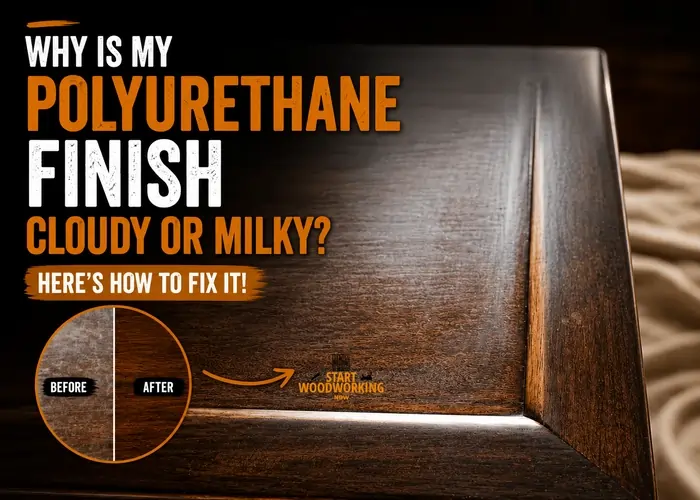
Why Is My Polyurethane Finish Cloudy or Milky?
Cloudy or milky polyurethane is caused by moisture becoming trapped in the finish film during application or curing. The moisture source — ambient humidity, cold temperatures, wet wood, or surface contamination — determines whether the cloudiness clears on its own or requires sanding and recoating.
Applying a new coat over cloudy polyurethane without identifying the cause compounds the failure. Each additional coat seals in the existing cloudiness and adds a new layer where the same condition can recur.
This article is part of the complete wood finish troubleshooting and removal reference — covering all finish failure types, chemical strippers, and post-stripping protocols.
Five conditions cause polyurethane to turn cloudy or milky:
- Humidity above 65% RH during application — moisture condenses in the partially cured film, creating light-scattering micro-droplets in the polymer matrix
- Temperature below 60°F (15°C) — slows curing and allows moisture to remain trapped in the film longer than the polymer can accommodate
- Wet or damp wood substrate — moisture content above 12% releases water vapour into the wet finish from below
- Surface contamination (wax, silicone, oil) — prevents the finish from bonding continuously, creating hazy patches where the film is discontinuous
- Water-based polyurethane applied too cold — film coalescence fails below 55°F (13°C), producing a white, powdery, or hazy surface
Navigate to your scenario
→ Cloudiness appeared during or right after application? — Humidity or temperature blush → Why Does Polyurethane Turn Milky from Humidity? ↓
→ Cloudy only in patches, not uniformly? — Contamination → Why Is Polyurethane Cloudy in Patches? ↓
→ Second coat cloudy, first coat was fine? — Recoat too soon or wrong conditions → Why Is the Second Coat of Polyurethane Cloudy? ↓
→ Need to fix existing cloudiness now? — Can You Fix Cloudy Polyurethane Without Stripping? ↓
Cloudiness from contamination (wax, silicone, oil) never clears on its own. Stripping back to bare wood is the only resolution.
Why Is My Polyurethane Finish Cloudy or Milky?
Polyurethane turns cloudy when moisture becomes trapped in the curing film. Humidity above 65% RH or temperature below 60°F produces this effect in oil-based polyurethane. Water-based polyurethane clouds when applied below 55°F because film coalescence fails.
| Cause | Identifying Condition | Symptom Pattern | Clears Without Stripping? |
|---|---|---|---|
| Humidity above 65% RH | High RH during or after application | Uniform milky haze, whole surface | Sometimes — within 24–48h if mild |
| Temperature below 60°F | Cold workshop or cold surface | Uniform haze, may clear as room warms | Often — correct temperature, wait 24h |
| Wet wood substrate | Wood moisture content above 12% | Haze concentrated at surface, may bubble | No — must strip, dry wood to below 12% |
| Wax or silicone contamination | Previous wax finish or silicone spray | Hazy patches, fish-eye craters present | No — must strip and clean contamination |
| Water-based applied too cold | Below 55°F (13°C) during application | White, powdery, or flat hazy surface | No — coalescence failure requires sanding |
| Recoated too soon over blush | Second coat applied before first coat cleared | Intensified cloudiness in second coat | No — both coats require sanding |
The moisture-condensation mechanism is the same as NC lacquer blush — different chemistry, same physics — the lacquer blush mechanism with retarder fix.
Why Does Polyurethane Turn Milky from Humidity?
Humidity above 65% RH causes oil-based polyurethane to turn milky because moisture condenses inside the partially cured film. The condensed water creates light-scattering micro-droplets in the polymer matrix — producing the white or milky appearance. Mild humidity blush on oil-based polyurethane clears within 24–48 hours as the film continues to cure and moisture evaporates.
Humidity blush [occurs when] ambient moisture [contacts] the polyurethane film before the surface has fully skinned. Moisture [condenses] at the film surface when the surface temperature [drops below] the dew point — even briefly. The condensed moisture [becomes trapped] in the polymer matrix as curing proceeds around it.
The dew point relationship is the key variable. The wood surface [must be] at least 5°F (3°C) above the ambient dew point for safe oil-based polyurethane application. At 70°F and 70% RH, the dew point [is] approximately 59°F. A concrete floor or exterior-adjacent wall [running] at 60°F in those conditions [is] at dew point — moisture [will] condense in any finish applied to that surface.
📝In workshop conditions over autumn and winter, humidity blush is the most predictable finish failure I encounter. The cause is consistently the same: the workshop thermostat reads 68°F but the concrete floor reads 58°F. All humidity blush I have seen on floors in these conditions cleared within 36 hours after raising the floor temperature — without sanding, without recoating.
| Condition | Minimum | Optimal | Maximum |
|---|---|---|---|
| Temperature | 60°F / 15°C | 65–75°F / 18–24°C | 85°F / 29°C |
| Relative Humidity | — | 40–55% RH | 65% RH |
| Surface vs. Dew Point | +5°F above dew point | +10°F above dew point | — |
| Wood Moisture Content | — | 6–10% | 12% |
Does Cloudy Polyurethane Go Away on Its Own?
Mild humidity blush in oil-based polyurethane clears on its own within 24–48 hours when the humidity drops below 55% RH and temperature stays above 65°F. Cloudiness from contamination, wet wood, or water-based coalescence failure never clears without intervention.
Can You Fix Cloudy Polyurethane Without Stripping?
Mild humidity blush in oil-based polyurethane fixes without stripping if the finish has not fully hardened. Correct the humidity and temperature, wait 48 hours. If cloudiness remains, sand with 320-grit and recoat in controlled conditions. Contamination-caused cloudiness always requires stripping.
Fix Protocol — Humidity Blush (Oil-Based, Still Soft)
- Run a dehumidifier to bring workspace RH below 50%. Raise temperature to 68–75°F.
- Wait 24 hours without touching the finish. Check: has the milky appearance reduced?
- At 48 hours — if cloudiness has cleared: sand lightly with 320-grit, wipe with tack cloth, apply next coat in correct conditions.
- At 48 hours — if cloudiness remains but finish is firm: sand with 220-grit to remove the failed layer, wipe clean, recoat thinned 10%.
- At 72 hours with no improvement: strip the polyurethane back to bare wood and restart in controlled conditions.
Fix Protocol — Contamination (Wax, Silicone, Oil)
- Strip the cloudy finish using NMP gel stripper — dwell time 45–60 minutes under plastic film.
- Wipe bare wood with mineral spirits — 3 passes minimum on clean rags. Each pass on a fresh rag section.
- For silicone contamination: follow with denatured alcohol — 2 passes. Silicone [is not removed] by mineral spirits alone.
- Run the water drop test on bare wood. Water [must spread and absorb] within 30 seconds. Beading [means] contamination [remains] — repeat cleaning.
- Allow 24 hours dry time. Sand 120→150→180 grit. Apply polyurethane in controlled conditions: below 55% RH, above 65°F.
Fix Protocol — Wet Wood Substrate
- Strip the cloudy finish completely.
- Measure wood moisture content with a pin-type moisture meter. Target: below 12% before any finish application.
- Allow the piece to acclimate in a heated, dry space — 68°F, below 50% RH — for minimum 72 hours after stripping. Check moisture content again before proceeding.
- Sand 120→150→180 grit on dry bare wood. Apply first coat thinned 10%. The thinned first coat [seals the surface] without trapping moisture from the grain.
Cloudy finish over stain is often a stain-still-wet problem rather than a polyurethane problem — the staining protocol with topcoat timing requirements.
Why Is Polyurethane Cloudy in Patches?
Polyurethane that is cloudy only in patches — not uniformly across the surface — indicates surface contamination rather than humidity or temperature. Wax, silicone, or oil residues prevent the finish from bonding continuously to the substrate, creating hazy or discontinuous areas where the film lacks adhesion.
Wax contamination [produces] hazy patches because wax [prevents] polyurethane [from] forming a continuous film. Polyurethane [bonds to] clean wood fibres directly. Over wax, polyurethane [sits on top of] the wax layer without bonding — the film [appears] dull or hazy where the wax [is] present.
Silicone contamination [produces] fish-eye craters alongside cloudiness. Fish-eye [is] circular depressions where the finish [has pulled away] from a silicone-contaminated point. Silicone [migrates across] surfaces from any aerosol product used in the workspace — furniture polish, silicone spray lubricant, or silicone-based wax applied to the workbench surface.
Patchy cloudiness from contamination [requires] complete stripping. Removing wax contamination before applying any new finish requires a specific protocol — mineral spirits alone is insufficient for silicone, and wax in grain pores requires multiple passes with fresh rags to fully remove.
Why Is the Second Coat of Polyurethane Cloudy?
A cloudy second coat over a clear first coat indicates the first coat had not fully cured before recoating, or conditions changed between the two applications. Solvents in the second coat re-enter the still-curing first coat and trap moisture in the combined film.
Oil-based polyurethane [requires] minimum 24 hours between coats at 65–75°F and below 55% RH. Recoating at 18 hours [leaves] residual solvents in the first coat. The second coat’s solvents [combine with] the first coat’s uncured chemistry — the combined layer [retains moisture] longer than either coat alone.
The second-coat cloudiness scenario [is] the most common failure mode when conditions were good for the first coat but changed before the second. A humidity increase overnight from 48% to 72% RH — common in autumn — [produces] a clear first coat and a milky second coat applied the following morning, even with identical technique.
Fix: Sand both coats with 220-grit until the surface is flat and uniform in sheen. Wipe with tack cloth. Check and record humidity and temperature before applying the next coat. Apply a single thin coat thinned 10% in confirmed correct conditions.
Do Not
Apply a third coat over two cloudy coats without sanding. Each additional coat seals in the existing cloudiness and adds a new layer where moisture can be trapped again. Sand back to firm, uniform material before any new coat — regardless of how many coats are already on the surface.
Why Does Polyurethane Look Cloudy in Cold Weather?
Cold weather causes polyurethane cloudiness through two mechanisms depending on finish type. Oil-based polyurethane clouds in cold because oxidative polymerization slows, extending the window for moisture to enter the film. Water-based polyurethane clouds in cold because film coalescence fails below 55°F — the acrylic-urethane particles cannot fuse into a continuous film at low temperature.
Oil-based polyurethane [cures through] oxidative polymerization at minimum 60°F. Below 60°F, curing [slows] proportionally. At 50°F, curing [takes] twice as long. The extended curing window [allows] atmospheric moisture [to enter] the film before the polymer matrix [closes around it].
Water-based polyurethane [fails differently] in cold. Coalescence — the stage where suspended acrylic-urethane particles [fuse into] a continuous film — [requires] minimum 55°F (13°C). Below that threshold, particles [remain separate] and the film [appears] white, powdery, or hazy. Warming the finish after coalescence failure [does not reverse] the damage — the film structure [has set] in a non-coalesced state.
Critical check for cold workshops: Press the back of your hand to the wood surface before application. The surface [must feel] the same temperature as the room air. Cold concrete floors, stone surfaces, and exterior-adjacent walls [absorb and store] cold — a 65°F room [can have] a 52°F floor surface that [produces] cloudiness in any finish applied to it.
Cloudiness and tackiness share a root cause more often than people expect — both point to moisture or solvent that never left the film. If your surface is soft as well as hazy, run both symptoms through the finish troubleshooter to see which cause explains them together.
How Do You Prevent Polyurethane from Going Cloudy?
Six preparation steps prevent polyurethane cloudiness in all standard scenarios. Temperature, humidity, and surface cleanliness [are] the three variables that determine the result — technique accounts for the remaining risk.
- Check and record temperature and humidity before every coat — not just before the first coat. Conditions can change between coats. Target: 65–75°F, below 55% RH. Check the actual wood surface temperature, not the thermostat.
- Measure wood moisture content before the first coat — pin-type moisture meter on the finish surface. Maximum 12%, optimal 6–10%. Fresh lumber, recently wetted wood, or pieces moved from outdoor storage [require] 48–72 hours of indoor acclimation before finishing.
- Clean the surface with mineral spirits before application — 2 passes minimum on clean rags, in grain direction. Allow 30 minutes of evaporation time. Mineral spirits [removes] oil and wax residues that cause patchy cloudiness.
- Thin the first coat 10% with mineral spirits (oil-based) or water (water-based). A thinned first coat [penetrates] the grain surface rather than sitting on top of it — reducing the risk of moisture being trapped between the finish and the wood.
- Maintain conditions during the full dry period, not just during application. Oil-based polyurethane [requires] 24 hours in controlled conditions to reach the recoat window. A humidity increase 6 hours after application [can produce] blush in a coat that looked perfect when applied.
- Do not apply polyurethane over any previous wax finish without confirming complete wax removal. The naphtha evaporation test [confirms] wax-free surfaces: apply naphtha, wait 15 seconds — clean evaporation [means] no wax, a ring or slow-absorbing area [means] wax remains.
For cloudy finish that won’t clear with heat fusion, wet-sanding through the haze followed by re-coating is the rescue — the wet sand polyurethane protocol.
Cloudiness and tackiness share a root cause more often than people expect — both point to moisture or solvent that never left the film. If your surface is soft as well as hazy, run both symptoms through the finish troubleshooter to see which cause explains them together.
Frequently Asked Questions
How long does it take for cloudy polyurethane to clear?
Mild humidity blush in oil-based polyurethane clears in 24–48 hours after humidity drops below 55% RH and temperature stays above 65°F. Cloudiness that has not reduced within 48 hours of corrected conditions will not self-resolve and requires sanding. Water-based polyurethane cloudiness from coalescence failure never clears on its own.
Can you sand out cloudy polyurethane?
Yes, for single-layer cloudiness that has fully hardened. Sand with 220-grit until the haze is gone and the surface is uniformly flat. Progress to 320-grit for final smoothing. Wipe with a tack cloth and apply one thin coat thinned 10% in correct conditions. Cloudiness from contamination requires stripping to bare wood, not sanding through the finish layers.
Does oil-based or water-based polyurethane cloud more easily?
Oil-based polyurethane clouds from humidity — above 65% RH. Water-based polyurethane clouds from cold — below 55°F. Oil-based humidity blush sometimes self-resolves. Water-based coalescence failure never does. In workshops without climate control, oil-based is more forgiving across autumn and winter because its cloudiness failure mode is correctable and humidity blush on oil-based often clears without intervention.
Why is my polyurethane cloudy near the edges only?
Cloudiness concentrated at edges indicates two possible causes. On furniture, edges and end grain have higher moisture content than face grain — the elevated moisture releases as vapour into the wet finish, producing localised blush. On floors, edges near exterior walls run colder than the room centre — cold surface temperatures at edges produce localised humidity condensation even when the central floor finish is clear.
Can a heat gun fix cloudy polyurethane?
A heat gun at low setting held 8–10 inches from the surface can sometimes re-fuse mild oil-based humidity blush while the finish is still within the first 12 hours of application. Move the gun continuously — never hold it stationary. This technique works only on mild blush in the early curing stage. It does not work on dried cloudiness, coalescence failure, or contamination-caused haziness. The risk — bubbling and blistering from overheating — outweighs the benefit except in controlled hands-on experience.
Why does polyurethane look clear when wet but cloudy when dry?
Polyurethane that looks clear when wet but clouds as it dries is experiencing moisture entrapment during the skinning stage. The wet film fills the surface with solvent, masking any haze. As the solvent evaporates and the film skins, moisture condensed inside the film becomes visible as the clear polymer matrix forms around the trapped water droplets. This is the defining mechanism of humidity blush — and the reason it can appear in a coat that looked perfect during application.