
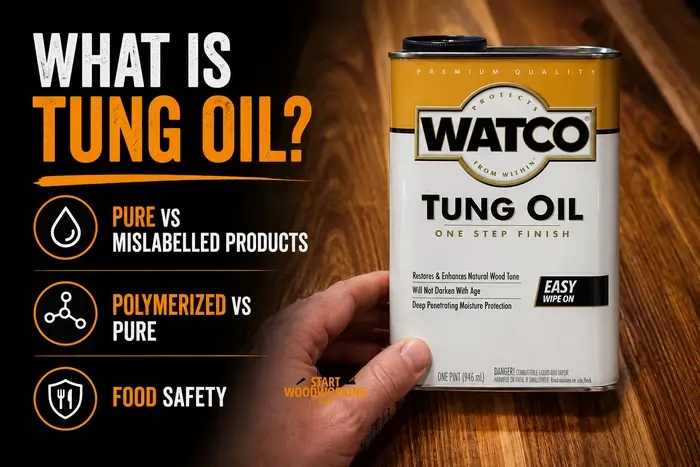
What Is Tung Oil? Pure vs Mislabelled Products, Polymerized vs Pure, and Food Safety
Tung oil is a natural drying oil pressed from the seeds of the tung tree (Vernicia fordii), native to China. It penetrates into the wood grain rather than forming a surface film, curing through oxidative polymerization — the oil reacts with oxygen in the air to form a solid, flexible, water-resistant polymer within the wood structure. Of all the penetrating oil finishes, pure tung oil produces the most water-resistant result because its primary fatty acid — alpha-eleostearic acid — contains three conjugated double bonds that form a denser cross-linked polymer network than linseed oil or danish oil.
This guide is part of the complete wood finishing guide. For comparison with danish oil — the most commonly confused finish with tung oil: Danish Oil vs Tung Oil →
The most important thing to understand about tung oil is that most products sold under the name “tung oil” at hardware stores contain little or no actual tung oil. Minwax Tung Oil Finish, Formby’s Tung Oil Finish, and similar retail products are naphtha-based wiping varnishes — they behave and perform like diluted alkyd varnish, not like a drying oil. Pure tung oil and these varnish blends are functionally different products with different chemistry, different cure times, and different food safety profiles.
Navigate to your question
→ What is tung oil and how does it work? → Mechanism and water resistance explained ↓
→ Is my “tung oil” really tung oil? → How to identify genuine vs mislabelled products ↓
→ Pure vs polymerized — which should I buy? → Differences in cure time and viscosity ↓
→ Can I use it on teak or oily wood? → Acetone pre-wipe protocol ↓
→ Is tung oil food-safe for cutting boards? → What’s safe vs what’s not ↓
⚠ Spontaneous Combustion Risk — Tung Oil Application Rags
Tung oil is a drying oil that generates heat through oxidative polymerization as it cures. Rags saturated with tung oil can ignite without external flame. After every application: spread used rags flat outdoors on a non-combustible surface until fully dry, or submerge in a sealed metal container filled with water. Never bundle, fold, or place in a bin. Products labelled “tung oil finish” that are actually varnish blends carry this risk if they contain any drying oil component — treat all tung oil rags as combustion risk.
⚠ Food Safety — Pure Tung Oil Only
Only 100% pure tung oil or 100% polymerized tung oil with no added metallic driers or petroleum solvents is food-safe when fully cured. Products labelled “tung oil finish,” “tung oil stain,” or similar may contain cobalt or manganese driers and petroleum-based solvents — these are not food-safe regardless of cure time. For cutting boards and food-contact surfaces, the label must confirm 100% pure or polymerized tung oil with no additives. Minimum cure time before food contact: 15 days at room temperature.
What Is Tung Oil and How Does It Work as a Wood Finish?
Tung oil is a penetrating drying oil that cures inside the wood grain through oxidative polymerization — the unsaturated fatty acids in the oil react with atmospheric oxygen, breaking and reforming molecular bonds to create a solid, inert polymer network within the wood cell structure. The cured oil does not sit on the wood surface as a film; it becomes part of the wood structure, filling the cell cavities and lumen walls.
The exceptional water resistance of tung oil compared to other drying oils comes from the molecular structure of alpha-eleostearic acid (approximately 77–81% of tung oil’s fatty acid content). Alpha-eleostearic acid contains three conjugated double bonds — carbon double bonds arranged in direct sequence rather than separated by single bonds. Conjugated double bonds polymerize significantly faster than isolated double bonds and form a denser cross-linked polymer network when cured.
Why Tung Oil Is More Water-Resistant than Linseed Oil — The Molecular Reason
Linseed oil contains linolenic acid as its primary fatty acid — this has three double bonds but they are methylene-interrupted (separated by single bonds, not conjugated). The polymer network linseed oil forms is less dense, with larger inter-chain spacing. Water molecules can penetrate this network relatively easily.
Tung oil’s conjugated triple bonds form a tighter, more uniform polymer network when cured. The smaller inter-chain spacing means water molecules encounter significantly more resistance penetrating the cured film.
Practical result: Tung oil was used on wooden boats for over 2,500 years before modern marine finishes existed. Linseed oil was historically mixed with varnish to improve its water resistance — tung oil did not require this modification.
| Property | Pure Tung Oil | Danish Oil | Hardwax Oil |
|---|---|---|---|
| Cure mechanism | Oxidative polymerization only | Oxidative polymerization + metallic driers | Oxidative polymerization (oil) + wax hardening |
| Touch dry | 5–7 days | 24–48 hours | 12–24 hours |
| Full cure | 15–30 days | 7–14 days | 5–10 days |
| Water resistance | Highest of penetrating oils | Moderate (varnish component helps) | High (wax component) |
| Food-safe when cured | Yes — no additives | No — metallic driers | Varies by brand — check TDS |
| Surface film | None — fully penetrating | Slight sheen (varnish component) | Matte surface presence (wax) |
Danish oil is most often a tung oil base blended with varnish resin and mineral spirits — the exact composition breakdown of danish oil vs pure tung oil and which sub-products fall into which category
What Is the Difference Between Pure Tung Oil and Products Labelled “Tung Oil Finish”?
Products labelled “tung oil finish” are not tung oil — they are wiping varnishes based on naphtha (petroleum solvent) or mineral spirits with an alkyd or polyurethane resin binder. They may contain a small amount of tung oil as a marketing ingredient or none at all. They dry by solvent evaporation and resin cross-linking — not by oxidative polymerization — and produce a thin, hard varnish film rather than a penetrating oil finish.
The Simple Identification Test — Pure Tung Oil vs Varnish Blend
Apply a small amount to bare wood and check at 24 hours. Pure tung oil: surface is still wet or tacky — the oil is still absorbing and has not begun to dry to touch. The wood surface has darkened with deep oil penetration.
Varnish blend (“tung oil finish”): surface is dry to touch and slightly glossy after 4–8 hours — the naphtha has evaporated and the resin has cross-linked on the surface. The wood is not deeply penetrated. If the product is dry to touch in under 8 hours — it is not pure tung oil.
Most products sold as ‘tung oil’ at hardware stores are actually thinned varnish blends with little or no real tung oil — the viscosity and smell test that confirms whether your tung oil is genuine, and the difference between pure tung and Minwax Tung Oil Finish.
What Is the Difference Between Pure Tung Oil and Polymerized Tung Oil?
Pure tung oil is the cold-pressed oil exactly as extracted from tung tree seeds, with no processing or additives. Polymerized tung oil is the same oil heated to 600–650°F in an oxygen-free environment until the fatty acid chains partially pre-link — accelerating the curing process that would otherwise happen slowly in air after application.
The pre-polymerization does not change the fundamental chemistry or the end result — both produce the same cross-linked, water-resistant tung oil polymer inside the wood. What changes is the timeline:
Pure Tung Oil
Touch dry: 5–7 days
Full cure: 15–30 days
Consistency: Thin — low viscosity, deepest penetration
Coats required: 3–6 on porous woods
Best for: Maximum penetration depth, food contact surfaces, outdoor wood where extended saturation builds the most protection
Polymerized Tung Oil
Touch dry: 2–4 days
Full cure: 7–14 days
Consistency: Thicker — higher viscosity, slightly less penetrating
Coats required: 2–4 on porous woods
Best for: Production work where shorter drying windows matter, gun stocks, small items where cure time is a practical concern
Tung oil cures by oxidative polymerization that can be disrupted by oily species terpenes — the four causes of oil finish not drying and the mineral spirits rescue protocol covers all failure modes.
📝True polymerized tung oil — heated to 600–650°F without added solvents or driers (Sutherland Welles process) — is food-safe when cured, same as pure tung oil. Products labelled “polymerized tung oil” that also list added metallic driers (cobalt naphthenate, manganese driers) or petroleum solvents as ingredients are not pure polymerized tung oil and may not be food-safe. Read the full ingredient list, not just the product name.
Does Tung Oil Work on All Wood Species?
Tung oil does not cure correctly on teak, IPE, rosewood, cocobolo, or other naturally oily exotic species without surface preparation. The natural terpenes and oils present in these species interfere with the oxidative polymerization of tung oil in two ways: surface oils prevent penetration of the tung oil into the grain, and the terpene compounds disrupt the polymerization chain reaction at the surface. The result is a permanently tacky surface that never fully cures.
Teak, IPE, Rosewood, Cocobolo — Required Surface Protocol Before Tung Oil
Acetone pre-wipe: Wipe the sanded surface firmly with acetone on a clean cloth immediately before applying tung oil. Acetone dissolves and removes the surface terpenes and oils that would otherwise block penetration and inhibit curing. One pass is usually sufficient on teak; two passes on IPE or rosewood.
Application window: Apply the first coat of tung oil within 20–60 minutes of the acetone wipe — before the surface oils regenerate from within the wood. After this window, repeat the acetone wipe before applying. This protocol also applies to danish oil and hardwax oil on these species.
On standard domestic hardwoods (oak, walnut, maple, cherry, birch, ash) and softwoods (pine, cedar, fir), tung oil applies and cures without any special preparation beyond sanding to the correct grit (120–150 grit for open-grain species; 180–220 grit for closed-grain species).
📝On a teak garden table I refinished — the previous owner had applied danish oil without the acetone wipe and the result was a sticky, never-dried surface that had to be stripped. After stripping and two acetone wipes per panel section, the polymerized tung oil dried correctly within 3 days and produced a uniform matte finish with the water beading characteristic of properly cured tung oil on teak.
Is Tung Oil Food-Safe for Cutting Boards and Kitchen Surfaces?
Pure tung oil — 100% tung oil with no added metallic driers, petroleum solvents, or varnish components — is food-safe when fully cured. The cured tung oil polymer is chemically inert: it does not react with food, does not leach compounds into food, and does not support bacterial growth. The same is true of pure polymerized tung oil (heat-treated, no additives). The full regulatory framework — which finishes qualify under the FDA food-contact rules and why cure state matters — is in food-safe wood finishes
The food safety of tung oil depends entirely on full cure. Uncured or partially cured tung oil contains reactive intermediates from the ongoing polymerization process. These intermediates are not food-safe. Minimum cure time before food contact: 15 days at 65–75°F. In cold or humid conditions (below 55°F or above 75% RH), full cure may take 25–30 days. The test for cure: rub the surface firmly with a dry cloth — no oil transfer = cured. Any oily residue on the cloth = not fully cured, not safe for food contact.
Pure tung oil is one of two food-safe finishes practical for cutting boards (mineral oil being the other) — the cutting board finishing protocol with refresh interval and food-contact certification details.
Frequently Asked Questions
How long does tung oil take to dry?
Pure tung oil: touch-dry in 5–7 days, fully cured in 15–30 days at 65–75°F. Polymerized tung oil: touch-dry in 2–4 days, fully cured in 7–14 days. These times are significantly longer than danish oil (24–48 hours to touch-dry) because pure tung oil contains no metallic driers — it relies entirely on atmospheric oxygen for polymerization. Products labelled “tung oil finish” that dry in 2–4 hours are wiping varnishes, not pure tung oil.
How many coats of tung oil do you need?
Typically 3–5 coats for most furniture applications. Open-grain species (oak, ash, walnut) absorb more oil and may require 4–6 coats before the grain is fully saturated and the surface shows even sheen. Closed-grain species (maple, cherry, birch) reach saturation in 2–3 coats. Apply each coat thinly, allow full absorption (24–48 hours minimum between coats for pure tung oil), and wipe off all excess before the oil begins to skin on the surface. Excess tung oil that is not absorbed and not wiped off will skin and remain tacky indefinitely.
Can you apply polyurethane over tung oil?
Yes — but only after the tung oil has fully cured (minimum 7 days after the last coat, confirmed by dry cloth transfer test showing zero oil transfer). Tung oil applied under polyurethane before full cure outgasses through the polyurethane film, producing a cloudy or soft finish. Oil-based polyurethane over fully cured tung oil is more compatible than water-based polyurethane, which is more sensitive to residual oil outgassing. If combining tung oil with a film topcoat, apply a minimum of 2 tung oil coats, allow full cure, then apply the film finish. Check all finish combinations →
Is tung oil good for outdoor wood?
Pure tung oil is one of the better natural options for outdoor wood — its water resistance is higher than linseed oil or danish oil, and it is flexible enough to move with the wood through seasonal changes without cracking. However, pure tung oil provides no UV protection and will grey on outdoor wood exposed to sun within 1–2 seasons without maintenance. For outdoor wood, apply 4–6 initial coats, then a maintenance coat each year before the surface dries out. Polymerized tung oil or tung oil blended with UV stabilisers performs better than pure tung oil on outdoor surfaces in direct sun.
What is the difference between tung oil and danish oil?
Both are penetrating oil finishes but they differ in chemistry and performance. Danish oil is a long-oil varnish — a blend of drying oil (tung oil, linseed oil, or a combination) with alkyd varnish at a roughly 2:1 oil-to-varnish ratio, plus metallic driers. Pure tung oil contains no varnish component and no metallic driers. The practical differences: danish oil dries in 24–48 hours (metallic driers accelerate the reaction); pure tung oil dries in 5–7 days. Danish oil produces a slight surface sheen from the varnish component; pure tung oil produces a matte finish. Danish oil is not food-safe due to metallic driers; pure tung oil is food-safe when fully cured. Full comparison: Danish Oil vs Tung Oil →