
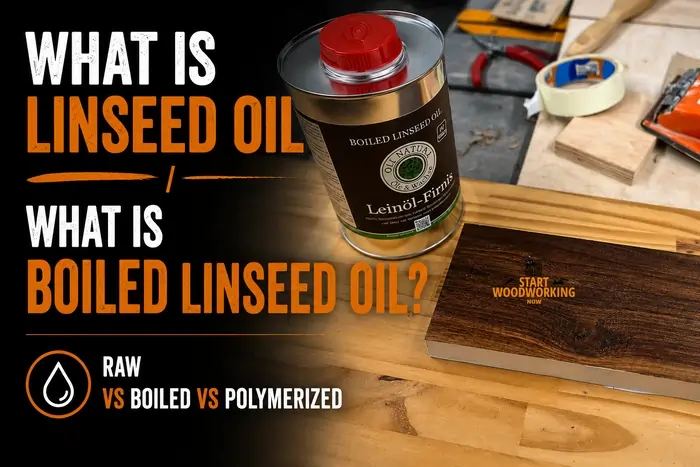
What Is Linseed Oil / What Is Boiled Linseed Oil?
Linseed oil is a penetrating drying oil pressed from flaxseed (Linum usitatissimum) that cures inside wood by oxidative polymerization — the oil’s unsaturated fatty acids react with atmospheric oxygen to form a solid, flexible polymer within the wood cell structure. In its raw form, linseed oil is the slowest-curing common wood finish: a single coat on wood can take two to ten weeks to fully cure at room temperature. Boiled linseed oil (BLO) is raw linseed oil with metallic driers added — cobalt and manganese compounds that accelerate the oxidation reaction and reduce cure time to 24–72 hours.
Understanding what BLO is and where it sits in the finishing hierarchy matters for three practical decisions: whether to use it at all (or upgrade to danish oil), whether it can touch food or children (it cannot), and how to apply it safely (its metallic driers make it the highest spontaneous combustion risk of any common finishing oil). BLO is also the direct base ingredient of danish oil — understanding BLO explains why danish oil behaves the way it does.
This guide is part of the complete wood finishing guide. For comparison with danish oil: Danish Oil vs Tung Oil →
Navigate to your question
→ What is linseed oil — how does it work? → Chemistry and cure mechanism ↓
→ Raw vs boiled vs polymerized — which is which? → Three-type comparison ↓
→ What are metallic driers and why do they matter? → Cobalt vs manganese — different functions ↓
→ What is BLO actually used for? → Use cases, limitations, gummy film failure ↓
→ How does it compare to danish oil and tung oil? → When BLO is sufficient vs when to upgrade ↓
⚠ Spontaneous Combustion — BLO Has the Highest Risk of Any Common Wood Finishing Oil
Boiled linseed oil [generates] more heat during oxidative curing than danish oil, tung oil, or hardwax oil — because its metallic driers accelerate the exothermic oxidation reaction. A folded rag saturated with BLO can reach 200°C within 45 minutes in warm conditions. After every application: spread rags flat outdoors on a non-combustible surface until fully dry (4–6 hours minimum), or submerge in a sealed metal container filled with water. Never fold, stack, or place in a bin while wet.
⚠ Food Safety — BLO Is Not Food-Safe Even When Fully Cured
Boiled linseed oil contains cobalt naphthenate — a metallic drier classified as a potential carcinogen. This cobalt compound remains present in the cured film and does not polymerize out during curing. Do not use BLO on cutting boards, wooden utensils, salad bowls, children’s toys, or any surface with regular skin or food contact. For food-contact surfaces, use pure food-grade mineral oil or 100% pure tung oil (no additives). The complete regulatory framework for which finishes qualify is in food-safe wood finishes.
What Is Linseed Oil and How Does It Cure Inside Wood?
Linseed oil is composed of approximately 57% alpha-linolenic acid (ALA) — a polyunsaturated omega-3 fatty acid with three isolated (non-conjugated) double bonds. These double bonds react with atmospheric oxygen through a chain reaction that cross-links the fatty acid molecules into a solid polymer network within the wood cell walls. The process is identical in raw and boiled linseed oil — the driers in BLO accelerate the reaction but do not change the final product.
Linseed oil’s high linolenic acid content [drives] both its primary value as a wood finish and its primary safety hazard. The same double bonds that [cross-link] into a protective polymer [generate] significant heat as they [oxidize] — making linseed oil rags more prone to spontaneous combustion than any other common finishing oil. The metallic driers in BLO [accelerate] this oxidation further, compressing what might take hours into tens of minutes in a folded rag.
Why Linseed Oil Cures Differently on Thin vs Thick Coats — The Oxygen Pathway
Thin coats (correct): A thin coat of BLO on wood exposes the entire film to oxygen. The linolenic acid double bonds react with oxygen uniformly through the film depth — polymerization proceeds from surface to wood grain, producing a hard, stable film throughout.
Thick coats (failure mode): A thick coat of BLO skins over on the surface as the outer layer polymerizes first. The inner oil is now shielded from oxygen. Starved of the oxygen needed for polymerization, the inner oil undergoes rancidification instead — producing aldehydes and carboxylic acids. The outer film is firm; the inner oil remains permanently soft and gummy. This cannot be fixed by waiting — the inner oil will not cure through a sealed surface layer.
Rule: Apply BLO in very thin coats — no more than 2–3 mils wet. Wipe off all excess after 20–30 minutes. Any BLO remaining on the surface that has not absorbed into the wood should be removed — it will produce a gummy surface film.
Linseed oil produces aldehyde and ketone chromophores during cure that darken light wood progressively — this is the same mechanism behind oil-based polyurethane yellowing on white cabinets — the BHT-quinone reaction that yellows oil-based finishes and the aliphatic alternative.
What Is the Difference Between Raw, Boiled, and Polymerized Linseed Oil?
“Boiled” linseed oil is a historical misnomer that has persisted for over 150 years. The original process — still reflected in the name — involved heating raw linseed oil to 150–300°C in open air to pre-polymerize some of the fatty acid chains, producing an oil that cured faster without chemical additives. Modern BLO involves no heating — it is raw linseed oil with metallic drier compounds added at the blending stage. The name “boiled” survives purely as a marketing convention.
| Type | Process | Dry Time | Food Safe | Best Use |
|---|---|---|---|---|
| Raw Linseed Oil | Cold-pressed flaxseed, no additives | 2–10 weeks | Yes — when fully cured | Artist’s primer, traditional paint binder, surfaces where cure time is irrelevant |
| Boiled Linseed Oil (BLO) | Raw oil + cobalt/manganese naphthenate metallic driers | 24–72 hours | No — cobalt driers remain in cured film | Tool handles, rough timber, exterior wood, workshop furniture |
| Polymerized Linseed Oil | Heated 300–500°C in oxygen-free environment — pre-polymerized without additives | 2–5 days (faster than raw, slower than BLO) | Yes — no metallic drier additives | Traditional oil painting medium, high-quality penetrating finish, food-safe surfaces where tung oil is unavailable |
Modern BLO is not actually boiled — it’s raw linseed oil with metallic driers added at room temperature, which is the same reason BLO is not food-safe — the full conjugated-vs-non-conjugated fatty acid chemistry and why tung oil outperforms linseed oil on water resistance.
Polymerized linseed oil — the modernized version of the original “boiled” process — is uncommon in the woodworking market but worth knowing about. It represents the closest product to the historical boiled oil and shares raw linseed oil’s food-safe profile while curing faster. It is sold by specialty art supply companies and a small number of finishing suppliers, but rarely stocked in hardware stores.
What Are the Metallic Driers in BLO and Why Do They Matter?
BLO contains two types of metallic driers performing different functions: cobalt naphthenate (a surface drier) and manganese naphthenate (a through-drier). They are not interchangeable — together they produce a cure profile that no single drier can achieve.
BLO Is the Foundation of Danish Oil — The Finishing Hierarchy
The relationship between BLO and danish oil is direct: danish oil [is] a long-oil varnish whose oil component is BLO (or tung oil, or a blend). Adding alkyd varnish at approximately 30–35% by weight to BLO produces a product with BLO’s penetrating properties plus a slight surface film — which is exactly what danish oil is.
This explains: why danish oil has the same metallic driers as BLO (both [contain] cobalt and manganese naphthenate); why danish oil has the same food safety profile as BLO (not food-safe); why danish oil produces a satin sheen where BLO produces only matte (the varnish component [builds] slight surface presence).
Practically: BLO is cheaper than danish oil and appropriate when no surface sheen is needed. Danish oil is BLO + varnish — the varnish component adds water resistance, sheen, and better surface durability for a higher cost per litre.
What Is Boiled Linseed Oil Used for in Woodworking and When Should You Avoid It?
BLO is most appropriately used on wood surfaces where deep penetration and protection from moisture and cracking are needed but surface appearance and food safety are not requirements. It is widely used, often misapplied, and occasionally a better choice than more expensive alternatives.
✅ Correct Uses for BLO
Tool handles — wooden hammer, chisel, plane handles. BLO penetrates deeply, prevents moisture absorption that swells handles and splits them, and reduces the brittleness that causes splinters. Apply 2–3 thin coats, wipe off excess after 20 minutes each coat. Do not use food-preparation tool handles.
Rough exterior timber — fence posts, log structures, shed cladding. BLO at low cost protects wood grain from moisture and cracking. It provides less UV protection than purpose-made exterior finishes but adequate moisture resistance for covered exterior applications.
Workshop furniture and non-decorative surfaces — workbench tops, jigs, storage boxes. Full penetration, matte result, no sheen concern.
Cast iron tool surfaces — BLO prevents surface rust on cast iron table saw tops, plane soles, and other iron surfaces by displacing moisture. Apply a few drops, spread with a cloth, wipe off completely.
❌ Where BLO Should Not Be Used
Food-contact surfaces — cutting boards, wooden spoons, salad bowls, children’s toys, rolling pins. Cobalt driers remain in the cured film regardless of cure duration. Use food-grade mineral oil or pure tung oil instead.
Decorative furniture where sheen matters — BLO produces a flat matte result with no surface presence. For furniture requiring any sheen or better water resistance: use danish oil, hardwax oil, or polyurethane.
Under film finishes as a primer — BLO takes 30+ days to fully cure and outgasses through polyurethane or varnish topcoats applied before full cure, causing cloudiness. Use danish oil as a primer if an oil base under a film finish is needed — not BLO.
Oily species without acetone pre-wipe — teak, IPE, rosewood: terpenes inhibit BLO curing. The metallic driers form stable complexes with terpenes and are neutralised before they can catalyse the oil cure. Result: permanently tacky surface.
The Gummy Film Failure — Why Thick Coats of BLO Are Permanent Problems
BLO applied too thickly skins over on the surface as the outer film polymerizes. Oxygen cannot penetrate the skinned surface to reach the inner oil. The inner oil, starved of oxygen for polymerization, instead undergoes rancidification — breaking down into aldehydes and carboxylic acids. The surface feels firm; the layer immediately below is permanently soft, tacky, and smells rancid.
This is permanent. Waiting does not fix it — the inner oil cannot cure through the sealed outer film. Partial fix: wipe with mineral spirits to remove as much uncured oil as possible from the surface, wait 48 hours, then assess. Full fix requires stripping to bare wood (mineral spirits or commercial stripper) and re-treating with correctly thin coats.
How Does Boiled Linseed Oil Compare to Danish Oil and Tung Oil?
BLO, danish oil, and tung oil are all penetrating oil finishes — but they differ in composition, durability, food safety, and appropriate use cases in ways that make “which is better” impossible to answer without specifying the application.
| Property | BLO | Danish Oil | Pure Tung Oil |
|---|---|---|---|
| Composition | Linseed oil + metallic driers | BLO (or tung oil) + alkyd varnish + metallic driers | 100% tung oil, no additives |
| Touch dry | 24–72 hours | 24–48 hours | 5–7 days |
| Surface sheen | Flat matte | Satin (varnish builds slight surface) | Flat matte |
| Water resistance | Moderate (no varnish component) | Better (varnish component) | Highest (dense polymer) |
| Food safe | No — cobalt driers | No — metallic driers | Yes — when cured (15+ days) |
| Combustion risk | Highest (metallic driers + linolenic acid) | High (same drier package) | High (drying oil, no driers) |
| Relative cost | Lowest | Medium | Higher (especially polymerized) |
Decision rule: Use BLO for non-decorative wood that needs moisture protection at minimum cost — tool handles, rough timber, workshop items. Use danish oil when a slight sheen and better water resistance justify the extra cost.
Use pure tung oil when food safety is required or maximum water resistance is needed. For decorative furniture that will be handled daily: all three are insufficient — use hardwax oil or polyurethane instead.
Frequently Asked Questions
Can you apply polyurethane over boiled linseed oil?
Yes — but only after full cure of the BLO, which takes 30–40 days minimum at room temperature. BLO applied to wood continues to outgas solvents and oxidation byproducts for weeks after it appears dry. Polyurethane applied before full BLO cure traps these byproducts under the film, producing cloudiness, softness, or adhesion failure. Confirm full cure: press firmly with a thumbnail — no impression in the film after 10 seconds. For a faster base-coat approach, use danish oil instead of BLO — danish oil reaches sufficient cure for topcoating in 7 days. Check compatibility →
Is raw linseed oil food-safe?
Raw linseed oil with no additives is considered food-safe when fully cured — the cured polymer is inert and does not leach fatty acids into food at detectable levels. However, raw linseed oil takes 2–10 weeks to fully cure, and uncured or partially cured linseed oil is not safe for food contact. Additionally, most commercial products labelled “linseed oil” or “flaxseed oil” for wood contain additives — always check the label. For food-contact surfaces, food-grade mineral oil or pure tung oil are more practical because their food safety profiles are clearer and their cure verification is more straightforward.
Linseed oil applied too thickly stays gummy permanently due to oxygen starvation — the inner oil cannot reach atmospheric oxygen — the complete oil finish drying failure diagnosis with the stripping and restart protocol.
How many coats of BLO should you apply?
2–4 coats is standard for most woodworking applications. Apply each coat thinly, allow full absorption (20–30 minutes), wipe off all remaining surface oil before it skins. Allow 24–48 hours between coats. On tool handles where maximum penetration is the goal: 3 coats applied on consecutive days. On rough exterior timber: 2 flood coats applied wet-on-wet (second coat while first is still wet), then 1 wipe-off coat. On open-grain species like oak: up to 4 coats before saturation is reached. The saturation test is the same as for tung oil: oil no longer absorbs within 30 minutes means the wood is saturated.
Can you mix BLO with mineral spirits?
Yes — thinning BLO with mineral spirits at 10–20% produces a lower-viscosity mixture that penetrates more deeply into dense or resinous wood. This is a common approach for the first coat on very dense species (hard maple, ipe) or for restoring severely dried wood. Do not thin more than 20% — it reduces the resin solids per coat significantly and extends the cure time. The BLO + mineral spirits mixture carries the same spontaneous combustion risk as undiluted BLO — treat all rags accordingly.
How is linseed oil different from flaxseed oil?
They are the same oil from the same plant (Linum usitatissimum). “Flaxseed oil” is the term used for food-grade oil sold for human consumption — it is raw linseed oil processed under food-safe conditions. “Linseed oil” sold in hardware and paint stores is intended for industrial and woodworking use and may contain trace solvents or processing residues not present in food-grade flaxseed oil. Both contain the same 57% alpha-linolenic acid composition and cure by the same oxidative polymerization mechanism. Do not use food-grade flaxseed oil from the grocery store as a wood finish — it will go rancid inside the wood for the same reason cooking oils should never be used on cutting boards.