
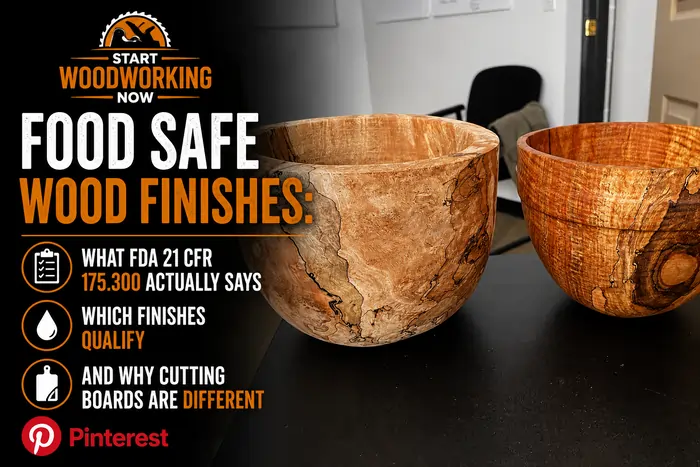
Food Safe Wood Finishes: What FDA 21 CFR 175.300 Actually Says, Which Finishes Qualify, and Why Cutting Boards Are Different
Most wood finish labelling around food safety is imprecise to the point of being misleading. “Non-toxic when dry,” “natural ingredients,” and even “FDA approved” appear on products without specifying what those claims actually mean in a food-contact context. The regulatory framework that governs food-contact surface coatings is FDA 21 CFR 175.300 — a specific regulation with a specific list of approved substances. Understanding what it does and does not cover is the difference between a finish that is genuinely food safe and one that merely avoids acute toxicity.
This article is part of the wood finishing safety guide — covering hazard profiles, cure state toxicity, respirator selection, and spontaneous combustion prevention.
⚠ Health Information
The food safety of a wood finish depends on its specific formulation, cure state, and application context. “Non-toxic when dry” and “FDA food safe” are not equivalent claims. This guide covers the regulatory framework and finish-specific criteria. When food safety is a hard requirement — for commercial kitchenware or items for vulnerable populations — verify compliance against the specific product’s SDS and FDA documentation.
Navigate to your question
→ What actually makes a finish “food safe”? → The FDA 21 CFR 175.300 framework and the cure-state requirement ↓
→ Which finishes are genuinely food safe — and which aren’t? → Finish-by-finish breakdown with regulatory status ↓
→ Is cured polyurethane food safe? → What the FDA actually says — and why the answer is more nuanced than yes or no ↓
→ What finish should I use on a cutting board? → Why film finishes fail on cutting boards — and which penetrating oils work ↓
→ How long before a finish is safe for food contact? → Cure timeline by finish type — the 30-day rule and its exceptions ↓
What Actually Makes a Wood Finish Food Safe?
A finish qualifies as food safe in a regulatory sense when it meets two conditions simultaneously: its chemical components are listed in FDA 21 CFR 175.300 (Resinous and Polymeric Coatings) as approved for food-contact surface use, and the finish is fully cured — meaning polymerization or film formation is complete and no mobile chemical species capable of migrating into food remain in the film.
The FDA’s food-contact surface regulation operates on the principle of migration: a coating is considered safe if it does not transfer chemical components to food in quantities that could be hazardous or that exceed established thresholds. The regulation specifies which polymer bases, crosslinkers, solvents, and additives are approved for use in food-contact coatings — not which final products carry blanket approval.
Cure State Is Not Optional
The FDA food-contact approval of any finish applies to the fully cured film, not to the wet finish during application or the partially cured film during the early dry period. A finish that contains FDA-listed components can still leach unreacted monomers, residual solvent, or intermediate cure products if it is not fully cured before food contact occurs. Cure state is the non-negotiable prerequisite for food safety regardless of the finish category — the same principle covered in the context of toxicity during the cure window in the wood finish toxicity guide covering off-gassing timelines by finish type.
That phrase — once fully cured — is doing a lot of work, and almost no label puts a number on it. Full cure is weeks, not days, and it moves with temperature and humidity.
Check it for your conditions
Pick your finish and workshop conditions.
This needs JavaScript. If this text stays visible, it did not load.
“Non-Toxic When Dry” Is Not the Same as “Food Safe”
Non-toxic means the finish does not produce biological harm at exposure levels encountered in normal use. Food safe means the finish has been reviewed for migration potential under food contact conditions — including acidic foods, hot liquids, and abrasive contact. A finish can be non-toxic in general use without meeting the migration threshold criteria for direct food contact. This distinction eliminates several finishes that are commonly described as “food safe” in consumer resources but are not approved under 21 CFR 175.300 for direct food contact surfaces.
Which Wood Finishes Are Genuinely Food Safe?
Shellac — The Only Film-Forming Finish with Explicit FDA Approval
Shellac — specifically lac resin, the natural secretion of the lac insect — is listed by name in FDA 21 CFR 175.300 as an approved substance for food-contact surface coatings. It is also listed under 21 CFR 175.105 (Adhesives) and is used by the food industry itself as a glaze on pharmaceutical tablets, candy coating, and fruit surface treatment. The FDA food-safe approval applies to the cured shellac film in both waxed and dewaxed formulations, though dewaxed shellac provides better adhesion for topcoating.
Shellac’s food safety profile is the strongest of any film-forming wood finish. Its solvent — denatured alcohol — is volatile and completely absent from the cured film. No metallic driers are used. No aromatic solvents. The cured resin is a natural polyester that hydrolyzes slowly in strongly alkaline conditions but is stable under normal food-contact conditions. For the complete shellac chemistry and application protocol, see the shellac guide covering pound cuts, dewaxed formulations, and sealer use.
Pure Tung Oil — Approved by Long Use, Not by Explicit Listing
Pure tung oil — extracted from the seeds of the Aleurites fordii tree, with no metallic driers added — is not explicitly listed in 21 CFR 175.300, but it falls under the broader GRAS (Generally Recognized As Safe) category for natural drying oils when fully cured. The fully polymerized tung oil film consists of crosslinked conjugated fatty acid polymers with no mobile chemical species. The FDA does not regulate cured natural oils as food-contact coatings in the same way it regulates synthetic polymer films, and fully cured tung oil has a long established history of safe food contact use on cutting boards and wooden utensils.
The critical qualification: pure tung oil, not products labeled as “tung oil finish.” Most commercially available products sold as “tung oil” are actually alkyd varnish thinned with mineral spirits — they contain metallic driers and synthetic resin components that are not food safe. The chemical test for genuine pure tung oil — viscosity, colour, and cure time — is covered in the tung oil guide covering pure vs blended product identification.
Food-Grade Mineral Oil — Specifically USP Grade
Mineral oil is the most widely used penetrating finish for cutting boards and wooden kitchen utensils. It is food safe — but only in its USP (United States Pharmacopeia) food-grade formulation. USP mineral oil has been refined to remove aromatic hydrocarbons and is listed under FDA 21 CFR 178.3620 as approved for food-contact use.
Technical or industrial mineral oil — including lubricating oils, machine oil, and some hardware store mineral spirits — is not food safe. The refining processes differ and the aromatic hydrocarbon content of technical grade mineral oil is not controlled to food-contact standards. When purchasing mineral oil for wooden kitchenware, “food grade,” “USP,” or “pharmaceutical grade” on the label confirms the correct specification. “Mineral oil” alone does not.
Mineral oil does not cure or polymerize — it remains liquid and must be periodically replenished as it migrates into the wood grain and evaporates over time. This is a functional limitation for high-use surfaces but an advantage in terms of application and food safety: it cannot crack, cannot harbour bacteria under a broken film, and can be reapplied without surface preparation.
Beeswax and Carnauba Wax — Food Safe as Topcoats
Both beeswax and carnauba wax are listed in FDA regulations as approved food-contact substances (21 CFR 184.1973 for beeswax, 21 CFR 184.1978 for carnauba wax). As finishing topcoats over mineral oil or tung oil on cutting boards and salad bowls, they provide additional water resistance and a smooth surface. Neither offers meaningful standalone protection as a wood finish — they are best used as the final layer over a penetrating oil foundation.
Danish Oil and BLO — Not Food Safe
Boiled linseed oil and danish oil are not food safe, and the reason is specific: the metallic drier compounds added to accelerate oxidative cure. Cobalt, manganese, and zirconium drier salts are incorporated into the crosslinked polymer network during cure but remain as metal compounds within the film. Under prolonged contact with acidic foods — vinegar, citrus, tomato — these metal compounds can migrate from the film into the food in trace amounts. Cobalt compounds specifically are classified as possible human carcinogens (IARC Group 2B) and have established upper limits for dietary intake.
The fact that BLO and danish oil produce “natural” penetrating finishes does not make them food safe. The cure chemistry that drives their usefulness as finishes is the same chemistry that incorporates cobalt into the film. No amount of curing eliminates the migrateable drier compounds — they are structural components of the crosslinked network, not residual contaminants that off-gas during cure.
| Finish | FDA Regulatory Status | Food Safe When Cured? | Reason for Status |
|---|---|---|---|
| Shellac (dewaxed or waxed) | Listed — 21 CFR 175.300 | YES ✅ | Lac resin explicitly FDA approved; used as food glaze |
| Pure tung oil (no driers) | GRAS / long-use acceptance | YES ✅ | Cured film is inert crosslinked fatty acid polymer |
| Mineral oil (USP food grade) | Listed — 21 CFR 178.3620 | YES ✅ | Explicitly approved; does not cure — refresh required |
| Beeswax / Carnauba wax | Listed — 21 CFR 184.1973/78 | YES ✅ | Approved food additives; safe as topcoat over oil |
| Oil-based polyurethane (fully cured) | Not listed for direct food contact | CONDITIONALLY ⚠️ | Cured film is inert but not FDA-approved for food contact |
| Water-based polyurethane (fully cured) | Not listed for direct food contact | CONDITIONALLY ⚠️ | Cured film is inert; no metallic driers; not FDA-listed |
| Danish oil / BLO | Not approved for food contact | NO ❌ | Cobalt/manganese driers remain in cured film; can migrate |
| Hardwax oil (Osmo, Rubio) | Not listed for direct food contact | NO ❌ | Contains drying oil base with metallic drier components |
| NC Lacquer / Oil-based varnish | Not approved for food contact | NO ❌ | Aromatic solvents, plasticisers; not food-contact listed |
Is Cured Polyurethane Food Safe? The Nuanced Answer
This is the most searched sub-question in wood finish food safety, and the answer is widely misrepresented in both directions. The accurate position: fully cured polyurethane film is chemically inert and does not leach compounds into food under normal use conditions. However, polyurethane is not listed in FDA 21 CFR 175.300 for direct food-contact surface coatings, meaning it does not carry explicit FDA approval for this use.
The practical distinction matters depending on application context:
For a dining table, serving tray, or charcuterie board where food contact is incidental and brief — polyurethane is in contact with food items for minutes, not hours — a fully cured polyurethane finish presents no meaningful food safety concern in practice. The cured crosslinked polymer has no mobile components, the solvent has long evaporated, and the migration potential is negligible under normal use conditions.
For a cutting board where the finish is subject to knife scoring, prolonged moisture contact, and food resting on a scored surface — polyurethane is not the correct finish regardless of its food safety status. The reason is mechanical, not chemical: knife cuts through a polyurethane film create micro-channels in the coating where food particles and moisture accumulate, supporting bacterial growth under conditions that are difficult to clean. This is a hygiene failure mode that affects all film-forming finishes on cutting boards, not a toxicity issue unique to polyurethane. The cutting board finishing guide covers why penetrating oil finishes outperform film finishes on cutting surfaces and the correct application and refresh protocol.
For commercial food-service equipment where regulatory compliance is legally required — film finishes that are not listed in 21 CFR 175.300 cannot be used. Shellac is the correct food-contact film finish in regulatory-compliance contexts. Water-based polyurethane coatings formulated specifically for food-contact compliance do exist (products certified to NSF/ANSI 51), but standard consumer water-based polyurethane does not carry this certification.
The Best Food Safe Finish for Cutting Boards — and Why Film Finishes Fail
Cutting boards present a unique finishing challenge because they are food-contact surfaces subject to repeated mechanical abrasion from knife use. This changes the finish selection criteria fundamentally compared to bowls, serving boards, or furniture.
Why Film Finishes Fail on Cutting Boards
Any film-forming finish — polyurethane, lacquer, shellac, or varnish — creates a continuous coating layer over the wood surface. Under knife use, the film is scored repeatedly. Each cut creates a channel in the film that exposes raw wood beneath and creates a pocket where food debris and moisture accumulate. Cleaning removes surface contamination but cannot reach material lodged under the film at the cut edges. Over time, the scored film lifts at the cut edges, accelerating moisture ingress and bacterial accumulation.
Even shellac — the only film-forming finish with explicit FDA approval — is not the correct choice for a functional cutting board for this mechanical reason. Shellac is alcohol-soluble and water-sensitive; repeated washing dissolves it progressively. The food safety advantage of shellac is relevant for bowls, serving surfaces, and items washed infrequently, not for boards washed after every use.
The Correct Cutting Board Finish Protocol
Penetrating oil finishes — mineral oil, pure tung oil, or food-grade blends of the two — are the correct choice for cutting boards because they impregnate the wood surface rather than coating it. Knife cuts through the surface do not create film channels because there is no film to cut. The oil-impregnated wood surface is self-healing in the sense that the surrounding wood closes minor knife cuts as the board experiences moisture cycles.
The standard protocol: apply food-grade mineral oil generously, allow it to penetrate (30–60 minutes), wipe off excess, and repeat 3–5 times for an initial seasoning. A final coat of beeswax or carnauba wax over the mineral oil provides additional water resistance and surface smoothness. Refresh the mineral oil application every 1–3 months depending on use intensity and washing frequency.
Pure tung oil can substitute for or supplement mineral oil for enhanced water resistance — tung oil polymerizes into a durable film within the wood surface rather than remaining liquid. The full cutting board finishing protocol with tung oil application steps, dilution ratios, and saturation testing is covered in the tung oil application guide covering the progressive dilution technique and food-contact use. The complete cutting board selection, preparation, and finishing guide — including wood species selection, grain orientation, end grain vs face grain, and refresh protocol — is in the cutting board finishing guide.
How Long Before a Finish Is Safe for Food Contact?
Full cure — not dry-to-touch — is the prerequisite for food contact use of any finish. Dry-to-touch means surface solvent has evaporated and the finish no longer transfers to contact. Full cure means the chemical processes that form the final polymer network are complete and no mobile species remain in the film.
Cure Timeline Before Food Contact
→ Shellac: Full cure in 24–48 hrs. Evaporative finish — no ongoing chemistry after solvent evaporation.
→ Pure tung oil: Surface cure in 24–48 hrs; full polymerization 14–30 days. Wait 30 days for food-contact items.
→ Water-based polyurethane: Tack-free 2–4 hrs; full cure 21–30 days. Wait 30 days for food contact.
→ Oil-based polyurethane: Tack-free 24 hrs; full cure 30 days. Wait 30 days minimum.
→ Mineral oil: No cure process — food safe immediately after application and absorption. No waiting period.
Temperature and humidity affect cure timelines significantly. Low temperatures (below 15°C) slow oxidative polymerization in oil-based finishes and can extend cure times considerably. High humidity above 70% can inhibit water-based polyurethane coalescence. The cure timelines above assume typical conditions of 18–24°C and 40–60% RH. When in doubt, extend the waiting period — finish that has cured for 45 days is not meaningfully different from finish cured for 30 days, but finish at 20 days may not be complete for slow-curing oil-based products in cold conditions.
Frequently Asked Questions
Is Watco Danish Oil food safe for a cutting board?
No. Watco Danish Oil and similar BLO-based danish oil products contain metallic drier compounds — primarily cobalt naphthenate — that remain in the cured film and can migrate under acidic food contact conditions. The fact that these products are sold for use on kitchen furniture does not make them food safe for direct food-contact surfaces. Use food-grade mineral oil or pure tung oil for cutting boards.
Can I use olive oil or vegetable oil to finish a cutting board?
No. Cooking oils — olive, vegetable, canola — have low iodine values and do not cure by oxidative polymerization. They remain liquid within the wood indefinitely and turn rancid over time, producing objectionable odours and potentially harbouring bacterial growth. Only non-drying oils (mineral oil) or properly curing oils (pure tung oil) are appropriate for cutting board finishing.
Does “food safe” lacquer exist?
Standard NC lacquer is not food safe — its aromatic solvent residues, nitrocellulose base, and plasticisers are not listed in 21 CFR 175.300 for food contact. Shellac is occasionally described as “the original lacquer” in historical context and is genuinely food safe. For finishing items that require both durability and food safety, shellac as a base coat followed by food-grade wax is the most practical food-safe film finish combination.
My cutting board already has polyurethane on it — is it safe to use?
A fully cured polyurethane finish on a cutting board is not acutely toxic in normal use — the cured film does not leach harmful compounds. The problem is hygiene: knife scoring of the film creates micro-channels that accumulate food debris and resist cleaning. If the finish is intact and unscored, occasional use is not a health concern. If the surface is heavily scored and showing film lifting, strip the polyurethane, sand back to bare wood, and refinish with mineral oil.