
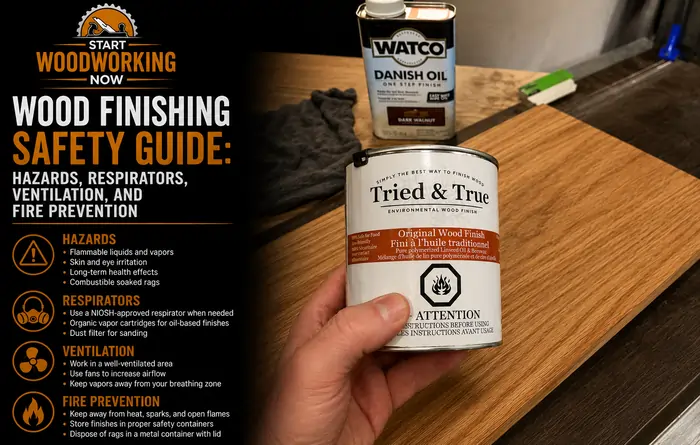
Wood Finishing Safety Guide: Hazards, Respirators, Ventilation, and Fire Prevention
Wood finishing involves controlled exposure to solvents, reactive curing agents, and combustible materials. The risks are real but specific — and each finish type carries a different hazard profile. Understanding which hazards apply to the finish you’re using, and which controls are actually effective, is what separates a safe finishing session from a fire, a respiratory sensitization event, or a spontaneous combustion incident in the shop bin.
⚠ Safety Information
Wood finishes contain solvents, metallic driers, and reactive compounds that present inhalation, fire, and skin contact hazards. This guide covers the specific hazards of each finish type and the correct controls for each. Always read the SDS (Safety Data Sheet) for your specific product before use.
Navigate to your question
→ What are the actual hazards in wood finishing? → Inhalation, fire, and skin contact hazards by mechanism ↓
→ Which finish is the most dangerous — lacquer, poly, or oil? → Hazard level by finish type with LEL and flash point data ↓
→ Do I need a respirator — and which type? → Why N95 fails for solvent vapours and which NIOSH cartridge to use ↓
→ How much ventilation do I actually need? → Air changes per hour by finish type and the LEL calculation ↓
→ My oily rags — how dangerous are they really? → The exothermic oxidation mechanism and the only safe disposal method ↓
→ Gloves, eye protection, skin contact → PPE by finish type — nitrile vs neoprene and why latex fails ↓
→ Which finishes are safe to use indoors without a spray booth? → Low-VOC and water-based finish options with real VOC numbers ↓
→ How do I dispose of finishing chemicals and contaminated rags? → Legal disposal protocols and what cannot go in household waste ↓
This article is part of the complete wood finishing guide — covering finish selection, application, troubleshooting, and safe use.
This guide covers every major finish category used in woodworking — lacquer, polyurethane, oil finishes, shellac, varnish — and maps the specific hazards and controls to each. The most dangerous misconceptions (N95 respirators for solvent vapour, or a single open window for lacquer application) are corrected with mechanism-level explanation, not just warnings.
What Are the Main Safety Hazards in Wood Finishing?
Wood finishing hazards fall into three categories with distinct mechanisms and distinct controls. Understanding which mechanism you’re dealing with determines which control is effective.
Inhalation Hazard: Solvent Vapour and Aerosol Particles
Solvent vapour — not dust, not odour intensity — is the primary inhalation hazard in wood finishing. Solvents evaporate at room temperature and mix with air invisibly. Naptha, toluene, xylene, methanol, and denatured alcohol all have permissible exposure limits (PELs) set by OSHA; the relevant question is whether vapour concentration in your workspace exceeds those limits.
Aerosol particles are a separate, additive hazard during spray application. When a finish is atomised, droplets of 1–10 microns in diameter penetrate deep into the lungs. A dust mask or N95 respirator filters particles — it does nothing for dissolved solvent vapour already in the air. This is the single most dangerous misconception in DIY finishing: using a particle-filter mask while applying lacquer provides particle protection and zero vapour protection simultaneously.
Fire and Explosion Hazard: Flash Point and LEL
Two numbers govern fire risk for any finish: flash point (the temperature at which vapour ignites given an ignition source) and LEL — Lower Explosive Limit, the minimum vapour concentration in air that supports combustion. When vapour concentration in a workspace exceeds the LEL for that solvent, any ignition source — a pilot light, a light switch, a static discharge — produces an explosion, not just a fire.
Most woodworkers think about fire risk in terms of keeping finishes away from open flames. The LEL mechanism is the more dangerous scenario: a sealed workshop with insufficient ventilation can reach explosive vapour concentrations from a single quart of lacquer thinner before any ignition source is present.
Skin and Eye Contact Hazard: Sensitization and Chemical Burns
Repeated skin contact with some finishing compounds produces chemical sensitization — an immune response that creates a permanent, progressively worsening reaction to subsequent exposures at any concentration. This is not the same as irritation.
Sensitization is irreversible. The most serious sensitization risk in finishing is isocyanate compounds in catalyzed two-part polyurethane finishes. Once sensitized, even low-level exposure produces systemic reactions including asthma.
Standard finishes (single-component polyurethane, lacquer, danish oil) do not carry sensitization risk but do cause irritation and dermatitis with repeated skin contact. Eye contact with solvent-based finishes causes chemical burns; with spray application, aerosol deposit on unprotected eyes carries both chemical and particle hazards.
| Hazard Type | Mechanism | Control | What Does NOT Work |
|---|---|---|---|
| Solvent vapour | Evaporation → lung absorption | NIOSH OV/P100 respirator + ventilation | N95, dust mask, bandana |
| Spray aerosol | Atomised 1-10μm particles → deep lung | OV/P100 half-face respirator | N95 alone (no vapour protection) |
| Fire / explosion | Vapour at LEL + ignition source | Ventilation below LEL + remove ignition sources | Keeping flames “away” while vapour builds |
| Rag combustion | Exothermic oxidation → self-ignition | Submerge in water in sealed metal can | Piling rags flat, paper bags, open bins |
| Skin sensitization | Isocyanate immune sensitization | Nitrile gloves, avoid catalyzed finishes where possible | Washing off after contact (too late for sensitization) |
| Eye contact | Chemical burn + particle deposit | Chemical splash goggles during spray | Safety glasses (no side seal) |
With the three hazard categories mapped to their mechanisms, the specific risk level per finish type follows logically from the chemistry of each.
Which Wood Finishes Are the Most Hazardous — and Why?
Hazard level in wood finishes correlates directly with solvent type and concentration, curing chemistry, and whether the product requires spray application. The ranking below is based on LEL data, flash point, and sensitization risk — not perception or odour strength (odour intensity and hazard level are not correlated).
Highest Hazard: Lacquer (NC, CAB-Acrylic, Catalyzed)
Nitrocellulose lacquer — the most common production furniture finish — uses a combination of strong ketone and ester solvents (acetone, MEK, ethyl acetate) with flash points between −18°C and −4°C. The LEL for acetone is 2.5% v/v in air; for MEK it is 1.4% v/v. A single quart of lacquer thinner evaporating in a 2,400 cubic foot workshop is sufficient to reach LEL for MEK under poor ventilation conditions.
The practical implication: lacquer requires true forced-air ventilation with explosion-proof fans (standard brushed-motor fans create spark risk), not just open windows. The full lacquer hazard profile — solvent types, flash points, and the spray application ventilation requirement — is detailed in the lacquer chemistry guide covering NC vs CAB-Acrylic vs catalyzed formulations.
Catalyzed lacquers (pre-cat and post-cat) add an isocyanate sensitization risk on top of the solvent hazard. These should not be used without a supplied-air respirator or a properly fitted half-face respirator with OV/P100 cartridges in a well-ventilated space.
High Hazard: Oil-Based Polyurethane and Varnish
Oil-based polyurethane and alkyd varnish use mineral spirits or VM&P naphtha as the primary solvent. Mineral spirits has a flash point around 38°C — significantly safer than lacquer solvents — but it is still a flammable liquid with a LEL of approximately 0.6–0.8% v/v.
The hazard during brush application is lower than lacquer because solvent evaporation is slower and no atomisation occurs. The hazard from oil-based polyurethane shifts significantly toward rag combustion during cleanup.
Oil-based polyurethane cures by oxidative polymerization — the same exothermic mechanism that causes spontaneous combustion in drying-oil-soaked rags. Application rags contaminated with oil-based poly must be treated with the same protocol as linseed-oil rags. The application safety protocol for oil-based polyurethane is covered in the polyurethane application guide including the rag disposal requirement.
High Hazard (Fire): Penetrating Oil Finishes (Tung Oil, BLO, Danish Oil)
Pure tung oil, boiled linseed oil (BLO), and danish oil have low vapour hazard during application but carry the highest spontaneous combustion risk of any finish category. The reason is the cobalt and manganese metallic driers added to BLO and most danish oil formulations to accelerate oxidative polymerization.
These driers function as catalysts for the same exothermic reaction that generates heat in a composting pile — but in a compressed rag, the heat has nowhere to dissipate.
A folded linseed-oil rag in a pile can reach self-ignition temperature (180°C) within 3–4 hours at room temperature. This is not a theoretical risk: spontaneous combustion from oily finishing rags is one of the most common causes of workshop fires. The tung oil application guide details the specific rag protocol required for each application step — the tung oil and BLO rag handling protocol with the sealed-can disposal method.
Moderate Hazard: Water-Based Polyurethane
Water-based polyurethane uses water as the primary carrier with a small percentage of co-solvents (glycol ethers, typically less than 10% by volume). Flash point is above 60°C — classified as a combustible liquid, not a flammable liquid under US DOT regulations.
LEL is effectively non-relevant at brush-application volumes in a normally ventilated space. VOC content runs 50–150 g/L compared to 350–450 g/L for oil-based polyurethane.
Water-based poly is the lowest-hazard film-forming finish for both inhalation and fire. The main precaution remains respiratory protection during spray application (aerosol particles, not vapour) and nitrile glove use for repeated skin contact. This safety profile is one of the decision factors in the polyurethane vs lacquer comparison covering application method and safety.
Low Hazard: Shellac
Shellac dissolved in denatured alcohol (ethanol with denaturing agents) has a flash point of 13°C for denatured alcohol — flammable, requiring basic precautions. However, the solvent load per application is low, evaporation is rapid, and shellac carries zero sensitization or chronic toxicity risk. Denatured alcohol is also water-miscible, making cleanup and disposal straightforward.
Shellac is the finish with the lowest overall health hazard profile, which is one reason it has been used for centuries in enclosed spaces. For the full shellac chemistry including which alcohol concentrations work and which don’t, see the shellac guide covering pound cuts, denatured alcohol requirements, and shelf life.
| Finish | Flash Point | Primary Solvent | Rag Fire Risk | Sensitization Risk | Overall Hazard |
|---|---|---|---|---|---|
| NC Lacquer | −18°C to −4°C | Acetone / MEK / ethyl acetate | Low (solvent-only rags) | Low (NC); High (catalyzed) | HIGHEST |
| BLO / Danish Oil / Tung Oil | 61°C (mineral spirits) | Oxidative cure (no solvent evap) | HIGHEST — cobalt drier | Low | HIGH (fire) |
| Oil-Based Polyurethane | 38°C | Mineral spirits / VM&P naphtha | High (oil component present) | Low | HIGH |
| Oil-Based Varnish | 38–60°C | Mineral spirits | Moderate | Low | MODERATE–HIGH |
| Shellac (denatured alcohol) | 13°C | Denatured alcohol (ethanol) | Low | None | LOW |
| Water-Based Polyurethane | >60°C | Water + glycol ether co-solvents | None | None | LOWEST |
With the hazard profile of each finish established, the respirator selection follows directly from the solvent chemistry.
What Respirator Do You Need for Wood Finishing?
Interactive Tool
Respirator, Glove and Ventilation Selector
Pick your product, application method, and workspace to get the filter class, glove material, and airflow that job needs. Each result also names what fails if you substitute the wrong material, and the two chemicals where no cartridge is adequate. Open the selector →
The correct respirator for wood finishing is a NIOSH-approved half-face respirator fitted with OV/P100 combination cartridges — Organic Vapour plus P100 particulate. The OV component filters organic solvent vapours through activated carbon. The P100 component filters 99.97% of aerosol particles. Together they address both inhalation hazard mechanisms.
Why N95 Masks Fail for Wood Finishing
N95 masks — including KN95 and surgical masks — are particle filters. They carry zero NIOSH rating for organic vapour and provide zero protection against solvent molecules dissolved in air. Wearing an N95 while applying oil-based polyurethane or lacquer gives the sensation of respiratory protection with none of the actual protection against the primary hazard. The activated carbon in OV cartridges is the only mechanism that captures solvent vapour molecules.
Cartridge Selection by Finish Type
| Finish / Scenario | Minimum Cartridge | Notes |
|---|---|---|
| Lacquer (brush or spray) | OV/P100 half-face | Spray lacquer: consider supplied-air in production settings |
| Catalyzed lacquer / 2-part poly | OV/P100 + full-face OR supplied-air | Isocyanate: no safe exposure threshold; supplied-air preferred |
| Oil-based polyurethane (brush) | OV/P100 half-face | Mineral spirits vapour; well-ventilated spaces may allow OV-only |
| Oil-based polyurethane (spray) | OV/P100 half-face | P100 mandatory for aerosol particle hazard |
| Danish oil / BLO / tung oil | OV/P100 half-face | Mineral spirits diluent; primary risk is rag combustion, not vapour |
| Shellac (denatured alcohol) | OV/P100 half-face | Ethanol vapour; good ventilation alone may be sufficient for brush |
| Water-based poly (brush) | None mandatory; OV optional | Co-solvent VOC low; spray application → P100 for aerosol |
Cartridge Change-Out Schedule
OV cartridges do not have an indicator — they exhaust silently. NIOSH and OSHA’s respiratory protection standard (1910.134) require cartridge replacement based on either time-in-use (a change schedule for the specific cartridge at your exposure level) or when you begin to smell solvent through the mask — whichever comes first.
Smelling solvent through a cartridge means the activated carbon is saturated and the cartridge is providing zero vapour protection. Replace cartridges before each finishing session if they have been used for more than 8 hours of total solvent exposure, or if they were left uncapped between sessions (open-air carbon adsorbs ambient moisture and loses capacity).
For a detailed guide to respirator selection, fit testing, and cartridge-life calculation for different finishing scenarios, see the dedicated respirator guide for wood finishing covering NIOSH APF ratings and cartridge schedules.
How Do You Ventilate a Wood Finishing Workshop?
Ventilation for wood finishing has one measurable goal: keep vapour concentration below 10% of LEL (the OSHA action level for flammable vapours). At 10% LEL, ventilation is considered adequate; at 25% LEL, work must stop. The calculation requires knowing the LEL of your finish’s primary solvent and the air volume of your workspace.
Ventilation Types and What Each Achieves
- General dilution ventilation — open windows and doors with cross-flow air movement — reduces average vapour concentration by diluting it with fresh air. This is adequate for oil-based brush finishing with mineral spirits solvents in large spaces. It is not adequate for spray lacquer application or any finish with acetone/MEK solvents in enclosed workshops.
- Local exhaust ventilation (LEV) — a fan positioned to draw contaminated air directly away from the finishing area and exhaust it outside — reduces vapour concentration at the breathing zone, regardless of room volume. This is the required configuration for spray finishing in enclosed spaces.
- Spray booth ventilation — a fully enclosed filtered exhaust system maintaining 100 FPM (feet per minute) face velocity — is the professional standard for lacquer spray application. The filters capture overspray particulate; the airflow prevents vapour accumulation above LEL. Explosion-proof fans are mandatory; standard brushed-motor fans create spark risk from carbon brush arcing.
Practical Ventilation by Finish Category
| Finish / Application | Minimum Ventilation | Fan Type |
|---|---|---|
| Lacquer — spray | Spray booth / LEV at 100 FPM | Explosion-proof only |
| Lacquer — brush | LEV or cross-flow, minimum 6 air changes/hr | Explosion-proof preferred |
| Oil-based poly — brush | Cross-flow dilution; 2–4 air changes/hr | Standard fan acceptable |
| Oil-based poly — spray | LEV or spray booth | Explosion-proof preferred |
| BLO / danish oil — brush | Cross-flow dilution adequate | Standard fan acceptable |
| Shellac — brush | Cross-flow; keep sources of ignition away | Standard fan acceptable |
| Water-based poly — brush | Normal room ventilation adequate | None required |
Full spray booth design requirements — including filter specifications, makeup air requirements, and explosion-proof fan selection — are covered in the spray finishing ventilation guide covering LEL calculations and booth configurations. The lacquer-specific application protocol including ventilation setup is in the lacquer application guide covering aerosol technique and booth requirements.
How Do You Prevent Spontaneous Combustion from Finishing Rags?
Spontaneous combustion of oily finishing rags is the most misunderstood fire hazard in woodworking. The mechanism is exothermic oxidative polymerization — the same chemical reaction that cures the finish on wood — occurring inside a folded or piled rag where the generated heat cannot dissipate.
The Chemistry: Why Rags Ignite Without an External Flame
Drying oils — linseed oil, tung oil, and the oil components of danish oil, hardwax oil, and oil-based polyurethane — cure by reacting with atmospheric oxygen. This oxidative polymerization reaction is exothermic: it releases heat as the oil crosslinks into a solid polymer. On a flat wood surface, this heat dissipates harmlessly into the surrounding air and wood.
In a folded or crumpled rag, the situation is different. The rag’s geometry creates insulation: the reaction generates heat, the insulation traps it, the elevated temperature accelerates the reaction rate, which generates more heat, which accelerates the reaction further. This thermal runaway continues until the rag reaches self-ignition temperature — approximately 180°C for linseed-oil-soaked rags — without any external ignition source.
Metallic driers — cobalt, manganese, and zirconium compounds added to BLO, danish oil, and oil-based polyurethane to accelerate cure — catalyse this oxidation reaction. BLO-soaked rags carry higher spontaneous combustion risk than pure tung oil rags for this reason: the cobalt drier makes the exothermic reaction faster and more intense at lower temperatures.
⚠ CRITICAL SAFETY RULE
Never pile oily finishing rags flat, fold them, or place them in paper bags, plastic bags, or open waste bins. Self-ignition can occur within 3–4 hours at room temperature with BLO or danish oil rags.
The only safe disposal method: spread rags flat and single-layer outdoors until completely hardened (cured through), OR place immediately in a sealed metal can with water.
The Two Safe Disposal Methods
Method 1 — Outdoor flat spread: Lay rags in a single layer on a non-combustible surface outside (concrete or gravel), separated from each other, until fully hardened. A cured rag — stiff and dry — cannot generate the exothermic reaction because the oil has already finished polymerizing. Cure time varies: 4–8 hours for thin BLO coats in warm weather, up to 24 hours in cold and humid conditions.
Method 2 — Sealed metal can with water: Place rags immediately into a metal can (an old paint tin works) with enough water to fully submerge them. Seal the lid. The water displacement prevents oxygen contact, stopping the oxidative reaction entirely. Take the sealed can to a hazardous waste facility — most local municipalities have periodic hazardous waste collection days for exactly this material.
Finishes that carry spontaneous combustion risk and require this protocol: BLO, raw linseed oil, danish oil, pure tung oil (lower risk without metallic driers but still present), oil-based polyurethane, oil-based varnish, and any wiping varnish with a drying oil component. The full mechanism and finish-by-finish risk assessment is covered in the dedicated guide to oil rag spontaneous combustion covering the temperature timeline and risk by finish type.
What Personal Protective Equipment Does Wood Finishing Require?
PPE for wood finishing covers three body zones: respiratory system (covered above in Respirator), skin, and eyes. The requirements vary by finish type and application method.
Gloves: Nitrile, Not Latex
Nitrile gloves — minimum 4-mil thickness, preferably 6-mil for extended finishing sessions — provide adequate chemical resistance to mineral spirits, denatured alcohol, acetone-based solvents, and the resins in most wood finishes. Latex gloves are not appropriate: many woodworkers are latex-sensitised, and latex degrades rapidly in contact with aromatic solvents (toluene, xylene).
For catalyzed finishes (two-part polyurethane, post-cat lacquer) containing isocyanate crosslinkers, neoprene gloves provide better chemical resistance than nitrile for extended skin contact. The isocyanate sensitization risk from catalyzed finishes cannot be adequately controlled by gloves alone — respiratory protection and skin minimisation are both required.
Disposable nitrile gloves are sufficient for all non-catalyzed finishing work. Change gloves if they become contaminated through a tear or if you handle the finish with bare hands before gloves are donned — sensitization can occur from a single high-concentration skin exposure.
Eye Protection: Goggles, Not Glasses
Safety glasses with open sides provide splash protection in most workshop scenarios but do not seal against aerosol deposition or liquid splash from close-range contact. For spray application of any finish, chemical splash goggles — sealed against the face — are required. The aerosol from an HVLP gun operating at 10–25 PSI deposits finish on unprotected eyes before the operator’s blink reflex can respond.
For brush application of non-spray finishes, impact-rated safety glasses are adequate in most scenarios. Keep eyewash solution accessible in any space where finishing chemicals are used.
Skin and Clothing
Long sleeves and closed footwear prevent repeated skin contact with finish splatter — the category of exposure most likely to produce sensitization over time through accumulated low-dose contact. For large-scale spray projects, a disposable Tyvek suit prevents finish deposition on clothing, which can become a secondary exposure route during removal.
Which Wood Finishes Are Safe to Use Indoors?
The standard for “safe for indoor use” in finishing is not a binary yes/no — it is a spectrum defined by VOC content, solvent flash point, ventilation requirements, and the space in which you’re working. Three categories exist.
Category 1: Low-VOC, Suitable for Residential Indoor Use with Normal Ventilation
Water-based polyurethane (50–150 g/L VOC) qualifies for residential indoor application with normal ventilation in brush application scenarios. Flash point above 60°C, no flammable vapour accumulation risk at brush-application volumes, glycol ether co-solvent concentrations below OSHA PELs in normally occupied spaces. This is the correct recommendation for finishing floors in occupied homes, for kitchen cabinet refinishing, and for any finishing project where a child, elderly person, or someone with respiratory sensitivity is present in the building.
Category 2: Moderate VOC, Adequate with Dedicated Ventilation and Respiratory Protection
Oil-based polyurethane, alkyd varnish, shellac, and danish oil applied by brush in spaces with cross-flow ventilation and OV/P100 respirator use. Not appropriate for finishing in occupied living spaces while occupants are present. Suitable for garage workshops, basement workshops with adequate ventilation, or outbuildings.
Category 3: High VOC — Requires Mechanical Ventilation, Not Suitable for Attached Residential Spaces
Nitrocellulose lacquer applied by spray falls in this category regardless of workshop location. The combination of high solvent load, explosive LEL, and aerosol hazard requires a dedicated exhaust ventilation system. Spray lacquer application in an attached garage without a spray booth creates genuine fire and inhalation risk to the adjacent residence.
The low-VOC finish options for each application type — including water-based lacquer alternatives, hardwax oil vs oil-based polyurethane, and low-VOC danish oil products — are covered in depth in the low-VOC wood finish guide covering g/L content by product and the VOC regulation thresholds by US state.
How Do You Dispose of Finishing Chemicals and Contaminated Materials?
Wood finishing waste falls into two categories with different disposal requirements.
Liquid Finish and Solvents: Hazardous Waste Stream
Partially-used cans of oil-based polyurethane, lacquer, solvent-based stain, paint thinner, and mineral spirits are hazardous waste in all US jurisdictions and most international equivalents. They cannot be poured down drains (solvent contamination of water supply), into septic systems (kills the bacterial culture), or into household trash (landfill contamination and fire risk during compaction).
The correct disposal route is a local hazardous household waste (HHW) collection site or collection event. Most US counties operate at least one permanent HHW facility. Earth911.com maintains a searchable database by material type and US zip code.
Small amounts of water-based finishes — water-based polyurethane, water-based stain, latex paint — can be allowed to dry completely in their containers with the lid off, then disposed of in household trash in most jurisdictions. Dry water-based finish is not classified as hazardous waste. Wet water-based finish in quantities above trace amounts is not accepted in household trash.
Contaminated Rags and Applicators
Rags contaminated with oil-based finishes must follow the spontaneous combustion prevention protocol above before disposal. Cured (hardened) rags can be disposed of in household trash. Wet or partially-cured oil rags require the sealed-can-with-water method followed by HHW disposal.
Foam brushes and synthetic brush applicators contaminated with oil-based finishes should be allowed to cure fully — laid flat on non-combustible surface — before disposal. Brushes cleaned in solvent produce contaminated solvent: reuse the solvent for further cleanups until it is too dirty to clean, then dispose of through HHW collection as a solvent waste.
Empty Containers
Empty finish containers — cans with dried residue only — are accepted in household recycling in most jurisdictions if the lid is left off to indicate they are empty. Containers with residual wet finish are HHW. Check local rules: some jurisdictions accept completely empty paint cans in metal recycling; others require HHW collection regardless.
Applying This Safety Knowledge to Your Finishing Project
The hazard profile of your finish determines your complete safety protocol before the first coat goes on. For the vast majority of home woodworkers using water-based polyurethane by brush, the requirements are modest: gloves, adequate ventilation, P100 respirator for spray. For lacquer spray application, the requirements are significant: forced-air exhaust ventilation, explosion-proof fan, OV/P100 respirator, and rag disposal protocol.
The wood finishing hub covering every finish type, application protocol, and troubleshooting covers finish selection from first principles — including finish-type comparison, application protocols, and troubleshooting for every finish covered in this safety guide.
For food-safe finishing specifically — cutting boards, salad bowls, and utensils where FDA compliance matters — the cutting board finishing guide covers which finishes meet FDA 21 CFR 175.300 for direct food contact and why the cure state of the finish determines food safety, not just the product label.
The safety comparison between polyurethane and lacquer — including how finish selection eliminates certain hazard categories entirely — is one of the practical decision factors in the polyurethane vs lacquer comparison covering chemistry, application method, and safety profile.
Controls in Detail
Each control in the hierarchy above has its own article:
- Ventilation for spray work — the primary engineering control, and what a fan alone does not achieve.
- Choosing a respirator — filter class by product, and when a cartridge is not enough.
- Stripper safety — the chemicals that pass through standard gloves.
- Why oily rags catch fire — the exotherm behind a hazard that needs no ignition source.
- Are wood finishes toxic — exposure route and dose, rather than the product alone.
- Low-VOC finishes — what reduced solvent content does and does not remove.
- Food-safe finishes — the post-cure question, separate from handling risk.
Frequently Asked Questions
Can I use polyurethane indoors without ventilation?
Water-based polyurethane can be applied by brush in a normally ventilated room. Oil-based polyurethane requires cross-flow ventilation with a respirator — the mineral spirits solvent produces vapour that exceeds comfortable exposure levels in enclosed spaces at brush-application volumes.
Is shellac toxic to breathe?
Shellac dissolved in denatured alcohol is among the least toxic finishes available — the shellac resin itself is non-toxic (it is used as a food glaze under FDA approval), and denatured alcohol is significantly less hazardous than aromatic or ketone solvents used in lacquer and oil-based poly. Basic cross-flow ventilation and an OV cartridge respirator are adequate for shellac finishing.
Can I leave oily rags in a bucket of water overnight?
Yes — submerging oil-soaked rags in water in a sealed metal container completely prevents the oxidative reaction that causes spontaneous combustion. The water displaces oxygen, stopping the exothermic polymerization reaction. The sealed metal container prevents any remaining vapour from creating a fire hazard. Take to HHW collection as soon as possible.
How long are finishing fumes dangerous after application?
Dangerous vapour concentrations persist as long as the finish is wet and solvent is evaporating. For lacquer, significant solvent off-gassing is complete within 30–60 minutes of application. For oil-based polyurethane, meaningful off-gassing continues for 4–8 hours during the drying window. Water-based polyurethane off-gassing is effectively complete within 1–2 hours. Ventilate throughout the full drying window, not just during application.
Is tung oil food safe when cured?
Pure tung oil — fully polymerized — is considered food-safe. The FDA does not regulate cured oils as food-contact substances in the same way it regulates coatings, but pure tung oil has a long history of food-contact use. Danish oil and BLO-based products are not food-safe because of the metallic drier compounds (cobalt, manganese, zirconium) that remain in the cured film. The full food-safety analysis by finish type is covered in the food-safe wood finishes guide.