
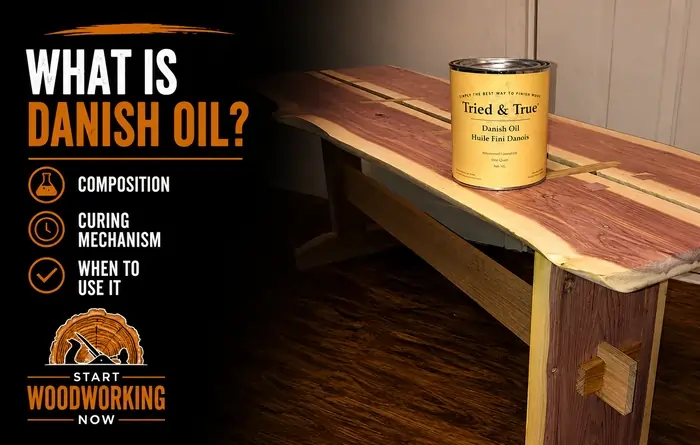
What Is Danish Oil? Composition, Curing Mechanism, and When to Use It
Danish oil is a long-oil varnish — a formulation with an oil-to-resin ratio typically above 2:1 — that penetrates the wood grain before forming a minimal surface film. The oil component saturates the wood cells; the alkyd resin concentrates near the surface, providing protection marginally above what pure oil alone achieves. The combined system cures by oxidative polymerisation initiated by metallic drier compounds in the formulation.
There is no regulated formulation for danish oil. “Danish oil” is a marketing category, not a technical specification — different manufacturers produce products under this name with substantially different oil-to-varnish ratios, oil types, and resin chemistry. This is why danish oil from one brand behaves differently from another: drying time, depth of penetration, surface sheen, and resistance to heat or chemicals all vary significantly between products sold as “danish oil.”
This article is part of the complete wood finishing guide — covering finish selection, application protocols, and troubleshooting for all finish types and species.
Navigate to your question
→ What is actually in danish oil? → Oil-to-varnish ratio and ingredients ↓
→ How does it cure inside the wood? → Oxidative polymerization mechanism ↓
→ When should I use danish oil vs poly or hardwax? → Decision by use case ↓
→ How does it compare to tung oil or linseed oil? → Full comparison table ↓
→ What are the real limitations? → Specifications and honest assessment ↓
The term “danish oil” has nothing to do with Denmark. It is a US marketing term from the 1950s, coined when Scandinavian Modern furniture became widely popular and American product manufacturers began selling finishing oils marketed to produce “the Scandinavian look.” No Danish standard, regulation, or formulation defines it.
⚠ Spontaneous Combustion Risk — Before You Apply
Danish oil cloths generate heat through the same oxidative polymerisation described in this article and can ignite without external flame. After every application: spread used cloths flat outdoors on a non-combustible surface until fully dry, or submerge in a sealed metal container filled with water. Never bundle, fold, or leave in a bin. This applies to danish oil, linseed oil, tung oil, and all oxidising oil finishes.
What Is Danish Oil Made Of?
Danish oil contains three components: a drying oil (tung oil or boiled linseed oil), an alkyd varnish resin, and a solvent carrier (mineral spirits or naphtha). The oil-to-varnish ratio is typically around 2:1 to 3:1 by volume — predominantly oil with a supporting fraction of varnish resin. This “long oil” formulation is what gives danish oil its penetrating character: high oil ratio means the finish flows into grain rather than sitting on top of it.
| Component | Typical % by Volume | Function | Effect on Performance |
|---|---|---|---|
| Tung oil or Boiled Linseed Oil (BLO) | 50–70% | Primary film-forming component. Penetrates grain, cures by oxidative polymerisation. | Higher oil % = deeper penetration, slower cure, more natural appearance |
| Alkyd varnish resin | 20–35% | Concentrates near surface. Provides marginal surface hardness and stain resistance above pure oil. | Higher varnish % = more surface sheen, faster cure, slightly less penetration depth |
| Mineral spirits / naphtha | 10–25% | Reduces viscosity for grain penetration. Evaporates during and after application. | Evaporation rate affects working time and initial tack |
| Metallic drier compounds | 0.1–0.5% | Catalyse oxidative polymerisation. Cobalt naphthenate and manganese naphthenate most common. | Without driers: oil takes weeks to cure. With driers: 6–8 hours. Driers inhibited by wood terpenes (teak, rosewood) |
The distinction between boiled linseed oil (BLO) and polymerized linseed oil matters more than most articles acknowledge. BLO is raw linseed oil with metallic drier compounds added — it has never been boiled despite its name. Polymerized linseed oil is heat-treated at 250–300°C without solvents, which partially pre-polymerizes the oil molecules before any metallic driers are added.
Polymerized linseed oil is thicker, slower to penetrate, and lower-VOC than BLO. Products using polymerized linseed oil (Tried and True, some premium brands) behave differently from products using BLO — longer working time, heavier first coat on bare wood, and different maintenance requirements.
How Does Danish Oil Cure and Why Does It Harden Inside the Wood?
Danish oil cures by oxidative polymerisation — the oil molecules react with atmospheric oxygen and link together into a three-dimensional polymer network. Metallic drier compounds in the formulation (cobalt naphthenate and manganese naphthenate) catalyse this reaction, reducing cure time from weeks to 6–8 hours. Because the oil has already penetrated the wood grain before curing begins, the polymer network forms inside the wood cells rather than on the surface.
Oxygen [diffuses] through the wood grain to reach the oil molecules inside the cells. The metallic driers [accelerate] the reaction between unsaturated fatty acid chains in the oil and ambient oxygen. The cross-linking [creates] a polymer matrix that bonds within the wood cell walls. This is different from a film finish: polyurethane [polymerises] on the wood surface through solvent evaporation and cross-linking at the air-film interface. Danish oil [polymerises] inside the wood, so the cured finish is mechanically embedded rather than bonded to the surface.
Why Teak and Rosewood Prevent Danish Oil from Curing
Teak, IPE, rosewood, and cocobolo contain natural terpenes — organic compounds that form stable complexes with cobalt and manganese ions. When danish oil is applied to these species, the terpenes immediately bind the metallic drier compounds, removing them from the oxidative polymerisation reaction. Without active driers, the oil cannot initiate its curing chain. The oil stays liquid on the surface indefinitely — a permanently tacky film that no waiting period resolves.
This is why an acetone pre-wipe is required before any penetrating finish on oily species: acetone dissolves and removes surface terpenes, temporarily opening a 20–60 minute window during which the finish can be applied before the terpenes migrate back from the wood interior. On teak, even with acetone prep, danish oil is not recommended — hardwax oil with its wax curing mechanism is the correct alternative.
When Should You Use Danish Oil Instead of Polyurethane or Hardwax Oil?
Use danish oil when natural appearance and ease of maintenance matter more than maximum protection. It is the correct finish for furniture that will be admired more than used hard — sideboards, bookshelves, display cabinets, bedside tables. For surfaces that receive daily contact, spills, or heat (dining tables, desks, kitchen worktops), danish oil provides insufficient protection and polyurethane or hardwax oil is the better choice.
📝My test for whether a client’s piece should get danish oil or polyurethane is simple: will something hot, wet, or sharp regularly contact this surface? Dining table — no to danish oil. Walnut sideboard in a living room — yes to danish oil. The finish that produces the most beautiful result on a sideboard is not the same as the finish that survives five years of daily use on a dining table. Danish oil on furniture that gets used like a table is a guarantee of disappointing results within 12–18 months.
How Does Danish Oil Compare to Tung Oil, Linseed Oil, and Hardwax Oil?
Danish oil, tung oil, and linseed oil are frequently confused but are chemically and practically different products. Danish oil contains all three components (oil + varnish + solvent with driers). Pure tung oil and pure linseed oil are single-component oils — no varnish resin, sometimes no metallic driers. Hardwax oil combines penetrating oil with a specific wax formulation that danish oil does not contain, producing higher water resistance.
Whether your danish oil is tung-oil-based or linseed-oil-based determines its water resistance, food safety, and yellowing — the side-by-side comparison of the two base oils used in danish oil products.
| Product | Components | Cure Time | Water Resistance | Coverage |
|---|---|---|---|---|
| Danish oil | Oil + alkyd varnish + thinner + metallic driers | 6–8 hours | Medium | ~12.5 m²/L |
| Pure tung oil | 100% tung oil, no varnish or driers | 24–48 hours | Medium — naturally water-resistant | ~20 m²/L (thicker, less penetration) |
| Boiled linseed oil (BLO) | Raw linseed + metallic driers (no solvent, no varnish) | 12–24 hours | Low — yellows significantly | ~15 m²/L |
| Raw linseed oil | 100% linseed, no driers | Weeks to months | Low — never fully hardens | ~15 m²/L |
| Hardwax oil | Oil + wax (specialised formulation, no thinner in most) | 12–24 hours per coat | High — wax deposits in pores | 8–20 m²/L (species-dependent) |
Hardwax oil is the modern alternative to danish oil for high-use surfaces — denser wax loading produces better water beading and more durability — the maintenance interval and cost per square metre comparison between hardwax oil and danish oil for floors.
What Are the Real Properties and Limitations of Danish Oil?
Danish oil provides moderate water resistance, low surface hardness (no Taber cycle rating — it has no measurable film thickness for standard abrasion testing), and a natural, low-sheen appearance. Its actual performance varies more by brand formulation than any other commonly used wood finish — the same application technique produces different durability, sheen, and colour depth results with different branded danish oils.
| Property | Value / Rating | Practical Meaning |
|---|---|---|
| Film thickness | None measurable | No surface film — the finish is inside the wood, not on it |
| Abrasion resistance | Not rated (no film) | Cannot be compared to polyurethane Taber cycle values — different protection mechanism |
| Water resistance | Moderate — repels water droplets for 10–20 min | Standing water penetrates within 20–30 minutes, producing white marks on the wood surface |
| VOC content | 200–350 g/L (typical) | Higher than hardwax oil (under 150 g/L), lower than oil-based polyurethane (250–400 g/L) |
| Colour effect | Warm amber — darkens wood 1–2 shades | More colour enhancement than water-based products; less than boiled linseed oil alone |
| Coverage rate | ~12.5 m²/L on average | Varies by species porosity: 8–10 m²/L on open-grain oak, 15–18 m²/L on closed-grain maple |
| Repairability | Invisible spot repair | Fresh danish oil blends seamlessly into cured danish oil — no patch boundary visible |
| Food contact safety | Not certified by default | Metallic drier compounds (cobalt, manganese naphthenate) are not food-safe. Some brands offer food-safe versions without metallic driers — check the specific TDS. Full framework: food-safe wood finishes. |
Frequently Asked Questions
Is danish oil the same as tung oil?
No. Tung oil is a single-component pure oil pressed from the nut of the tung tree — it contains no varnish resin, no solvent, and may or may not contain metallic driers depending on the product. Danish oil is a formulated blend that may contain tung oil as its oil component, alongside alkyd varnish resin and mineral spirits. Pure tung oil takes 24–48 hours per coat to cure and produces a softer, more natural finish than danish oil. Products labelled “tung oil finish” at retail are often danish oil blends, not pure tung oil — check the ingredient list for varnish or alkyd content.
Can you make danish oil at home?
Yes — a functional danish oil equivalent is: 1 part boiled linseed oil + 1 part alkyd varnish + 1 part mineral spirits. This 1:1:1 ratio produces a standard penetration-to-protection balance. For deeper penetration (more natural look, less surface sheen): increase the oil ratio to 2:1:1 oil:varnish:thinner. For faster cure and more surface protection: increase varnish to 1:2:1 oil:varnish:thinner. Always use boiled linseed oil (with metallic driers), not raw linseed oil. Raw linseed without driers takes weeks to cure and may never fully harden.
Does danish oil protect wood outdoors?
Standard danish oil is not formulated for outdoor use — it lacks UV stabilisers that prevent photo-degradation from direct sunlight. Outdoors, danish oil typically requires reapplication every 3–6 months compared to 12–24 months indoors. For outdoor hardwood furniture, use exterior-grade hardwax oil (Osmo UV Protection, Rubio Monocoat Exterior) or teak oil for oily tropical species. For softwood outdoor furniture, a primer and exterior paint system provides longer-lasting protection than any penetrating oil.
Why does danish oil smell after it has dried?
The mineral spirits carrier in danish oil evaporates progressively — most evaporates during application and the first 24 hours, but trace quantities continue evaporating for 7–14 days after application as the oil fully cures. The smell is from these residual solvent vapours and from the oxidative polymerisation reaction itself, which produces aldehydes and other volatile organic compounds as byproducts. The smell reduces daily and should be undetectable after 7–10 days in a ventilated space. If smell persists beyond 14 days, excess oil was not wiped off and is still curing on the surface.
What is the difference between Watco Danish Oil and Tried and True Danish Oil?
These are substantially different products. Watco Danish Oil contains linseed oil, alkyd varnish resin, mineral spirits, and metallic driers — a conventional danish oil formulation with moderate penetration and a light satin sheen. Tried and True Danish Oil uses only polymerized linseed oil without varnish resin, solvent, or metallic driers — technically it is a pure polymerized oil, not a varnish blend. Tried and True cures by polymerisation of the pre-treated oil alone, takes longer per coat (12–24 hours), produces a warmer, deeper colour effect, and has essentially zero VOC. Watco is faster, more widely available, and produces a slightly more surface-protected result. Neither is better — they suit different priorities.
For complete application instructions, coat count, wipe-off protocol, and common problems: How to Apply Danish Oil — Complete Step-by-Step Guide →
