
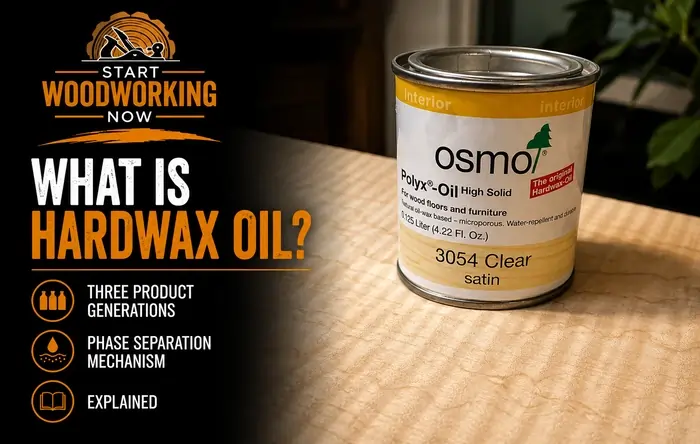
What Is Hardwax Oil? Three Product Generations, Phase Separation Mechanism Explained
Hardwax oil is a wood finish that combines vegetable oils and waxes in a single penetrating product — the oil saturates the wood grain and the wax component deposits near the surface, providing a level of water and stain resistance that oil alone cannot achieve. It cures inside the wood without forming a continuous surface film, which is why it cannot chip or peel the way polyurethane does, and why scratches are invisibly repaired rather than visibly patched.
“Hardwax oil” describes a product category, not a single formulation. The market contains three technically different product generations that all carry this name: conventional oil-plus-wax systems (Osmo Polyx, Bona), reactive oil systems that bond covalently to wood cellulose (Rubio Monocoat), and urethane-enhanced hardwax oils that add a polymer component for improved durability (General Finishes Hard Wax Oil). Each generation behaves differently in application and produces different results. Choosing between them requires understanding which category a product belongs to.
This article is part of the complete wood finishing guide — covering finish selection, application protocols, and troubleshooting for all finish types and species.
Navigate to your question
→ Rubio vs Osmo vs Bona — which type? → Three types comparison ↓
→ What’s actually in it — oils and waxes? → Composition and wax types ↓
→ How does it work differently from varnish? → Penetrating mechanism explained ↓
→ Should I use hardwax oil or polyurethane? → Decision matrix ↓
→ Can I stain before applying hardwax oil? → Stain compatibility rules ↓
→ What are its real limits? → Limitations and maintenance ↓
Hardwax oil was developed in Germany and the Netherlands in the 1990s for the commercial flooring industry. Osmo (German company, founded 1878) was the first to commercialise it as a consumer product. Rubio Monocoat (Belgian, founded 2006) introduced reactive oil technology — a fundamentally different chemistry to conventional hardwax oil that produces a permanent covalent bond with wood cellulose.
⚠ Spontaneous Combustion Risk — Applies at Application
Hardwax oil cloths generate heat through oxidative curing and can ignite without external flame. This is the same chemical mechanism — oxidative polymerisation — described in this article. When applying hardwax oil: spread used cloths flat outdoors on a non-combustible surface until fully dry, or submerge in a sealed metal container filled with water. Never bundle, fold, or leave in a bin. This risk applies to all oxidising oil finishes regardless of brand or temperature.
What Are the Three Types of Hardwax Oil and How Do They Differ?
The hardwax oil category contains three distinct product generations with different chemistries, application requirements, and performance characteristics.
Conventional hardwax oil requires two coats and produces water resistance through wax deposition. Reactive oil hardwax requires one coat and bonds permanently to wood cellulose. Urethane-enhanced hardwax oil adds a polymer component that builds marginal surface hardness above standard hardwax oil. Choosing the wrong type for the application produces either under-protection or wasted product.
What Does Hardwax Oil Contain and Why Do Wax Types Matter?
Hardwax oil contains vegetable oil as the primary penetrating component and one or more waxes as the surface-depositing component. The wax type determines water beading strength, surface hardness, and melting resistance.
Carnauba wax (plant-derived, melting point 82–86°C) provides the highest water resistance and UV stability. Beeswax (animal-derived, melting point 62–65°C) offers softer feel and better penetration at room temperature. Paraffin or microcrystalline wax (petroleum-derived) provides good water resistance at lower cost.
| Component | Type / Examples | Melting Point | Key Property |
|---|---|---|---|
| Oil base | Linseed, tung, sunflower, soy, thistle | — | Penetrates grain, cures by oxidative polymerisation. Provides internal protection. |
| Carnauba wax | Used by Rubio Monocoat, premium Osmo | 82–86°C | Highest hardness, UV resistance, water beading. Heat-stable — surfaces near radiators or with hot cups hold better. |
| Beeswax | Used in Tried & True, some Fiddes | 62–65°C | Softer, warmer feel. Better penetration into grain at room temperature. Less heat-stable — marks from hot cups more likely. |
| Paraffin / Microcrystalline | Used in most mid-range products | 50–80°C (varies by grade) | Good water resistance, lower cost. Less natural than plant/animal waxes. |
| Metallic driers (most products) | Cobalt naphthenate, manganese naphthenate | — | Catalyse oil cure. Without driers: weeks to cure. With driers: 12–24 hours. Inhibited by teak/rosewood terpenes. |
The wax melting point has a practical implication for surface use: a dining table finished with beeswax-based hardwax oil (62–65°C melting point) will show ring marks from hot mugs placed directly on the surface — mug base temperature is typically 70–80°C. The same table finished with carnauba-based hardwax oil (82–86°C) handles hot mugs without marking. This is not stated on product labels — it requires knowing which wax type the product uses, available in the Technical Data Sheet or manufacturer specification.
How Does Hardwax Oil Work Inside the Wood?
Hardwax oil works through a natural phase separation of its oil and wax components during penetration. The oil molecules (lower molecular weight, polar) penetrate deep into wood cells by capillary action — the same mechanism that draws water into a sponge. The wax molecules (higher molecular weight, non-polar) cannot follow the oil into the narrow cell lumens; they remain near the wood surface and deposit in the uppermost layer of the grain structure as the oil below them cures and immobilises the wax in position.
The result is a two-layer protection system created in a single application: oil-cured polymer inside the wood grain provides internal dimensional stability and moisture resistance, while wax deposited at the surface provides water beading and low-friction resistance to surface abrasion. Neither layer forms a film — both are embedded in the wood structure.
Why Hardwax Oil Cannot Chip — And What “Wear” Actually Means
Chipping requires a surface film that can delaminate from its substrate. Polyurethane chips because the cured film is bonded to the wood surface — when the film is cut or impacted, it separates from the wood below in flakes. Hardwax oil has no surface film to delaminate. There is nothing to chip.
What hardwax oil does instead is wear — the wax layer near the surface is gradually abraded away under traffic or use, reducing water beading and stain resistance. The underlying oil remains in the grain indefinitely. Worn hardwax oil looks dry and less enriched; it does not look damaged or chipped. The maintenance response is re-oiling the worn area — not repair, not sanding, not stripping.
This distinction determines maintenance frequency: polyurethane needs attention when it chips or scratches through to bare wood (unpredictable, years apart). Hardwax oil needs attention when the surface looks dry (predictable, 1–4 years depending on traffic).
Temperature Effect on Wax Deposition
The phase separation that deposits wax near the wood surface is temperature-dependent. At 18–22°C (optimal application temperature), wax separates from oil at the correct depth — in the uppermost wood cells. At temperatures below 15°C, the oil is too viscous to penetrate adequately before the wax has time to separate — resulting in excess wax at the surface before oil penetration is complete, producing patchy sheen and sticky spots. At temperatures above 28°C, the wax remains fluid too long and follows the oil deeper into the grain, depositing at insufficient depth to provide surface protection. Always bring hardwax oil product to 18–22°C before application.
When Should You Use Hardwax Oil Instead of Danish Oil or Polyurethane?
Use hardwax oil when you want the natural, tactile appearance of an oil finish with the water resistance and floor-suitable durability that danish oil alone cannot provide. Hardwax oil is the correct choice for floors, kitchen countertops, and dining tables where danish oil would fail within a year.
For maximum protection on heavily used surfaces — commercial floors, high-traffic tabletops — oil-based polyurethane provides higher abrasion resistance. Hardwax oil occupies the practical middle ground between danish oil and polyurethane.
📝The question I get most often about hardwax oil is whether it is suitable for a dining table. The answer depends on the wax type. Carnauba-wax hardwax oil (Rubio Monocoat, Osmo Polyx Original) handles daily dining table use — regular spills, cleaning with a damp cloth, occasional hot cups — adequately. Beeswax-based hardwax oil is better suited to furniture that is less frequently wet or heated. The practical test: leave a water drop on the finish for 20 minutes after full cure. If the finish beads well and no white mark forms — suitable for dining table. If the wood darkens or a faint ring appears — use for lower-contact furniture and apply carnauba-wax product on the table.
| Property | Hardwax Oil | Danish Oil | Oil-Based Poly |
|---|---|---|---|
| Surface film | None | None | Yes — 3–4 mils |
| Floor suitability | Yes — wax barrier resists traffic | No — wears within 6–12 months | Yes — maximum durability |
| Water resistance | High — wax beads water | Medium — no wax layer | Maximum — continuous film |
| Fail mode | Wears — looks dry, no damage | Wears — looks dry faster | Chips / peels — visible damage |
| Spot repair | Invisible | Invisible | Visible until aged (~30 days) |
| VOC (typical) | <150 g/L (Rubio ~0) | 200–350 g/L | 250–400 g/L |
| Maintenance interval | 1–4 years (traffic-dependent) | 1–2 years | 5–10 years (then strip/recoat) |
Hardwax oil’s wax loading is what distinguishes it from danish oil — the full per-coat coverage difference between hardwax oil and danish oil including the cost per square metre on floors.
What Are the Key Properties and Limitations of Hardwax Oil?
Hardwax oil provides good water and stain resistance, natural appearance, and easily maintained surfaces with invisible spot repair. Its key limitation compared to polyurethane is abrasion resistance: without a surface film, the wax layer wears under traffic faster than polyurethane film does. This is not a failure — it is how the product is designed to age, and maintenance is simpler than polyurethane recoating.
Hardwax oil is spot-repairable invisibly because no surface film exists to disrupt — this is the same advantage that makes shellac the antique restoration finish — the comparison of repairability between shellac and modern film finishes.
| Property | Value / Rating | Practical Meaning |
|---|---|---|
| Film thickness | None measurable on surface | No film to chip, scratch, or peel. Wear is gradual and recoverable. |
| VOC (Rubio Monocoat) | ~0 g/L | Reactive oil technology requires no solvent carrier — near zero VOC at application. |
| VOC (Osmo Polyx, conventional) | <150 g/L | Lower than danish oil (200–350 g/L) and oil-based poly (250–400 g/L). |
| Water beading duration | 20–60 min standing water resistance (species and wax type dependent) | Wipe spills within 20 minutes — standing water beyond this window penetrates through worn wax areas |
| Coverage (Osmo Polyx) | 8–20 m²/L (species-dependent) | Open-grain oak: 8–12 m²/L. Closed-grain maple: 15–20 m²/L. Same tin covers different areas. |
| Food contact safety | Product-dependent | Rubio Monocoat has USDA food-contact certification. Osmo Polyx certified for indirect food contact. Check specific product TDS — not all hardwax oils are food-safe. |
Frequently Asked Questions
Is hardwax oil better than polyurethane?
“Better” depends on the surface and priorities. Polyurethane provides maximum abrasion resistance — a continuous polymer film rated at 300–500 Taber cycles. Hardwax oil provides natural appearance, low VOC, invisible spot repair, and simpler maintenance. On a residential dining table where aesthetics and ease of maintenance matter as much as protection, carnauba-based hardwax oil is a more practical choice for most users. On a commercial floor with high foot traffic, oil-based polyurethane or conversion varnish outperforms hardwax oil in wear lifespan. There is no universally better product — only the correct product for the specific application.
How do you remove hardwax oil from wood?
Conventional hardwax oil (Osmo, Bona, Treatex) can be partially removed with repeated naphtha or mineral spirits treatment, but sanding is the most reliable method. Reactive oil hardwax (Rubio Monocoat) forms covalent bonds with wood cellulose that no solvent can break — sanding is the only effective removal method. Start with 80-grit to break through the wax surface layer, then 100–120-grit to remove the oil-impregnated wood surface. Unlike polyurethane, which strips to the bare wood surface cleanly, hardwax oil removal may require removing a thin wood layer to reach oil-free grain. Complete removal guide →
Can you apply polyurethane over hardwax oil?
No. The wax component in hardwax oil prevents polyurethane adhesion by the same mechanism that paste wax prevents polyurethane adhesion — wax lubricates the surface and prevents film-forming finishes from bonding. If you want to switch from hardwax oil to polyurethane, the hardwax oil must be completely removed (sanding to bare wood) before polyurethane can be applied. Check all finish compatibility →
Is Osmo Polyx the same as Rubio Monocoat?
No — they use different chemistries. Osmo Polyx is a conventional hardwax oil (Generation 1): vegetable oil + wax blended with conventional penetration mechanism, requiring two coats. Rubio Monocoat is a reactive oil (Generation 2): modified oil that forms covalent bonds with wood cellulose, requiring one coat. Osmo Polyx is more widely available, less expensive, and has a longer product history in flooring applications. Rubio Monocoat has lower VOC, single-coat application, and the permanent covalent bond — which also means it cannot be removed with solvents. They produce similar visual results but through different mechanisms with different maintenance requirements.
Does hardwax oil work on all wood species?
Hardwax oil works reliably on most domestic hardwood and softwood species. It does not work without preparation on oily tropical species (teak, IPE, rosewood, cocobolo) — natural terpenes in these woods inhibit the metallic drier compounds that catalyse oil curing. For oily species, an acetone pre-wipe 20 minutes before application removes surface terpenes and opens a 60-minute window for application. Rubio Monocoat’s reactive chemistry is less susceptible to terpene inhibition than conventional hardwax oil — it is the recommended choice for teak and similar oily species without requiring an acetone pre-wipe in all cases (check the product TDS for specific species guidance).
For complete application instructions including product-specific wipe-off windows and the buffing protocol: How to Apply Hardwax Oil — Complete Step-by-Step Guide →