Danish Oil vs Linseed Oil (BLO): Economic Threshold, and Layered Application Technique
Danish oil and boiled linseed oil (BLO) are more closely related than most guides acknowledge — danish oil’s oil component is typically BLO or tung oil, and both products contain the same metallic driers. The practical differences are real but narrower than their price gap suggests: danish oil adds a varnish component that produces a slight satin sheen and marginally better water resistance; BLO adds nothing beyond the oil itself and produces a flat matte result. For applications where sheen and slightly improved water resistance justify the cost premium, danish oil is the better choice. For applications where neither matters, BLO is the economically correct product.
Navigate to your question
→ What is the actual difference between them? → Composition and the shared drier problem ↓
→ Is danish oil really more durable than BLO? → What the varnish adds — and what it doesn’t ↓
→ Can I use BLO instead of danish oil to save money? → When BLO is sufficient vs when to upgrade ↓
→ Which gives a darker, warmer result on wood? → Amber shift and sheen comparison ↓
→ Can I apply danish oil over BLO? → Layered technique and timing ↓
This guide is part of the complete wood finishing guide. For definitions: What Is Danish Oil? · What Is Linseed Oil?
What Is the Actual Difference Between Danish Oil and Boiled Linseed Oil?
Danish oil is BLO (or tung oil) plus alkyd varnish at approximately a 2:1 oil-to-varnish ratio. BLO is the oil component of danish oil without the varnish. Both products contain the same metallic driers — cobalt naphthenate and manganese naphthenate. This shared chemistry has two practical consequences that most guides overlook:
⚠ Spontaneous Combustion — Both Danish Oil and BLO Rags
Danish oil and BLO contain the same metallic driers (cobalt and manganese naphthenate) that accelerate oxidative polymerization and generate heat. Rags saturated with either oil can ignite without external flame. After every application: spread rags flat outdoors until fully dry, or submerge in a sealed metal container filled with water. Neither product is food-safe — both contain cobalt driers that remain in the cured film.
| Property | Boiled Linseed Oil (BLO) | Danish Oil |
|---|---|---|
| Composition | Linseed oil + cobalt/manganese driers | BLO or tung oil (~65-70%) + alkyd varnish (~30-35%) + cobalt/manganese driers |
| Metallic driers | Yes — cobalt + manganese | Yes — same cobalt + manganese |
| Food safe | No | No |
| Surface film | None — fully penetrating | Thin — varnish component builds minimal surface presence |
| Sheen | Flat matte | Satin |
| Touch dry | 24–72 hours | 24–48 hours |
| Relative cost | 40–60% cheaper | Standard market price |
Danish oil’s varnish resin component is what distinguishes it from straight BLO — same base oil, different surface protection — the per-product breakdown of pure tung oil vs danish oil and what the resin addition changes.
Is Danish Oil More Durable Than BLO — What Does the Varnish Component Actually Add?
Danish oil is marginally more water-resistant than BLO — the varnish component adds approximately 15-20% improvement in water resistance. It does not add meaningful abrasion resistance, UV protection, or chemical resistance. Understanding exactly what the varnish adds prevents overspending on danish oil for applications where BLO performs equally well.
📝On a set of workshop shelves where I used BLO on half the boards and danish oil on the other half, the difference under workshop conditions after two years was negligible — both had lightened slightly from cleaning, both showed absorbed oil stains around the same hinges and fittings, and neither had developed a visible protective film. The danish oil boards looked marginally better under a raking light due to the satin sheen — that sheen difference was the only perceptible distinction. For non-decorative workshop furniture, BLO at half the price was the correct economic choice.
Can You Use BLO Instead of Danish Oil — When Each Is the Right Choice?
BLO is the right choice whenever sheen is not required and the cost difference matters. Danish oil is the right choice whenever any visible satin result is expected, or when the surface will be viewed under light where sheen variation is visible.
Use BLO When
✅ Tool handles — hammer, chisel, plane handles. Matte finish appropriate, maximum penetration desired. BLO at 40-60% lower cost performs identically to danish oil on handle wood.
✅ Workshop furniture and jigs — workbenches, storage units, fixture boards. No sheen requirement, moisture protection sufficient.
✅ Rough exterior timber — fence posts, log structures under cover. Maximum penetration at minimum cost. Neither BLO nor danish oil is adequate for direct rain or sun exposure.
✅ First coats under danish oil — BLO as the base penetration coats, danish oil as the finishing coats. See layered technique below.
Use Danish Oil When
✅ Decorative furniture — bookshelves, sideboards, coffee tables. The satin sheen from danish oil reads as a “finished” surface; BLO reads as raw or under-finished.
✅ Any surface viewed under lighting — danish oil’s sheen is visible under lamps and natural light; BLO’s matte finish disappears under light.
✅ Faster project turnaround — danish oil typically reaches handle-ready state 12-24 hours before BLO due to the varnish component hardening faster.
✅ Primer before polyurethane — danish oil builds a better substrate for film finishes than BLO due to its varnish component (allow 7 days full cure before topcoating).
The Economic Threshold — When BLO Is the Correct Choice
BLO is typically 40-60% cheaper than danish oil per litre. On a workshop bench requiring 2 litres of finish, that difference is meaningful. The question is whether the performance gap justifies it:
No sheen required + no decorative purpose: BLO is economically correct. The 40-60% premium for danish oil buys a sheen nobody will notice on a workbench.
Sheen required OR surface will be seen: Danish oil is worth the premium. The satin finish is a real visual improvement that BLO cannot replicate regardless of how many coats are applied.
Which Gives a Warmer, Darker Result — Danish Oil or BLO?
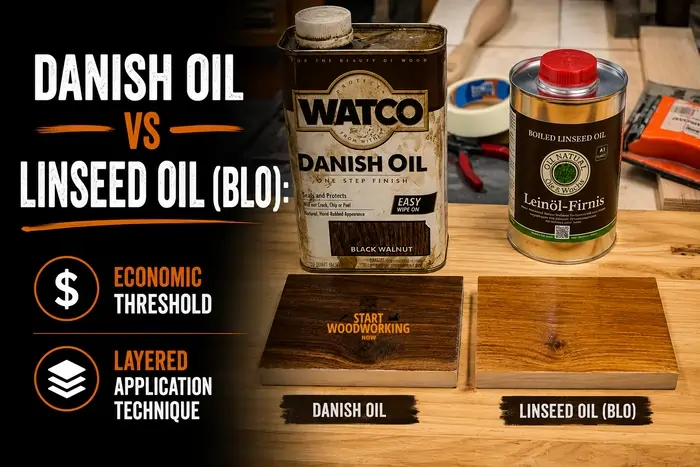
BLO produces a stronger, deeper amber shift than danish oil on the same species. The pure linseed oil in BLO has more direct contact with the wood’s chromophore compounds — the natural pigments in the wood that deepen under oil. Danish oil’s varnish component sits between the oil and the wood surface, slightly reducing the direct oil-to-wood contact that drives amber toning.
In practice on an oak test panel: BLO produces a noticeably richer, more golden-amber tone than danish oil applied under identical conditions and coat counts. Danish oil produces a warmer tone than the bare wood but with a slightly cooler, more “finished” appearance than BLO. Neither is objectively better — it depends on the target appearance.
BLO Result
Deep amber-golden tone. Strong grain contrast. Flat matte surface. Looks like the oil has gone deeply into the wood — because it has.
Danish Oil Result
Warm amber tone, slightly less deep than BLO. Good grain contrast. Light satin sheen. Looks “finished” rather than raw-oiled.
Light Species (Maple, Birch)
Both add amber that may be undesirable on very light species. For maple or birch where colour neutrality matters: hardwax oil or water-based finish is a better choice than either BLO or danish oil.
Linseed oil and BLO-based danish oil both produce progressive amber over time — the same chromophore mechanism that causes polyurethane yellowing on white cabinets — the full BHT-quinone reaction explained.
Can You Apply Danish Oil Over BLO — The Layered Technique?
Yes — and it is a deliberate professional technique. Applying BLO for the first 1-2 coats and then danish oil for the final 1-2 coats combines BLO’s deeper penetration with danish oil’s satin finish.
BLO penetrates more deeply than danish oil because it has no varnish thickener. Pure linseed oil [enters] the wood cell walls more completely than a thicker oil-varnish blend. Danish oil’s alkyd component [increases] viscosity, which [limits] penetration depth slightly on dense species. By using BLO first, the wood grain is saturated with pure oil at depth; the danish oil coats then build the surface sheen over a fully saturated substrate.
Protocol — BLO Base + Danish Oil Finish
Coat 1: BLO thinned 10% with mineral spirits. Apply liberally, allow absorption 20-30 minutes, wipe off all excess. Allow 48 hours.
Coat 2 (optional on porous species): BLO undiluted. Same application protocol. Allow 48 hours.
Coat 3: Danish oil. Apply, wipe off excess, allow 24-48 hours.
Coat 4 (final): Danish oil. Apply, wipe off excess, allow 7 days before heavy use.
Important: Do not apply danish oil over BLO before the BLO is fully tack-free (minimum 48 hours at 18-24°C). BLO that is not yet cured under danish oil will outgas through the varnish component, producing cloudiness or soft patches in the finish. Confirm readiness: no impression from firm thumbnail pressure, no oily transfer on a clean cloth.
Danish oil’s wipe-off window is wider than pure linseed oil’s — making it more forgiving for beginners — the complete danish oil application protocol with the three-coat system.
Frequently Asked Questions
Is danish oil just BLO with varnish added?
Essentially yes for most commercial formulations, with one caveat: some danish oils use tung oil as the base rather than linseed oil, and the exact oil-to-varnish ratio varies by manufacturer. Watco Danish Oil uses a tung/linseed blend; other brands may use a purely linseed base. But the structural description — drying oil at approximately 65-70% plus alkyd varnish at 30-35% plus metallic driers — describes most products sold as danish oil.
Can you mix BLO and danish oil together?
Technically compatible — both are oil-based and the solvents will not react. But there is no practical benefit to mixing them. Mixing dilutes the varnish concentration of the danish oil and extends the drying time without achieving the deeper penetration of pure BLO. If the goal is deep penetration with a satin finish, use them sequentially (BLO first, danish oil last) rather than mixed.
Is danish oil better than BLO for outdoor wood?
Marginally — danish oil’s varnish component provides slightly better initial water resistance. But neither is adequate for wood in direct rain or sun exposure. For covered outdoor wood (under eaves, sheltered porch), BLO provides sufficient moisture protection at lower cost. For direct exposure: use an exterior-formulated product with UV stabilisers. The difference between danish oil and BLO on outdoor wood is irrelevant beyond the first season if no UV protection is present — both will allow the wood to grey at the same rate under sun.
Does danish oil last longer than BLO before needing reapplication?
Slightly — the varnish component in danish oil extends the maintenance interval by approximately 20-30% on indoor furniture. For a piece that needs BLO re-oiling every 12 months, danish oil may last 14-16 months before visible drying or water absorption begins. The difference is real but small. For outdoor wood, both require annual maintenance regardless.
If either finish has stayed sticky, the cause is the same — oxygen starvation from thick application — the full oil finish drying failure diagnosis and the only viable fix.
Which is better for a dining table — danish oil or BLO?
Neither — a dining table with daily use, hot plates, and spills requires a more protective finish than either product can provide. Both will show water rings within weeks and hot-plate marks immediately. For a dining table: hardwax oil (Rubio Monocoat, Osmo Polyx) provides oil-finish aesthetics with significantly better durability, or oil-based polyurethane provides the most abrasion and moisture resistance. If a natural oil appearance is essential and the table will receive light use only: danish oil is preferable to BLO because the satin sheen reads better as a deliberate finish choice.