
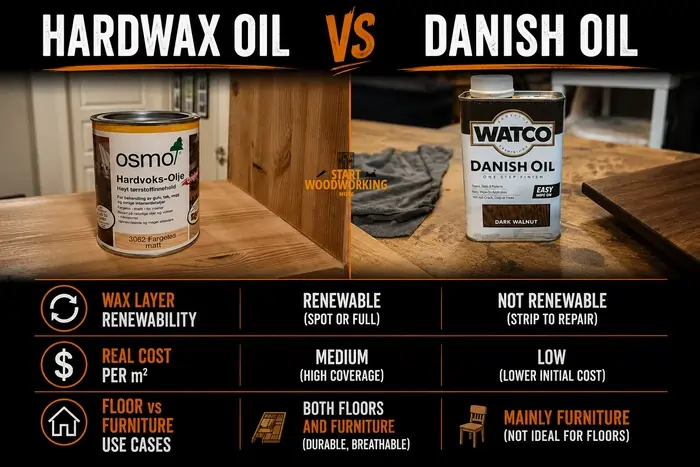
Hardwax Oil vs Danish Oil: Wax Layer Renewability, Real Cost Per m², and Floor vs Furniture Use Cases
Hardwax oil and danish oil are both penetrating oil finishes that leave no thick surface film — but they protect wood through different mechanisms, and those mechanisms produce different long-term maintenance profiles. Danish oil uses an oil-plus-varnish formulation: the oil penetrates and the varnish component builds a thin surface film. Hardwax oil uses an oil-plus-wax formulation: the oil penetrates and the wax component builds a sacrificial surface layer. The key difference: the wax layer in hardwax oil can be renewed by adding more wax without stripping the finish. The varnish layer in danish oil is harder to refresh predictably once it has aged.
Navigate to your question
→ What is actually different between them? → Composition and the wax layer mechanism ↓
→ Which is more durable — and is Rubio Monocoat different? → Durability + Rubio reactive oil chemistry ↓
→ How does maintenance work for each? → Wax renovation vs varnish refresh ↓
→ Which is better for floors? → Floor-specific performance comparison ↓
→ Which should I use for my project? → Decision matrix + real cost comparison ↓
This guide is part of the complete wood finishing guide. For full definitions: What Is Hardwax Oil? · What Is Danish Oil?
⚠ Spontaneous Combustion — Both Danish Oil and Hardwax Oil Rags
Both products contain drying oils (and metallic driers in most formulations) that generate heat during oxidative curing. Used rags can ignite without external flame. Spread rags flat outdoors until fully dry, or submerge in a sealed metal container filled with water. Never fold, bundle, or bin while wet.
What Is the Core Difference Between Hardwax Oil and Danish Oil?
Both are penetrating finishes — neither builds a thick film like polyurethane. The distinction is what the non-oil component does after the oil has penetrated.
Why the Wax Layer Makes Hardwax Oil More Maintainable
Danish oil’s alkyd varnish film [ages] over time as the polymer chains continue cross-linking and yellowing. A fresh coat of danish oil applied over aged danish oil [introduces] a new, less-aged varnish layer on top of the old one. In high-use areas, this mismatch can be visible as a slightly different sheen or colour.
Hardwax oil’s wax layer [wears] by abrasion — the wax thins gradually in high-traffic zones. A maintenance coat of hardwax oil or dedicated hardwax maintenance product [replenishes] only the wax layer, which [remains] chemically consistent with the original finish. The result: hardwax oil maintenance coats blend invisibly; danish oil refreshes are more noticeable on aged surfaces.
Danish oil’s base oil determines its food safety — pure tung-based vs BLO-based differ entirely — the danish oil composition breakdown by base oil with each oil’s properties.
Which Is More Durable and How Does Rubio Monocoat Differ from Standard Hardwax Oil?
Hardwax oil is more durable than danish oil for surface wear resistance. Standard hardwax oils (Osmo, Woca, Treatex) and Rubio Monocoat are both hardwax oil products but use different chemistry — and this matters for application and performance.
| Property | Danish Oil | Hardwax Oil (Osmo) | Rubio Monocoat |
|---|---|---|---|
| Coats needed | 3 | 2 | 1 |
| Touch dry | 24–48 hrs | 8–12 hrs | 12–24 hrs |
| Water resistance | Moderate (varnish) | Good (wax layer) | Good (chemical bond) |
| Spot repair | Visible on aged surface | Invisible — wax blends | Invisible — chemical blend |
| Amber shift | Moderate amber | Warm, slight amber | Minimal — most neutral |
| Food safe | No — metallic driers | Check TDS per product | Yes when cured (Rubio 2C) |
Hardwax oil sits between a pure oil and a film finish. Compare it head to head with polyurethane, varnish, or any other finish in the finish comparison tool.
How Does Maintenance Work for Each — and Which Is Easier Long-Term?
Hardwax oil maintenance is more predictable and more forgiving than danish oil maintenance. The wax surface layer of hardwax oil wears by abrasion in a visible, uniform way — you can see when it needs attention because the surface looks drier and water no longer beads as well. Renewing the wax layer with a maintenance coat restores protection without stripping.
Danish Oil Maintenance
When needed: Surface looks dry, colour has faded, water absorbs rather than beads.
Protocol: Clean surface with mineral spirits. Sand lightly with 320-grit if surface is rough. Apply new coat of danish oil, allow absorption, wipe off excess.
Problem: The aged varnish component in the existing finish may be a different colour or texture to the fresh danish oil coat. On light species or satin finishes, this can be visible as a slightly different sheen in maintained areas.
Interval: Indoor furniture every 1–3 years. Outdoor every 6–12 months.
Hardwax Oil Maintenance
When needed: Surface looks dull, water no longer beads prominently. The wax layer is thin but the oil in the grain remains protective.
Protocol: Clean with dedicated hardwax oil soap (Osmo Wash & Care, Rubio Monocoat Soap). Apply a thin maintenance coat of the same hardwax oil product — one coat, wipe off excess. No sanding required in most cases.
Advantage: Wax blends invisibly with the existing wax layer — same chemistry, same age compatibility. No mismatch risk.
Interval: High-traffic floors once a year. Indoor furniture every 2–5 years. Regular cleaning with pH-neutral soap extends the interval significantly.
Hardwax oil’s product family — Rubio Monocoat, Osmo Polyx, Bona — each requires a different wipe-off window — the per-product hardwax oil application protocol with the reactive vs conventional oil distinction.
📝On a solid oak dining room floor I refinished with Osmo Polyx 3232 six years ago, the maintenance routine has been: annual cleaning with Osmo Wash & Care and a maintenance coat of Osmo Polyx in the main traffic corridor (door to table). The rest of the floor has never needed anything beyond cleaning. The maintained section is visually indistinguishable from the rest — the wax blend is complete. The same floor finished with danish oil would have required a full re-oiling of the entire surface at least twice in the same period, and achieving a perfect colour match across the entire floor at each refresh would have been challenging.
Which Is Better for Hardwood Floors — Hardwax Oil or Danish Oil?
Hardwax oil is significantly better than danish oil for hardwood floors — on durability, maintenance system, and long-term appearance. Danish oil is not typically recommended for floors by finishing professionals; it is primarily a furniture and smaller woodwork finish.
Why Hardwax Oil for Floors
✅ Wax maintenance system specifically designed for floor use — specialist floor soaps that clean and refresh the surface simultaneously
✅ “Breathing” — high moisture vapor transmission allows the floor to move with seasonal humidity changes without film stress
✅ Spot repair invisible — traffic damage in doorways can be refreshed without refinishing the whole floor
Why NOT Danish Oil for Floors
❌ Varnish component not designed for foot traffic — wears unevenly in high-traffic zones
❌ No dedicated floor maintenance system — refreshing requires re-oiling the entire floor for consistent appearance
❌ Lower water resistance than hardwax oil — wet shoes and wet mopping cause faster finish degradation
For Very High Traffic Floors
Both hardwax oil and danish oil are penetrating finishes — neither provides the abrasion resistance of oil-based polyurethane (300–500 Taber) or catalyzed lacquer (400–600 Taber).
Commercial spaces, hallways with heavy foot traffic: oil-based polyurethane or catalyzed lacquer floor system. Hardwax oil for residential floors with moderate traffic and regular maintenance.
The moisture vapor transmission advantage for floors: Solid wood floors in buildings with underfloor heating or significant seasonal humidity variation (old stone buildings, poorly insulated rooms) benefit from the “breathing” property of hardwax oil. When humidity rises, the wood expands; when it falls, it contracts. A high-MVT finish allows this movement freely. A finish with a stronger moisture vapor barrier (danish oil’s varnish, polyurethane) resists moisture entry but can create stress in the wood at the finish boundary during seasonal swings.
When Should You Choose Hardwax Oil and When Should You Choose Danish Oil?
“Danish oil is cheaper” is true per litre but often false per m² of finished surface. Hardwax oil has a significantly higher coverage rate per litre — which changes the real-cost comparison on larger areas.
Real Cost Comparison Per m² — Large Surface
| Product | Price/L | Coverage/L | Coats | Cost/m² |
|---|---|---|---|---|
| Danish oil | ~£18 | ~12m² | 3 | ~£4.50/m² |
| Osmo Polyx | ~£35 | ~25m² | 2 | ~£2.80/m² |
| Rubio Monocoat | ~£65 | ~20m² | 1 | ~£3.25/m² |
Indicative UK market prices. Coverage rates vary by wood species and porosity.
Choose Danish Oil When
✅ Small decorative furniture — chairs, shelves, boxes, occasional tables. The slightly better sheen is attractive; the maintenance system is adequate for low use.
✅ Tool handles and workshop items — where maximum protection is not required and cost is a factor.
✅ Budget projects — per litre danish oil is the lower upfront investment for small areas.
✅ Primer under polyurethane — danish oil’s varnish component builds a better substrate for film finishes than hardwax oil. Danish oil application guide →
Choose Hardwax Oil When
✅ Hardwood floors — the only oil finish with a dedicated maintenance system designed for floor use. Osmo or Rubio Monocoat.
✅ Dining tables and high-use furniture — better water resistance and invisible spot repair make it a better long-term choice than danish oil.
✅ Large surfaces where real cost matters — cost per m² is lower than danish oil on areas above ~15m².
✅ Buildings with humidity variation — solid wood floors or furniture in buildings with underfloor heating, stone walls, or seasonal climate variation benefit from hardwax oil’s breathing property.
Frequently Asked Questions
Can you apply hardwax oil over danish oil?
Not recommended. Danish oil’s varnish component creates a surface barrier that prevents hardwax oil from penetrating correctly — the oil component of hardwax oil cannot reach the wood grain through cured varnish. If the danish oil has already been applied: sand back to bare wood if you want a hardwax oil finish. Alternatively, refresh the danish oil with more danish oil and maintain that system going forward rather than switching. Mixing the two finishes produces an inconsistent result. Check finish compatibility →
Is hardwax oil food-safe?
It depends on the specific product — always check the TDS (Technical Data Sheet) for the brand you are using. Rubio Monocoat 2C (two-component version with hardener) is certified as safe for indirect food contact when fully cured. Osmo Polyx contains linseed oil and carnauba/sunflower wax — not certified for direct food contact surfaces (cutting boards). Standard danish oil: not food-safe due to metallic driers. For cutting boards, use food-grade mineral oil or 100% pure tung oil only.
Does Rubio Monocoat really only need one coat?
Yes — genuinely. The reactive oil chemistry chemically bonds to the cellulose OH groups in the wood on first contact. Once all available binding sites are saturated (after one application), additional coats cannot bond and simply sit on the surface as an uncured oily layer that needs to be wiped off. Applying a second coat of Rubio Monocoat is a waste of product — the chemistry is complete after the first coat. This is the fundamental difference from Osmo, Woca, and other standard hardwax oils that require two coats.
Which adds less amber colour — hardwax oil or danish oil?
Rubio Monocoat adds the least amber of any oil finish — its reactive chemistry changes the wood tone minimally. Standard hardwax oils (Osmo) add a warm but slight amber. Danish oil adds moderate amber (similar to BLO) from its oil component direct contact with the wood. For species where colour neutrality is important (maple, ash, very light birch): Rubio Monocoat Natural or a white-pigmented hardwax oil provides the most neutral result. None of these approaches the colour neutrality of water-based polyurethane.
How long does hardwax oil last compared to danish oil?
With correct maintenance: a hardwax oil floor finish in a residential setting can last decades without full refinishing — only annual or biennial maintenance coats in high-traffic zones. Danish oil on the same floor would typically need a full re-oiling every 3–5 years on high-traffic areas and may need stripping and refinishing every 7–10 years as the varnish component builds up unevenly. On furniture with lighter use: both provide adequate protection for years with minimal maintenance, but hardwax oil maintains its appearance more consistently over time.