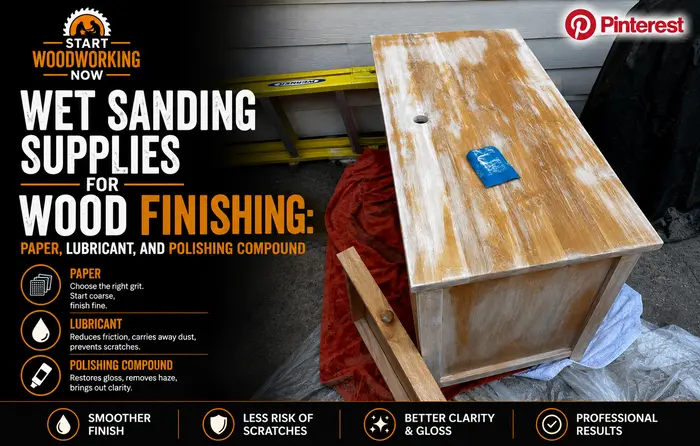
Wet Sanding Supplies for Wood Finishing: Paper, Lubricant, and Polishing Compound Explained
Wet/dry sandpaper uses a different abrasive mineral than ordinary dry sanding paper for a specific mechanical reason, and the lubricant choice between mineral spirits and soapy water matters considerably more than the generic “use whichever you have” advice suggests. Getting the supplies right before starting a wet-sand session — the right abrasive type, a complete grit progression with no gaps, and the correct lubricant for the finish being polished — prevents the frustration of a session that looks fine at one grit and reveals problems at the next.
This article is part of the wood finishing guide — covering finish selection, application, troubleshooting, and the equipment that determines application quality. For the application technique itself, see the wet sanding polyurethane guide covering the grit progression for a mirror finish.
Navigate to your question
→ What makes wet/dry sandpaper different from regular sandpaper? → Silicon carbide vs aluminum oxide — the mineral that matters ↓
→ Why can’t I skip a grit to save time? → Why each grit needs the next one close enough to erase it ↓
→ Should I use mineral spirits or soapy water as lubricant? → Why the choice matters more than it appears ↓
→ Do I need a sanding block, or is my hand good enough? → Why backing determines whether pressure stays even ↓
→ What do I need for the final polishing step? → Polishing compound as the continuation of the same grit progression ↓
What Wet/Dry Sandpaper Actually Is?
Wet/dry sandpaper is not simply ordinary sandpaper made waterproof — it uses a different abrasive mineral entirely, chosen specifically for how it behaves under wet sanding conditions.
Silicon Carbide vs Aluminum Oxide
Most dry sanding paper for woodworking uses aluminum oxide as its abrasive mineral — a tough, durable abrasive that wears relatively gradually and holds its cutting edge over an extended sanding session, well suited to bulk material removal on bare wood. Wet/dry paper instead uses silicon carbide, a harder but more brittle (friable) mineral that behaves differently as it wears: rather than gradually rounding off and dulling like aluminum oxide, silicon carbide particles fracture as they wear, continuously exposing new sharp edges.
This friable, self-sharpening characteristic is well suited to the fine, controlled cutting wet sanding requires on a cured finish film, where a consistently sharp, fine cutting action matters more than raw durability over a long sanding session.
The waterproof paper backing matters too — wet/dry paper uses a backing and adhesive specifically formulated to resist breaking down when saturated with water or mineral spirits for an extended period, unlike standard dry sandpaper backing, which can soften, tear, or delaminate from its abrasive coating when used wet.
Paper Grit Range for Finish Work
For wet sanding a cured finish (rather than bare wood), the relevant grit range starts considerably finer than woodworking grits used on raw wood — typically beginning around 400–600 grit for initial levelling of minor texture or dust nibs, and progressing through 800, 1000, 1500, and up to 2000 grit or finer for the final stages before polishing compound takes over. This is a meaningfully different range than the 80–220 grit progression used for surface preparation on bare wood, and buying a single “assorted grit pack” without checking it actually covers this finer finish-specific range is a common supply mistake.
Why Skipping a Grit Leaves Scratches the Next Grit Can’t Erase
Each grit in a sanding progression leaves a scratch pattern of a characteristic depth and width — coarser grits leave deeper, more visible scratches; finer grits leave progressively shallower ones. The purpose of progressing through intermediate grits rather than jumping straight from a coarse grit to a fine one is that each subsequent grit needs to be close enough in abrasive size to actually remove — not just visually soften — the scratch pattern left by the previous grit.
The Mechanical Reason Behind the Rule
A fine grit (say, 1500) removes material at a very shallow depth per pass, because its particles are small. If the surface still carries scratch grooves from a much coarser grit (say, 600) because an intermediate step was skipped, the 1500-grit paper can polish the peaks between those grooves smooth and shiny while never actually cutting deep enough to remove the groove floors themselves.
The surface can look deceptively good under normal lighting at this stage, but under raking light — covered in the wood finish sheen guide covering how light angle reveals surface texture — the underlying coarse-grit scratch pattern remains visible as a network of fine lines beneath the polished surface, and no amount of additional time with the same fine grit corrects this, because that grit simply isn’t capable of cutting to the depth needed.
This is why a complete, gap-free progression — typically no more than roughly a doubling of grit number between consecutive steps (600→800→1000→1500, rather than 600→1500) — produces a reliably clear result, while skipping steps to save time produces an inconsistent outcome that depends heavily on how aggressive the coarser grit happened to be and how much time is spent at each subsequent step trying to compensate.
Lubricant Choice — Mineral Spirits vs Soapy Water
The lubricant used during wet sanding does more than reduce friction — it carries away the abraded material (swarf) that would otherwise clog the paper and scratch the surface, and the choice between mineral spirits and soapy water has real consequences beyond simple finish compatibility.
Mineral Spirits
Mineral spirits is the standard lubricant choice for oil-based finishes and is broadly compatible with most cured film finishes regardless of their original carrier, since by the time wet sanding happens, the finish is fully cured and chemically stable against the solvent (the same cured-film solvent resistance covered for thermoset finishes in the curing chemistry guide). Beyond compatibility, mineral spirits provides notably smooth lubrication with a “slicker” feel than water, which translates to less drag and a more controllable sanding feel, particularly at the finer grits where excess friction can cause uneven cutting.
Soapy Water
A small amount of dish soap in water is a common, low-cost lubricant alternative, and works adequately for most wet sanding tasks, particularly on water-based finishes where some sanders prefer to keep the process fully water-based rather than introducing a solvent. The practical drawback is a higher risk of grain raising if any water reaches exposed bare wood through a sand-through or a thin spot in the finish — a risk mineral spirits doesn’t carry, since it doesn’t swell wood fibres the way water does.
For sanding sessions where there’s meaningful risk of sanding through to bare wood at an edge or corner, mineral spirits is the more forgiving choice for this reason alone, independent of finish type compatibility.
The Loading-Up Problem
Even with adequate lubricant, wet sanding paper accumulates swarf in the spaces between abrasive particles as it works — called loading up — which reduces cutting efficiency and can cause the paper to drag or skip rather than cut cleanly.
Periodically rinsing the paper in a shallow container of the same lubricant being used, and lightly wiping the sanded surface clean of accumulated slurry to check progress, prevents loaded paper from being mistaken for a dull or low-quality product when the real issue is simply accumulated debris needing a rinse.
Sanding Blocks and Backing — Why Even Pressure Matters
Sanding entirely by hand, with the paper held directly in the fingers, makes it difficult to apply consistent, even pressure across the full width of the paper — fingertips naturally apply more localized pressure than a flat palm or a rigid backing, which can produce uneven cutting and, at worst, small low spots where finger pressure was concentrated.
Rigid Sanding Blocks
A rigid sanding block — cork, rubber, or a dedicated sanding block product — distributes hand pressure evenly across the paper’s full contact area, producing more consistent results on flat panels and large surfaces than sanding free-hand. For wet sanding specifically, a block with some give (cork or medium-density rubber rather than completely rigid material) follows minor surface irregularities better than a perfectly rigid block while still providing meaningfully more pressure consistency than bare fingers.
Foam-Backed Pads
A foam-backed sanding pad — either a dedicated foam block product or simply backing the paper with a folded piece of foam — combines reasonable pressure distribution with enough flexibility to follow gentle curves or slightly uneven surfaces, a useful middle ground between a fully rigid block (best on flat panels) and bare-hand sanding (best on complex shapes where no block would conform well).
Micromesh Systems
Micromesh is a specific cushioned abrasive product — a flexible foam-backed abrasive sheet available in extremely fine grit equivalents, often used as a bridge between conventional wet/dry paper’s finest grits and polishing compound.
Its cushioned backing conforms well to gentle curves and is popular for finishing work on turned pieces and other rounded forms where a rigid block isn’t practical, providing the fine-grit final-stage cutting that flat work would typically get from the highest grits of conventional paper.
Polishing Compounds — The Final Step Equipment
Once sanding reaches its finest practical grit (typically 1500–2000), polishing or rubbing compound continues the same fundamental process — progressively finer abrasive cutting — in a different physical form.
Compound Is Just Very Fine Grit in Paste Form
Polishing and rubbing compounds are abrasive particles suspended in a paste or liquid carrier, rather than bonded to a paper backing, but the underlying mechanism is identical to sandpaper: progressively smaller abrasive particles progressively reduce the depth of the scratch pattern left by the previous step.
Compounds are typically rated by particle size in microns rather than by the grit numbering convention used for sandpaper, but the two systems describe the same underlying continuum — a coarser rubbing compound corresponds roughly to the cutting power of a very fine sandpaper grit, while a fine polishing compound corresponds to an even finer equivalent that sandpaper grits don’t typically reach. Treating compound as “a different process” rather than as the next, finer step in the same progression that sandpaper started is a common conceptual gap that makes the overall process seem more mysterious than it is.
Application Equipment — Pads and Buffers
Compound is applied with a soft cloth for hand application on small areas, or with a buffing pad on a random-orbit polisher or dedicated buffer for larger surfaces, where mechanical buffing achieves a more even, consistent result with less physical effort than extended hand rubbing. A foam or microfiber buffing pad designed for the specific compound grade being used (coarser pads for cutting compounds, softer finishing pads for final polish) avoids the swirl marks that can result from using an overly aggressive pad with a fine polish, or an underpowered pad that fails to properly work a cutting compound into the surface.
The relationship between final polish quality and the gloss/DOI characteristics this whole process is working toward — distinguishing genuine smooth reflection from a surface that merely reads glossy at a glance — is covered in the wood finish sheen guide covering gloss units and distinctness of image. For the complete step-by-step wet sanding and polishing sequence using these supplies, see the wet sanding polyurethane guide, and for general application technique that determines how much correction wet sanding will need to do in the first place, see the polyurethane application guide.
Frequently Asked Questions
Can I use regular dry sandpaper for wet sanding if that’s what I have on hand?
Not reliably. Standard dry sandpaper’s backing and adhesive aren’t formulated to resist water or solvent saturation and can soften, tear, or shed their abrasive coating when used wet. The aluminum oxide abrasive typical of dry paper also doesn’t have the same friable, self-sharpening behaviour that makes silicon carbide well suited to fine wet sanding work. Wet/dry paper is inexpensive enough that substituting dry paper isn’t worth the inconsistent results and risk of the paper falling apart mid-session.
How do I know if I’m loading up the paper versus just needing a finer grit?
Loaded paper typically shows visible debris buildup in the abrasive when you look closely, and cutting performance drops noticeably mid-session compared to how the same paper cut at the start. Rinsing the paper in lubricant and continuing usually restores performance if loading is the issue. If performance doesn’t improve after rinsing and the surface still shows visible scratch pattern from a previous grit, that’s a sign you need a finer grit rather than a clean piece of the same grit.
Do I really need every grit step, or can I jump from 600 to 1500?
Jumping grits risks leaving the deeper scratch pattern from the coarser grit underneath a surface that looks polished at a glance but still shows fine scratch lines under raking light, because the finer grit isn’t capable of cutting deep enough to remove what the coarser grit left behind. A complete progression with no more than roughly a doubling of grit number per step (600→800→1000→1500) reliably avoids this; skipping steps to save time often costs more time overall correcting the inconsistent result.
Is polishing compound necessary, or is the finest sandpaper grit good enough?
For most furniture-grade satin or semi-gloss work, the finest practical sandpaper grit (1500-2000) combined with light buffing is often sufficient. For true high-gloss or “piano finish” results, polishing compound continues the same scratch-reduction process to a finer level than sandpaper grits typically reach, producing the higher distinctness of image (sharper, less distorted reflections) that high-gloss work calls for. Whether compound is necessary depends on the target sheen and DOI level for the specific project.