
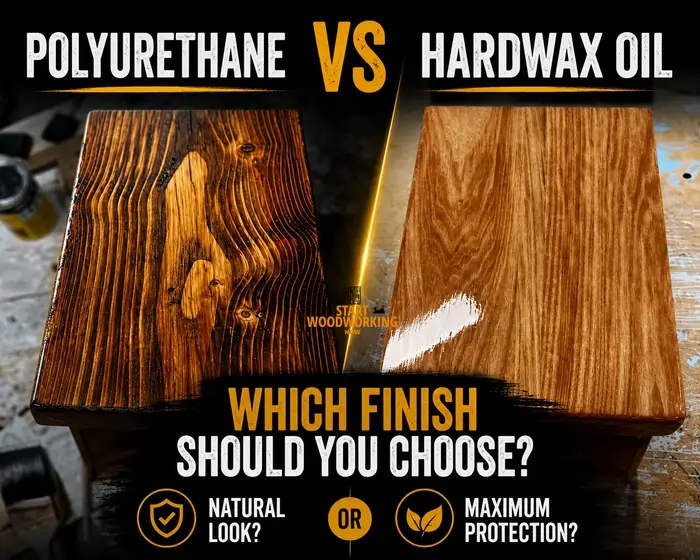
Hardwax Oil vs Polyurethane: Chemistry, Hardness, Repairability, and When to Use Each
Hardwax oil and polyurethane are both used to protect wood floors and furniture, but they work through completely different mechanisms — one forms a film on the surface, the other cures inside the grain and this difference in mechanism produces completely different practical consequences in durability, repairability, and long-term maintenance.
Hardwax Oil vs Polyurethane — The Five Differences That Matter
→ Hub: How to Remove Wood Finishes — Complete Guide
→ Remove hardwax oil: How to Remove Hardwax Oil from Wood
→ Remove polyurethane: How to Remove Polyurethane from Wood
→ Water-based vs oil-based polyurethane: Water-Based vs Oil-Based Polyurethane
This guide covers the chemistry of both finishes and why it determines every practical outcome, the hardness comparison using König pendulum values, the repairability comparison in detail, appearance differences, application requirements, maintenance intervals, water resistance, species recommendations, the full specification EAV table, and the decision matrix that maps each use case to the correct finish choice.
The Chemistry — Why Penetrating vs Film-Forming Changes Everything
The penetrating vs film-forming distinction is not marketing language — it describes a fundamentally different physical relationship between the finish and the wood substrate. Understanding this relationship explains why every practical outcome (hardness, repairability, appearance, maintenance) is different between the two finish types.
How Each Finish Cures
Polyurethane is a film-forming finish: it cures on top of the wood surface as a hard transparent polymer layer, sealing the wood beneath a protective film. Hardwax oil is a penetrating finish: the oil component absorbs into the wood cell structure and polymerises within the grain, while the wax component crystallises at the surface. The wood is not sealed — it remains a living, breathing substrate with finish inside it rather than on top of it. This distinction changes everything about how each finish behaves over time.
What Happens When It Wears
A polyurethane film, once it wears through in a high-traffic area, exposes bare wood in that spot while the surrounding finish remains intact — the worn-through area absorbs moisture and dirt differently from the coated area, the boundary is visible and worsening, and the only correct repair is sanding the entire floor and refinishing. A hardwax oil finish, when it wears in a high-traffic area, simply means the finish has worn thin in those wood cells — the adjacent cells still contain oil.
Repairability — The Deciding Factor for High-Traffic Floors
If you have one reason to choose hardwax oil over polyurethane for floors that will experience furniture movement, pet traffic, or regular use — repairability is it. The chemistry difference above produces a practical consequence that affects every owner of a hardwood floor eventually: wear occurs, and it needs to be addressed.
Repairing it requires sanding one or two boards lightly and applying fresh hardwax oil to those boards. No visible boundary forms because the repair material penetrates, matching the surrounding finish. This repairability difference is not a minor convenience — it is the most important practical factor in choosing between these two finish types for floors that will see regular traffic and furniture movement.
Hardness Comparison — With König Pendulum Values
Polyurethane is harder than hardwax oil — this is the correct statement for standard consumer products. The claim requires qualification because commercial 2K water-based polyurethane (Bona Traffic HD, Loba 2K) is significantly harder than any hardwax oil formulation, while 1K consumer water-based polyurethane (Minwax Polycrylic) is only moderately harder than Osmo Polyx-Oil.
The practical question is whether the hardness difference is large enough to matter in real use — and the answer depends on the specific products compared, not on the categories.
König pendulum hardness measures resistance to micro-deformation under a pendulum oscillation — higher seconds = harder film. Pencil hardness (ASTM D3363) measures resistance to gouging. Both are post-cure values at 7 days after application at 20°C.
Neither is universally better — it depends on which properties matter for your project. Weigh all seven in the finish comparison tool.
The hardness gap between 1K hardwax oil (König 55–80s) and 1K oil-based polyurethane (König 120–160s) is real and significant — polyurethane is roughly twice as hard. In practical terms: hardwax oil shows wear in high-traffic areas faster. However, hardness is only one component of floor finish durability — repairability is the other, and hardwax oil’s advantage in repairability compensates for its hardness disadvantage in many use contexts.
For a floor that will be professionally refinished every 10–15 years regardless: polyurethane’s superior hardness makes it the lower-maintenance choice per year. For a floor where the owner will maintain it themselves: hardwax oil’s spot-repairability makes it easier to keep looking good over time.
Appearance — Natural Texture vs Film Surface
Water Resistance, Application, and Maintenance — Full Comparison
| Factor | Hardwax Oil | Polyurethane |
|---|---|---|
| Water resistance | Good — wax component seals surface pores. Spills beaded for 30–60 seconds before penetration risk. Not suitable for prolonged water contact or wet areas (bathrooms). Water drop beads on a well-maintained surface. | Excellent — continuous polymer film creates complete water barrier. Suitable for kitchens and high-humidity areas. Water exposure risk is only at gaps between boards or at worn-through areas. |
| Chemical resistance | Moderate — acidic spills (vinegar, citrus) can etch the wax surface over time. Avoid harsh cleaning agents. Alcohol can dull the wax component. Re-oil after any chemical spill exposure. | Good to excellent — cross-linked urethane polymer resists household chemicals, mild acids, cleaning products. 2K formulations: excellent chemical resistance equivalent to commercial coatings. |
| Number of coats | Rubio Monocoat: 1 coat (reactive oil — excess is buffed off). Osmo Polyx-Oil: 2 thin coats. Bona Craft Oil: 2 coats. Total application time: 2–4 hours per coat including buffing. | 3 coats minimum for floors (2 for furniture). 1K products: one coat per day. 2K commercial: 2 coats in one day (1.5h between coats). Total: 2–3 days for a full floor application. |
| Application difficulty | Moderate — the buffing-off step is critical (excess hardwax oil left on surface creates a sticky, uneven result). Rubio Monocoat requires particularly careful excess removal. Good results achievable by careful DIY. | Moderate to high — maintaining wet edge, avoiding lap marks, and preventing dust contamination during the longer open time require attention. Water-based is faster-drying and has less margin for error. Professional recommended for floor refinishing. |
| Maintenance cleaning | pH-neutral cleaner specifically formulated for oiled floors (Rubio Surface Care, Osmo Wash & Care). Standard floor cleaners may contain detergents that degrade the wax layer over time. Avoid steam mops — heat melts the wax component. | pH-neutral hardwood floor cleaner (Bona, Pallmann FloorCleaner). Avoid oil soaps (leave dulling residue). Avoid steam mops. Damp mop only — standing water at board gaps causes swelling over time. |
| Maintenance re-application | Spot re-oil high-traffic areas every 1–2 years (DIY, 3–4 hours). Full room re-application every 5–8 years. Refresh products (Rubio Refresh, Osmo Spray Care) extend interval between full re-applications. | Screen-and-recoat every 5–7 years (professional or skilled DIY, 1–2 days). Full sand and refinish every 15–25 years (professional, 4–5 days). Wax application: not applicable — wax is incompatible with polyurethane. |
| Removal | Two-stage: naphtha (wax component, stage 1) + sanding 40–80 grit (oil component in grain, stage 2). NMP gel ineffective — removes wax but not penetrated oil. Brand-specific grit: Rubio 40–60, Osmo 60–80, Bona 80. Full removal guide → | NMP gel 60–90 min (oil-based) or 35–60 min (water-based) under plastic film. Drum sander for floors (36 grit start). Dwell time increases 25–50% for finish over 5 years old. Full removal guide → |
| Cost per m² (product only) | £3–8/m² for 1K products (Osmo, Bona Craft). £8–15/m² for Rubio Monocoat (higher unit cost but 1 coat only). Lower re-application cost (DIY-accessible, less product per m² per year). | £1.50–4/m² per coat for consumer 1K products. £5–12/m² for commercial 2K. 3 coats required = total product cost similar to hardwax oil per m². |
Species Compatibility — Which Finish for Which Wood
| Species | Hardwax Oil | Polyurethane | Recommendation |
|---|---|---|---|
| Oak (white and red) | Excellent — open grain structure ideal for oil penetration. Deepens grain contrast beautifully. | Excellent — very commonly used. Oil-based adds classic honey amber. Water-based gives contemporary grey-brown. | Either. Aesthetics determine choice — hardwax oil for natural/Scandinavian look, polyurethane for traditional or contemporary-clear looks. |
| Walnut | Very good — oil enriches the deep chocolate tones. Natural appearance preserves the wood’s inherent warmth. | Very good — oil-based amber barely perceptible on dark walnut. Water-based keeps the cooler, grey-toned appearance. | Either. Hardwax oil slightly preferred for furniture where natural touch is prioritised. |
| Maple | Good — closed grain (tight pores) means less oil penetration than open-grain species. Requires thorough buffing to avoid surface residue. | Water-based strongly preferred — oil-based turns maple orange-yellow, which most owners consider undesirable. Water-based preserves natural creamy-white tone. | Water-based polyurethane for colour preservation. Hardwax oil acceptable if amber enrichment is not a concern. |
| Pine (light) | Very good — soft, open grain absorbs oil well. Good penetration depth. Hardwax oil on pine creates a warm, traditional appearance popular in Scandinavian design. | Water-based preferred — oil-based ambers pine significantly. Soft pine dents more easily under any finish type. | Hardwax oil often preferred on pine floors — the penetrating nature means individual board repairs are practical on a surface that dents regularly from furniture. |
| Teak / oily tropical species | Excellent — hardwax oil is the standard choice for teak furniture and decking. The natural oils in teak are compatible with additional penetrating oil finish. | Problematic — natural teak oils inhibit polyurethane curing. Requires acetone decontamination + shellac sealer before polyurethane — see How to Fix Sticky Varnish for the contamination protocol. | Hardwax oil — strongly recommended. Polyurethane requires careful preparation and has lower compatibility. |
| Ash | Very good — open grain structure similar to oak. Oil penetrates well. Natural or limed ash particularly suited to the natural appearance hardwax oil produces. | Water-based preferred — ash is an amber-sensitive light species. Water-based preserves natural pale tone. | Either. Hardwax oil for natural/contemporary look. Water-based polyurethane to preserve pale ash colour. |
Decision Matrix — Which Finish for Each Situation
Choose Hardwax Oil when:
✓ Floor that will need future repairs — furniture will be moved, children or pets are present, and visible spot repairs on individual boards are required to be invisible
✓ Natural/Scandinavian aesthetic — the wood texture should be tactile and the appearance should read as “wood”, not “wood with a finish on it”
✓ Oily species (teak, rosewood, padauk) — natural oil compatibility eliminates the adhesion and curing problems polyurethane has on these species
✓ DIY maintenance preference — the owner wants to maintain the floor themselves without professional refinishing interventions
✓ New or light-coloured wood — hardwax oil does not amber (unlike oil-based polyurethane) and preserves natural wood colour better than most film finishes
✓ Pine or softwood floors — penetrating finish repairs are practical on surfaces that dent regularly from furniture movement
Choose Polyurethane when:
✓ Maximum hardness required — commercial 2K water-based polyurethane (Bona Traffic HD) is the hardest consumer floor finish available; König 180–220s vs 55–80s for hardwax oil
✓ Wet or humid areas — kitchen, basement, or high-humidity spaces where continuous water barrier is important
✓ High chemical exposure — commercial kitchen, workshop, or other space with regular exposure to cleaning chemicals, mild acids, or solvents
✓ Long maintenance intervals preferred — the owner prefers lower maintenance frequency (recoat every 5–7 years) over more frequent touch-up re-oiling
✓ Gloss finish required — high-gloss piano or lacquer look is not achievable with hardwax oil which maxes out at satin
✓ White-stained or painted wood — hardwax oil over white-stained wood may alter the colour; water-based polyurethane preserves it
📝The question I get most often is “which is better” — hardwax oil or polyurethane. I have a direct answer: for a floor in a house with children, furniture that moves, and an owner who is willing to do maintenance themselves, hardwax oil is the better choice. The ability to repair individual boards invisibly is worth more in practice than the hardness advantage of polyurethane. I have re-oiled countless floors at the customer’s dining table and entry area without touching the rest of the floor, and the result is invisible. I have also been called in to fix polyurethane spot repairs that were visible from across the room — the homeowner applied fresh poly to a worn patch with the correct product and the correct technique, but the new film reflects light differently from the aged film, and the result looks worse than the original wear.
Key Specifications — Hardwax Oil vs Polyurethane EAV Reference
| Entity / Variable | Attribute | Value and Detail |
|---|---|---|
| Applying polyurethane over hardwax oil | Compatibility and required preparation | Not directly compatible. Polyurethane cannot adhere to an oiled surface because the residual oil and wax prevent film formation and cross-linking. Required preparation: complete removal of all hardwax oil using the two-stage protocol (naphtha + sanding 40–80 grit), confirmation of clean bare wood with the water drop test and naphtha evaporation test, before polyurethane application. Applying polyurethane over a surface that tests clean (both water drop and naphtha evaporation) is safe — the tests confirm oil removal from the accessible surface layer. |
| Applying hardwax oil over polyurethane | Compatibility and required preparation | Not compatible as a topcoat. Hardwax oil cannot penetrate through an intact polyurethane film — it sits on top as an oily residue rather than penetrating into the wood. Required preparation: complete polyurethane removal by NMP gel + sanding to bare wood, naphtha evaporation test confirms wax-free wood. Hardwax oil can then be applied to bare wood correctly. Some owners attempt to apply hardwax oil over a heavily worn polyurethane floor — this does not work as a maintenance product but can work as a full conversion project if the polyurethane is fully stripped first. |
| The Rubio Monocoat single-coat claim | Why it works and what the limitation is | Rubio Monocoat uses a reactive molecular bonding technology — the oil molecules bind to the cellulose of the wood at a 1:1 molecular ratio. Once all available binding sites are occupied, additional oil cannot penetrate further and must be removed (this is why excess buffing-off is critical — unremoved excess becomes a sticky surface film). The single-coat claim is genuine: one correctly applied coat is equivalent to two coats of standard hardwax oil. The limitation: if the buffing-off step is incomplete, the remaining surface oil does not cure properly and creates a tacky, collecting-dirt surface. Rubio Monocoat requires more careful application technique than standard two-coat hardwax oils. |
| Hardwax oil on floors vs furniture — different protocols | Why floor-grade and furniture-grade products differ | Floor-grade hardwax oils (Osmo Polyx-Oil Floor, Bona Craft Oil 2K) are formulated with harder wax blends (montan wax, carnauba) and harder oil fractions that withstand foot traffic abrasion. Furniture-grade hardwax oils (Osmo Polyx-Oil Furniture, Rubio Monocoat Oil Plus 2C for furniture) use softer wax blends appropriate for the lower abrasion loads of table and chair surfaces. Using furniture-grade hardwax oil on a floor produces a softer, faster-wearing result. Using floor-grade hardwax oil on furniture is acceptable — it will simply be harder than necessary. For floors with both a central table and surround floor finishing: use the same floor-grade product on both for consistent appearance. |
| The “water pop” technique before hardwax oil application | What it is and when it is recommended | Water popping: lightly dampening sanded bare wood with water before oil application. The moisture causes wood fibres to swell slightly, opening pores. When the water evaporates (30–60 minutes), the pores are slightly more open than without water popping, allowing deeper oil penetration. Results in richer colour and deeper protection. Recommended by Rubio Monocoat for light-coloured or very smooth-sanded species (maple, birch) where standard sanding produces closed pores that limit oil penetration. Not recommended for species with already-open grain (oak, ash, pine) where oil penetrates readily without assistance. Not necessary for polyurethane — film adhesion to smooth sanded wood is excellent without water popping. |
📝For a kitchen floor with a heavy-use dishwasher zone and regular wet mopping: I would choose commercial 2K water-based polyurethane (Bona Traffic HD). The water resistance and hardness are genuinely better suited to that environment, and the kitchen floor will be refinished as a project when the time comes regardless of finish type. For an open-plan living area and hallway: hardwax oil. The repairability advantage plays out in practice many times over the life of the floor.
Frequently Asked Questions — Hardwax Oil vs Polyurethane
Is hardwax oil more durable than polyurethane?
Hardwax oil is softer than polyurethane in hardness testing — König pendulum values of 55–100 seconds for hardwax oil versus 120–220 seconds for polyurethane (1K oil-based to commercial 2K water-based). This means hardwax oil shows surface wear in high-traffic areas faster than polyurethane under equivalent traffic. However, durability over the life of the floor is not determined by hardness alone — repairability is the other component. A harder finish that requires a full professional refinish when worn is not necessarily more durable in practical terms than a softer finish that can be spot-repaired at the board level. For pure hardness in a high-traffic commercial environment: polyurethane, specifically commercial 2K. For overall long-term floor condition in a residential setting with regular use: hardwax oil, because individual board repairs prevent the progressive deterioration that eventually forces full refinishing.
Can you mix hardwax oil and polyurethane on the same floor?
No — not as overlapping applications. Applying polyurethane over hardwax oil results in adhesion failure because the residual oil and wax prevent the polyurethane film from bonding. Applying hardwax oil over polyurethane results in the oil sitting as a surface residue rather than penetrating — it cannot reach the wood through an intact polyurethane film. The only scenario where both can coexist on the same floor is adjacent areas separated by a threshold: hardwax oil finish in the living area, polyurethane in the kitchen, with a threshold strip at the boundary. This is a common design choice that works well when the threshold is visible — it is not a technical restriction but a design boundary.
How long does hardwax oil last compared to polyurethane?
With correct maintenance, both finishes can last the lifetime of the floor — they are removed only when the wear layer (for engineered floors) or the desire for a different finish requires it, not due to finish failure. Hardwax oil requires re-oiling of high-traffic areas every 1–2 years and a full re-application every 5–8 years. Polyurethane requires screen-and-recoat every 5–7 years and full sand and refinish every 15–25 years. The comparison is not about how long either lasts before it fails — a well-maintained floor with either finish does not fail. It is about how frequently each requires maintenance intervention and what that intervention involves: small, DIY, frequent (hardwax oil) or larger, less frequent, professional (polyurethane).
Summary — Key Values for Hardwax Oil vs Polyurethane
Fundamental difference: hardwax oil penetrates into wood cell structure (oil polymerises in grain, wax crystallises at surface) — finish is inside the wood. Polyurethane forms a transparent polymer film on the wood surface — finish is on top of the wood. Hardness: hardwax oil 1K = König 55–80s (HB pencil).
Polyurethane 1K oil-based = König 120–160s (H–2H). Commercial 2K water-based poly = König 180–220s (2H–3H). Repairability: hardwax oil = individual board repair without visible boundary (penetrating nature means no film-vs-film boundary).
Polyurethane = minimum full room screen-and-recoat for invisible repair. Appearance: hardwax oil = tactile wood grain surface, matte to satin, no amber. Polyurethane = film surface (smooth, consistent), full sheen range, oil-based ambers progressively. Water resistance: hardwax oil = good for spills (bead 30–60 sec), not suited for prolonged wet exposure.
Polyurethane = excellent, continuous barrier. Maintenance: hardwax oil = spot re-oil every 1–2 years DIY; full room every 5–8 years. Polyurethane = screen-and-recoat every 5–7 years; full refinish every 15–25 years. Compatibility: polyurethane over hardwax oil = not possible without full removal. Hardwax oil over polyurethane = not possible without full removal. Best for spot-repair priority floors: hardwax oil.
Best for maximum hardness and water resistance: commercial 2K water-based polyurethane. Oily species (teak, rosewood, padauk): hardwax oil strongly preferred — polyurethane curing is inhibited by natural wood oils.
→ Remove hardwax oil: How to Remove Hardwax Oil from Wood — Two-Stage Protocol
→ Remove polyurethane: How to Remove Polyurethane from Wood
→ Remove polyurethane from floors: How to Remove Polyurethane from Wood Floors
→ Water-based vs oil-based polyurethane: Water-Based vs Oil-Based Polyurethane
→ Hub: How to Remove Wood Finishes — Complete Guide