What Is Polyurethane? Chemistry, Types, Hardness, and How It Compares to Varnish and Lacquer
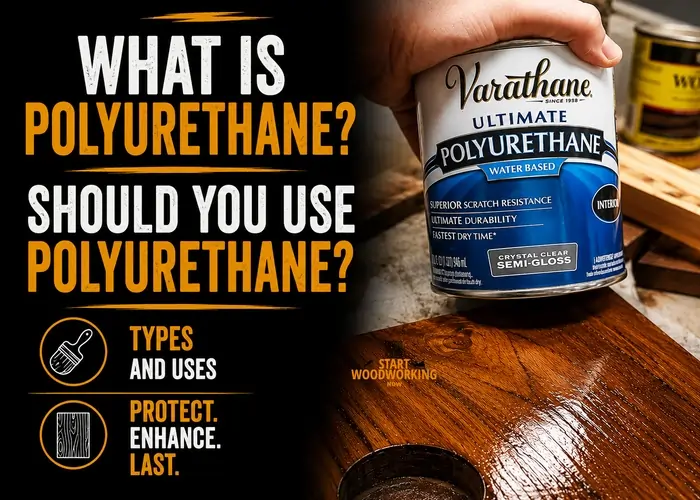
Polyurethane is a clear protective wood finish that forms a hard, durable film on top of the wood surface. It is used on hardwood floors, furniture, cabinets, and countertops because it provides significantly better water, scratch, and chemical resistance than most traditional wood finishes.
The term polyurethane does not refer to a single product. Modern polyurethane finishes fall into three categories: oil-based 1K polyurethane, water-based 1K polyurethane, and commercial 2K polyurethane systems. All three use urethane chemistry, but they differ substantially in hardness, drying time, appearance, VOC emissions, and long-term durability.
Understanding these differences is more important than understanding the chemistry itself because the performance gap between polyurethane types is often greater than the difference between polyurethane and competing finishes such as varnish or lacquer.
This guide covers the urethane chemistry that all polyurethane finishes share, the three system types and what makes each distinct, the curing mechanism in detail, the hardness values with König pendulum and pencil measurements, how polyurethane compares to varnish, lacquer, and shellac, how to identify whether an existing finish is polyurethane, the removal overview, and the decision matrix for choosing between polyurethane types.
What Is Polyurethane — The Key Facts
Chemistry
Urethane cross-links
Isocyanate + polyol/moisture reaction. Forms a continuous polymer film on the wood surface.
Hardness Range
F–3H pencil
Consumer WB 1K: F–H. Oil-based 1K: H–2H. Commercial 2K: 2H–3H (König 180–220s).
Finish Type
Film-forming
Sits on top of the wood surface as a polymer film. Does not penetrate into grain like oil finishes.
Identification
Zero solvent reaction
No reaction to lacquer thinner after 5 min or acetone after 30 sec = oil-based polyurethane confirmed.
→ Hub: How to Remove Wood Finishes — Complete Guide
→ Remove polyurethane: How to Remove Polyurethane from Wood
→ Drying time: Polyurethane Drying Time — Complete Reference
→ Varnish vs polyurethane: Varnish vs Polyurethane — Curing Mechanism and Removal
→ Water-based vs oil-based: Water-Based vs Oil-Based Polyurethane
Why Is Polyurethane the Most Popular Wood Finish?
Polyurethane became the dominant wood finish because it combines three properties that are difficult to achieve simultaneously:
- High scratch resistance
- High water resistance
- Long service life
Traditional finishes typically excel in only one or two of these areas. Shellac is easy to repair but water-sensitive. Lacquer dries quickly but is vulnerable to solvents. Hardwax oils are easy to maintain but offer less protection against standing water. Polyurethane provides a balance of durability, moisture resistance, and low maintenance that makes it suitable for both residential and commercial applications.
The exact level of protection depends on the polyurethane system used. Commercial 2K polyurethane provides the highest durability, while consumer water-based products prioritize colour stability and low VOC emissions.
Is Polyurethane Plastic?
Yes. Polyurethane is a plastic. More specifically, polyurethane is a polymer that forms a solid plastic film after curing. In woodworking, this plastic film sits on top of the wood surface and acts as a protective barrier against water, abrasion, chemicals, and staining.
This sometimes creates confusion because many woodworkers use the word “plastic” negatively. However, the same characteristic that makes polyurethane a plastic is also what gives it its durability. The cured polymer network is responsible for the hardness, scratch resistance, and chemical resistance that make polyurethane one of the most protective clear finishes available.
The Urethane Chemistry — What All Polyurethane Finishes Share
Every product sold as “polyurethane” — regardless of whether it is oil-based, water-based, 1K, or 2K — contains urethane linkages in its cured polymer structure. The urethane bond forms when an isocyanate group (−NCO) reacts with a hydroxyl group (−OH). In wood finish chemistry, this reaction produces the cross-links that give polyurethane its hardness, flexibility, and chemical resistance.
The Urethane Cross-Link Reaction
Isocyanate Group
−NCO
From the urethane polymer component
+
Hydroxyl Group
−OH
From moisture (1K) or polyol hardener (2K)
→
Urethane Linkage
−NHCOO−
Hard, flexible cross-link
The density of these urethane cross-links — how many form per unit volume of the cured film — determines the hardness, flexibility, and chemical resistance. More cross-links per unit volume = harder, less flexible, more chemically resistant film. 2K systems produce more cross-links than 1K systems because the dedicated polyol hardener provides far more reactive −OH groups than atmospheric moisture alone.
The Three Polyurethane Systems — How Each Delivers the Urethane Bond
What Does Polyurethane Do to Wood?
Polyurethane does not strengthen the wood itself. Instead, it protects the wood by forming a continuous film over the surface.
This film reduces water penetration, slows staining, improves abrasion resistance, and makes cleaning easier. The protection comes from the cured polyurethane layer rather than from any change to the wood fibres beneath it.
Because polyurethane sits on top of the wood surface, damage to the finish can usually be repaired only by sanding and refinishing the affected area or stripping the finish completely.
How Hard Is Polyurethane Compared to Other Wood Finishes?
Polyurethane is generally harder than shellac, lacquer, hardwax oil, and traditional alkyd varnish.
Commercial 2K polyurethane is among the hardest clear wood finishes commonly available, while consumer water-based polyurethane sits closer to the middle of the hardness spectrum.
In practical terms, higher hardness means better resistance to scratching, abrasion, chair movement, pet claws, and repeated cleaning. Hardness alone does not determine durability, but it is one of the strongest predictors of long-term wear performance.
📝The most common misunderstanding I see about polyurethane is treating it as a single product category when making decisions. Someone will ask “is polyurethane durable?” and the correct answer is: which polyurethane? Consumer water-based 1K (Minwax Polycrylic) is softer than oil-based 1K (Minwax Fast-Drying Polyurethane), which is softer than Bona Traffic HD (commercial 2K water-based). Those three products are all called polyurethane. Their König hardness values differ by a factor of nearly 3x from bottom to top.
How to Identify Polyurethane — The Sequential Solvent Test
Identifying whether an existing finish is polyurethane — and which type — determines the correct stripper, dwell time, and removal approach. Polyurethane is identified by elimination: it is the finish that does not respond to any common solvent at standard contact times.
Identification Tests — Run in This Order on a Hidden Area
For the full interactive tool: Wood Finish Identifier — Interactive 5-Step Sequential Test →
Polyurethane vs Varnish, Lacquer, and Shellac — The Key Differences
| Property | Oil-Based Poly 1K | Water-Based Poly 1K | Alkyd Varnish | NC Lacquer | Shellac |
|---|---|---|---|---|---|
| Cure mechanism | Moisture + oxidative cross-linking | Water evaporation + urethane cross-linking | Oxidative cross-linking only | Solvent evaporation only (thermoplastic) | Alcohol evaporation (thermoplastic) |
| Hardness (König) | 120–160 sec | 80–120 sec | 60–90 sec | 40–80 sec | 30–60 sec |
| Amber tone | Yes — deepens over years | None — crystal clear | Yes — similar to oil-based poly | None (NC) or slight (CAB) | Warm amber/orange |
| Repair option | Strip and refinish only | Strip and refinish only | Strip and refinish only | Re-amalgamation (dissolve + re-flow) | Re-amalgamation with denatured alcohol |
| Removal solvent | NMP gel 60–90 min | NMP gel 35–60 min | NMP gel 45–90 min | Lacquer thinner 10–60 sec | Denatured alcohol 30–120 sec |
| Water resistance | Excellent | Excellent | Good–Excellent (spar: excellent) | Good (interior only) | Poor — water-sensitive |
| Exterior use | Only with exterior-rated formula | Only with exterior-rated formula | Spar varnish: excellent exterior | Not suitable exterior | Not suitable exterior |
What Are the Key Specifications for Polyurethane?
| Entity / Variable | Attribute | Value and Detail |
|---|---|---|
| König pendulum hardness — what it measures and why it matters | Test method and values for each polyurethane type | König pendulum hardness (DIN EN ISO 1522): a pendulum placed on the cured finish surface oscillates until friction stops it. Harder surfaces dampen the oscillation more slowly = higher seconds = harder finish. Consumer water-based 1K: 80–120 seconds. Oil-based 1K: 120–160 seconds. Commercial 2K: 180–220 seconds. Alkyd varnish: 60–90 seconds. Shellac: 30–60 seconds. The König test measures surface hardness specifically — resistance to micro-deformation from repeated contact. Pencil hardness (ASTM D3363) measures gouge resistance. Both tests are performed after 7 days at 20°C (post-cure baseline). Results measured at 24 hours would be significantly lower for all types. |
| The “polyurethane varnish” naming confusion | Why some products are sold as both varnish and polyurethane | Many products are labelled “polyurethane varnish” or “urethane varnish” — these are alkyd varnish formulations with urethane modification added to the alkyd resin. They are more accurately described as alkyd varnish with enhanced hardness, not as polyurethane. The key diagnostic: if lacquer thinner shows any reaction at 3–5 minutes = alkyd chemistry is present and it is a varnish. True polyurethane (1K oil-based) shows zero reaction to lacquer thinner at any contact time. In removal terms: “polyurethane varnish” requires NMP gel at varnish dwell times (45–90 min) while true polyurethane requires NMP gel at polyurethane dwell times (60–90 min). The practical difference is small — both respond to NMP gel — but the identification matters for selecting dwell times and for understanding the amber tone (polyurethane varnish ambers like alkyd, not like pure poly). |
| Applying water-based polyurethane over oil-based and vice versa | Cross-system compatibility and required conditions | Water-based over fully cured oil-based: possible with strict conditions — minimum 72 hours cure at 20°C for the oil-based, 220-grit degloss, press-cloth test (no colour transfer and no mineral spirits smell confirms complete evaporation). Applying too soon: permanent white haze as mineral spirits vapour disrupts water-based film coalescence. Oil-based over water-based: easier — 24-hour cure wait, 220-grit degloss. Cross-system application is possible but the aesthetic result differs: water-based over an amber oil-based base adds a cooler, clearer layer that reflects light differently from the amber layer below. For colour consistency: stay within the same chemistry system throughout all coats. See: Water-Based vs Oil-Based Polyurethane — Full Compatibility Guide. |
| Sheen levels available and what determines them | Gloss units, what silica flatting does, and how to choose | Polyurethane is available in matte (5–15 gloss units), satin (25–40 GU), semi-gloss (45–60 GU), and gloss (70–90 GU). The sheen level is controlled by adding silica flatting agents to the formulation — silica particles scatter light at the film surface, reducing apparent gloss. More silica = lower gloss. A consequence: matte and satin finishes have slightly lower hardness than gloss formulations of the same product because the silica particles interrupt the continuous polymer surface slightly. The difference is small (5–10% lower König hardness) but exists. For maximum hardness on a high-traffic floor: gloss or semi-gloss is marginally harder than matte of the same product. In practice, the difference is not meaningful for residential use. |
| Polyurethane for exterior wood — what changes | Why standard interior polyurethane fails outdoors and what exterior-rated formulas contain | Standard interior polyurethane (oil-based or water-based) cracks and peels on exterior wood within 1–3 years due to two mechanisms: UV degradation of the urethane polymer (UV light breaks urethane bonds — the film yellows, chalks, and loses flexibility) and thermal cycling (wood expands and contracts with temperature; a rigid film cracks rather than flexes). Exterior-rated polyurethane (Helmsman Spar Urethane, Varathane Exterior) adds UV absorbers to block degradation and modifies the alkyd ratio to produce a more flexible film. Even exterior-rated polyurethane on outdoor wood requires more frequent maintenance than traditional spar varnish — reapplication every 2–4 years vs 3–7 years for quality spar varnish. For exterior wood that cannot be regularly maintained: spar varnish (alkyd, high oil ratio) remains the more durable long-term choice. |
Should I use polyurethane?
Polyurethane is the best choice when maximum protection is the primary goal.
For hardwood floors, dining tables, kitchen cabinets, and high-traffic furniture, polyurethane provides greater water resistance and abrasion resistance than most alternative finishes.
However, polyurethane is not always the best choice. If easy spot repairs, natural appearance, or low-film aesthetics are more important than maximum durability, hardwax oil or traditional oil finishes may be preferable.
Decision Matrix — Which Polyurethane Type to Choose
Choose Oil-Based 1K when:
✓ Longer open time helps with a large application area
✓ No colour-sensitive surfaces (white paint, maple, ash)
✓ Project timeline allows one coat per day
✓ No need for rapid re-occupancy
Choose Water-Based 1K when:
✓ Any white or light-stained surface
✓ Low VOC requirement — occupied home
✓ Modern/contemporary aesthetic — crystal clear look
✓ Kitchen cabinets where colour stability is critical
Choose Commercial 2K when:
✓ Fastest return to service — full hardness in 5–7 days
✓ Professional or skilled DIY application
✓ High chemical exposure environment
✓ Budget allows higher product cost for long-term performance
If the finish needs to be removable or repairable without full stripping — polyurethane is not the correct choice. Consider lacquer (re-amalgamation possible) or hardwax oil (individual board repairs without visible boundary). Polyurethane can only be repaired by full strip and refinish.
📝The second misunderstanding is that “polyurethane varnish” is the same as polyurethane. It is not — it is alkyd varnish with urethane modification. The identification test distinguishes them: apply lacquer thinner for 5 minutes. Alkyd varnish (including polyurethane varnish) shows very slight softening at 3–5 minutes. True oil-based polyurethane shows zero reaction. In removal terms the difference is minor — both need NMP gel — but in amber tone and progressive yellowing terms, polyurethane varnish behaves like alkyd varnish, not like pure polyurethane.
Frequently Asked Questions About Polyurethane
Is polyurethane a varnish?
Polyurethane and varnish share some properties — both are film-forming finishes that cure by chemical cross-linking and produce hard, clear films — but they are different products with different chemistry. Varnish (alkyd varnish) cures purely by oxidative cross-linking of the alkyd component. Polyurethane cures by urethane bond formation (isocyanate + hydroxyl). Products sold as “polyurethane varnish” or “urethane varnish” are alkyd varnish formulations with urethane modification — they behave like alkyd varnish in amber tone, removal, and dwell times, not like pure polyurethane. The identification test distinguishes them: lacquer thinner at 5 minutes shows slight softening on alkyd varnish (including polyurethane varnish) and zero reaction on true oil-based polyurethane. For the full comparison: Varnish vs Polyurethane — Full Chemistry Comparison.
Can polyurethane be applied over varnish or lacquer?
Polyurethane can be applied over varnish or lacquer if the existing finish is fully adhered, deglossed at 150–220 grit, and the correct polyurethane type is chosen. Oil-based polyurethane over alkyd varnish: compatible — both are oil-based chemistry. Water-based polyurethane over alkyd varnish: possible but requires 72-hour cure wait for the varnish and careful deglossing — the mineral spirits in alkyd varnish interferes with water-based coalescence if not fully evaporated. Polyurethane over lacquer: compatible in principle but carry risk — lacquer thinner can be present in lacquer-based fillers or repair products applied to the lacquer surface. Any residual lacquer thinner in the surface disrupts polyurethane cure. Test in a hidden area 24 hours before full application. If the existing finish has adhesion problems anywhere: strip completely before applying polyurethane. New polyurethane over a failing existing finish always fails by the same mechanism as the original.
Does polyurethane yellow over time?
Oil-based polyurethane yellows progressively and permanently — the amber tone deepens for 5–10 years as the alkyd component continues to oxidise in the cured film. This is significant on light-coloured wood (maple, ash, pine, white-stained surfaces) where the amber shift is clearly visible. Areas protected from light (under furniture, beneath rugs) continue to amber more slowly than exposed areas, creating visible differential when they are uncovered. Water-based polyurethane does not yellow in typical residential use — the acrylic-urethane chemistry does not contain the alkyd pigments responsible for amber development. A very slight yellowing is theoretically possible over decades of UV exposure, but this is not perceptible in practice. For any application where colour stability over time is important (white cabinets, light maple floors, Scandinavian-style interiors), water-based polyurethane is the correct choice.
Summary — Key Values for Polyurethane
Polyurethane is a film-forming finish that cures by urethane cross-links (isocyanate + hydroxyl reaction) on top of the wood surface.
Three systems: 1K oil-based (alkyd-modified urethane in mineral spirits, cures by moisture + oxidation, König 120–160s, H–2H pencil, full cure 14–30 days, amber), 1K water-based (acrylic-urethane dispersion, cures by water evaporation + cross-linking, König 80–120s, F–H pencil, full cure 7–14 days, crystal clear), 2K commercial (two-component, isocyanate hardener + polyol base, König 180–220s, 2H–3H pencil, full cure 5–7 days, crystal clear).
Identification: blade scrape (film finish confirmed), then elimination test — zero reaction to denatured alcohol (not shellac), lacquer thinner 30 sec (not lacquer), lacquer thinner 5 min (not varnish), acetone 30 sec partial softening (water-based) or zero reaction (oil-based). Repair: no re-amalgamation possible — strip and refinish only.
Compared to: lacquer (thermoplastic, re-amalgamation possible, faster removal) and varnish (amber, similar removal). Amber: oil-based progressively deepens, water-based none. Light species: water-based mandatory. Recoat: knuckle test confirms Stage 2 regardless of elapsed time. Area rugs: oil-based 30 days, water-based 14–21 days, 2K 7–10 days. Removal: NMP gel 60–90 min oil-based, 35–60 min water-based.
→ Remove polyurethane: How to Remove Polyurethane from Wood
→ Drying time guide: Polyurethane Drying Time — Complete Reference
→ Water-based vs oil-based: Water-Based vs Oil-Based Polyurethane
→ Varnish vs polyurethane: Varnish vs Polyurethane — Full Comparison
→ Hardwax oil vs polyurethane: Hardwax Oil vs Polyurethane
→ Hub: How to Remove Wood Finishes — Complete Guide