
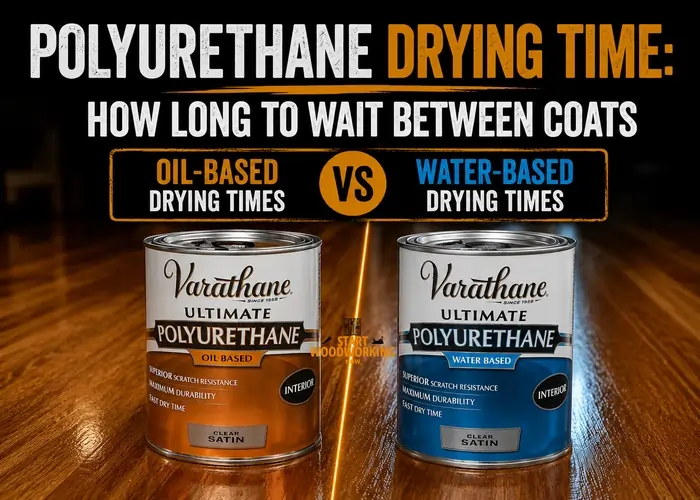
Polyurethane Drying Time — How Long to Wait Between Coats and Before Use
Polyurethane drying time refers to the time required for a polyurethane coating to transition through three stages: touch-dry, recoat-ready, and full cure. These stages are controlled by temperature, humidity, coat thickness, and chemical formulation.
These stages determine when a surface can safely receive another coat or be used in real conditions and are governed by temperature, humidity, coat thickness, ventilation, and wood substrate.
Different polyurethane systems behave differently: oil-based 1K systems rely on solvent evaporation and oxidation, water-based 1K systems rely on water evaporation and film coalescence, while commercial 2K polyurethane systems use catalytic cross-linking for significantly faster curing.
A floor can feel dry within hours while still being soft underneath for days.
Polyurethane Drying Time — The Key Numbers
Oil-Based 1K
8–12 hours
Recoat window at 20°C. Touch-dry in 4–6h. Full cure: 14–30 days.
Water-Based 1K (Consumer)
2–4 hours
Recoat window at 20°C. Touch-dry in 1–2h. Full cure: 7–14 days.
Commercial 2K Water-Based
1.5–3 hours
Recoat window at 20°C. Touch-dry in 45–90 min. Full cure: 5–7 days.
This guide explains drying times by polyurethane type, what affects recoat timing, how to avoid coating failure, and when surfaces are safe for use.
→ Hub: How to Remove Wood Finishes — Complete Guide
→ Remove polyurethane: How to Remove Polyurethane from Wood
→ Water-based vs oil-based: Water-Based vs Oil-Based Polyurethane — Full Comparison
→ Identify existing finish: How to Identify Wood Finish
The Three Drying Stages
Stage 1 — Touch-Dry (Solvent Evaporation)
Solvents have evaporated from the surface, but no full chemical curing has occurred.
Safe:
- Light inspection
- Sock-only walking
Unsafe:
- Recoating
- Furniture placement
- Heavy traffic
Oil-based: 4–6h | Water-based: 1–2h | 2K: 45–90 min
Stage 2 — Recoat-Ready (Cross-Linking Initiation)
The surface has developed sufficient molecular bonding for a new layer to adhere without trapping solvent.
Validation method:
Knuckle test — press knuckles firmly for 5 seconds. No tackiness or imprint = ready.
Safe:
- Apply next coat
- Light sanding (220 grit)
Unsafe:
- Furniture placement
- Rugs
- Heavy traffic
Oil-based: 8–12h | Water-based: 2–4h | 2K: 1.5–3h
Stage 3 — Full Cure (Complete Cross-Linking)
The coating reaches full hardness, chemical resistance, and mechanical durability.
Properties:
- Maximum hardness
- Maximum chemical resistance
- Full scratch resistance
Oil-based: 14–30 days | Water-based: 7–14 days | 2K: 5–7 days
Important: Full cure can take up to 30 days even when the surface feels dry much earlier.
The Five Critical Variables That Control Drying Time
Product labels state times under ideal conditions that most real-world applications do not match. The five variables below interact — low temperature and high humidity together produce the longest possible drying times, often 3–4 times the label value.
Why Polyurethane Drying Time Fails in Real Applications
Failures occur when environmental conditions, application technique, and chemical behavior interact incorrectly, producing unstable curing conditions.
Application Errors (User-Controlled)
- Recoating too early traps solvent between layers
- Excessive coat thickness causes surface skinning over uncured material
Environmental Failures
- Low temperature slows or stalls cross-linking
- High humidity disrupts curing balance in both oil and water systems
Chemical and Physical Mechanisms
- Uneven evaporation causes internal stress and wrinkling
- Skinning effect traps solvent under dry surface
Drying Time Reference Table — All Conditions
| Condition | Oil-Based 1K — Recoat | Water-Based 1K — Recoat | Commercial 2K — Recoat | Status |
|---|---|---|---|---|
| 22–25°C / 40–55% RH | 6–8 hours | 1.5–2.5 hours | 1–1.5 hours | ✅ Ideal |
| 18–22°C / 50–65% RH | 8–12 hours | 2–4 hours | 1.5–3 hours | ✅ Normal |
| 15–18°C / 60–70% RH | 14–18 hours | 4–6 hours | 3–5 hours | ⚠️ Slow |
| 10–15°C / 65–75% RH | 24–36 hours | 6–10 hours | 5–8 hours | ⚠️ High risk |
| Below 10°C / any humidity | Unpredictable / indefinite | 12–24+ hours | 10–18+ hours | ❌ Do not apply |
| Any temperature / above 80% RH | Unpredictable | Blushing risk | Reduced quality | ❌ Do not apply |
Time-based estimates are unreliable because curing depends on environmental conditions rather than elapsed time.
If your coat has passed these times and is still soft, the problem is no longer timing — something interrupted the cure. The finish troubleshooter identifies which of the five causes applies from the pattern on the surface.
How to Know When Polyurethane Is Recoat-Ready
Time-based estimates are unreliable. Environmental conditions change curing speed significantly.
The Knuckle Test — How to Confirm Recoat-Ready Without Guessing
Time elapsed since application is an unreliable indicator of Stage 2 completion. A coat applied at 18°C in the evening in a workshop that drops to 8°C overnight and rises to 15°C in the morning has not progressed through Stage 2 at the rate the label implies. Confirming readiness by test rather than by time eliminates the most common cause of recoat failure.
The Knuckle Test — Run Before Every Recoat Regardless of Time Elapsed
Press the back of your knuckles firmly — not fingertips — onto the finish surface in an inconspicuous area. Hold for 5 seconds with real pressure.
Lift your hand and inspect: No mark, no tackiness, completely smooth surface = recoat-ready. Proceed with the next coat.
Slight tackiness or fingertip impression = not ready. Wait 2 more hours and test again. Applying a coat now traps solvent and risks permanent wrinkling or milky inter-coat adhesion failure.
Why knuckles, not fingertips: Fingertip skin has oils that can affect the test result. Knuckle skin is drier and firmer — the test pressure is more consistent and the result more reliable.
The knuckle test replaces guessing based on elapsed time. Always run it before applying any subsequent coat.
📝The question I get most often about polyurethane drying is “I applied the second coat after 24 hours but the floor is still tacky/cloudy/soft — why?” Almost every time, the answer is one of two things: either the workshop was cold overnight and the effective curing time was far less than 24 calendar hours, or the first coat was too thick and the surface skinned over while the interior was still wet. Both problems have the same fix going forward: the knuckle test before every recoat, and confirming temperature stays above 15°C through the full drying period.
What Happens If You Recoat Polyurethane Too Soon?
- Mild: extended softness
- Moderate: cloudy or milky finish
- Severe: wrinkling and surface collapse
Severe cases require complete stripping and refinishing.
Traffic and Furniture Restrictions During Full Cure
| Activity | Oil-Based 1K | Water-Based 1K | Commercial 2K |
|---|---|---|---|
| Sock/slipper foot traffic | 24 hours | 8–12 hours | 6–8 hours |
| Normal shoe traffic | 48–72 hours | 24 hours | 12–18 hours |
| Furniture placement (light) | 72 hours | 48 hours | 24 hours |
| Furniture (felt pads required) | 7 days minimum | 5–7 days | 3–5 days |
| Area rugs | 30 days minimum | 14–21 days | 7–10 days |
| Rubber-backed mats | Never — rubber transfers to and discolours uncured poly | Never during cure / use only cotton-backed | Never during cure / use only cotton-backed |
| Normal cleaning (pH-neutral) | 7 days | 5–7 days | 3–5 days |
| Full hardness / full cure | 14–30 days | 7–14 days | 5–7 days |
If your coat has passed these times and is still soft, the problem is no longer timing — something interrupted the cure. The finish troubleshooter identifies which of the five causes applies from the pattern on the surface.
What Are the Key Specifications for Polyurethane Drying?
| Entity / Variable | Attribute | Value and Detail |
|---|---|---|
| Area rug placement — why 30 days for oil-based | Why rugs require the longest wait of all activities | Rugs trap solvent vapour still off-gassing from the curing film — the rug acts as a barrier that prevents solvent from dispersing into the room air. Trapped solvent slows Stage 2 cross-linking in the covered area while the surrounding uncovered area cures normally. The result: soft spots under the rug boundary that are visible as a sheen differential when the rug is eventually moved. Oil-based polyurethane off-gasses mineral spirits for up to 30 days. Water-based off-gasses for 14–21 days. Commercial 2K off-gasses for 7–10 days. Additionally: rugs with rubber backing transfer plasticiser compounds to the uncured polyurethane surface — permanent discolouration that requires stripping and refinishing to correct. |
| Wrinkling after second coat — cause and prevention | Why wrinkling occurs and what prevents it | Wrinkling occurs when a second coat is applied over a first coat that has not completed Stage 2. The solvent in the second coat re-dissolves the surface of the first coat, while the residual solvent from the first coat (still trapped under its surface skin) is now combined with the fresh solvent from the second coat. As this combined solvent mass evaporates, it contracts at an uneven rate producing the wrinkled texture. Prevention: always perform the knuckle test before recoating. If wrinkling has already occurred: strip both coats completely with NMP gel (see Remove Polyurethane from Wood), allow full dry, investigate and correct the cause (temperature, humidity, or coat thickness), restart. |
| Blushing on water-based polyurethane | What it is, why it occurs, and whether it resolves | Blushing: a white haze or cloudy appearance in the cured water-based film. Cause: humidity above 70% RH during Stage 1 — water vapour from the ambient air is absorbed by the still-wet film before Stage 1 is complete. The water molecules interfere with the coalescence of the acrylic-urethane particles as they fuse into a film, producing micro-voids that scatter light (the white haze). Mild blushing may resolve partially as the film continues to cross-link and the micro-voids reduce in size. Severe blushing (solid white opacity in sections) does not resolve — strip and restart. Prevention: measure humidity with a hygrometer; do not apply water-based polyurethane when humidity is forecast above 70% for the next 4 hours. |
| Inter-coat sanding for water-based — timing requirement | When to sand between coats and why the first coat is special | First coat of water-based polyurethane raises wood grain — the water carrier causes wood fibres to swell and stand up. This produces a rough, slightly fuzzy surface on the first coat. Fix: after first coat is touch-dry (1–2 hours at 20°C), sand with 220 grit on a flat block in grain direction — one light pass. This removes the raised fibres. Subsequent coats: 220-grit scuff between all coats is best practice for adhesion. Do not sand until at least Stage 1 is complete — sanding a partially dry water-based coat produces gummy sandpaper clogging within seconds. Oil-based polyurethane: 220-grit between all coats. No grain-raising issue since mineral spirits does not swell wood fibres. |
| Number of coats and cumulative drying time | Total project time from first coat to walkable floor or usable furniture | Oil-based 1K on floors (3 coats at 20°C): Coat 1 day 1 → recoat after 8–12h → Coat 2 day 2 → recoat after 8–12h → Coat 3 day 3 → walkable at 48h after Coat 3 = minimum 5 days project. Water-based 1K on floors (3–4 coats at 20°C): Coat 1 AM → Coat 2 PM (same day) → Coat 3 next morning → Coat 4 that afternoon → walkable 12h after Coat 4 = minimum 2.5 days project. Commercial 2K on floors (2 coats): Coat 1 AM → Coat 2 3–4 hours later → walkable 8h after Coat 2 = same day or next morning = 1–1.5 day project. The water-based and 2K speed advantage is significant for minimising disruption on residential floors. |
Floors vs Furniture — Where the Protocols Differ
📝The worst outcome I’ve seen from not waiting for full cure is a dining table where the owner placed a rubber-backed decorative mat after one week on oil-based polyurethane. The rubber transferred and chemically bonded to the uncured surface in a ring pattern. The mat outline became permanent after the polyurethane finished curing around it. Stripping and refinishing was the only fix. On oil-based polyurethane, 30 days before any rug or mat is not excessive caution — it reflects the actual curing timeline of the alkyd component.
Decision Guide — When Is Polyurethane Safe?
You can proceed if:
- Knuckle test passes (no tackiness or imprint)
- Temperature remains above 15°C during curing
- Surface shows no soft spots or uneven gloss
You must wait if:
- Humidity exceeds 70%
- Temperature drops overnight
- Surface feels soft beneath dry film
You must restart if:
- Wrinkling appears
- Milky or cloudy haze develops
- Adhesion failure occurs between coats
Frequently Asked Questions About Polyurethane Drying Time
How long after polyurethane can I walk on floors?
With clean socks or slippers: 24 hours after the final coat of oil-based polyurethane at 20°C, or 8–12 hours after the final coat of water-based 1K. With shoes: 48–72 hours for oil-based, 24 hours for water-based 1K. These times assume 20°C and 50–65% RH — at lower temperatures, add 50–100% to each. The knuckle test on an inconspicuous area (a closet floor, a corner under a door) confirms readiness more reliably than time elapsed. Never walk on a freshly coated floor before Stage 1 (touch-dry) is confirmed — foot pressure on a wet poly film leaves permanent impressions that require sanding and recoating to fix.
Can I apply a second coat of polyurethane the same day?
For water-based polyurethane 1K: yes, applying 2–3 coats in one day is possible and common — a coat in the morning, one in the early afternoon, and a final coat in the late afternoon are achievable at 20°C. Each coat must pass the knuckle test before the next is applied. For commercial 2K water-based (Bona Traffic HD, Loba 2K): yes — recoat window of 1.5–3 hours allows 2 coats in one day easily. For oil-based polyurethane 1K: no — the minimum recoat window at 20°C is 8–12 hours, making same-day recoating impractical. One coat per day is the standard for oil-based. Never apply the second coat based on touch-dryness alone for any product — the knuckle test confirms recoat-readiness.
What happens if you recoat polyurethane too soon?
Applying a second coat before Stage 2 is sufficiently advanced produces one of three failure modes depending on how early the recoat was applied. Mild (Stage 2 partially complete): the finish takes significantly longer to dry and may feel slightly soft for days or weeks. Moderate (Stage 2 early): white haze or milky inter-coat adhesion — the trapped solvent from the first coat clouds the second coat as it cures around it. Severe (Stage 1 barely complete): wrinkling — the second coat’s solvent re-dissolves the surface of the first coat while residual first-coat solvent combines with it; the whole mass contracts unevenly as it dries, producing a wrinkled, crinkled texture that cannot be resolved without stripping both coats completely. The fix for all three: strip with NMP gel (see the polyurethane removal guide), allow correct conditions, restart with the knuckle test protocol.
Summary — Key Values for Polyurethane Drying Time
Three stages: Stage 1 (touch-dry) — solvent evaporation only, no cross-linking; Stage 2 (recoat-ready) — sufficient cross-linking for inter-coat adhesion; Stage 3 (full cure) — complete cross-linking, final hardness.
Oil-based 1K at 20°C: touch-dry 4–6h, recoat 8–12h, full cure 14–30 days. Water-based 1K at 20°C: touch-dry 1–2h, recoat 2–4h, full cure 7–14 days.
Commercial 2K water-based at 20°C: touch-dry 45–90 min, recoat 1.5–3h, full cure 5–7 days. Five variables: temperature (most impactful — below 10°C reaction stops), humidity (40–65% RH optimal), coat thickness (max 75–100 microns wet film), ventilation (accelerates Stage 1 only), wood species (oily species slow first coat).
Temperature adjustment: add 50% to all times at 15°C; double at 10°C. Humidity: above 80% RH do not apply; water-based blushing risk above 70% RH. Confirmation test: knuckle test — back of knuckles, firm pressure, 5 seconds; zero tackiness and no impression = recoat-ready. Area rugs: oil-based 30 days, water-based 1K 14–21 days, commercial 2K 7–10 days — never rubber-backed during cure.
Recoat too soon: wrinkling (severe), milky haze (moderate), extended tacky period (mild). Fix for all: strip both coats, identify cause, restart. Water-based raised grain: first coat only — sand 220 grit after Stage 1, one light pass.
→ Remove polyurethane from wood: How to Remove Polyurethane from Wood
→ Remove polyurethane from floors: How to Remove Polyurethane from Wood Floors
→ Water-based vs oil-based polyurethane: Water-Based vs Oil-Based Polyurethane
→ Fix sticky varnish (same drying chemistry): How to Fix Sticky Varnish
→ Hub: How to Remove Wood Finishes — Complete Guide