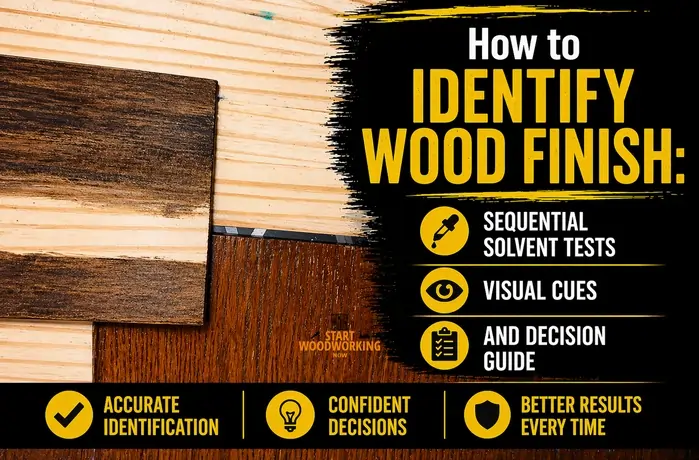
How to Identify Wood Finish: Sequential Solvent Tests, Visual Cues, and Decision Guide
Identifying the finish on wood before stripping or recoating determines which solvents, removers, and repair methods will work safely. Using the wrong solvent on the wrong finish wastes time, damages the surface, or produces no result.
Wood furniture commonly contains either film-forming finishes (polyurethane, lacquer, shellac, varnish, and water-based finishes) or penetrating finishes such as oil, Danish oil, tung oil, linseed oil, and wax. Correct identification requires a fixed sequence: visual inspection first, then a blade scrape test, followed by mineral spirits, denatured alcohol, lacquer thinner, and xylene in order. The interactive tool below runs the same professional identification protocol step by step, while the sections that follow explain the chemistry, interpretation logic, and edge cases behind each test.
→ After identification: How to Remove Wood Finishes — Complete Hub
→ After removal: How to Refinish Wood After Stripping
What Visual and Age Cues Identify Wood Finish Before Any Chemical Test?
Visual inspection and provenance information eliminate half of all possibilities before the first solvent is opened. These pre-filters are not definitive on their own — they narrow the field to 1–2 candidates that the solvent tests then confirm.
A piece of furniture with all the visual characteristics of shellac that passes the denatured alcohol test is confirmed shellac; the visual cues merely make the test result predictable.
- Pre-1950: Shellac (80%+ probability). Polyurethane wasn’t commercially available until the late 1950s. Lacquer was available but shellac was dominant for furniture.
- 1950s–1980s: Lacquer (factory/mass-market), nitrocellulose most common. Some alkyd varnish on older pieces.
- Post-1990: Polyurethane (DIY and consumer), lacquer (factory), water-based finishes (post-2000).
- Exterior furniture: Spar varnish, teak oil, or exterior oil — not polyurethane.
- Kitchen/children’s furniture: Water-based poly or catalyzed lacquer.
- Hand-built artisan pieces: May have oil, wax, or shellac regardless of age.
- Warm amber/orange glow with depth: Shellac or amber lacquer — film has a visual warmth that polyurethane lacks.
- Crystal clear, very high gloss, plastic appearance: Polyurethane (oil or water-based) or catalyzed lacquer.
- Slight orange/amber tint, less glossy than poly: Alkyd varnish — especially on older dining tables and floors.
- Matte or satin, wood grain visible and tactile: Oil or wax finish — surface feels like wood, not plastic.
- Milky or cloudy in crazed areas: Old shellac or lacquer showing moisture damage.
- Crazing (fine network of cracks in finish): Shellac or old nitrocellulose lacquer — polyurethane peels rather than crazes.
- Waxy, slightly draggy feel, no slipping of finger: Wax finish or oil finish — not a film-forming finish.
- Very hard, no give under fingernail pressure: Polyurethane or catalyzed lacquer — most durable film finishes.
- Slightly soft feel, especially in warm room: Shellac or old nitrocellulose lacquer — thermoplastic finishes soften with heat.
- Water drops bead immediately and stay: Film-forming finish present (poly, lacquer, shellac).
- Water drops absorb or spread into grain: Penetrating finish (oil, wax) or bare wood.
- Peeling in sheets or flakes: Film-forming finish delaminating — polyurethane or varnish most commonly.
How Do You Tell If Wood Has a Film-Forming or Penetrating Finish?
Before applying any solvent, confirm whether there is a film-forming finish on the surface at all. Penetrating finishes — oil, danish oil, wax, tung oil — absorb into the wood pores and do not form a removable surface layer. Film-forming finishes — polyurethane, lacquer, shellac, varnish — sit on top of the wood as a cured polymer film that can be scraped.
How to perform the blade scrape test
Use a utility knife or sharp penknife. On a hidden area (underside of tabletop, back of a leg, inside drawer opening), hold the blade at approximately 30–45 degrees and scrape lightly — 2–3 cm stroke with light pressure. Examine what comes off the surface and what the scraped area looks like.
| What the scrape produces | Finish type | Likely colour of shavings | Implication |
|---|---|---|---|
| White or off-white plastic-like shavings or powder that curl or flake | Film-forming finish present | White = water-based poly, shellac, or lacquer. Off-white/cream = oil-modified poly or amber shellac. Pale yellow = varnish or spar varnish. | Proceed to solvent tests (Tests 1–4) to identify which film finish. |
| Blade immediately contacts wood grain — no shavings, just wood dust | Penetrating finish — no surface film | Natural wood colour dust only | Finish is oil, wax, danish oil, or bare wood. Apply mineral spirits cloth test to check for wax. Solvent tests for film finishes do not apply. |
| Waxy, soft debris that smears rather than shaving cleanly | Wax finish or heavily waxed surface over film finish | Opaque white or slightly yellowish smear | Wax finish confirmed, or wax over existing film. Remove wax with mineral spirits first, then re-test with blade to check for film beneath. |
What Are the Four Solvent Tests for Identifying Wood Finish?
The four solvent tests must be performed in the order listed. Each solvent is more aggressive than the previous, and each test is meaningful only if the previous tests have been performed first. If lacquer thinner (Test 3) is applied before denatured alcohol (Test 2), it produces a positive result for both shellac and lacquer — the test cannot distinguish between them because both dissolve in lacquer thinner. The sequence is the method.
For each test: apply solvent to a white cotton swab or folded white cloth. Hold the swab in firm contact with the finish for the specified duration — do not rub back and forth immediately. Hold still first, then wipe. Use a different hidden area for each test or wait for the previous test to dry (2–3 minutes) before testing the same spot.
Mineral Spirits — Wax Identification Test
Contact time: 30–60 seconds firm contact. What to observe: Look at the cloth, not the surface. Any waxy, greasy, or oily film transferring to the cloth = wax present. Surface sheen also reveals: mineral spirits temporarily saturates sealed surfaces and shows what a fresh coat would look like.
Why first: Wax often sits on top of an underlying film finish. If wax is present, it must be removed with mineral spirits before subsequent solvent tests can reach the actual finish beneath. Testing through a wax layer with denatured alcohol or lacquer thinner gives misleading results because the wax acts as a barrier.
Denatured Alcohol — Shellac Test
Contact time: 30 seconds held still, then wipe with light pressure. What to observe: Finish becomes sticky, tacky, or gummy on contact — or dissolves with amber residue on the swab. Any softening within 30 seconds indicates shellac.
Why second: Denatured alcohol dissolves shellac rapidly and selectively. Lacquer and polyurethane are not affected at this contact time. This makes alcohol the ideal test for eliminating shellac before applying lacquer thinner (which also dissolves shellac and would produce a false positive).
Partial result interpretation: Immediate full dissolution = dewaxed or clear shellac. Slight tackiness = possibly waxed shellac (wax partially resists alcohol) — or old, degraded lacquer. If ambiguous: re-apply alcohol for 60 seconds and scrub lightly.
Lacquer Thinner — Lacquer Test
Contact time: 30 seconds held still. What to observe: Finish softens, smears when rubbed, or becomes gummy and transfers to swab = lacquer. Softening may occur after 20–30 seconds rather than 5 seconds as shellac does.
Why third (after alcohol, not before): Lacquer thinner dissolves both shellac AND lacquer. If performed first, a positive result cannot distinguish between the two. Only perform this test after confirming “no shellac” in Test 2.
Sub-types: Nitrocellulose dissolves quickly (10–20s). CAB-acrylic softens more slowly (20–40s). Catalyzed lacquer shows minimal or no reaction.
Xylene — Water-Based vs. Oil-Based Polyurethane Test
Contact time: 60 seconds held still. What to observe: Finish becomes gummy, tacky, or sticky = water-based polyurethane/acrylic. Surface unaffected after 60 seconds = oil-based polyurethane or alkyd varnish.
Why xylene: Xylene dissolves acrylic polymer chains in water-based finishes. Oil-based polyurethane is an aliphatic urethane cross-linked with alkyd resin, which resists xylene.
Poly vs. Varnish: Post-1960 age and extreme clarity indicate poly; warmer amber tones and slight softening with 5-min lacquer thinner contact indicate old alkyd varnish.
Complete Solvent Response Matrix by Finish Type
| Finish Type | Mineral Spirits | Denatured Alcohol 30 sec | Lacquer Thinner 30 sec | Xylene 60 sec | Removal Guide |
|---|---|---|---|---|---|
| Shellac (dewaxed) | No effect | Dissolves immediately | Dissolves (do not test if alcohol +) | Dissolves | → Remove Shellac |
| Shellac (waxed) | Slight waxy film | Softens / partial dissolve | Dissolves eventually | Dissolves | → Remove Shellac |
| Nitrocellulose Lacquer | No effect | No effect | Dissolves 10–20 sec | Dissolves | → Remove Lacquer |
| CAB-Acrylic Lacquer | No effect | No effect | Softens 20–40 sec | Softens / gummy | → Remove Lacquer |
| Catalyzed / Post-Cat Lacquer | No effect | No effect | No effect (or slight 5+ min) | No effect | → Remove Lacquer (catalyzed section) |
| Water-Based Polyurethane / Acrylic | No effect | No effect | May soften slightly | Gummy / tacky | → Remove Polyurethane |
| Oil-Based Polyurethane | No effect | No effect | No effect | No effect | → Remove Polyurethane |
| Alkyd Varnish | No effect | No effect | Slight softening (5 min) | No effect | → Remove Varnish |
| Spar / Marine Varnish | No effect | No effect | No effect | No effect | → Remove Varnish (spar section) |
| Wax Finish | Dissolves — cloth picks up wax | No effect (on wax) | No effect | No effect | → Remove Wax Finish |
| Danish Oil / Penetrating Oil Finish | Slight transfer on old/uncured oil | No effect | No effect | No effect | → Remove Danish Oil |
| Chalk Paint (unsealed) | No effect | No effect | No effect | No effect (but water softens) | → Remove Chalk Paint |
How Do You Interpret Ambiguous or Partial Test Results?
In practice, finish identification is not always a binary pass/fail. Old finishes, mixed finishes (multiple coats of different products applied over decades), and degraded surfaces produce partial reactions that can be confusing. The following scenarios cover the most common ambiguous results.
Scenario: Denatured alcohol produces slight tackiness but does not fully dissolve
This typically indicates one of three situations: waxed shellac (the wax component resists alcohol and prevents full dissolution — remove wax with mineral spirits first, then retest); old, degraded nitrocellulose lacquer (which can become slightly alcohol-sensitive as it ages and loses plasticiser); or shellac mixed with another finish.
Protocol: apply mineral spirits first, wipe clean, then retest with denatured alcohol for 60 seconds with light rubbing. Full dissolution with extended contact = shellac confirmed. Continued partial reaction = likely waxed shellac or degraded lacquer.
Scenario: Lacquer thinner produces slight softening but not full dissolution
Three possibilities: CAB-acrylic lacquer (slower to dissolve than nitrocellulose — extend contact to 60 seconds); old alkyd varnish (which can soften slightly under lacquer thinner at extended contact); or multiple coats of different finishes (the top coat is varnish applied over lacquer — lacquer thinner softens the bottom lacquer layer through the varnish).
Protocol: extend contact to 60–90 seconds. Full dissolution at extended time = lacquer. Persistent partial softening only = varnish over lacquer. Proceed to xylene test regardless.
Scenario: All four solvents produce no reaction
Two finish types resist all standard solvent tests: oil-based polyurethane and catalyzed lacquer (conversion varnish, post-cat lacquer). Visual and age cues distinguish them: post-cat lacquer is found on professional cabinetry and furniture from specialist workshops; oil-based polyurethane is the standard consumer product. Age also helps: pre-1970 pieces with excellent chemical resistance = likely catalyzed varnish or early urethane; post-1970 consumer pieces = oil-based polyurethane.
The removal protocol is similar for both: chemical gel stripper (NMP-based for 45–60 min dwell) or mechanical sanding.
Scenario: Multiple layers producing conflicting reactions in different areas
Common on furniture that has been partially refinished over time — original shellac, later lacquer topcoat applied over it, or polyurethane applied as a spot repair.
Test in multiple locations: original factory areas (under the table, inside drawer) typically have the oldest, most consistent finish; areas near repairs or edges may have different top coats. If test results vary by location, treat each area according to its individual test result.
Why Do All Four Solvent Tests Sometimes Produce No Reaction?
Catalyzed lacquer (post-catalyzed lacquer, pre-catalyzed lacquer) and conversion varnish are cross-linked finishes used in professional cabinetry and furniture manufacturing.
Unlike standard lacquer, which re-dissolves in its own solvent (lacquer thinner), catalyzed finishes have undergone a cross-linking reaction with an acid catalyst that makes them chemically resistant to all standard solvents — including lacquer thinner. Their resistance profile is similar to polyurethane.
Identifying catalyzed finishes: the finish resists all four solvents. The piece is professional cabinetry, kitchen cabinets, or commercial furniture rather than consumer or antique. The surface has exceptional chemical resistance — water, alcohol, and most household cleaners have zero effect. The finish is very hard with minimal scratch sensitivity.
Removal protocol for catalyzed finishes: NMP-based gel stripper at extended dwell (45–60 minutes under plastic film). This is the same protocol as polyurethane but may require multiple applications. Mechanical sanding is also effective. Full detail in the lacquer removal guide (catalyzed section).
📝On a mid-century walnut cabinet, the finish showed typical lacquer traits (fine checking and quick gloss dulling), but the lacquer thinner test had almost no effect after 30 seconds. A deeper test with extended dwell and light scraping revealed a catalyzed lacquer layer over an older finish, which required a benzyl alcohol gel stripper with a full 90-minute dwell under plastic film to break down.
Which Removal Method Should You Use After Identifying Your Finish?
| Identified Finish | Removal Method Summary | Full Guide |
|---|---|---|
| Shellac | Denatured alcohol — re-amalgamation for repairs; full removal with methylene chloride or alcohol wash | Remove Shellac → |
| Nitrocellulose / CAB-acrylic Lacquer | Lacquer thinner wash (nitro 2–5 min); NMP gel stripper (CAB); re-amalgamation option for repairs | Remove Lacquer → |
| Oil-Based Polyurethane | Methylene chloride or NMP gel stripper 30–45 min; mechanical sanding | Remove Polyurethane → |
| Water-Based Polyurethane | NMP gel stripper or lacquer thinner with extended dwell | Remove Polyurethane → |
| Alkyd Varnish | Lacquer thinner (spirit varnish 2–3 min); NMP gel stripper (alkyd) | Remove Varnish → |
| Spar / Marine Varnish | NMP gel stripper extended dwell (60+ min); heat gun supplement | Remove Varnish → |
| Wax Finish | Mineral spirits — 2–5 passes; naphtha for microcrystalline wax; naphtha evaporation test confirms removal | Remove Wax Finish → |
| Danish Oil / Penetrating Oil | Cure state determines protocol: mineral spirits (uncured), chemical stripper (partial), sanding only (fully cured) | Remove Danish Oil → |
| Chalk Paint | Identify seal coat first: unsealed = warm water; wax-sealed = mineral spirits then water; polycrylic-sealed = gel stripper | Remove Chalk Paint → |
| Paint (latex or oil-based) | Chemical stripper or heat gun + scraper; lead test on pre-1978 pieces | Remove Paint → |
📝In another case, an antique oak chest gave inconsistent results — slight tackiness with alcohol, minimal response to lacquer thinner, and resistance to mineral spirits — indicating a mixed finish history (shellac base with later varnish topcoat). I removed it in stages: first alcohol to lift the shellac layer, followed by a gel stripper to fully clear the remaining film, confirming clean wood with a successful water drop test.
Frequently Asked Questions About Identifying Wood Finish
Can I use acetone instead of lacquer thinner to test for lacquer?
Acetone is a strong, fast-evaporating solvent that can be used as a lacquer thinner substitute for identification purposes. It dissolves nitrocellulose lacquer rapidly and also dissolves shellac. Because it evaporates much faster than lacquer thinner, the contact window for the test is shorter — hold the swab for 15–20 seconds rather than 30. Acetone also affects some water-based finishes (partial tackiness) and can cloud acrylic finishes. For reliable results, lacquer thinner is preferred because its slower evaporation gives more control. If lacquer thinner is not available, acetone is an acceptable substitute with the shortened contact time.
What if the solvent tests show different results in different areas of the same piece?
Multiple finish layers or partial refinishing produce different results in different locations — this is common on pieces that have been repaired or refinished over decades. The original finish is most reliably found in unexposed areas: the underside of horizontal surfaces, the inside of drawer openings, the back face of panels. Test these first for the original factory finish. Then test the top visible surfaces separately. If results differ, treat each area according to its specific test result — the removal method that works for the original finish may not work for the repair finish applied on top.
Does the test work on very old antique furniture?
Yes, but with modified expectations. Pre-1950 antique furniture is overwhelmingly shellac — the denatured alcohol test typically confirms this immediately. On very old pieces (Victorian, Edwardian), the shellac may have been repaired or overcoated multiple times, so the surface coat may be younger shellac over older shellac, or lacquer over shellac. If the surface coat resists alcohol but looks visually like an old finish with crazing or warmth, test with lacquer thinner for the possibility of nitrocellulose lacquer applied as a later repair coat. For genuinely valuable antiques, consult a conservator before any solvent testing — some original finishes have historical significance.
How do you tell the difference between polyurethane and varnish?
Polyurethane and alkyd varnish both resist all four standard solvent tests, making chemical tests alone insufficient to distinguish them. Age and visual cues are the primary differentiators: polyurethane produces a crystal-clear, very hard, plastic-like surface and became the dominant consumer finish after the early 1970s. Alkyd varnish produces a warmer amber tone, slightly less gloss, and a subtly more elastic surface that shows fine checking in aged examples. If age is uncertain, extended lacquer thinner contact (5 full minutes, covered) produces slight softening in alkyd varnish but none in oil-based polyurethane — a slow chemical distinction rather than a fast one.
Can you identify wood finish without using chemical solvents?
Yes — visual inspection, age, tactile tests, and the blade scrape test together identify the finish in the majority of cases without opening any solvent. Pre-1950 pieces with warm amber glow and slight heat softness are shellac with high probability. Matte, tactile surfaces where water absorbs are penetrating oil or wax — confirmed by blade scrape producing no plastic shavings. Very hard, crystal-clear, plastic-like post-1990 furniture is oil-based polyurethane in most cases. Chemical solvents are required only when visual and tactile tests produce ambiguous results — typically on pieces from 1950–1990 where lacquer, varnish, and early polyurethane overlap in age range.
How do you know if furniture has been refinished with a different product?
Refinished furniture shows conflicting test results between the original finish areas and the refinished areas — the most reliable indicator. Test in three locations: an unexposed original surface (underside of tabletop, inside of drawer opening), the top visible surface, and any area showing visual inconsistency (sheen difference, colour mismatch). If the underside tests as shellac but the top surface tests as polyurethane, the piece has been refinished with a different product applied over the original. In this case, the refinished surface must be treated according to the top coat result — not the original finish result — because the top coat is what the stripper contacts first.
→ After identification, remove the finish: How to Remove Wood Finishes — Complete Hub
→ After removal: How to Refinish Wood After Stripping
→ Full refinishing guide: How to Refinish Furniture