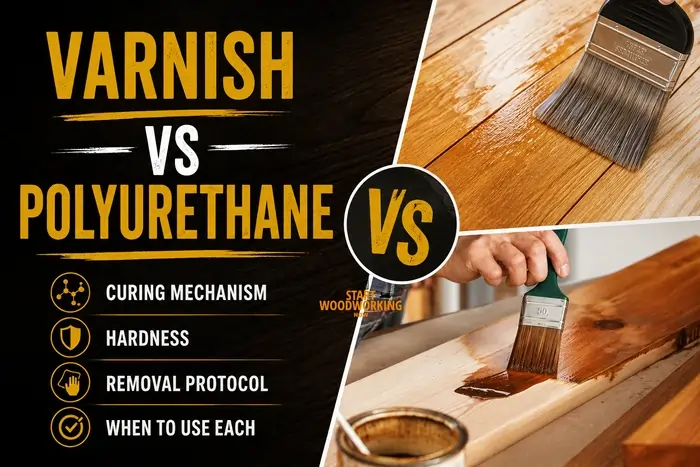
Varnish vs Polyurethane: Curing Mechanism, Hardness, Removal Protocol, and When to Use Each
Polyurethane is harder, more water-resistant, and better for indoor surfaces like floors, tables, and kitchen cabinets. Traditional varnish is more flexible, easier to repair, and better for exterior wood because it handles UV exposure and seasonal wood movement more effectively.
For most indoor furniture and hardwood floors, polyurethane is the better choice. For outdoor furniture, boats, and exterior wood trim, spar varnish lasts longer because it remains flexible instead of cracking as wood expands and contracts.
The fundamental difference is the curing mechanism: standard alkyd varnish cures by oxidative polymerization, where atmospheric oxygen reacts with the drying oil component over 8–24 hours to form a moderately cross-linked film. Polyurethane cures by urethane cross-linking, where isocyanate groups react with hydroxyl groups to form a densely cross-linked polymer network — the same chemistry used in industrial coatings, skateboard wheels, and automotive bumpers. The urethane cross-link density is significantly higher than the oxidative cross-links in varnish, which is why polyurethane is substantially harder, more chemically resistant, and more difficult to remove.
Quick recommendation: Choose polyurethane for durability and chemical resistance. Choose varnish for exterior flexibility and easier long-term maintenance.
Varnish vs Polyurethane — Key Differences at a Glance
- Polyurethane is harder and more chemical-resistant than varnish. Urethane cross-linking produces a denser polymer network than oxidative polymerization. Polyurethane resists household solvents, acids, and alkalis that will damage varnish over time. For kitchen surfaces, bathroom woodwork, and high-traffic floors: polyurethane is the correct choice.
- Varnish (spar/marine) is the only film finish for exterior use. Spar varnish contains UV absorbers and has a higher oil-to-resin ratio that maintains flexibility as exterior wood expands and contracts seasonally. Interior polyurethane becomes brittle outdoors and cracks within 1–2 seasons. Exterior-rated polyurethane exists but is less common and more expensive than spar varnish.
- Oil-based polyurethane ambers more aggressively and permanently than alkyd varnish. The urethane component contributes additional yellowing beyond the linseed oil oxidation that causes varnish to amber. On light-coloured wood (maple, ash, pine), oil-based polyurethane produces a noticeably warmer golden tone at application that continues to deepen over 5–10 years.
- Removal protocol is the same product but different dwell time. Both alkyd varnish and oil-based polyurethane require NMP gel stripper under plastic film. Alkyd varnish releases in 45–90 minutes (1–2 applications). Oil-based polyurethane requires 60–90 minutes and typically 2 applications. Water-based polyurethane responds faster: 30–60 minutes. The label time of 15–30 minutes applies to latex paint, not to either varnish or polyurethane.
- The term “polyurethane varnish” describes a hybrid product, not pure polyurethane. Products sold as “polyurethane varnish” or “urethane varnish” are alkyd resins modified with urethane linkages — harder than standard alkyd varnish but softer than 2-component polyurethane. They are identified by behaving like varnish in solvent tests (slight lacquer thinner softening at 5 minutes) while being harder than standard alkyd varnish in scratch tests.
This guide covers the curing mechanisms of each finish and why cross-link density determines hardness, the “polyurethane varnish” naming confusion and what it means in practice, a complete comparison table with specific values, the amber tone timeline for oil-based polyurethane, the identification test that distinguishes the two finishes, the removal protocols with specific dwell times, and the decision matrix for choosing between them.
→ Identify which finish is on your wood: How to Identify Wood Finish — Sequential Solvent Test
→ Remove varnish: How to Remove Varnish from Wood
→ Remove polyurethane: How to Remove Polyurethane from Wood
→ Hub: How to Remove Wood Finishes — Complete Guide
The “Polyurethane Varnish” Naming Problem — Why the Terminology Confuses
⚠️ Three different products sold under similar names
Walking into a hardware store and asking for “varnish” or “polyurethane” does not reliably identify what chemistry you are buying. The product naming has drifted significantly from the underlying chemistry:
| Product Label | Actual Chemistry | Hardness | Removal |
|---|---|---|---|
| “Alkyd Varnish” (e.g. Ronseal Interior Varnish) |
Alkyd resin + linseed oil, oxidative cure | Moderate | NMP gel 45–90 min |
| “Polyurethane Varnish” / “Urethane Varnish” (e.g. Rustins Polyurethane Varnish) |
Alkyd resin modified with urethane linkages, hybrid cure | Moderate-Hard | NMP gel 45–90 min (same as varnish) |
| “Polyurethane” (e.g. Minwax Polyurethane) |
True polyurethane, urethane cross-linking, moisture-cure 1K | Hard | NMP gel 60–90 min |
| “2K Polyurethane” (e.g. Bona Traffic HD) |
2-component isocyanate + polyol, maximum cross-link density | Very Hard | NMP gel + IR pre-heat, 90–120 min, 2–3 applications |
The practical consequence: when a client says “my furniture has varnish on it” and it turns out to be oil-based polyurethane, the removal protocol is different.
Lacquer thinner — which some people try on “varnish” after reading that it works on spirit varnish — has zero effect on polyurethane at any contact time. NMP gel at the correct dwell time removes both, but the dwell time and number of applications differ enough to matter on a project.
How Each Finish Cures — Why Cross-Link Density Determines Everything
Alkyd Varnish — Oxidative Polymerization
Polyurethane (1K moisture-cure) — Urethane Cross-Linking
Drying vs Curing — Why a Finish Can Feel Dry Before It Is Fully Hardened
Both varnish and polyurethane become dry to the touch long before they reach full hardness. Drying only means the solvent has evaporated from the surface. Curing refers to the chemical cross-linking process continuing inside the film.
This is why freshly finished furniture can still dent during the first several weeks even when the surface feels dry. Oil-based polyurethane may require up to 30 days to achieve maximum hardness and chemical resistance.
Placing rugs on newly finished hardwood floors before full cure can trap solvents and leave permanent marks in the finish.
Why the cross-link density difference produces harder polyurethane:
Imagine the polymer network as a fishing net. Varnish creates a net with widely-spaced knots (oxidative cross-links between oil molecules). Polyurethane creates a net where every intersection point has a strong urethane knot — the same type of bond used in construction adhesives and rigid plastic components.
Scratch resistance, chemical resistance, and impact resistance all scale with the density of these knots per unit volume of film. This is why 2K polyurethane (isocyanate + polyol mixed at application) achieves the highest hardness of any consumer wood finish: maximum cross-link density by design.
Hardness and Durability Comparison — Specific Values
Film hardness in wood finishes is assessed by pencil hardness (ASTM D3363 standard — the softest pencil that scratches the cured film) and König pendulum hardness (seconds of oscillation before damping). These values are from manufacturer technical data sheets and independent testing, not marketing claims.
Hardness has a practical cost:
Higher cross-link density makes polyurethane harder to scratch — and harder to repair. A scratch in varnish can be sanded locally and re-varnished with reasonable blending.
A scratch in 2K polyurethane requires sanding the entire panel to blend the repair because the high cross-link density resists adhesion of a small repair patch. This is the trade-off: maximum durability for new surfaces; maximum repairability for antique or high-use furniture where scratches are expected.
Polyurethane wins on hardness, but varnish blends better on repair — see the full seven-axis breakdown, plus every other pairing, in the finish comparison tool.
Complete Specification Comparison — Varnish vs Polyurethane
| Specification | Varnish (Alkyd) | Polyurethane (1K Oil-Based) | Polyurethane (Water-Based) |
|---|---|---|---|
| Curing mechanism | Oxidative polymerization — oxygen reacts with drying oil double bonds. Moderate cross-link density. | Urethane cross-linking — isocyanate groups react with moisture. High cross-link density. | Same urethane cross-linking as oil-based but water as carrier. Equivalent cross-link density to oil-based 1K. |
| Drying time (tack-free) | 8–12 hours at 18–24°C. Below 15°C: significantly slower. Below 10°C: cure stalls. | 8–12 hours at 18–24°C. Similar temperature sensitivity to varnish. | 2–4 hours at 18–24°C. Less temperature-sensitive than oil-based. Two coats possible in one day. |
| Full cure | 14–21 days (alkyd). 21–30 days (spar varnish). | 14–30 days. Surface hardness develops progressively — moves furniture after 72h but avoid heavy use for 30 days. | 7–14 days. Faster full cure than oil-based due to water carrier evaporating faster than mineral spirits. |
| Amber tone on application | Moderate warm amber from linseed oil. Deepens slowly over years from continued oil oxidation. | Warm amber-golden tone stronger than alkyd varnish. The urethane component contributes additional yellowing beyond oil oxidation. Deepens noticeably over 5–10 years. | Water-clear — no amber at application. Very slight yellowing over decades (not noticeable on most species). Correct choice for maple, ash, light pine. |
| Exterior suitability | Spar varnish: exterior-rated. Contains UV absorbers + high oil content for flexibility. Interior alkyd: NOT exterior — embrittles without UV protection. | Standard 1K interior poly: NOT exterior. Exterior-formulated polyurethane exists (Helmsman Spar Urethane, etc.) but is essentially a spar varnish-polyurethane hybrid. True 2K poly: not suitable for exterior wood movement. | Not suitable for exterior unless specifically formulated as exterior. Most water-based polyurethanes are interior-only. |
| Chemical resistance (cured) | Good water resistance. Moderate chemical resistance — prolonged contact with acetone, strong acids, or alkalis will damage the film over time. | Excellent chemical resistance. Resists most household solvents, dilute acids, alkalis, and cleaning products. Correct choice for kitchen woodwork and surfaces with regular cleaning. | Equivalent to oil-based in chemical resistance. Modern formulations (Bona Traffic, Loba 2K water-based) match or exceed oil-based. |
| Flexibility in cured film | More flexible than polyurethane — especially spar varnish. Can accommodate 2–5% wood movement without cracking. Critical advantage for exterior and for antique furniture with seasonal movement. | Less flexible than varnish. Standard interior poly cracks on exterior wood in 1–2 seasons. On interior wood with normal humidity control: sufficient flexibility for furniture and floors. | Similar to oil-based. Slightly less flexible than alkyd varnish in comparable formulations. |
| Re-amalgamation (repair without stripping) | Not possible. Oxidative cure is irreversible. Damaged areas must be sanded or stripped. | Not possible. Urethane cross-links are irreversible. Damaged areas must be sanded or stripped. | Not possible for the same reasons. |
| Number of coats — furniture | 3 coats for furniture (interior), 4 for floors. 4–5 for spar varnish on exterior horizontal surfaces. | 2–3 coats for furniture, 3 for floors. Oil-based applies thicker per coat than varnish due to higher solids content in some formulations. | 3 coats minimum for furniture, 3–4 for floors. Water-based applies in thinner layers — compensate with additional coats. |
| Application method | Natural bristle brush (oil-based). Long grain-direction strokes. T-bar for floors. Never roller. | Natural bristle brush. Same technique as varnish. Tip-off technique especially important as oil-based poly levels more slowly than varnish. | Synthetic brush only (natural bristle absorbs water and becomes limp). T-bar for floors. Faster application due to shorter open time. |
| VOC content (typical) | Oil-based alkyd varnish: 300–450 g/L. Water-based varnish: 50–150 g/L. | Oil-based 1K poly: 275–400 g/L. | 50–150 g/L. Significantly lower than oil-based. Rooms can be re-occupied sooner. Lower solvent concentration during application. |
| Typical cost (UK/EU, per litre) | Interior alkyd: £8–20/L. Spar varnish: £15–35/L. Premium brands (International, Sikkens): up to £50/L. | Standard 1K oil-based: £10–25/L. 2K poly: £30–80/L (commercial grade). | Standard: £12–28/L. Commercial grade (Bona Traffic): £45–80/L. |
Which Is Better for Floors, Furniture, Cabinets, and Outdoor Wood?
| Surface | Best Finish | Why |
|---|---|---|
| Hardwood floors | Polyurethane | Better abrasion resistance |
| Kitchen cabinets | Water-based polyurethane | Non-yellowing and washable |
| Dining tables | Polyurethane | Chemical and water resistance |
| Outdoor furniture | Spar varnish | UV resistance and flexibility |
| Boats and marine wood | Spar varnish | Handles moisture movement |
| Antique furniture | Varnish | Easier repair and restoration |
| Bathroom vanity | Polyurethane | Better moisture resistance |
| Decorative furniture | Varnish | Warmer traditional appearance |
Oil-Based Polyurethane Amber Tone — The Timeline Most Guides Omit
Oil-based polyurethane yellows in two distinct phases. Most guides mention that oil-based poly ambers — but none describe the progression over time or how to predict the final appearance on your specific species and light exposure.
The practical implication: if the project is light-coloured wood (maple, birch, ash, pine) and colour accuracy matters — kitchen cabinets, light-stained furniture — water-based polyurethane is the correct choice. The clear film preserves the natural or stained colour permanently. Oil-based polyurethane on the same species produces a noticeably different result at application, and a progressively more different result each year.
The UV acceleration effect:
Areas of an oil-based poly floor that receive direct sunlight through windows amber faster than protected areas under furniture. After several years, removing the furniture reveals an obvious colour differential — the exposed area has progressed further through the amber timeline than the protected area.
This is not a flaw — it is the expected behaviour of oil oxidation in the film. On floors where this differential is undesirable, UV-stable water-based polyurethane eliminates the effect.
How to Tell if Varnish or Polyurethane Is Failing
Polyurethane Failure Signs
- White water spots from trapped moisture
- Peeling or delamination near edges
- Cloudy appearance from moisture intrusion
- Cracking on exterior wood exposed to UV
- Deep scratches that expose bare wood
Varnish Failure Signs
- Crazing or fine surface cracking
- Alligatoring on very old finishes
- UV degradation on exterior surfaces
- Brittleness from oxidation over decades
- Dull appearance from weather exposure
Identifying Varnish vs. Polyurethane Without Stripping
🔬 Sequential Solvent Identification Test
Run these tests on a hidden area. Always run in sequence—earlier tests must be negative before proceeding to the next.
📝The identification test I use before any stripping job is exactly this sequence. The most common misidentification I see from clients who have tried to strip their own furniture: they try lacquer thinner (which they read online works on “varnish”) and after 30 seconds see no reaction and conclude the finish is polyurethane. Sometimes this is correct — but if they had waited 5 minutes with lacquer thinner on an alkyd varnish piece, they would see a slight softening that confirms varnish. The 5-minute extended test is the step most guides omit. The practical implication: on an alkyd varnish piece, I know NMP gel at 45–60 minutes will work cleanly on the first application. On a polyurethane piece (zero 5-minute reaction), I plan for 60–90 minutes and a second application on multi-coat builds. These 30–45 extra minutes per application add up significantly on a large piece. Knowing the finish in advance means planning the correct amount of stripper and time.
Removal Protocol Differences — Specific Dwell Times
Common Mistakes When Choosing Between Varnish and Polyurethane
- Using interior polyurethane outdoors where UV exposure causes cracking
- Applying polyurethane before varnish fully cures
- Assuming all “polyurethane varnish” products are true polyurethane
- Using oil-based polyurethane on light maple without expecting ambering
- Skipping sanding between coats and causing adhesion problems
- Applying water-based polyurethane over wax-contaminated surfaces
When to Use Varnish and When to Use Polyurethane — Decision Guide
Any exterior application where spar varnish provides UV resistance and flexibility for seasonal wood movement. Antique furniture where the original finish was varnish and aesthetic continuity matters. Boat joinery and outdoor furniture. Interior wood where moderate hardness is acceptable and a warm amber tone complements the species. Pieces that will be maintained and refinished periodically rather than stripped. ❌ Do NOT choose varnish when:
Kitchen countertops, bathroom woodwork, or any surface with regular contact with cleaning chemicals — polyurethane’s superior chemical resistance is required. High-traffic floors where maximum abrasion resistance is needed. Light-coloured wood where amber tone would change the intended appearance.
Maximum hardness and chemical resistance on interior surfaces. High-traffic floors (oil-based or water-based 1K; 2K for commercial). Kitchen woodwork and surfaces that contact cleaning products regularly. Light-coloured wood where non-yellowing finish is required (water-based poly). Modern furniture where clarity and durability over warm tone is the priority. ❌ Do NOT choose polyurethane when:
Standard exterior use without specifically exterior-rated formula (interior poly cracks outdoors). Antique furniture where original finish was shellac or varnish — creates restoration incompatibility. Projects where damage repair is likely to be needed — polyurethane cannot be re-amalgamated and patches are difficult to blend.
Frequently Asked Questions — Varnish vs Polyurethane
Is “polyurethane varnish” the same as polyurethane?
No — “polyurethane varnish” is a product category name that describes alkyd varnish modified with urethane linkages, not pure polyurethane finish. The confusion comes from manufacturers using the word “polyurethane” on the label of alkyd-urethane hybrid products. The practical difference: alkyd-urethane “polyurethane varnish” shows very slight softening when tested with lacquer thinner at 5 minutes (the alkyd component reacts slightly); pure polyurethane shows zero reaction at any lacquer thinner contact time. Both require NMP gel for removal, but pure polyurethane needs longer dwell time. For hardness: alkyd-urethane hybrids fall between standard alkyd varnish and true 1K polyurethane.
Can polyurethane be applied over varnish?
Yes, with preparation — but it is generally not recommended. Both varnish and polyurethane cure by different mechanisms, and the adhesion of polyurethane over varnish depends on adequate mechanical keying (sanding at 120–150 grit to give the polyurethane tooth) and on the varnish being fully cured (minimum 30 days). The risk: if the varnish was applied in multiple coats and any layer is not fully cross-linked, the polyurethane may delaminate over time as the underlying varnish continues to cure and move. The correct approach for a piece with existing varnish that needs polyurethane durability: strip completely and apply polyurethane to bare wood.
Which lasts longer outdoors — spar varnish or polyurethane?
Spar varnish lasts longer on exterior wood for a specific reason: flexibility. Exterior wood moves 2–5% dimensionally with seasonal humidity changes. Spar varnish maintains sufficient flexibility in the cured film to accommodate this movement without cracking — the higher tung oil content and phenolic resin are specifically formulated for this. Standard interior polyurethane has higher cross-link density which makes it rigid — it cracks along the wood grain within 1–2 outdoor seasons. Exterior-rated polyurethane products (Minwax Helmsman, Varathane Exterior) are essentially spar varnish-polyurethane hybrids with added UV absorbers and flexibility agents — they perform comparably to spar varnish. Pure 2K polyurethane on exterior wood fails rapidly.
Summary: Key Values for Varnish vs Polyurethane
Varnish cures by oxidative polymerization (moderate cross-link density, 8–12h tack-free, flexible film). Polyurethane cures by urethane cross-linking (high cross-link density, 8–12h oil-based / 2–4h water-based, harder film). Polyurethane hardness: H–2H pencil (1K oil-based). Alkyd varnish hardness: HB–F pencil. 2K polyurethane: 2H–3H pencil — hardest consumer finish. Exterior use: spar varnish only — standard interior poly cracks outdoors.
Amber tone: oil-based poly ambers more aggressively than alkyd varnish and continues deepening for 5–10 years; water-based poly is water-clear. Identification: lacquer thinner 5 minutes — very slight varnish softening vs. zero polyurethane reaction.
Removal: NMP gel at 45–90 min (alkyd varnish), 60–90 min (oil-based poly), 30–60 min (water-based poly). 2K poly: NMP + IR pre-heat, 90–120 min, 2–3 applications. Label time of 15–30 min applies to latex paint — not to varnish or polyurethane. “Polyurethane varnish” = alkyd-urethane hybrid, harder than standard alkyd but softer than true poly, same removal protocol as varnish.
→ Remove varnish: How to Remove Varnish from Wood — All Types
→ Remove polyurethane: How to Remove Polyurethane from Wood
→ Varnish vs lacquer: Varnish vs Lacquer — Curing Mechanism and Removal
→ Identify your finish: How to Identify Wood Finish — Sequential Solvent Test
→ Choose the right chemical stripper: How to Choose a Chemical Stripper
→ Hub: How to Remove Wood Finishes — Complete Guide