
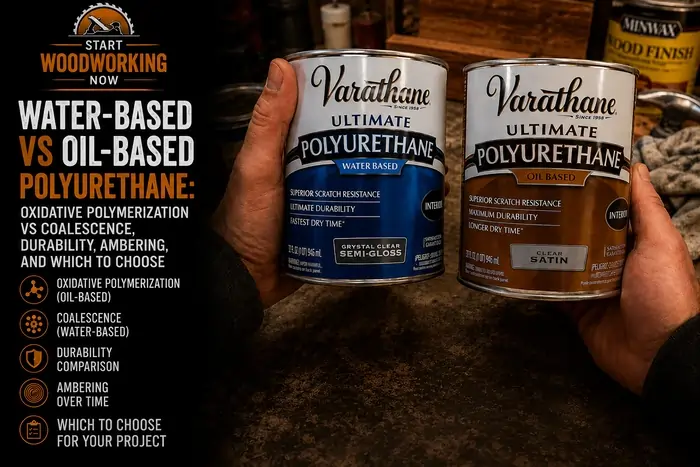
Water-Based vs Oil-Based Polyurethane: Oxidative Polymerization vs Coalescence, Durability, Ambering, and Which to Choose
Water-based and oil-based polyurethane cure through two fundamentally different mechanisms — oil-based hardens via oxidative polymerization, a chemical reaction with oxygen that continues for weeks after application, while water-based hardens via coalescence, a physical fusion of suspended particles as water evaporates. This single difference is the root cause of nearly every practical distinction between them: why oil-based ambers and keeps getting harder for months, why water-based stays clear and reaches stable hardness faster, and why each behaves differently in cold weather.
This guide is part of the complete wood finishing guide. For the comparison with varnish specifically: Varnish vs Polyurethane →
Most comparisons list these as separate, disconnected facts — “oil-based is harder,” “water-based dries faster,” “oil-based yellows.” They are not separate facts. They are three visible symptoms of the same underlying mechanism difference, and understanding that mechanism makes the choice between them far easier than memorizing a list of pros and cons.
What Is the Core Difference Between Water-Based and Oil-Based Polyurethane?
Oil-based polyurethane cures through oxidative polymerization — the oil component reacts with atmospheric oxygen, breaking and reforming molecular bonds to build a cross-linked polymer network, a chemical process that continues slowly for weeks to months after the surface feels dry. Water-based polyurethane cures through coalescence — microscopic polymer particles suspended in water physically fuse together as the water evaporates, a process that completes within days rather than continuing indefinitely.
The full chemistry of oxidative polymerization — including why it keeps building hardness long after the surface seems cured — is covered in the oxidative polymerization guide. The practical takeaway here is that oil-based polyurethane is never fully “finished” curing in the same sense water-based is — it continues to slowly densify for months, which is why manufacturers specify a much longer full-cure time (often 30 days) than touch-dry time (24 hours) for oil-based products specifically.
Why One Mechanism Explains Three Different Symptoms
Because oxidative polymerization is an ongoing chemical reaction, oil-based polyurethane keeps building cross-link density over time — which is also why it keeps getting slightly harder for months, and why the same reaction that builds cross-links also generates light-absorbing chromophore byproducts that amber the finish, covered in the why finishes yellow guide.
Coalescence, by contrast, is a physical process, not an oxidative chemical reaction — there’s no equivalent byproduct-generating reaction happening, which is exactly why water-based polyurethane stays clear and doesn’t amber the way oil-based does. Hardness, color stability, and cure timeline aren’t three unrelated properties to memorize — they’re three consequences of one mechanism choice.
Which Is More Durable — Water-Based or Oil-Based Polyurethane?
Oil-based polyurethane is generally harder and more abrasion-resistant than standard one-part water-based polyurethane, which is why it has long been the default for tabletops and floors. The gap has narrowed: water-based floor finishes with an added crosslinker, including two-part products, are built for commercial traffic and can match or beat oil-based wear resistance. Standard consumer water-based products still fall short of oil-based hardness per coat, so they need more coats for the same protection.
| Property | Oil-Based | Water-Based |
|---|---|---|
| Abrasion resistance | Higher than standard water-based | Lower when standard; similar or higher with a crosslinker or as a two-part product |
| Film build per coat | Thicker | Thinner, so more coats for the same build |
| Colour | 2Amber from day one, ambers further with age | Stays essentially clear (oil-modified versions look warmer) |
| Full cure timeline | Longer; see the product’s data sheet | Shorter; see the product’s data sheet |
This durability-versus-clarity trade-off is the pattern behind most finish choices. See it across all ten common finishes in the finish comparison tool.
The lower solids content of most water-based polyurethane is a direct practical consequence worth planning around: since each coat deposits less actual solid film material, reaching the same total dry film thickness as oil-based requires roughly one additional coat. This isn’t a flaw in the product — it’s a direct consequence of the formulation, and budgeting for an extra coat avoids an under-built, less durable result.
Which Yellows Less Over Time — Water-Based or Oil-Based?
Water-based polyurethane stays clear and does not amber with age; oil-based polyurethane ambers progressively, deepening from a slight initial amber tint to a noticeably warmer, more yellow-orange tone over years. This is the direct downstream effect of the oxidative polymerization mechanism — the same reaction that builds hardness over months also generates chromophore compounds that absorb light differently, producing the characteristic amber shift.
What Are the Practical Application Differences?
Water-based polyurethane dries to the touch faster (1–2 hours vs 6–8 hours for oil-based) and recoats sooner, but gives you a shorter working window to correct brush marks before it begins to set. Oil-based polyurethane’s slower-evaporating solvent gives a longer “open time” — more minutes to tip off brush strokes and level the finish before it starts to skin over.
Cold-Weather Application — A Real Asymmetry
Water-based polyurethane has a hard minimum film formation temperature (MFFT) threshold — below it, the coalescence process fails outright, producing a cracked or chalky film rather than a smooth one. Oil-based polyurethane simply slows down in the cold rather than failing at a hard threshold. This distinction, including the specific temperature ranges and a go/no-go check, is covered in the temperature and humidity guide — it’s one of the more consequential practical differences and a common cause of failed water-based applications in unheated workshops.
| Factor | Oil-Based | Water-Based |
|---|---|---|
| Touch dry | 6–8 hours | 1–2 hours |
| Open/working time | Longer — easier to tip off marks | Shorter — faster technique required |
| Cleanup | Mineral spirits | Soap and water |
| Cold-weather behavior | Slows gradually | Hard MFFT threshold — can fail outright |
VOC content and odor follow the same pattern — oil-based products release significantly more solvent vapor during application and require more ventilation, covered in detail in the low-VOC wood finishes guide. Water-based polyurethane is the meaningfully lower-odor, lower-VOC option of the two for anyone finishing in a space with limited ventilation.
When Should You Use Water-Based vs Oil-Based Polyurethane?
Choose oil-based when maximum hardness and a warm amber tone both work in your favor. Choose water-based when color clarity, faster turnaround, or lower odor matter more than maximum abrasion resistance.
Use Oil-Based When
- ✅ Maximum abrasion resistance matters — high-traffic floors, dining tables, stair treads.
- ✅ Warm-toned hardwoods (oak, walnut, cherry) where the amber shift enhances rather than distorts the wood.
- ✅ Brushing without spray equipment — the longer open time forgives less-than-perfect technique.
- ✅ Fewer total coats preferred — higher solids content reaches full build faster.
Use Water-Based When
- ✅ Color clarity matters — maple, birch, white oak, painted surfaces, or any pale/neutral finish that ambering would ruin.
- ✅ Faster project turnaround needed — quicker touch-dry and recoat windows.
- ✅ Limited ventilation or odor sensitivity — significantly lower VOC and easier cleanup.
- ✅ Working in a warm, climate-controlled space — avoids the MFFT cold-weather risk entirely.
Once applied, ongoing care follows the same general principles regardless of which type was used, covered in the polyurethane maintenance guide.
Frequently Asked Questions
Can you apply water-based polyurethane over oil-based, or vice versa?
Water-based polyurethane can be applied over fully cured oil-based polyurethane, provided the surface is properly scuff-sanded for adhesion. Applying oil-based over water-based is also possible after full cure. Going from oil-based to water-based mid-project is far more common than the reverse, since many people apply oil-based stain or a single oil-based sealer coat for color, then switch to water-based topcoats for clarity and faster build. Never apply either over an uncured coat of the other — outgassing solvents from an uncured layer cause cloudiness or adhesion failure.
Is water-based polyurethane as durable as oil-based for floors?
Standard consumer water-based polyurethane is generally less abrasion-resistant than oil-based at equivalent film thickness, but professional-grade water-based floor finishes with crosslinker additives close much of this gap and are widely used commercially. For a DIY floor refinish with standard hardware-store products, oil-based remains the more durable choice; for professional-grade water-based products specifically formulated for flooring, the durability difference is much smaller.
Why does my water-based polyurethane look cloudy or have a chalky texture?
This is almost always a minimum film formation temperature (MFFT) failure — the surface or surrounding air was too cold for the coalescence process to complete properly when the finish was applied. The particles never fully fused into a continuous film. There’s no fix once it’s happened other than sanding off and reapplying in warmer conditions; prevention means checking actual surface temperature, not just air temperature, before applying. Full detail in the temperature and humidity guide.
Will oil-based polyurethane eventually turn orange?
It will amber progressively over years through the ongoing oxidative reaction, but “orange” is an extreme end-state usually associated with very old, thick, or UV-exposed finishes rather than typical indoor aging. On warm-toned wood the shift is often barely noticed because it deepens an already-warm color; on pale wood it’s far more visible since there’s no warm base tone to blend into. The mechanism is the same chromophore-forming reaction covered in the why finishes yellow guide.