
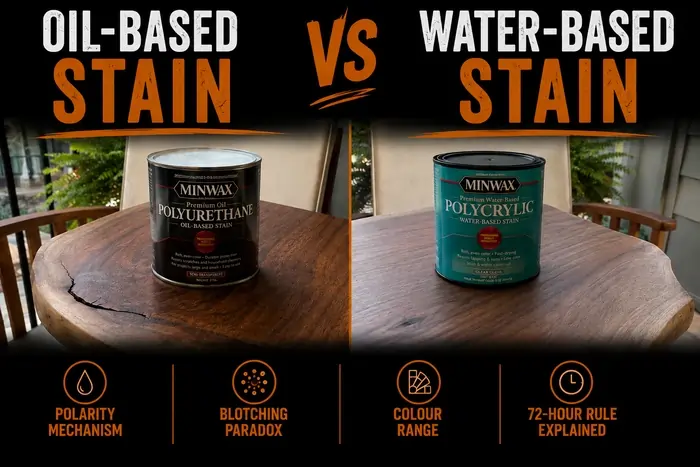
Oil-Based vs Water-Based Stain: Polarity Mechanism, Blotching Paradox, Colour Range, 72-Hour Rule Explained
Oil-based and water-based stains colour wood through the same mechanism — pigment or dye suspended in a carrier that carries it into the wood — but the carrier’s chemistry determines how deeply the colour penetrates, how quickly it dries, how it interacts with different species, and what topcoats can be applied over it. Oil-based stain’s non-polar mineral spirits carrier slips through the wood’s lignin barrier without reacting with cell walls, producing deep penetration and rich colour on open-grain species. Water-based stain’s polar water carrier bonds briefly to wood cell walls, causing grain raising and limiting deep penetration — which paradoxically produces more uniform colour on blotch-prone dense species.
Navigate to your question
→ What is the actual difference in how they work? → Polarity, penetration depth, and grain raising ↓
→ Which is better for blotch-prone species? → The blotching paradox — and where gel stain fits ↓
→ Can I get colours with water-based that I can’t with oil? → Colour range and the saturation ceiling ↓
→ How long before I can apply topcoat over each? → The 72-hour rule explained ↓
→ Which should I use for my project? → Decision matrix by species and use case ↓
This guide is part of the complete wood finishing guide. For the complete application protocol for both types: How to Stain Wood →
⚠ Spontaneous Combustion — Oil-Based Stain Rags
Oil-based stain contains drying oils that generate heat through oxidative curing. Rags saturated with oil-based stain can ignite without external flame. Spread rags flat outdoors until fully dry, or submerge in a sealed metal container filled with water. Water-based stain rags do not carry this risk.
What Is the Actual Difference in How Oil-Based and Water-Based Stain Work?
The difference is polarity. Mineral spirits (the carrier in oil-based stain) is a non-polar solvent. Water is highly polar. Wood’s cell structure contains both polar components (cellulose cell walls, with hydroxyl groups) and non-polar components (lignin, which forms the hydrophobic outer layer of cell walls). This difference drives everything.
The Water-Pop Technique — How to Increase Oil Stain Depth
Water-popping is a technique used specifically with oil-based stain to intentionally pre-swell the wood fibres before staining. Apply clean water to the sanded surface with a clean cloth. Allow to dry completely (1–2 hours). The fibres swell then contract as they dry, leaving the cell structure very slightly more open than in raw unsanded wood.
Oil-based stain applied to a water-popped surface penetrates more deeply and evenly than on non-water-popped wood — producing a richer, more saturated colour with excellent grain contrast. Professional floor stainers routinely water-pop before oil-based stain application on hardwood floors. Not recommended before water-based stain — it causes excessive grain raising in that context.
The full stain type taxonomy goes deeper than oil vs water-based — pigment stain, dye stain, and gel stain are three separate categories with different mechanisms — the complete stain types breakdown and the species-stain compatibility matrix.
Which Is Better for Blotch-Prone Species — and Where Does Gel Stain Fit?
Water-based stain produces more uniform colour on blotch-prone species than oil-based stain — but for a counterintuitive reason: the grain-raising mechanism that is a nuisance on open-grain species actually helps on blotch-prone species by restricting the uneven deep penetration that causes blotching.
On pine, maple, cherry, and birch — where the cellular anatomy varies dramatically between earlywood (fast-absorbing) and latewood (slow-absorbing) — oil-based stain penetrates very deeply into the earlywood zones and barely at all into the dense latewood zones. This differential produces the characteristic dark splotches of blotched wood stain. Water-based stain’s surface-concentrating mechanism reduces this differential — the colour stays near the surface where the absorption variation is less dramatic.
| Species | Oil-Based Pigment | Water-Based Pigment | Dye Stain | Gel Stain |
|---|---|---|---|---|
| Oak, Ash, Walnut | ✅ Excellent | ✅ Good | ✅ Good | ✅ Good |
| Hard Maple, Birch | ❌ Poor — barely colours | ⚠ Moderate | ✅ Best — penetrates cells | ⚠ Moderate (needs ≤150 grit) |
| Pine, Poplar | ❌ Heavy blotching | ⚠ Better — some blotching | ⚠ Better but not ideal | ✅ Best blotch control |
| Cherry | ⚠ Moderate blotching | ⚠ Better — lighter colours | ✅ Good | ✅ Good blotch control |
Where Gel Stain Fits in the Oil vs Water-Based Decision
Gel stain is oil-based stain with thickening agents that prevent deep penetration. Because it sits on the surface through viscosity (rather than being restricted by grain-raising like WB stain), gel stain provides the BEST blotch control of any stain type on pine, poplar, and cherry — better than water-based stain for these species.
Gel stain also carries the same spontaneous combustion risk as standard oil-based stain and requires the same rag disposal precautions. It cannot be topcoated with water-based finish within 72 hours, just like standard oil-based stain.
The blotching paradox and the wipe-off window tradeoff: Water-based stain’s grain-raising mechanism that reduces blotching also shortens the wipe-off window to 2–5 minutes (vs 5–15 minutes for oil-based). On a large surface like a dining tabletop, this shorter window can cause lap marks if you cannot complete the application fast enough. Oil-based stain’s 5–15 minute window is more forgiving on large areas. The choice for blotch-prone species on large surfaces involves weighing the shorter window of water-based stain against the superior blotch control it provides.
Can Water-Based Stain Achieve Colours That Oil-Based Cannot?
Yes — water-based stain can produce true blacks, bright reds, saturated blues, and white-wash effects that oil-based stain cannot replicate. The colour range of oil-based stain is limited to the earth-tone palette: browns, ambers, greys, tans, and limited greens. Water-based stain’s wider colour range is not simply a marketing claim — it is a chemical consequence of the pigment concentration difference between the two systems.
Oil-Based Stain Colour Range
Limited to earth tones: golden oak, dark walnut, ebony (dark brown-black), grey, red oak (amber-red). Difficulty achieving saturated colours because oil-based pigment dispersions become viscous at high concentrations.
Cannot achieve: True black, bright red, saturated blue or green, white-wash, true charcoal.
Water-Based Stain Colour Range
Full spectrum including contemporary colours: true black, white-wash, charcoal, blue-grey, green, red, and the standard earth tones. Acrylic pigment dispersions remain fluid at high concentrations.
Can achieve: Any colour in the standard paint palette, including whites for white-washing and greys for weathered effects.
For any project requiring contemporary or non-traditional stain colours — painted furniture effects, Scandinavian-grey finishes, white-washed oak, charcoal floors — water-based stain is the only practical option. Oil-based stain simply cannot produce these colours regardless of application technique or coat count.
How Long Before You Can Apply Topcoat — and Why Is 72 Hours the Rule for Oil Stain?
The 72-hour rule for water-based topcoat over oil-based stain is not arbitrary — it reflects the off-gassing timeline of mineral spirits from the wood, and violating it produces a permanent white haze in the topcoat.
Why Water-Based Topcoat Over Oil-Based Stain Needs 72 Hours
Mineral spirits is a heavy solvent that evaporates slowly from wood fibres. Even when the stain surface feels and appears completely dry, mineral spirits continues to off-gas from within the wood for 48–72 hours after application. The surface dryness you can feel is only the surface film cure — not the complete evaporation of solvent from the wood structure.
When water-based polyurethane or varnish is applied before 72 hours, the water-based film forms a barrier over the still-off-gassing wood. The trapped mineral spirits vapour pushes through the WB film as it tries to escape, producing a permanent white haze — microscopic bubbles and micro-crazing in the finish that appear as milky cloudiness.
This is permanent and irreversible — it cannot be polished out. The only fix is to sand the topcoat back to the stain and start again, waiting the full 72 hours this time. Always confirm stain dryness with the cloth test: press clean white cloth firmly on the stained surface — zero colour transfer AND zero oily feel = safe to topcoat with water-based finish.
| Stain Type | Oil-Based Topcoat | Water-Based Topcoat | Confirm With |
|---|---|---|---|
| Oil-based stain | 24 hours min | 72 hours min | Cloth test: zero colour transfer + zero oily feel |
| Water-based stain | 4–8 hours | 4–8 hours | Cloth test: zero colour transfer |
| Gel stain (oil-based) | 24–48 hours | 72 hours min | Cloth test: no tacky feel, no colour transfer |
When Should You Use Oil-Based Stain and When Should You Use Water-Based?
The decision is determined by four factors in order: required colour, species type, available application window, and topcoat timeline.
Use Oil-Based Stain When
✅ Rich, deep earth tones on open-grain species — walnut, golden oak, dark mahogany on oak, ash, or walnut. Oil-based stain’s deep penetration produces the dramatic grain-contrast effect that water-based stain cannot match on these species.
✅ Large surfaces where a longer wipe-off window matters — dining tables, floors, long runs of cabinetry. The 5–15 minute window reduces lap mark risk significantly on large areas.
✅ Outdoor wood (deck stain, exterior furniture) — oil-based penetrating stains for exterior use provide deep grain protection and longer maintenance intervals than water-based exterior stains on most species.
✅ Traditional warm-toned furniture — antique pine, oak furniture with amber/honey tones. The amber undertone of oil-based stain enhances these aesthetics; WB stain produces a cooler, flatter result.
Use Water-Based Stain When
✅ Contemporary or non-traditional colours — charcoal, grey, black, white-wash, blue-toned wood, Scandinavian-style pale finishes. Oil-based stain cannot produce these colours.
✅ Light-coloured species where amber shift is undesirable — maple, birch, light ash. Oil-based stain adds amber undertone; WB stain maintains colour clarity without warming.
✅ Same-day project completion required — water-based stain dries in 2–4 hours, allowing topcoat application the same day. Oil-based requires 24–72 hours before topcoat.
✅ Indoor use with low-VOC requirements — nurseries, children’s rooms, enclosed spaces. Water-based stain: 50–150 g/L VOC. Oil-based: 250–450 g/L VOC.
The 85°F Temperature Threshold for Oil-Based Stain
Oil-based stain applied at temperatures above 85°F (29°C) has a significantly shortened effective working window — the mineral spirits evaporates rapidly from the surface, causing the stain to skin before the wood has fully absorbed what it can. The result is shallow penetration, uneven colour, and a tacky surface that may never cure properly. Apply oil-based stain in the morning or evening when temperatures are lower, or in a climate-controlled environment. Water-based stain at high temperatures: already has a 2–5 minute window at normal temperatures — becomes almost unworkable outdoors above 30°C.
After staining, the cure time before topcoat differs significantly between the two stain types — the polyurethane application protocol covering oil-based and water-based stain cure windows covers each combination.
Frequently Asked Questions
Can you apply a second coat of water-based stain over dried oil-based stain?
Not reliably — oil-based stain uses a mineral-spirits binder that may prevent water-based stain from absorbing evenly over it. The WB stain can bead or absorb unevenly over the OB layer. If you want to deepen colour with a second coat: apply the same type of stain as the first coat, or use a gel stain (oil-based) as a colour-deepening second pass over a first oil-based coat. Mixing stain types in sequence typically produces unpredictable results.
Does water-based stain raise the grain?
Yes — water causes wood fibres to swell, raising the grain and producing a rough surface after the first coat dries. Manage this with a pre-wetting protocol: before applying water-based stain, wipe the sanded surface with clean water, allow to dry completely (1–2 hours), then lightly re-sand with 220-grit to knock down the pre-raised grain. When the stain is applied, the grain has already been raised and knocked down — the stained surface dries much smoother than without this preparation.
Is oil-based stain more durable than water-based?
For colour durability (resistance to fading): modern water-based stains with UV inhibitors can match or exceed oil-based stains. For penetration depth (physical permanence in the wood): oil-based stains are more durable because the colour is distributed deeper into the wood structure and cannot be sanded off as easily. For exterior durability: quality exterior-formulated penetrating oil stains typically outlast water-based exterior stains in direct UV/rain exposure, though modern WB formulations have closed this gap significantly.
Can you mix oil-based and water-based stain?
No — oil and water do not mix. Attempting to blend them produces an emulsion that separates and applies unevenly. For colour mixing: mix within the same type (OB + OB, or WB + WB). Many manufacturers offer tinting services — take your colour reference to the store and have the stain tinted to match. Alternatively, dilute the same product to achieve lighter shades, or use multiple thin coats to achieve deeper ones.
Which is better for hardwood floors — oil or water-based stain?
Oil-based stain with water-popping is the professional standard for hardwood floor staining — the water-pop technique maximises colour depth and richness on the long boards. Water-based stain on floors: the short 2–5 minute wipe-off window makes large-area application very challenging and prone to lap marks when working alone. Professional floor staining with WB stain is done by two-person teams to manage the window. For DIY floor staining: oil-based stain’s 5–15 minute window is significantly more forgiving and the depth of colour is typically more satisfying on oak and maple floors.