How Do Wood Finishes Cure? The Four Mechanisms — Evaporative, Oxidative, Coalescence, and Cross-Linking
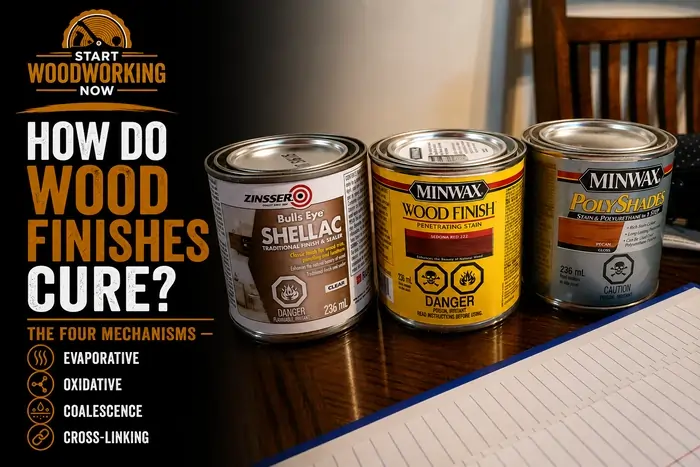
Every property that matters about a wood finish — how durable it is, whether it can be repaired, which topcoats can go over it, how long before furniture can be used — is determined by its cure mechanism. The four mechanisms are evaporative cure, oxidative polymerization, coalescence, and chemical cross-linking. Each produces a fundamentally different type of polymer film with different molecular architecture and different physical behaviour. Understanding them at the mechanism level explains every finish compatibility rule, every recoat window, and every repair approach in one framework.
This article is part of the wood finishing guide — covering finish selection, application, troubleshooting, and the chemistry that explains why finishes behave the way they do.
Navigate to your question
→ Quick overview — what are the four cure mechanisms? → Evaporative, oxidative, coalescence, cross-linking — the framework ↓
→ How does lacquer cure — and why can it be re-dissolved? → Evaporative cure and the re-amalgamation property explained ↓
→ How does oil-based polyurethane cure — what takes 30 days? → Two-stage oxidative cure and why dry-to-touch ≠ fully cured ↓
→ How does water-based polyurethane cure differently? → Coalescence mechanism — why co-solvent is mandatory even in a water-based finish ↓
→ What makes catalyzed finishes harder than single-component ones? → Cross-linking thermoset chemistry and the NCO:OH stoichiometry ↓
→ Why does the cure mechanism determine repairability, compatibility, and durability? → What each cure type means for every finishing decision ↓
Most finishing guides describe curing as “drying” — lacquer “dries fast,” polyurethane “takes longer,” oil finishes “cure slowly.” These are observations about timelines, not explanations of mechanisms.
The mechanisms are what make predictions possible: knowing that lacquer cures by solvent evaporation immediately explains why it can be re-dissolved with fresh lacquer thinner (re-amalgamation), why it can be sprayed over itself 15 minutes later, and why it cannot be applied over a cross-linked thermoset finish.
The Four Cure Mechanisms — A Framework
The four mechanisms differ in whether a chemical reaction occurs during cure, and if so, what type:
| Mechanism | Chemical Reaction? | Trigger | Polymer Type | Finishes |
|---|---|---|---|---|
| Evaporative | No — physical only | Solvent evaporation | Thermoplastic | Lacquer, shellac, some dyes |
| Oxidative | Yes — O₂ radical chain | Atmospheric oxygen | Thermoset (loosely) | Drying oils, OB poly, alkyd varnish |
| Coalescence | No — physical fusion | Water evaporation + co-solvent | Thermoplastic (fused) | Water-based poly, water-based lacquer |
| Cross-linking | Yes — covalent bonds | Catalyst / second component | Thermoset (true) | 2-part poly, conversion varnish, epoxy |
The distinction between thermoplastic and thermoset is the most consequential division in finishing chemistry. Thermoplastic films — produced by evaporative and coalescence curing — can be re-softened by heat or re-dissolved by solvent after cure because no new chemical bonds were formed during the cure process; the polymer chains are held together by physical entanglement, not chemical bonds. Thermoset films — produced by oxidative and cross-linking cure — form new covalent bonds during cure that cannot be broken by solvent or heat without destroying the polymer network itself.
That single distinction determines repairability, stripping method, compatibility with topcoats, and response to heat — for every finish category.
Evaporative Cure — Lacquer and Shellac
Evaporative cure is the simplest mechanism: the finish is a solid polymer dissolved in solvent. When the solvent evaporates, the polymer chains that were held apart in solution come into contact with each other and entangle, forming a solid film. No chemical reaction occurs. The polymer that existed in the can is chemically identical to the polymer in the cured film — the only change is the removal of the solvent that held the chains in solution.
The Molecular Architecture of an Evaporative Film
Nitrocellulose lacquer consists of nitrocellulose polymer chains dissolved in a blend of ketone and ester solvents. Each polymer chain has a molecular weight of 50,000–500,000 daltons. In solution, the chains are separated by solvent molecules. As solvent evaporates, chain concentration increases until the chains are forced into physical contact. Above a critical concentration, the chains interpenetrate and entangle — this is the “dry” state. The film has mechanical strength because the chains are too large and too entangled to separate under normal mechanical stress.
No new bonds are formed. The polymer chains are the same chains that existed in the liquid finish. This is why evaporative films are called thermoplastic: heating the film above the glass transition temperature (Tg) gives the chains enough thermal energy to disentangle and flow again. Applying fresh solvent re-dissolves the film by re-separating the chains into solution — this is the chemical basis of lacquer re-amalgamation.
Re-Amalgamation — The Property That Defines Lacquer
Re-amalgamation is the ability of a fresh coat of lacquer to partially dissolve the surface of the previous coat and fuse the two coats into a single continuous film. This occurs because fresh lacquer thinner re-dissolves the surface layer of the cured film, allowing the new polymer chains from the wet coat to intermingle with the chains from the cured coat. When the solvent from the new coat evaporates, both layers cure as a single entangled polymer mass with no interface boundary between them.
The practical consequences are significant: inter-coat adhesion for lacquer is mechanically superior to inter-coat adhesion achieved by sanding and mechanical adhesion alone, because the coats become one film rather than two films bonded at a surface. Re-amalgamation also explains why lacquer can be sprayed in rapid succession (15–20 minute recoats) without sanding between every coat — and why a scratch or dent in a lacquer film can be dissolved, reflowed, and re-cured with fresh lacquer if caught early. The full comparison of re-amalgamation properties between shellac and lacquer — both evaporative finishes — is in the shellac vs lacquer guide covering repair and compatibility chemistry.
Why Evaporative Films Cannot Go Under Cross-Linked Finishes
The reverse application — applying a cross-linked thermoset finish (catalyzed lacquer, 2-part poly) over an evaporative film — creates a compatibility failure. Cross-linking reactions generate heat and chemical stress at the interface. More critically, the solvents in some thermoset topcoats can partially dissolve the evaporative film beneath, causing wrinkling, crazing, or delamination.
The evaporative film has no chemical bonds to resist solvent attack — its integrity depends entirely on the solvent in the topcoat not re-dissolving it before the topcoat cures. This is the mechanism behind the finish compatibility rules in the polyurethane vs lacquer comparison covering the strip-to-bare-wood requirement for mixed schedules.
Oxidative Polymerization — Drying Oils and Oil-Based Polyurethane
Oxidative cure is a true chemical reaction: atmospheric oxygen reacts with unsaturated carbon-carbon double bonds in drying oil molecules, generating free radicals that initiate chain-growth polymerization. The result is a crosslinked polymer network — new covalent bonds formed during cure connect the oil molecules into a three-dimensional structure that cannot be re-dissolved by the original solvent.
The Free Radical Chain Reaction
Drying oils — linseed, tung, and the oil components of alkyd varnish and oil-based polyurethane — contain unsaturated fatty acids with carbon-carbon double bonds (C=C). Atmospheric oxygen attacks these double bonds through a radical chain mechanism:
Initiation: Oxygen reacts with a double bond to form a peroxide radical (R-OO•). Metallic driers — cobalt, manganese — catalyse this initiation step, accelerating the reaction rate and shortening the cure time. This is why BLO cures faster than raw linseed oil and why the metallic driers are added.
Propagation: The peroxide radical abstracts a hydrogen from an adjacent double bond, forming a new radical and a hydroperoxide. The new radical attacks another double bond, continuing the chain. Each propagation step extends the crosslinked network.
Termination: Two radicals combine, forming a stable covalent bond between two polymer chains. Termination reactions build the crosslink density of the network — higher crosslink density produces a harder, more solvent-resistant film.
This entire reaction is exothermic — it releases heat. On a wood surface, this heat dissipates harmlessly. In a folded rag, it drives thermal runaway. The spontaneous combustion mechanism covered in the safety cluster is the same oxidative polymerization reaction operating without adequate heat dissipation.
Two-Stage Cure of Oil-Based Polyurethane
Oil-based polyurethane cures through two sequential stages that most finishing guides conflate into a single “drying” process:
Stage 1 — Solvent evaporation (hours 1–24): Mineral spirits or naphtha evaporates from the wet film. The film becomes tack-free and can be walked on or lightly handled. This is “dry to touch” — but it is not “cured.” The alkyd oil component has not yet polymerized significantly.
Stage 2 — Oxidative polymerization (days 1–30): The alkyd resin and oil components react with atmospheric oxygen, forming crosslinks that progressively harden and densify the film. Full hardness — the state at which the film has maximum scratch resistance, chemical resistance, and adhesion — is reached at approximately 30 days. At 7 days, OB poly is hard enough for normal use but still softer and more solvent-sensitive than it will be at 30 days.
The practical significance: sanding or topcoating OB poly before Stage 2 is sufficiently advanced risks scratching a film that is softer than its final state, and applying a second coat before adequate Stage 2 progress traps solvent beneath the new coat, causing fisheye or wrinkling.
The full recoat timing and the cure window for OB poly is covered in the polyurethane application guide covering recoat windows for both oil-based and water-based formulations. Alkyd varnish cures by the same oxidative mechanism and follows the same recoat-window logic — its application specifics are in the varnish application guide.
Why Oxidative Films Resist Solvent After Cure
Unlike evaporative films, oxidatively cured films form new covalent bonds during cure that connect the polymer chains into a three-dimensional network. Solvent molecules that enter this network can swell it — stretching the covalent bonds — but cannot dissolve it because the bonds cannot be broken by solvent alone. This is why fully cured OB poly cannot be re-dissolved by mineral spirits (the original solvent) but can be stripped by strong solvents like methylene chloride or acetone, which can break hydrogen bonds and swell the network enough to lift it physically from the substrate.
When an oil finish fails to cure and remains tacky, the cause is disruption of the oxidative chain reaction — either by oxygen starvation (thick coat), surface contamination, or oily species terpenes — as detailed in the oil finish not drying guide covering the failure mechanisms and rescue protocol.
Coalescence — Water-Based Finishes
Water-based polyurethane and water-based lacquer cure by a mechanism called coalescence — fundamentally different from both evaporative cure and oxidative polymerization, and widely misunderstood because of the misleading “water-based” label.
What a Water-Based Finish Actually Contains
A water-based finish is not a water solution of polymer — it is an emulsion: solid polymer particles dispersed in water. The polymer particles (typically 0.1–1.0 microns in diameter) are suspended in the aqueous carrier by surfactants that keep them from coalescing prematurely. The finish is liquid in the can not because the polymer is dissolved but because the polymer particles are dispersed.
The Coalescence Mechanism
When applied to a surface, the water begins to evaporate. As water content decreases, the polymer particles are forced progressively closer together. When particle spacing decreases below a critical threshold, the surfactant layer separating the particles is no longer sufficient to prevent contact. The particles begin to deform and flow into each other — this is coalescence.
For complete coalescence to occur — forming a continuous, void-free film rather than a collection of fused but imperfectly merged particles — the polymer particles must be above their Minimum Film Formation Temperature (MFFT).
Below the MFFT, the polymer is too rigid to flow and fuse; the result is a powdery, non-continuous film with poor adhesion. This is why water-based finishes cannot be applied below their minimum temperature rating (typically 10–15°C for most products).
Why Co-Solvents Are Mandatory — Not Optional
Co-solvents — glycol ethers including 2-butoxyethanol and propylene glycol n-butyl ether — are added to water-based finishes specifically to ensure coalescence occurs even at the lower end of the application temperature range.
Co-solvents partition into the polymer particles, temporarily plasticizing them — lowering the effective MFFT so the particles can deform and fuse at room temperature. As the co-solvent evaporates (more slowly than water), the polymer returns to its full rigidity after coalescence is complete.
This is why zero-VOC water-based finishes that eliminate glycol ether co-solvents require careful application temperature management — without co-solvent plasticization, the MFFT is higher and the coalescence window is narrower. It also explains why water-based finishes that have been frozen and thawed fail: the freeze-thaw cycle destabilizes the emulsion and causes premature coalescence in the can, producing a lumpy product that cannot form a continuous film.
The coalesced film produced by a water-based finish is technically thermoplastic — the polymer chains are entangled but not covalently bonded.
However, the coalescence process produces a denser, more uniform film than simple evaporative cure of the same polymer, because the particle-fusion mechanism eliminates most of the voids that would otherwise exist between polymer chains precipitating from solution.
Chemical Cross-Linking — Catalyzed and Two-Part Finishes
Cross-linking cure produces the hardest, most chemically resistant films available to woodworkers — but at the cost of pot life, application complexity, and in some cases, significant health hazard. The mechanism is a direct chemical reaction between two reactive components that forms permanent covalent bonds connecting polymer chains into a dense three-dimensional network.
Two-Part Polyurethane — The NCO:OH Reaction
Two-part polyurethane finishes consist of two separately stored components: a hydroxyl-functional polyol resin (the “A side”) and an isocyanate crosslinker (the “B side”). When combined, isocyanate groups (−NCO) react with hydroxyl groups (−OH) to form urethane linkages (−NH−COO−). Each urethane linkage is a new covalent bond connecting two polymer chains.
The stoichiometry of this reaction — the NCO:OH ratio — directly determines the final film properties. At a ratio of 1:1, every isocyanate reacts with exactly one hydroxyl, producing a fully crosslinked network with optimal flexibility and hardness balance. At ratios above 1:1 (excess isocyanate), additional crosslinks form through isocyanate self-reaction, producing a harder but more brittle film.
At ratios below 1:1 (insufficient crosslinker), unreacted hydroxyls remain in the film, producing a softer, less chemically resistant result. Professional two-part finishes specify the exact mixing ratio by volume or weight to achieve the designed NCO:OH ratio — deviation from this ratio changes the final film properties predictably and irreversibly.
The pot life of a two-part finish — the working time after mixing before viscosity increase makes application impractical — is determined by how quickly the NCO:OH reaction proceeds at ambient temperature. Catalysts accelerate the reaction, reducing pot life. Lower temperature extends pot life; higher temperature shortens it. Once mixed, the reaction cannot be stopped — the finish must be applied and will cure regardless of whether it has been applied to a surface.
Conversion Varnish — Acid-Catalyzed Cross-Linking
Conversion varnish uses an acid catalyst to trigger crosslinking of an alkyd-amino resin system. The catalyst (typically para-toluenesulfonic acid) is added as a small-percentage addition to the base varnish, protonating reactive sites on the amino resin that then react with the alkyd to form methylene bridge crosslinks. The result is a thermoset film with hardness and chemical resistance that exceeds single-component finishes — passing KCMA (Kitchen Cabinet Manufacturers Association) alkali resistance and edge-soak tests that standard lacquer fails.
Conversion varnish’s acid catalyst creates a different pot life dynamic than isocyanate-based finishes: the catalyzed varnish remains usable for 8–72 hours depending on formulation and temperature, making it more forgiving than two-part polyurethane for production workflows. After the pot life expires, the partially crosslinked varnish must be discarded.
Why the Cure Mechanism Determines Every Important Finish Property
With the four mechanisms established, the practical implications resolve into a consistent framework. Every rule that seems arbitrary in finishing guides has a mechanism-level explanation.
Repairability — Thermoplastic vs Thermoset
Thermoplastic films (evaporative, coalescence) can be locally repaired because solvent can re-dissolve or soften the film boundary around a scratch, allowing new material to fuse with the existing film. Thermoset films (oxidative, cross-linking) cannot be re-dissolved — repairs require either abrading back to bare wood or bridging the damage with material that bonds mechanically to the cured surface. This is why a lacquer scratch can often be spot-repaired invisibly while a polyurethane scratch requires more extensive intervention — the chemistry of what’s possible with each is completely different.
Topcoat Compatibility — Chemical Attack Risk
Applying a new finish over an existing one requires that the topcoat’s solvent does not attack the underlying film. Thermoset films (OB poly, conversion varnish, cured 2-part) resist solvent attack because covalent crosslinks prevent dissolution — almost any topcoat can go over them. Thermoplastic films (lacquer, shellac) are vulnerable to solvent from topcoats — and thermoset topcoats with reactive solvents can wrinkle or lift them. The practical rules that emerge: apply lacquer over lacquer freely; apply anything over fully cured thermosets; never apply a reactive thermoset over an uncured or incompatible thermoplastic without testing.
Durability — Crosslink Density
Hardness and chemical resistance in a cured film correlate with crosslink density — the number of covalent bonds per unit volume connecting polymer chains. True cross-linked thermosets (2-part poly, conversion varnish) have the highest crosslink density and the highest Taber abrasion resistance. Oxidatively cured films have intermediate crosslink density. Thermoplastic films have none — their hardness depends entirely on polymer chain entanglement and molecular weight, which is why lacquer films are significantly softer than catalyzed finishes at equal film thickness. Glass transition temperature (Tg) — the temperature above which a thermoplastic film softens and flows — is a direct measure of entanglement density; higher Tg correlates with greater resistance to heat marking.
Yellowing — Mechanism-Specific Chemistry
Oxidatively cured films yellow for a different reason than thermoplastic films. Oil-based polyurethane yellows because the alkyd oil component generates chromophore compounds (aldehydes, ketones) during and after oxidative cure — BHT (butylated hydroxytoluene), a UV stabiliser present in OB poly, reacts with NOx from combustion gases to produce yellow quinone compounds. This is why OB poly yellows faster near gas ranges. NC lacquer yellows because the nitrocellulose backbone generates nitric acid on extended UV exposure, which produces yellow chromophores in the film. Water-based polyurethane formulated with aliphatic polyurethane (as opposed to aromatic) has no chromophore-forming pathway and does not yellow — the mechanism is absent, not merely suppressed.
The yellowing mechanism for each finish type — and the practical solutions — are covered in depth in the core troubleshooting content. For the polyurethane-specific BHT-NOx mechanism and the aliphatic alternative, see the polyurethane yellowing guide covering the NOx mechanism and white cabinet solutions. For the broader finish chemistry comparison that the cure mechanisms underpin, see the lacquer guide covering NC vs CAB-Acrylic vs catalyzed formulations and their solvent differences.
Where Each Mechanism Leads
The three mechanisms above explain how a film hardens. What follows from them is covered separately:
- Oxidative polymerisation in detail — the reaction itself, and why it releases heat.
- Film-forming versus penetrating finishes — whether the cured result sits on the wood or in it.
- Reversible versus irreversible cures — which finishes can be re-dissolved and repaired invisibly.
- Why finishes amber over time — the same oxidation that hardens an oil also colours it.
- How sheen is set during cure — appearance locked in while the film is still levelling.
- Tannin bleed through a curing film — migration that happens before the film closes.
Frequently Asked Questions
Why can I recoat lacquer after 15 minutes but need to wait 24 hours between polyurethane coats?
Lacquer cures by evaporation — once the fast-evaporating ketone solvents leave, the surface is ready to accept another coat, and the fresh coat re-amalgamates with the previous one. Oil-based polyurethane needs time for Stage 2 oxidative crosslinking to advance sufficiently before the surface can mechanically support sanding and re-coating without lifting or fish-eye. Water-based poly needs the co-solvent to evaporate and coalescence to complete — typically 2–4 hours at room temperature.
Can I apply water-based polyurethane over oil-based polyurethane?
Yes — once the OB poly is fully cured (30 days, or at minimum 72 hours and hard to the nail test). Fully cured OB poly is a thermoset film that resists solvent attack from the water-based topcoat’s co-solvents. The adhesion is mechanical rather than chemical fusion. Sand the OB poly lightly with 220-grit before applying WB topcoat to provide mechanical keying. The reverse — OB poly over WB poly — is riskier because mineral spirits in OB poly can penetrate the coalesced WB film and cause adhesion failure on softer WB formulations.
Why does oil finish sometimes stay tacky permanently?
Oxidative polymerization requires continuous atmospheric oxygen contact with the unsaturated fatty acid double bonds in the oil. Applying the finish too thickly creates a skin on the surface that cures while the oil beneath is oxygen-starved and cannot polymerize — the result is a permanently soft underlayer beneath a skinned surface. The same mechanism operates on species with terpene-rich extractives (teak, rosewood, cocobolo) that inhibit the radical chain reaction. The rescue protocol — mineral spirits removal and restart — and the full failure mode analysis are in the oil finish not drying guide. The same oxygen-starvation trap also happens from recoating too soon rather than too thick — see why you can’t recoat an oil finish too soon and fully cured vs dry to touch for the timeline distinction that prevents it.
Is a coalesced water-based finish as durable as a cross-linked thermoset?
No — but the gap is smaller than it used to be. Coalesced WB polyurethane is thermoplastic: it can be softened by strong solvents and heat above its Tg. Cross-linked thermosets (2-part poly, conversion varnish) are chemically resistant to solvents that would mar or dissolve WB films. For kitchen cabinetry subject to grease, cleaning chemicals, and heat, conversion varnish or 2-part poly outperform WB poly. For residential floor finishing and furniture with normal use, modern WB poly formulations achieve Taber abrasion values comparable to OB poly and significantly better than NC lacquer.