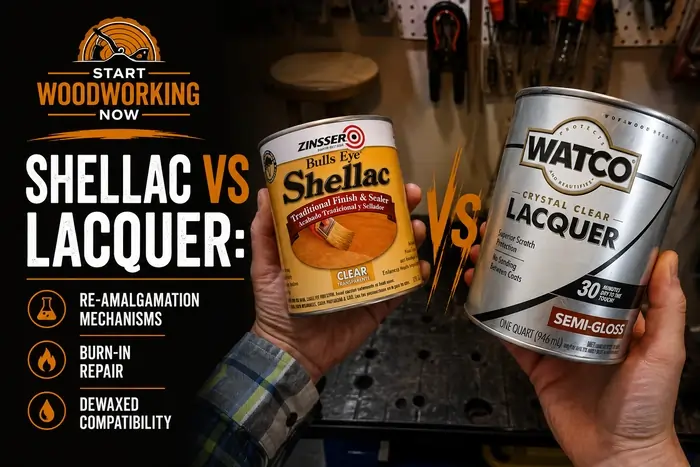
Shellac vs Lacquer: Re-Amalgamation Mechanisms, Burn-In Repair, Dewaxed Compatibility
Shellac and NC lacquer are both thermoplastic film finishes that dry by solvent evaporation rather than chemical cross-linking — which means both can be re-dissolved by their own solvents and both can be repaired without sanding through to bare wood. This shared characteristic is where the similarity ends. The solvent for shellac is denatured alcohol, which evaporates slowly enough to allow brush application and produces a finish with exceptional antique-compatible repairability. The solvent for NC lacquer is lacquer thinner, which evaporates so rapidly that brush application is impractical on large surfaces, requiring spray equipment — but producing a harder, more chemically resistant film.
This guide is part of the complete wood finishing guide. For application protocols: How to Apply Shellac → and How to Apply Lacquer →
Navigate to your question
→ What is the actual chemistry difference? → Re-amalgamation, solvents, and why shellac brushes while lacquer sprays ↓
→ Which is easier to repair — and how does each repair work? → Burn-in repair (shellac only) vs lacquer re-amalgamation ↓
→ Can I apply lacquer over shellac? → The dewaxed rule — why waxed shellac causes delamination ↓
→ Which stays clearest on light-coloured wood? → Colour clarity matrix and yellowing timelines ↓
→ When should I choose one over the other? → Decision matrix by project type, use case, and application method ↓
⚠ Flammability — Shellac Solvent
Shellac is dissolved in denatured alcohol — highly flammable (flash point ~13°C). Apply away from open flames, pilot lights, and sparks. Allow full solvent evaporation before ignition sources. Store sealed containers away from heat. NC lacquer and lacquer thinner are similarly flammable — same precautions apply.
What Is the Core Chemistry Difference Between Shellac and NC Lacquer?
Both finishes dry by solvent evaporation — the polymer chains do not cross-link as polyurethane does. This is called a thermoplastic cure. The dried film can be re-dissolved by the same solvent used to apply it, which enables re-amalgamation repairs. What differs fundamentally is the solvent chemistry and polymer structure.
Why Shellac Can Be Brushed and Lacquer Typically Cannot
The open time of a finish — how long the wet film remains workable before it begins to set — is determined by solvent evaporation rate. Denatured alcohol evaporates significantly more slowly than standard lacquer thinner. On a 60×60cm panel, shellac remains workable for 2–3 minutes after application, allowing brush strokes to be blended and surface irregularities to level.
NC lacquer’s solvent flashes off in 30–60 seconds at room temperature. A brush stroke applied to one end of a panel has already begun to set by the time the brush reaches the other end. Attempting to re-work or blend partially set lacquer creates drag marks that worsen rather than improve the surface. Adding lacquer retarder (a slow-evaporating ester) extends the open time to 2–3 minutes and makes brush application viable — but this is a modification from standard practice.
NC Lacquer Blush in Humidity — Why Shellac Doesn’t Have This Problem
When NC lacquer is sprayed in humid conditions (above 70% relative humidity), the rapid solvent evaporation cools the surface of the wet film below the local dew point. Microscopic condensation droplets form within the film as it sets — these droplets scatter light and produce a permanent white haze called blush. Shellac does not blush because denatured alcohol evaporates more slowly (no rapid surface cooling) and ethanol is hygroscopic — it absorbs rather than repels atmospheric moisture, preventing condensation formation in the film. In high-humidity spray environments: shellac is safer than NC lacquer. NC lacquer blush is fixed by spraying a light coat of lacquer retarder over the blushed area while still slightly warm.
Which Is Easier to Repair — Shellac or NC Lacquer?
Both finishes can be re-amalgamation repaired — a fresh coat of the same finish partially dissolves the surface of the old coat, fusing the two layers into a single continuous film. Shellac has an additional repair technique unavailable with NC lacquer: burn-in repair, which allows deep chips and scratches to be filled invisibly without sanding or refinishing the surrounding surface.
Lacquer’s repairability through re-amalgamation makes dent and scratch repair on production furniture different from polyurethane — the full scratch repair protocol that uses the same re-amalgamation principle for polyurethane surfaces.
Shellac — Two Repair Methods
Method 1: Re-amalgamation
Apply a fresh coat of shellac (same or lower pound cut) over the damaged area. The denatured alcohol in the fresh coat dissolves the surface of the existing dried film. Both layers fuse into a single continuous film as the solvent evaporates. Surface scratches and shallow damage are eliminated. No sanding required.
Method 2: Burn-In Repair (unique to shellac)
A colour-matched burn-in stick (solid shellac in a range of wood tones) is melted with a heated burn-in knife directly into a chip, gouge, or deep scratch. The molten shellac flows into the defect cavity, fuses with the surrounding shellac film, and levels as it cools. When flush, the repair is virtually invisible. This technique is impossible with NC lacquer — NC lacquer chars and bubbles when melted rather than flowing cleanly into defects.
NC Lacquer — One Repair Method
Re-amalgamation (spray only)
Spray a light coat of fresh lacquer over the damaged area. The lacquer thinner partially dissolves the old film surface, fusing the layers. Surface scratches and moderate damage are eliminated. Works best when sprayed — brush application on aged lacquer risks lifting and peeling because the old film absorbs the aggressive solvent unevenly.
Deep repairs require sanding
For chips and deep gouges in NC lacquer: fill with lacquer-compatible filler (not shellac burn-in stick), sand flat, spot-spray to blend. The repair is more visible than shellac burn-in repair because the filler and the surrounding lacquer film have different refractive indices until multiple topcoats are built up over the repair.
In antique furniture restoration, the burn-in repair technique is why shellac remains the professional preference for period pieces over any other finish. A correctly executed shellac burn-in repair on an 18th-century piece is indistinguishable from the surrounding original finish under both normal and raking light. The same repair on a NC lacquered surface requires significantly more work to achieve equivalent invisibility.
Can You Apply NC Lacquer Over Shellac — and Why Does Waxed vs Dewaxed Matter?
Yes — but only over dewaxed shellac. Applying NC lacquer over waxed shellac causes delamination, fisheye craters, or both. The mechanism: unprocessed shellac contains 3–5% natural wax from the lac secretion process. As the shellac film dries, these wax molecules migrate to the surface of the film, forming a microscopically thin wax layer. NC lacquer has no adhesion to wax — the lacquer film sits on the wax layer rather than bonding to the shellac resin, and eventually peels or craters.
❌ Waxed Shellac Under Lacquer
Waxed shellac (premixed cans with no “dewaxed” label, orange shellac flakes not processed to remove wax) contains natural wax that surfaces on the dried film.
NC lacquer over waxed shellac: delamination over time, fisheye craters on application (wax repels lacquer at microscopic level), or both. NOT compatible.
✅ Dewaxed Shellac Under Lacquer
Dewaxed shellac (Zinsser SealCoat, dewaxed blonde flakes, or any product labelled “dewaxed”) has had the wax removed. The dried film presents clean resin surface.
NC lacquer bonds well to dewaxed shellac resin. This combination is a classic professional sealer system — dewaxed shellac seals resin bleed from oily species and tannin bleed from walnut/oak, while lacquer provides the hard topcoat.
The Professional Dewaxed Shellac Sealer System
On oily tropical species (teak, rosewood, cocobolo) and high-tannin domestic species (walnut, cherry, oak), resin and tannin bleed-through can prevent topcoat adhesion or produce discolouration in the finish. Dewaxed shellac applied as a sealer coat (1 lb cut, one thin coat, 45 minutes dry) seals these compounds beneath a resin film that accepts NC lacquer topcoats without adhesion failure.
Zinsser SealCoat (dewaxed shellac, 2 lb cut, ready-mixed) is the standard product for this use. Dilute 1:1 with denatured alcohol for the sealer application, apply one coat, allow 1 hour dry time, light 320-grit scuff, then topcoat with NC lacquer. This sequence resolves adhesion and bleed-through failures that no other sealer system addresses as cleanly.
Which Stays Clearest on Light-Coloured Wood — Shellac or Lacquer?
Neither orange shellac nor NC lacquer is the clearest option for light species. The complete colour clarity ranking from clearest to most amber, including common alternatives, helps select the right finish where colour neutrality matters.
| Finish | Day-One Tint | Long-Term Shift | On Maple/Birch |
|---|---|---|---|
| CAB-Acrylic Lacquer | Water-white (clearest) | Negligible | Best choice |
| Water-Based Polyurethane | Water-white | Negligible | Excellent — brush application |
| NC Lacquer (new) | Slight warm tint | Progressive amber (NC oxidation) | Acceptable when new, yellows |
| Dewaxed Shellac (blonde) | Warm amber — slight | Minimal additional shift | Warms light species — may be desired |
| Orange Shellac | Strong amber | Stable at amber level | Significantly yellows light species |
| Oil-Based Polyurethane | Amber from day one (alkyd) | Progressive yellowing (quinones) | Avoid on maple/birch |
NC lacquer yellows progressively over years through nitrocellulose oxidation — a different mechanism from OB polyurethane but producing a similar result on light species. For truly non-yellowing, non-ambering results on maple, birch, or white-painted surfaces: CAB-acrylic lacquer (cellulose acetate butyrate — acrylate modified) or water-based polyurethane are the correct choices. Neither shellac type nor NC lacquer achieves water-white neutrality. For details on why polyurethane yellows and the aliphatic alternative →
How Alcohol-Sensitive Is Shellac — What Are the Real Risk Thresholds?
“Shellac is sensitive to alcohol” is stated universally without the threshold that determines whether this sensitivity is practically relevant. The reality: shellac’s alcohol sensitivity is proportional to the alcohol concentration and contact duration. Most incidental spill contact causes no permanent damage if wiped up promptly.
| Substance | ABV / Concentration | Risk to Shellac | Practical implication |
|---|---|---|---|
| Denatured alcohol | 95–100% | Immediate dissolution | This is the shellac solvent — instant damage |
| Isopropyl alcohol 70% | 70% | Damage within 30 seconds | Never use as a cleaner on shellac surfaces |
| Spirits / whisky | 40% ABV | White ring after >2 min contact | Wipe spills within 1 minute — no permanent damage if wiped promptly |
| Wine | 12–15% ABV | Minimal — possible white ring after extended contact (>10 min) | Wipe up — brief contact causes no damage |
| Beer | 4–6% ABV | Negligible | No practical risk from brief beer spill |
When Should You Choose Shellac and When Should You Choose NC Lacquer?
Choose Shellac When
✅ Antique and period furniture restoration — original shellac finish must be matched; burn-in repair technique required for deep damage
✅ No spray equipment available — shellac is the only professional film finish that can be brushed without retarder on large surfaces
✅ Sealing resin-bleeding or tannin-rich species before any topcoat — dewaxed shellac is the universal adhesion sealer
✅ Musical instruments — classical guitar bodies, violins; shellac is the traditional and tonally preferred finish
✅ High-humidity application environment — shellac does not blush; NC lacquer does above 70% RH
Choose NC Lacquer When
✅ Production cabinet and furniture work with spray equipment — NC lacquer’s rapid flash-off allows 3 coats in a single day; shellac requires longer intervals between coats
✅ Surfaces exposed to moderate alcohol contact — NC lacquer resists 40% ABV spirits without the white-ring risk that shellac carries
✅ Higher durability required — NC lacquer’s Taber abrasion resistance (100–200 cycles) exceeds shellac (~50 cycles)
✅ Clear finish over CAB-acrylic for non-yellowing — CAB-acrylic lacquer (a lacquer variant) is the correct choice where NC lacquer yellowing is unacceptable
Both are thermoplastic and easy to repair, but neither is very durable. To see how they stack up against a hard film finish, compare any pair in the finish comparison tool.
Frequently Asked Questions
Can shellac be applied over lacquer?
Yes, with a compatibility test first. Shellac’s denatured alcohol solvent can soften some lacquer formulations on contact — apply a drop of denatured alcohol to an inconspicuous area of the cured lacquer, wait 30 seconds, and wipe. If the lacquer softens or lifts, shellac should not be applied over it. If unaffected, shellac can be applied as a repair coat or a finish layer. Note: shellac over lacquer limits future topcoat options — applying lacquer over shellac again requires using dewaxed shellac, and if the shellac applied over the lacquer was waxed, further lacquer coats will delaminate.
Lacquer applied over polyurethane causes irreversible failure — the full polyurethane-vs-lacquer compatibility logic for finish schedules and the strip-to-bare-wood requirement.
Which dries faster — shellac or lacquer?
NC lacquer is touch-dry within 5–10 minutes and ready for a second coat in 30–60 minutes at room temperature. Shellac is touch-dry in 15–30 minutes and ready for a second coat in 45–60 minutes. In production terms, NC lacquer’s faster flash-off makes multi-coat builds significantly faster over a full day — 5–6 lacquer coats in a day is achievable with spray equipment. The practical difference on a single-coat application is minimal.
Is shellac food-safe when cured?
Yes — cured shellac is FDA-approved for food contact. It is used as a coating for pills, supplements, and confectionery (including the glaze on Skittles). The food-safety applies after the denatured alcohol solvent has fully evaporated (minimum 24 hours at room temperature, 48 hours for full cure). Uncured shellac contains denatured alcohol which is not food-safe. NC lacquer is not food-safe and should not be used on surfaces in direct food contact.
How long does pre-mixed shellac last — and how do I know if it has expired?
Pre-mixed shellac in cans has a shelf life of approximately 1–3 years from the mixing date (not the purchase date). The Julian date on the bottom of Zinsser cans indicates the mixing date — day 001 to 365 followed by the year. Expired shellac does not dry properly — it remains tacky or soft indefinitely regardless of application conditions. Test before using a can from storage: apply a thin coat to a scrap piece of wood; if not fully hard and dry within 4 hours, discard the solution and mix fresh from flakes. Shellac flakes in dry, sealed storage last indefinitely.
Can you use shellac and lacquer on the same piece?
Yes — the dewaxed shellac sealer + NC lacquer topcoat system is a standard professional combination. Apply one coat of dewaxed shellac (1 lb cut) to seal the wood, allow 1 hour, scuff with 320-grit, then apply NC lacquer topcoats. The shellac seals tannin and resin bleed; the lacquer provides the harder, more chemically resistant finish surface. Do not reverse this order (lacquer sealer + shellac topcoat) unless you have confirmed compatibility with a solvent test — lacquer thinner in the sealer may interact poorly with shellac applied on top.