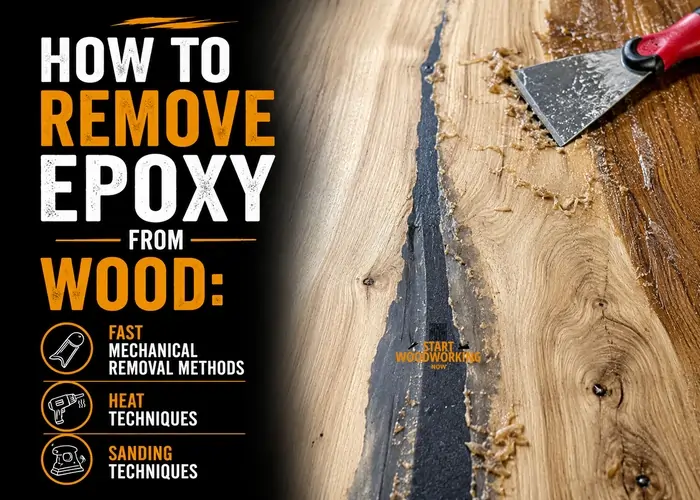
How to Remove Epoxy from Wood: Mechanical Removal Methods, Heat & Sanding Techniques
Removing epoxy from wood is fundamentally different from removing any other wood finish. Once epoxy fully cures, it becomes a thermoset polymer with an irreversible cross-linked structure, meaning it cannot be softened or dissolved using standard woodworking solvents such as acetone, lacquer thinner, or commercial paint strippers.
This single property changes the entire removal strategy: epoxy removal is not a chemical process first, but a mechanical one. Success depends on controlling abrasion, heat, and material thickness rather than selecting a solvent.
Before choosing a removal method, the most important factor is identifying the physical context of the epoxy:
- Thin seal coats (surface-level epoxy)
- Thick river pours or structural fills
- Epoxy that has penetrated wood grain or veneer layers
- Epoxy floors or industrial coatings
Each category behaves differently under heat and mechanical stress, and each has a different level of risk to the underlying wood surface.
In practical terms, epoxy removal is not defined by “what removes it,” but by three controlling variables:thickness of epoxy, type of wood substrate, and depth of penetration into the grain.
These factors determine whether the epoxy can be removed cleanly, whether sanding into the wood is unavoidable, or whether full restoration of the original surface is realistically possible.
How Do You Remove Epoxy from Wood?
- Confirm the epoxy type and thickness before choosing any method. Measure thickness at an edge, corner, or damage point. Under 2mm (thin seal coat or flood coat): heat gun + orbital sander at 40–60 grit is the primary method. 2–10mm (medium pour, partial fill): carbide scraper + belt sander 24–36 grit. Over 10mm (thick river pour, full fill, floor coating): grinder with carbide or diamond disc — power tool removal only. Thin coats can be removed with wood largely intact. Thick pours cannot be removed without significant sanding of the wood surface afterward.
- For uncured or partially cured epoxy — completely different protocol. If the epoxy is still tacky, soft, or rubbery (applied within the last 24–72 hours or mixed at wrong ratio), it is not yet thermoset. Remove immediately with acetone or isopropyl alcohol before full cure — these solvents swell and soften uncured epoxy chains before cross-linking is complete. Wipe with acetone-soaked cloth, work in sections, replace cloth frequently. Do not allow uncured epoxy to cure on the wood surface — removal becomes exponentially harder once thermoset. Test for cure state: press a thumbnail firmly — if it leaves an impression, the epoxy is still curing. If rock hard with zero impression: fully cured, proceed to mechanical methods.
- For thin seal coats (under 2mm) — heat gun + orbital sander protocol. Set heat gun to 90–120°C (below the flash point of epoxy, above the glass transition temperature Tg of most casting resins). Hold 5–8cm from surface, move continuously in small circles — do not hold stationary. When the surface softens slightly (typically 30–45 seconds per area), immediately work with a carbide scraper at a 20° angle to peel sections. Follow immediately with an orbital sander at 40 grit. The combination of heat-reduced brittleness and mechanical abrasion removes thin epoxy efficiently without gouging the wood.
- For thick pours (over 2mm) — mechanical removal only. No heat gun on thick epoxy sections — the thermal mass prevents reaching Tg uniformly and the risk of scorching the wood beneath is high. Use a belt sander with 24–36 grit belt for flat sections, a carbide-tipped scraper for edges and detail areas. Work in passes along the grain. Expect to see epoxy clog abrasives every 3–5 minutes — replace belts/discs when clogging begins. The goal of the first mechanical phase is gross removal to within 1–2mm of the wood surface. Final approach: orbital sander 40 → 60 → 80 → 120 grit to remove residual epoxy from grain without cutting into wood.
- Safety protocol during all mechanical epoxy removal: mandatory. Epoxy dust is a sensitizer — repeated exposure without respiratory protection causes progressive allergic sensitization that can become permanent and disabling. N95 minimum, P100/FFP3 respirator recommended for extended work. Safety glasses (not goggles alone). Nitrile gloves throughout — avoid skin contact with epoxy dust. HEPA vacuum dust collection at the sander. Do not sand epoxy without dust collection — the particles are too fine for standard shop vacuums and settle on all workshop surfaces.
- Post-removal wood preparation — confirm all epoxy removed from grain. Epoxy fills wood grain even after mechanical removal — residual epoxy in pores prevents new finish penetration and adhesion. Raking light test: hold a lamp at 5–10° to the surface. Remaining epoxy in grain appears as a faint sheen or gloss in the valleys — bare wood is uniformly matte. Address with 80-grit orbital passes in grain direction until the raking light test shows consistent matte. Water drop test: drops must spread and absorb within 30 seconds — beading indicates either epoxy residue or wax contamination.
→ Hub: How to Remove Wood Finishes — Complete Guide
→ Identify existing finish: How to Identify Wood Finish — Interactive Sequential Test
→ Remove polyurethane (different from epoxy): How to Remove Polyurethane from Wood
→ Remove old finish: How to Remove Old Finish from Wood
When Is Epoxy Removal from Wood Actually Feasible?
The feasibility of epoxy removal depends primarily on four variables:
- Epoxy thickness
- Wood thickness or veneer thickness
- How deeply the epoxy penetrated the grain
- The desired final appearance after removal
Thin epoxy seal coats on solid wood furniture are usually removable with acceptable surface preservation. Thick river table pours, epoxy inside cracks, and epoxy on veneer are fundamentally different because the cured epoxy mechanically locks into the wood fibres themselves.
In many cases, the question is not whether the epoxy can technically be removed, but whether the wood surface underneath can still look acceptable afterward.
| Scenario | Removal Feasibility | Expected Wood Damage |
|---|---|---|
| 0.5–2mm seal coat on solid wood | High | Minimal to moderate sanding |
| 5–20mm river table pour | Moderate | Heavy sanding near boundary |
| Epoxy on veneer under 2mm | Low | Very high risk of sanding through veneer |
| Epoxy floor coating on engineered hardwood | Low to moderate | Possible wear-layer destruction |
| Uncured epoxy under 48h | Very high | Minimal if removed immediately |
The most important decision before starting removal is determining whether preserving the original wood surface is realistic. Thick epoxy applications often require sacrificing part of the wood surface itself because cured epoxy penetrates pores, cracks, and fibre boundaries mechanically rather than simply sitting on top like polyurethane.
The Three Epoxy Types on Wood — Why Each Requires a Different Approach
Epoxy is applied to wood in three fundamentally different ways, producing three different thicknesses and three different removal challenges. Treating all three with the same removal approach is the most common error — a method appropriate for a floor coating will destroy a veneered tabletop, and the approach for a thin seal coat will make no progress on a 25mm river table pour.
Epoxy vs Polyurethane — How to Confirm Which Finish You Have
Both epoxy and oil-based polyurethane resist all standard solvents — this is the most common identification confusion. The sequential solvent test used for all other finishes produces “zero reaction” results for both. The distinction requires two additional tests beyond the standard solvent sequence.
Why Polyurethane Removal Is Easier Than Epoxy Removal?
Polyurethane sits primarily as a surface film and responds to chemical strippers because its polymer structure remains chemically accessible after curing. Epoxy behaves differently because the cured resin forms a dense thermoset network that cannot be re-dissolved under normal woodworking conditions.
This difference changes the entire removal strategy:
- Polyurethane → chemical stripping first
- Epoxy → mechanical removal first
Mistaking epoxy for polyurethane wastes time, stripper, sanding discs, and often leads to unnecessary surface damage from repeated failed chemical applications.
Uncured Epoxy — Remove Immediately Before Full Cure
Uncured or partially cured epoxy is a completely different removal challenge from fully cured epoxy. Before the epoxy reaches its glass transition temperature and the cross-linking is complete, it is susceptible to organic solvents. This window is the only point where chemical removal is effective. Miss this window and all options become mechanical.
Within 24–48 Hours of Application
Most epoxy resins reach handling strength in 24–48 hours at 20°C but do not reach full thermoset cure for 3–7 days. During this window, the polymer chains are still flexible and partially cross-linked.
Method: Acetone applied generously to a cloth. Press onto the uncured area, wait 30–60 seconds, then wipe firmly. Repeat with fresh cloths until no more epoxy transfers. Isopropyl alcohol (90%+ concentration) works on very recently applied epoxy (under 12 hours). For epoxy at 24–48 hours: acetone is more effective.
After chemical removal: Wipe with clean damp cloth, allow to dry, sand at 100 grit to remove any trace residue before refinishing.
After 7+ Days — Fully Cured
After full cure, epoxy is thermoset — the cross-linking is irreversible and no solvent penetrates the polymer network. Acetone, NMP gel, lacquer thinner, methylene chloride, and industrial strippers all produce zero effect on a fully cured standard epoxy resin.
For fully cured epoxy: mechanical removal is the only reliable method.
Mechanical Removal Protocol — Thin Seal Coats (Under 2mm)
Mechanical Removal Protocol — Thick Pours (Over 2mm)
How Epoxy Removal Damages Wood — The Most Common Failure Modes
Most epoxy removal failures are not caused by the epoxy itself, but by excessive aggression during the mechanical removal phase.
The three most common damage patterns are:
1. Sand-Through on Veneer
Aggressive sanding with 40-grit or belt sanders removes veneer thickness faster than expected. Standard furniture veneer may only be 0.6–1mm thick. Once the veneer is breached, the substrate below becomes permanently visible.
Warning signs:
- Colour change during sanding
- Different grain pattern appearing suddenly
- Patchy dull zones near edges
2. Heat Scorching from Excessive Heat Gun Use
Holding a heat gun stationary overheats the lignin within the wood fibres. This creates dark burn marks that often penetrate deeper than later sanding can remove.
Scorching risk is highest on:
- Maple
- Birch
- Pine
- Thin veneer
3. Low Spots and Uneven Surface Geometry
Belt sanders remove epoxy rapidly but also remove surrounding wood. Pausing too long in one area creates depressions visible under raking light after refinishing.
This is especially visible on tabletops and river tables where reflected light exaggerates even small surface irregularities.
The safest removal strategy is controlled material reduction rather than aggressive removal speed. Removing epoxy slowly is usually preferable to removing excessive wood permanently.
📝The most common epoxy removal problem I see is someone applying NMP gel to an epoxy floor coat or table top for 90 minutes, getting zero result, and then doubling the dwell time to 3 hours — still zero result — and concluding that the product doesn’t work. The product works correctly. It is the wrong product for this finish. NMP gel removes thermoplastic and oxidative finishes. Thermoset epoxy is neither. It was not designed for this task and no amount of additional dwell time changes the chemistry.
The Epoxy Dust Safety Protocol — This Is Not Optional
Epoxy Dust Is a Sensitizer — This Changes the Safety Requirements
Epoxy dust from sanding or grinding cured epoxy is different from wood dust, polyurethane dust, or varnish dust. The bisphenol-A (BPA) and amine components in cured epoxy, when inhaled as fine particles, cause sensitization — an allergic response that develops with repeated exposure and becomes progressively more severe. Critically, sensitization is cumulative and potentially permanent: once sensitized, even brief exposures to epoxy dust can trigger severe respiratory responses. This is not a warning to observe once and then ignore — it applies to every session of epoxy sanding.
Required PPE for all epoxy sanding
- P100 or FFP3 respirator (not N95, not dust mask)
- Safety glasses with side shields
- Nitrile gloves — not latex
- Long sleeves and long trousers
- HEPA-filtered dust collection at source
After sanding — decontamination procedure
- Remove clothing and bag immediately — do not carry dust into living areas
- Wash hands and exposed skin with soap and water
- HEPA vacuum all workshop surfaces — epoxy particles settle on all surfaces
- Do not blow dust off surfaces with compressed air — re-suspends fine particles
- Dispose of sanding discs in sealed bags
Wet sanding with water eliminates airborne dust at the cost of longer drying time before refinishing. On projects where HEPA collection is not available, wet sanding is the safer alternative.
What Are the Key Specifications for Epoxy Removal from Wood?
| Entity / Variable | Attribute | Value and Detail |
|---|---|---|
| Glass transition temperature (Tg) — why it matters for removal | What Tg is and how it determines heat gun effectiveness | Tg is the temperature at which an epoxy transitions from a hard, glassy state to a softer, more rubbery state. Standard casting resins (clear river table epoxy): Tg 35–55°C. Standard laminating resins: Tg 45–65°C. Marine epoxy (West System, MAS): Tg 65–80°C. High-temperature industrial epoxy: Tg 100–150°C. The heat gun technique works by raising the epoxy surface above its Tg, making it more susceptible to abrasion. Below Tg: the epoxy is at maximum hardness and abrades slowly. Above Tg: softer and more brittle simultaneously — more susceptible to scraping. For standard consumer casting resins: 80–100°C from heat gun is sufficient. For marine or high-temp epoxy: standard heat gun temperatures (max 550°C tool temperature, 90–150°C at surface 5cm away) may not reach Tg — mechanical removal at room temperature is more effective. |
| NMP gel on epoxy — why it fails and when partial effectiveness occurs | Conditions where chemical strippers have any effect on epoxy | NMP (N-Methyl-2-pyrrolidone) gel works on thermoplastic and oxidative finishes by penetrating the polymer film and breaking intermolecular bonds — the same mechanism that makes it effective on polyurethane and varnish. Fully cured thermoset epoxy has covalent cross-links (urethane bonds) that NMP cannot break. However: two partial exceptions. First, epoxy with significant micro-porosity (poor application, incomplete mixing, or aged outdoor epoxy with UV degradation) may show partial swelling with extended NMP dwell (4–8 hours). This produces soft spots on the surface that can be scraped more easily — not full removal. Second, speciality epoxy strippers (Dicco-Strip EP-100, Peel Away EP) use methylene chloride or benzyl alcohol at high concentration — limited effectiveness on thin coats under 1mm, dwell 4–8 hours. Not recommended as primary method — mechanical removal is faster and more reliable for any epoxy over 1mm. |
| Epoxy on veneer — removal feasibility assessment | When removal is possible vs when replacement is the only option | Veneer thickness: decorative wood veneer on flat-pack furniture: 0.6mm. Quality furniture veneer: 1–3mm. Architectural veneer: 3–6mm. After mechanical removal of thin epoxy seal coat (0.5–1mm) from veneer, the grit sequence (40 → 60 → 80 → 120) removes an additional 0.2–0.5mm of veneer surface at each grit change (approximate, depending on pressure and species). Total material removed during full grit sequence on standard veneer: 0.5–1.5mm. On 0.6mm flat-pack veneer: removal of a thin epoxy coat will sand through the veneer entirely. On 1–3mm quality furniture veneer: borderline — possible with extreme care, hand-sanding only at 220 grit after scraping, accepting a rough surface. On 3mm+ veneer: feasible with careful technique. Decision rule: if veneer under 2mm, do not attempt mechanical epoxy removal — the outcome will be destroyed veneer. Options: overpaint the epoxy, or replace the veneer panel. |
| Post-removal finishing compatibility — what finishes go over epoxy residue | How incomplete epoxy removal affects new finish adhesion | If residual epoxy remains in wood grain after sanding (confirmed by raking light showing sheen in grain valleys): the new finish will have adhesion and appearance issues. Polyurethane or varnish over epoxy residue: the epoxy-filled grain pores do not absorb new finish — the new coat sits on a mixed surface (epoxy in pores, bare wood on ridges) and may delaminate at the epoxy zones. Hardwax oil or penetrating oil over epoxy residue: oil cannot penetrate the epoxy-filled pores — the result is an uneven, blotchy appearance. Correct protocol: remove all visible epoxy residue (raking light shows consistent matte before proceeding). If some epoxy in grain is unavoidable (deeply penetrated at boundaries): a thin epoxy seal coat as the new first finish coat may actually improve adhesion — new epoxy bonds to old epoxy. Then sand smooth and apply topcoat over the epoxy seal. |
| Abrasive consumption rate — planning material for epoxy removal | How many sanding discs and belts to prepare for a typical project | Epoxy clogs abrasives at 3–5× the rate of wood or polyurethane. Estimated consumption for removing a thin epoxy seal coat (1mm) from a 1.5m² table surface: 40-grit orbital discs: 8–12. 60-grit: 5–7. 80-grit: 3–5. 120-grit: 2–3. Belt sander belts (for thick pour removal, 1m² section): 24-grit belts: 4–6. The primary reason for slow or ineffective epoxy removal in DIY projects is attempting to continue with clogged abrasives. Continuing to sand with a clogged disc generates heat from friction, which softens epoxy above Tg and causes it to smear across the surface — making the situation worse. Replace discs at the first sign of loading — before the abrasive is clogged, not after. |
📝The second situation I encounter often is someone who wants to remove a river table epoxy pour to “restore the original wood.” On a 20mm river pour between two live-edge slab sections, the epoxy has mechanically interlocked with the wood grain for 1–3mm on each side of the pour. Restoring the original clean wood surface is not possible — there is no clean boundary between the epoxy and the wood at the grain level. The practical outcome after removal is a wood surface that needs 3–5mm of sanding at the former boundary to look uniform. Whether the piece is worth this level of intervention is the first question to answer before starting.
Frequently Asked Questions About Removing Epoxy from Wood
Can you use acetone to remove epoxy from wood?
Acetone removes uncured or partially cured epoxy (applied within 24–48 hours) by swelling the still-flexible polymer chains before cross-linking is complete. Apply acetone generously to a cloth, press onto the uncured area, wait 30–60 seconds, wipe firmly. Repeat with fresh cloths. On fully cured epoxy (7+ days), acetone has no effect — the thermoset cross-links are not susceptible to acetone. Test the cure state first: press a thumbnail firmly into the epoxy — any impression means it is still curing and acetone may help. Zero impression means fully cured and acetone will not work. For fully cured epoxy: mechanical removal (heat gun + scraper + orbital sander) is the correct method.
Will a heat gun remove epoxy from wood?
A heat gun does not remove epoxy on its own — it reduces the glass transition temperature of the epoxy, making it more susceptible to scraping and abrasion. The technique is: heat gun at 90–120°C, continuous movement 5–8cm from surface, then immediately scrape with a carbide scraper at 20° while the surface is still warm. The combination of reduced brittleness from heating and mechanical scraping removes thin epoxy coats (under 2mm) efficiently. On thick pours (over 2mm), a heat gun does not help — the thermal mass of thick epoxy prevents uniform Tg reduction and scorching the wood is a real risk. For thick pours: belt sander 24–36 grit without heat is more effective and safer.
What is the difference between removing epoxy and removing polyurethane?
Polyurethane is removed chemically — NMP gel at 60–90 minutes (oil-based) or 35–60 minutes (water-based) softens the polymer film for scraping. Epoxy cannot be removed chemically once fully cured — it is a thermoset with irreversible cross-links that no standard solvent penetrates. Epoxy is removed mechanically — heat gun + carbide scraper + orbital sander for thin coats, belt sander for thick pours. The identification test that distinguishes them: heat gun at 200°C for 10 seconds — polyurethane softens and becomes tacky; fully cured epoxy does not. This matters because applying NMP gel to an epoxy surface wastes time and product with zero result. Confirming epoxy before starting means going directly to mechanical tools instead.
Summary — Key Values for Removing Epoxy from Wood
Epoxy is a thermoset polymer — fully cured epoxy cannot be removed by any standard chemical stripper including NMP gel, lacquer thinner, or acetone. Identification vs polyurethane: both resist standard solvents; heat gun test at 200°C distinguishes them (polyurethane softens, epoxy does not).
Three epoxy types: thin seal coat under 2mm (heat gun 90–120°C + carbide scraper + orbital 40→60→80→120 grit), thick pour 2–50mm (belt sander 24–36 grit then orbital 40→80→120), floor coating (floor grinder with diamond disc). Uncured epoxy (under 48h): acetone or isopropyl removes it before thermoset cure — press thumbnail first to confirm cure state.
Safety mandatory: P100/FFP3 respirator for all mechanical epoxy removal (sensitizer — cumulative and potentially permanent), nitrile gloves, HEPA dust collection at source, post-session decontamination. Veneer under 2mm: removal not feasible — epoxy penetrates grain and grit sequence sands through veneer.
Glass transition temperature (Tg): standard casting resins 35–55°C, marine epoxy 65–80°C — heat gun technique only effective at or above Tg. Abrasive consumption: replace discs at first loading sign (every 3–5 min on 125mm disc) — clogged abrasives generate heat, smear epoxy, make situation worse. Post-removal: raking light test confirms residual epoxy in grain (sheen in valleys = epoxy still present). Water drop test: must spread in 30 seconds before any new finish. Grain boundary on river tables: 1–3mm epoxy penetration into wood — 2–5mm surface sanding required at boundary after bulk removal.
The critical distinction in epoxy removal is understanding that cured epoxy behaves more like a bonded composite material than a removable wood finish. Successful removal depends less on finding the “right solvent” and more on controlling heat, abrasion, material thickness, and wood preservation during the mechanical removal process. The thicker the epoxy and the thinner the wood beneath it, the lower the probability of preserving the original surface perfectly.
→ Identify your finish first: How to Identify Wood Finish — Interactive Tool
→ Remove polyurethane (different protocol): How to Remove Polyurethane from Wood
→ Remove old finish (all types): How to Remove Old Finish from Wood
→ Choose the right stripper: How to Choose a Chemical Stripper for Wood
→ Hub: How to Remove Wood Finishes — Complete Guide