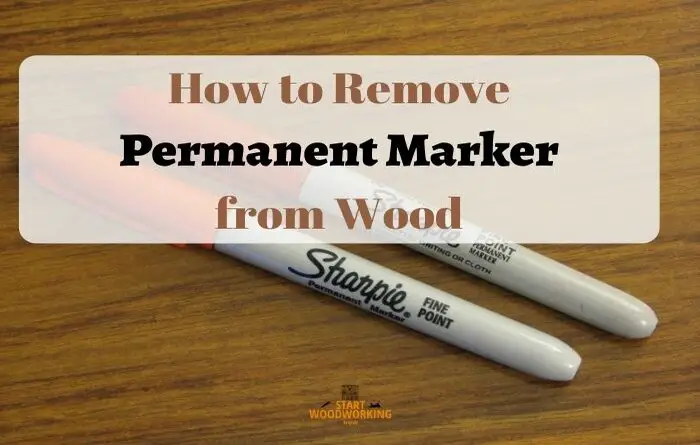
How to Remove Permanent Marker from Wood: Acetone, Alcohol, and Sanding Guide by Marker Type
Permanent marker is harder to remove from wood than most other ink types because it contains a resin binder — a polymer dissolved in a solvent carrier that bonds the pigment or dye to the surface as the carrier evaporates. This resin binder is specifically formulated to be resistant to water and to standard isopropyl alcohol at 70%.
Acetone is the correct primary solvent for most permanent marker inks because it dissolves the resin binder directly — not just the carrier. The correct method, contact time, and solvent concentration depend on three variables: the marker brand and formulation (Sharpie alcohol-based vs. Posca water-based vs. oil-based paint markers), how long the marker has been on the surface, and whether the wood has a sealed finish or is bare.
How Do You Remove Permanent Marker from Wood?
This guide covers the correct solvent for each marker type, exact contact times per finish, the curing timeline that determines removal difficulty, and the sanding protocol for marker that has penetrated bare wood grain.
→ For removing general ink stains from wood including ballpoint and fountain pen: How to Remove Ink Stains from Wood
→ For a complete overview of all wood stain removal: How to Remove Wood Finishes and Stains
What Type of Permanent Marker Is on the Wood?
Not all permanent markers use the same chemistry. The three types below cover the vast majority of permanent markers found in household and workshop settings — and each requires a different primary solvent.
How Does Marker Age Affect Removal Difficulty?
Permanent marker resin binder continues to cure and harden on the wood surface over time as the solvent carrier fully evaporates and the resin cross-links. The longer the marker has been on the surface, the more fully cured the resin binder is and the more solvent penetration and contact time is required to dissolve it.
Carrier not fully evaporated: Acetone or 90% isopropyl removes in 1–2 applications; blotting with dry cloth may remove before solvent needed.
Carrier evaporated: Resin binder not fully cross-linked. Acetone removes in 2–3 applications at 30–60 sec contact each.
Resin significantly hardened: Acetone requires 3–5 applications. Penetration into finish may have occurred on older or worn finishes.
Maximum cross-linking: Acetone still effective on sealed finishes; multiple applications + sanding often needed on bare wood; finish damage more likely.
What Are the Key Specifications for Removing Permanent Marker from Wood?
| Method | Attribute | Value |
|---|---|---|
| Acetone (alcohol-based permanent marker) | Contact time per application — sealed finish | 20–30 seconds maximum; lift and repeat |
| Acetone (on bare wood) | Contact time | 60–90 seconds; allows deeper penetration into grain |
| Isopropyl alcohol 90–99% (acrylic marker) | Contact time | 45–90 seconds per application; 2–4 applications |
| Acetone on polyurethane finish | Safe contact time limit | 30 seconds maximum — extended contact dulls finish |
| Acetone on lacquer finish | Safe use | NOT safe — acetone dissolves lacquer immediately |
| Acetone on shellac finish | Safe use | NOT safe — acetone dissolves shellac. Use 99% isopropyl |
| Lacquer thinner (oil-based paint marker) | Contact time on sealed finish | 20–30 seconds; extremely aggressive — test first |
| Application method — all solvents | Direction | Blot from stain edge inward — never wipe outward or circular |
| Fresh marker (under 30 min) — first action | Before any solvent | Dry white cloth blot — removes ink before resin binder bonds |
| Sandpaper (marker on bare wood) | Starting grit | 80–100 grit if deep penetration; 120 grit for surface stain |
| Sandpaper — final pass | Grit before refinishing | 180 grit |
| Finish restoration after acetone | On wax finishes | Re-apply paste wax after treatment |
| Finish restoration after acetone | On polyurethane | Apply paste wax and buff if dulling visible after 3+ applications |
Why Do Toothpaste, Baking Soda, Sunscreen, and Vinegar Fail on Permanent Marker?
Understanding why common home remedies fail on permanent marker prevents wasted time and avoids methods that may push pigment deeper into the wood grain before the effective solvent is applied.
Toothpaste and baking soda are mild abrasives. On non-porous smooth surfaces (glass, laminate, enamel) they physically abrade the marker from the surface layer. On wood with an open grain texture, the abrasive action pushes dissolved pigment and resin into the grain rather than removing it, potentially making the stain harder to remove with subsequent solvent treatment.
Sunscreen contains zinc oxide or titanium dioxide as UV filters in an oil-based carrier. It has no solvent chemistry for permanent marker resin binder and no mechanism for removing solvent-based dye from a wood surface.
Vinegar (pH 2.5) is a dilute acid that dissolves mineral deposits and emulsifies some fats. It does not dissolve polymer resin binders or the dye molecules in permanent marker.
WD-40 contains petroleum hydrocarbons that partially dissolve fresh oil-based marker carriers. It is not effective on cured resin binder and leaves an oily residue on the wood surface that must be cleaned with mineral spirits before refinishing.
Acetone-free nail polish remover does not contain acetone — its active ingredient is ethyl acetate. Ethyl acetate partially dissolves fresh marker carrier but is significantly less effective than acetone on cured resin binder. Using acetone-free remover instead of acetone on permanent marker typically produces partial results that frustrate the user into abandoning the chemical method and moving to sanding, which is unnecessary if acetone is used correctly.
How Do You Remove Permanent Marker from Wood Using Acetone?
Acetone is the correct primary solvent for alcohol-based permanent markers (Sharpie and similar) and oil-based paint markers on sealed wood surfaces. It dissolves both the dye carrier and the resin binder in a single application, whereas isopropyl alcohol at standard concentrations dissolves only the carrier and leaves the resin partially intact. The result with acetone is complete removal of the marker compound; the result with 70% isopropyl is often a faded but still visible smear.
Acetone is safe on polyurethane and alkyd varnish at contact times of 30 seconds or less per application. It dissolves lacquer, shellac, and spirit varnish immediately — use isopropyl 99% instead on these finishes.
STEP 1 – Blot fresh marker immediately before resin binder cures
If the marker is under 30 minutes old, press a clean dry white cloth firmly onto the mark and lift straight up. Do not wipe sideways — lateral movement spreads the still-liquid carrier across a larger area.
A dry blot on fresh marker can remove 40–60% of the ink before any solvent is needed, significantly reducing the number of solvent applications required and the risk of finish dulling from extended acetone contact.
STEP 2 – Confirm the finish type — do not apply acetone to lacquer or shellac
Apply one drop of acetone to an inconspicuous area and wipe after 10 seconds. If the finish is unaffected, it is polyurethane or varnish — proceed with acetone.
If the finish softens, becomes tacky, or dissolves, it is lacquer, shellac, or spirit varnish — use 99% isopropyl alcohol instead, applied at 30-second contact times per application.
STEP 3 – Apply acetone to a white cotton pad — 20–30 second contact limit per application
Saturate a white cotton pad or folded white cloth with acetone. Press onto the outer edge of the marker stain — never the centre first — and hold for 20–30 seconds. Lift and check: dissolved marker should be visible on the cotton pad as a coloured stain.
Move to a clean cotton section and repeat, working from the stain edge inward in overlapping passes. The 20–30 second contact limit per application on polyurethane prevents the micro-dulling that results from extended acetone contact with the finish. Multiple short applications are more effective and safer than one long application.
STEP 4 – Restore finish sheen after treatment
After 3 or more acetone applications on polyurethane, a faint dulling of the finish surface may be visible where the acetone contacted the finish. Apply a thin coat of paste wax to the treated area and buff with a clean cloth — this fills the micro-voids left by acetone contact and restores uniform sheen.
On varnish finishes, a small amount of matching furniture polish restores sheen without requiring wax.
How Do You Remove Permanent Marker from Lacquer and Shellac Finishes?
On lacquer and shellac finishes where acetone cannot be used, 99% isopropyl alcohol is the alternative solvent. At this concentration, isopropyl dissolves most permanent marker resin binders over multiple applications — it is slower than acetone but does not dissolve lacquer or shellac at the brief contact times required for marker removal.
The technique is identical to the acetone method: blot from the edge inward, 30-second contact per application, white cotton pad, work in overlapping passes. On fresh permanent marker (under 24 hours), 99% isopropyl typically resolves the stain in 3–5 applications.
On fully cured marker (over 1 week), 5–8 applications may be needed before the stain is fully removed. On shellac finishes, limit contact to 20 seconds per application and test after each pass — shellac does dissolve in concentrated isopropyl over extended cumulative contact time.
On acrylic paint markers (Posca, Molotow Aqua): These water-based markers use an acrylic polymer binder rather than a resin binder. When fresh (under 30 minutes), they can often be removed with warm water and a cloth.
When partially cured, isopropyl 90–99% dissolves the acrylic polymer. When fully cured (over 24 hours), acetone is the most effective solvent for the hardened acrylic. On shellac, use 90% isopropyl at 20-second maximum contact and multiple applications.
How Do You Remove Permanent Marker from Bare or Unfinished Wood?
On bare, unfinished, or oil-finished wood, permanent marker penetrates the open grain fibres directly. Acetone treatment dissolves the marker compound on and near the surface but cannot reach pigment that has wicked deep into the pore channels.
The removal process has two stages: solvent extraction of accessible marker, followed by sanding to remove stained fibres if discolouration persists.
Stage 1 — Acetone treatment on bare wood
On bare wood, acetone contact time can be extended to 60–90 seconds per application — there is no finish to damage. Apply acetone with a white cotton cloth and work it firmly into the grain in the direction of the wood fibres. Allow 60–90 seconds before wiping clean.
Repeat 3–4 times. After each application, inspect in raking light (lamp held close to the surface at a low angle) — if the mark is visibly fading, continue solvent treatment. If no change is visible after 4 applications, the marker has penetrated below the depth acetone can reach and sanding is required.
Stage 2 — Sanding when solvent treatment leaves residual staining
Sand in the grain direction starting at 80–100 grit for deep penetration or 120 grit for a surface stain that responded partially to acetone. Check progress after each pass by wiping with a tack cloth — if pigment is still visible in the grain, continue at 80–100 grit.
Progress to 120 and 180 grit after the stain is fully removed to prepare the surface for refinishing. On high-tannin species (oak, walnut), a faint grey residue may remain after sanding — apply oxalic acid at 60 g per litre for 15–20 minutes to neutralise residual iron-tannate compounds if this occurs.
How Does the Wood Surface Type Affect Permanent Marker Removal?
| Surface Type | Marker Type | Primary Method | Key Constraint |
|---|---|---|---|
| Polyurethane finish | Alcohol-based (Sharpie) | Acetone — 20–30 sec per application, blot edge to centre; paste wax after 3+ applications | 30 sec contact limit — extended acetone dulls polyurethane |
| Polyurethane finish | Acrylic (Posca) | Isopropyl 90–99% — 45–60 sec per application; acetone if isopropyl insufficient | Fresh acrylic: warm water + soap first; cured: acetone most effective |
| Lacquer finish | Any permanent marker | Isopropyl 99% only — 20–30 sec max contact; blot method | Acetone dissolves lacquer immediately — never use on lacquer |
| Shellac finish (antique) | Any permanent marker | Isopropyl 99% — 20 sec maximum per application; test after each pass | High-concentration isopropyl dissolves shellac over cumulative contact — limit strictly |
| Wax finish | Any permanent marker | Acetone (polyurethane wax) or isopropyl 90% (shellac/lacquer wax); re-wax after | Solvents remove wax layer alongside marker — always re-apply paste wax |
| Bare / unfinished wood | Any | Acetone, 60–90 sec contact, 3–4 cycles; sand 80–180 grit if residue persists | Open grain allows deep penetration — sanding often required for complete removal |
| Oil finish | Any | Acetone; re-apply matching oil after treatment | Re-oil the surface after any solvent treatment |
| Veneer | Any | Isopropyl 90–99% only — blot method, minimal contact; no acetone, no sanding | Acetone risks delaminating veneer adhesive; veneer too thin for sanding |
| Laminate surface | Alcohol-based | Acetone or isopropyl 90% — laminate is non-porous; marker sits on surface | Dry-erase marker trick: write over Sharpie with dry-erase marker, wipe clean — effective on laminate only |
Dry-erase marker trick on laminate surfaces only: Writing over a Sharpie mark with a dry-erase whiteboard marker and immediately wiping works on laminate and other fully non-porous surfaces because the dry-erase marker solvent re-dissolves the Sharpie resin binder. This technique only works on non-porous surfaces — it has no effect on wood grain textures, sealed or unsealed, where the Sharpie has partially absorbed into the surface texture.
📝 In my restoration workshop, the most common permanent marker scenario is a Sharpie mark on an oak dining table with polyurethane finish — typically left by children doing homework. The 30-second acetone contact limit is critical on polyurethane: I work in very short applications and check after each one. On fully cured marks over a week old, I typically need 5–6 applications before the mark is gone, but the finish remains intact throughout. On one occasion a client had already tried toothpaste before calling me — the abrasion had pushed pigment into the finish micro-texture and I needed two additional acetone applications to clear what the toothpaste had worked in.
Frequently Asked Questions About Removing Permanent Marker from Wood
Why does acetone work better than rubbing alcohol on permanent marker?
Standard rubbing alcohol (70% isopropyl) dissolves the solvent carrier in permanent marker ink but has limited effectiveness against the resin binder — the polymer component that bonds the pigment to the surface. This is why alcohol treatment often produces a faded smear rather than complete removal.
Acetone dissolves both the carrier and the resin binder completely, which is why it removes permanent marker in fewer applications. At 90–99% isopropyl concentration, the solvent effectiveness increases significantly and can dissolve most resin binders — though it is still slower than acetone on fully cured marks.
Does acetone damage wood when used to remove permanent marker?
Acetone does not damage the wood fibre itself — it evaporates completely without leaving residue and does not penetrate deeply into wood at the brief contact times used for marker removal.
The risk is to the finish: acetone dissolves lacquer and shellac immediately, and dulls polyurethane at extended contact times. At 20–30 seconds per application on polyurethane, the finish is not visibly damaged in most cases. Restore sheen with paste wax after 3 or more applications if any dulling is visible.
Can you remove fully dried permanent marker from wood without sanding?
Yes — on sealed wood surfaces with polyurethane or varnish, acetone removes fully cured permanent marker without sanding, though it requires more applications than on fresh marks.
On fully cured marker over 1 week old on polyurethane, 4–6 acetone applications at 20–30 seconds each typically resolve the stain completely. On bare or unfinished wood where the marker has penetrated the grain fibres, solvent treatment alone is often insufficient after full curing and sanding from 80–120 grit is required to remove the stained wood fibre layer.
What is the fastest way to remove a fresh Sharpie mark from wood furniture?
The fastest method for fresh Sharpie on sealed wood is to blot immediately with a dry white cloth to remove the still-liquid carrier, then apply acetone at 20–30 seconds contact time. On polyurethane-sealed furniture, fresh Sharpie applied within the last 30 minutes is typically removed in one or two acetone applications. Acting within 30 minutes significantly reduces the number of applications needed — after 24 hours the resin binder has cured sufficiently to require 3–5 applications for the same result.
📝 The most challenging permanent marker removal I have done was on a shellac-finished Victorian side table where someone had written a price tag in Sharpie directly on the wood surface — probably at an antique fair. Acetone was completely off the table due to the shellac finish. I used 99% isopropyl at strict 20-second contacts, 8 applications over two sessions separated by 10 minutes to allow the shellac to re-solidify between passes. The mark resolved completely without visible finish damage, but the process required patience and discipline with the contact time limit that most DIY guides do not convey.
Summary: Key Values for Removing Permanent Marker from Wood
Removing permanent marker from wood requires acetone for alcohol-based markers (Sharpie and most permanent markers) and for oil-based paint markers, or isopropyl 90–99% for acrylic-based markers (Posca) and for all markers on lacquer and shellac finishes where acetone cannot be used.
On polyurethane and varnish, limit acetone contact to 20–30 seconds per application — multiple short applications are safer and more effective than one extended application. Work from the stain edge inward with a white cotton pad.
Fresh marker under 30 minutes can often be partially removed by dry blotting before any solvent is applied.
On bare wood, extend acetone contact to 60–90 seconds and repeat 3–4 cycles before assessing for sanding at 80–120 grit.
On lacquer and shellac, use 99% isopropyl at 20-second contact maximum per application. Common home remedies — toothpaste, baking soda, sunscreen, vinegar — are ineffective on permanent marker resin binder. Acetone-free nail polish remover is also insufficient because it does not contain the solvent required to dissolve permanent marker resin.
→ Related: How to Remove Ink Stains from Wood
→ Related: How to Remove Hair Dye from Wood
→ Hub: How to Remove Wood Finishes and Stains — Complete Guide