Does Polyurethane Yellow? Oil-Based vs Water-Based, and How Fast
Yes — oil-based polyurethane yellows; water-based stays essentially clear. Oil-based poly is amber from the first coat and keeps darkening as its drying oil oxidises for the life of the film — fastest in dark places such as cabinet interiors, and partly fading back in daylight. Direct sun adds a second, surface yellowing..
Part of Why Finishes Yellow · Wood Finishing Guide. To apply it: How to Apply Polyurethane →
Navigate to your question
→ Why does polyurethane turn yellow — what is actually happening? → Quinone chemistry and the aromatic vs aliphatic distinction ↓
→ Does water-based polyurethane yellow? → Why WB poly stays clear and OB doesn’t ↓
→ My poly yellowed even in a dark room — why? → The BHT paradox — yellowing without UV ↓
→ Does UV Light Yellow Polyurethane? → UV-blocking window film ↓
→ How Fast Does Polyurethane Yellow? → Timeline by light exposure conditions ↓
→ How do I prevent or fix yellowing? → Non-yellowing products and the only real fix ↓
Water-based polyurethane does not yellow for a specific chemical reason: it is formulated with aliphatic isocyanates rather than aromatic ones. Aliphatic isocyanates contain no aromatic rings and therefore cannot form quinones. This is not simply “less oil” — it is a fundamentally different polymer backbone that lacks the structural components that cause yellowing.
Why Does Polyurethane Turn Yellow — What Is the Chemistry?
Oil-based polyurethane yellows because it is formulated with aromatic isocyanates — specifically MDI (methylene diphenyl diisocyanate) or TDI (toluene diisocyanate). When aromatic isocyanates are exposed to UV light or oxygen, the aromatic ring structures undergo photooxidation and form quinones. Quinones are yellow compounds embedded directly in the polymer backbone — they cannot be removed without dissolving the film.
The Two Distinct Causes of Polyurethane Colour Change
1. Amber tint from day one — NOT yellowing: Oil-based polyurethane for woodworking is alkyd-modified — it contains an alkyd resin (the same material in oil-based varnish) to improve flow, leveling, and durability. Alkyd resins are inherently amber-coloured. When you apply OB poly, this amber is visible immediately from the first coat. On dark species like walnut and oak, this amber enhancement is desirable. On maple, birch, or white-painted surfaces, it is a problem from the very first application.
2. Progressive quinone yellowing — actual yellowing over time: Separate from the initial amber tint, aromatic isocyanates in the polymer backbone continue to degrade under UV and oxygen exposure, forming additional yellow quinone compounds. A 5-year-old OB poly finish is noticeably more yellow than a 6-month-old finish on the same piece — this additional shift is the progressive yellowing on top of the existing amber.
Aliphatic WB polyurethane is non-yellowing in the same way that CAB-acrylic lacquer is non-yellowing — same chemistry approach, different polymer — the lacquer family chemistry including CAB-acrylic for non-yellowing applications.
Does Water-Based Polyurethane Yellow?
Standard water-based polyurethane stays essentially clear for its whole life. It has no drying oil to oxidise and its binders are not aromatic, so neither darkness nor sunlight yellows it noticeably. Two exceptions: oil-modified water-based products, which add oil for a warmer tone and amber slightly, and a clear coat over wood or paint that is itself changing colour underneath. On the label, “non-yellowing” or “water-clear” marks the clear type; “oil-modified” marks the warm one.
Water-based poly can experience very slight colour changes over decades through other aging mechanisms — but these are an order of magnitude smaller than OB poly yellowing and are not visible to the naked eye under normal interior conditions within the typical life of a furniture finish.
| Finish | Day-One Tint | 5-Year Shift | On Light Species |
|---|---|---|---|
| Oil-based polyurethane | Amber (alkyd component) | Additional yellow shift (quinones) | Significantly yellow — not suitable for maple, birch, white paint |
| Water-based polyurethane | Water-white — crystal clear | Negligible | Preserves natural colour — correct choice |
| NC Lacquer (for comparison) | Slight warm amber | Progressive amber (nitrocellulose photooxidation) | Warms light species — use CAB-acrylic instead |
Does Oil-Based Polyurethane Yellow? Why It Happens Even in a Dark Room?
Yes — and it yellows faster in the dark than in the light. The drying oil keeps oxidising whether or not light reaches it. Daylight partly bleaches the yellow compounds as they form; in a cabinet interior, behind furniture or under a rug nothing bleaches them, so the amber builds up. That is why the inside of a cabinet door can look more yellow than its sunlit front. Conservation research on oil-based films shows much of this dark yellowing fades again after weeks of ordinary daylight — the finish’s permanent amber does not.
Oil-based polyurethane contains antioxidants — typically BHT (butylated hydroxytoluene) — to prevent premature oxidation during storage. In a poorly-ventilated space containing nitrogen dioxide (NO₂) from gas appliances, combustion byproducts, or simply accumulated from the air, BHT [reacts] with NO₂ to form yellow quinoid compounds — without any UV exposure whatsoever. This reaction is called gas-phase or NOₓ yellowing.
📝Kitchen cabinets finished with oil-based polyurethane in homes with gas ranges are the most common scenario I encounter where clients report rapid yellowing. A set of maple cabinets I refinished with water-based poly five years ago remains visually white. A comparable set in the same kitchen that the previous owner had finished with oil-based poly had turned distinctly amber within 18 months of the gas range installation. The combination of heat from the range, NO₂ from gas combustion, and the closed cabinet environment created near-ideal conditions for both UV-independent dark yellowing and heat-accelerated oxidation.
Does UV Light Yellow Polyurethane?
Yes, but mostly at the surface and mostly in direct sun. UV breaks down the aromatic urethane links in oil-based polyurethane and forms yellow compounds, starting in the top layer of the film. On a sunny surface two things happen at once: daylight partly bleaches the oil’s dark yellowing, while UV adds surface yellowing and changes the colour of the wood underneath. The net result near a window is usually warmer, sometimes duller wood — not a faster version of dark yellowing.
Does UV-blocking window film stop yellowing?
It protects the wood and slows the sun-side change, so it is worth fitting on sunny windows over light woods. It cannot stop the oil in an oil-based finish from ambering, because that part needs no light.
Why is there a yellow patch shaped like a rug or furniture?
Mostly the wood. Cherry darkens strongly in light; maple and hickory amber slightly; red oak, white oak and walnut tend to lighten. The finish adds to it: under the rug an oil-based film sits in the dark and can dark-yellow. Leave the area uncovered for a few weeks. A difference that fades was dark yellowing or early wood change; a difference that stays is the wood’s own colour change.
Outdoors, where UV dominates, see the best finish for outdoor wood.
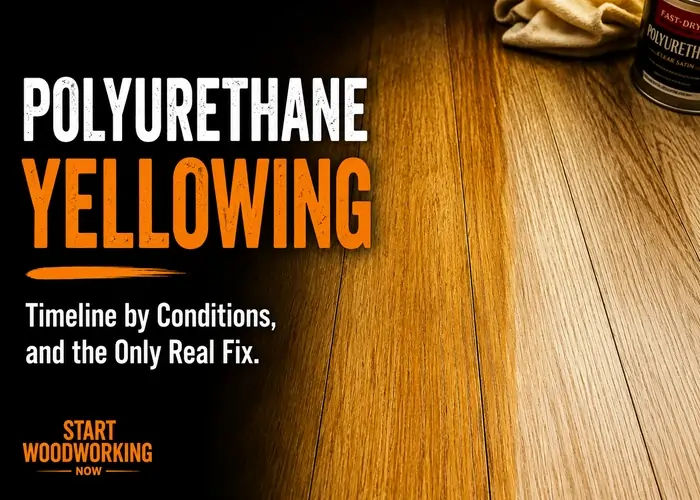
How Fast Does Polyurethane Yellow?
“Polyurethane yellows over time” is consistently stated without any timeline. The actual rate varies enormously depending on light exposure, temperature, and ventilation.
There is no reliable published timeline: speed depends on the product, film thickness, the wood and, most of all, on light. What you can predict is which process dominates where.
| Location | What dominates | What you see |
|---|---|---|
| Cabinet interiors, closets, under rugs | Dark yellowing of the oil | Steady amber; partly fades if moved into daylight |
| Rooms with indirect daylight | Oil oxidation, partly bleached by light | Slow, even warming |
| Beside sunny windows | UV at the surface + wood colour change | Warmer or duller surface; wood darkens or lightens by species |
| Kitchens near cookers | Heat, cooking residues, cleaners | Local yellowing above and around the cooker |
| Standard water-based poly, any location | — | Essentially none |
How Do You Prevent Yellowing — and Can Yellowed Polyurethane Be Fixed?
Prevention is the only effective approach — once quinones form in the polymer backbone, they cannot be reversed, neutralised, or polished out. The two reliable prevention strategies are choosing the right finish type and managing the curing environment.
Prevention — Finish Selection
Use water-based polyurethane on any surface where colour neutrality matters: light species (maple, birch, ash), white-painted or light-painted surfaces, cabinets in well-lit kitchens, furniture in direct sun exposure.
What to look for on labels for non-yellowing: “water-based,” “aliphatic polyurethane,” “non-yellowing,” “UV-resistant.” Avoid OB poly entirely where colour neutrality matters.
Products: General Finishes High Performance Water Based Topcoat, Minwax Polycrylic, Bona Traffic HD (commercial), Varathane Crystal Clear.
Choose standard water-based, not oil-modified, wherever colour must stay neutral. Varathane itself warns that its oil-based polyurethane over white can discolour.
Prevention — Application Conditions
If using oil-based poly: Thin coats, good ventilation while curing, and no storage in the dark once finished. None of these stops oil-based poly from ambering; they only slow it.
HALS (Hindered Amine Light Stabilisers): Some premium exterior and commercial formulations include HALS additives that scavenge free radicals and slow the quinone-forming degradation. Labels specify “UV stabilised” or “light stabilised.” These slow but do not prevent yellowing in aromatic poly — only aliphatic formulations provide true non-yellowing performance.
UV-blocking window film: Applied to windows, reduces UV transmission to near zero — dramatically slows OB poly yellowing on furniture near windows. Practical for clients committed to OB poly’s durability who want to minimise colour change.
Fixing Yellowed Polyurethane — What Works and What Doesn’t
Most yellowed oil-based polyurethane cannot be made clear again in place, but two kinds of yellowing respond to simple treatment. Diagnose first:
| Symptom | Likely cause | Test |
|---|---|---|
| Yellower in covered or shaded areas | Dark yellowing of the oil | Bright indirect daylight for a few weeks |
| Yellow or dull on sun-facing surfaces | UV damage in the top layer | Scuff-sand a hidden sun-side spot: lighter = surface layer |
| Even amber everywhere, worst on light wood and white paint | The finish’s built-in colour | Compare with a fresh sample board |
| Rug or furniture outline on a floor | Mostly the wood | Uncover and watch for a few weeks |
No bleach, cleaner or UV spray removes yellow compounds built into the film. Recoating on top does not help either: a fresh clear coat sits over the amber, it does not replace it.
To take it back to bare wood: how to remove polyurethane from wood.
Frequently Asked Questions
Will oil-based polyurethane always yellow?
Yes — the amber tint is present from day one (alkyd component) and progressive yellowing occurs over time (aromatic isocyanate degradation). On dark species like walnut, cherry, and oak, this amber shift can enhance appearance and may never be visible as a problem. On maple, birch, white paint, or light ash, it will become noticeable within 2–4 years in a typical indoor environment.
Does keeping furniture away from windows prevent polyurethane yellowing?
Partially. Keeping furniture away from direct sunlight significantly slows UV-driven quinone formation and extends the time before visible yellowing. However, OB poly can also yellow in dark environments through the BHT+NO₂ gas-phase reaction — particularly in kitchens with gas appliances or poorly ventilated spaces. Moving furniture away from windows reduces yellowing rate but does not prevent it entirely for OB poly.
Is water-based polyurethane as durable as oil-based?
Modern water-based polyurethane is very close to oil-based in durability. Oil-based poly: 300–500 Taber abrasion cycles. Good water-based poly (General Finishes HP, Bona Traffic HD): 150–300 cycles for standard products, up to 400+ cycles for commercial-grade WB formulas. For most furniture applications: WB poly’s durability is sufficient, and the non-yellowing benefit outweighs the modest durability difference. For hardwood floors receiving heavy traffic: commercial-grade WB poly or OB poly are both appropriate choices. Full polyurethane application guide →
Can I put water-based polyurethane over oil-based to stop it yellowing?
No — this does not work. The OB poly underneath continues to yellow regardless of what is applied on top. Applying WB poly over already-yellowed OB poly merely adds a clear layer that may disguise the yellowing temporarily — but the yellow is in the film below, not on the surface. Additionally, WB poly over OB poly has adhesion issues if the OB poly is not fully cured and sanded. The only solution is to strip the OB poly and start with WB poly on clean wood.
What is the best non-yellowing finish for white-painted furniture?
Water-based polyurethane is the standard recommendation for white-painted furniture. For best results: General Finishes High Performance Water Based in flat or satin, or Minwax Polycrylic in flat. Apply over fully dried white paint (oil-based paint: 72 hours; water-based paint: 24 hours). Two coats, light 320-grit between coats. Avoid OB poly entirely on white paint — it produces visible yellowing within 1–2 years. Also avoid CAB-acrylic lacquer unless you have spray equipment — WB poly applied by brush produces equivalent non-yellowing results with standard brush-on application.
] }