
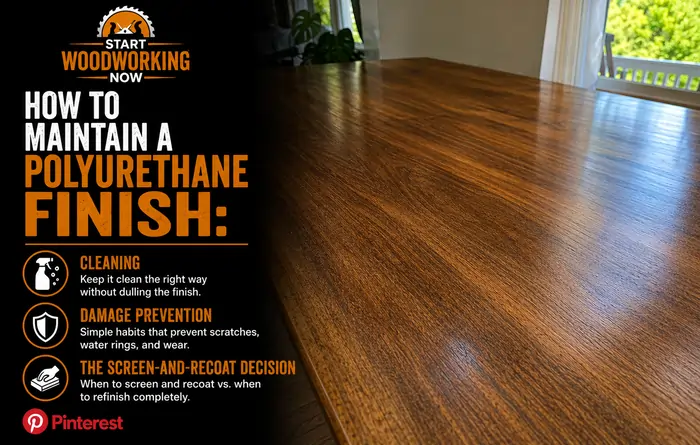
How to Maintain a Polyurethane Finish: Cleaning, Damage Prevention, and the Screen-and-Recoat Decision
A polyurethane finish maintained correctly can extend the interval between full refinishing from roughly 7 years to 15 years or more — the difference between maintenance and neglect is almost entirely about what you clean it with and how early you catch surface wear. Polyurethane does not require complex care, but several extremely common household practices — ammonia-based cleaners, vinegar solutions, wax-based furniture polish — chemically degrade the film over time in ways that are invisible until the damage is already done. Understanding the chemistry behind each practice turns vague “use a soft cloth” advice into specific, justified decisions.
This article is part of the wood finishing guide — covering finish selection, application, troubleshooting, and the chemistry that explains finish behaviour over time.
Navigate to your question
→ How often should I clean a polyurethane finish? → Cleaning intervals by surface type and traffic level ↓
→ What cleaning products should I use — and which ones damage the finish? → Why ammonia and vinegar chemically attack polyurethane over time ↓
→ How do I prevent scuffs and wear patterns? → Felt pads, rugs, and the mechanics of how scratch patterns form ↓
→ When should I screen-and-recoat instead of fully refinishing? → The adhesion test that tells you which option is still available ↓
→ What else damages polyurethane that I should watch for? → UV oxidation, humidity swings, and silicone contamination ↓
How Often Should You Clean a Polyurethane Finish?
Cleaning frequency depends on surface type and traffic level, but the underlying principle is the same across all applications: routine light cleaning prevents the accumulation of abrasive grit that causes most of the visible wear on polyurethane over time.
Floors
Dry dust mopping or vacuuming (with a hard-floor attachment, not a beater bar) should happen weekly in normal-traffic homes, more frequently in homes with pets or in entryways. This is the single most impactful maintenance practice for polyurethane floors: loose grit and sand act as an abrasive between the floor and foot traffic, creating fine scratches that accumulate into a dulled, hazy appearance over months.
The scratching is mechanical — happening through normal walking — not a finish defect, and removing the grit before it gets walked into the floor prevents the majority of micro-abrasion damage.
Wet cleaning with a manufacturer-approved hardwood floor cleaner should follow at 1–2 week intervals for normal traffic, more often for kitchens and high-traffic hallways. Excess water should never be used — pooling water at board edges and seams can penetrate beneath the finish at the wood-to-wood joints and cause cupping or staining at the joint line, a problem entirely separate from the finish itself.
Furniture and Tabletops
Dusting with a dry microfiber cloth should happen as needed — visible dust accumulation is both an aesthetic issue and, over time, a source of fine abrasive particles that can scratch the surface when wiped with a dry or rough cloth. Wet cleaning for spills and fingerprints should use a damp (not wet) microfiber cloth, addressing contamination promptly rather than letting spills sit and potentially penetrate at any micro-cracks or seams in the film.
What Cleaning Products to Use — and Why Common Ones Damage the Finish
The chemistry of polyurethane’s crosslinked network — covered in the curing chemistry guide — explains exactly why certain widely recommended household cleaning products cause long-term damage that is not immediately visible.
The Correct Products
A pH-neutral cleaner specifically formulated for finished wood (commercial hardwood floor cleaners, or furniture cleaners labelled for polyurethane and varnish) is the correct choice. These formulations are buffered near pH 7, meaning they neither attack the crosslinked polymer network through acid hydrolysis nor through alkaline hydrolysis. A simple alternative for light cleaning: water alone, slightly dampened on a microfiber cloth, with no chemical additive at all — adequate for routine dust and light grime removal on a fully cured finish.
Why Ammonia-Based Cleaners Degrade Polyurethane Over Time
Ammonia-based glass and household cleaners are commonly recommended for “shiny” surfaces, including finished wood, by general cleaning advice that does not account for polymer chemistry. Ammonia is alkaline (pH 11–12) and alkaline conditions catalyse hydrolysis of the urethane linkages (−NH−COO−) that form the crosslinked network in polyurethane.
Each hydrolysis event breaks one crosslink, and repeated exposure over months and years of routine cleaning cumulatively reduces crosslink density at the surface, producing a film that becomes progressively softer, duller, and more prone to scratching at the exact zones where ammonia-based cleaner contacts most frequently.
The damage is not visible after a single cleaning — this is precisely why the practice persists despite being harmful. The crosslink degradation is cumulative and surface-limited, meaning the effect builds slowly and is concentrated in the top few microns of the film, exactly where visual sheen and scratch resistance are determined.
A floor cleaned weekly with ammonia-based glass cleaner for two years will show measurably reduced scratch resistance and surface haze compared to an identical floor cleaned with pH-neutral product, even though both received the same cleaning frequency.
Why Vinegar Solutions Have the Same Problem from the Opposite Direction
Vinegar (acetic acid, pH 2.5–3) is recommended as a “natural” cleaning alternative, and while it avoids the alkaline hydrolysis mechanism of ammonia, dilute acetic acid catalyses acid hydrolysis of the same urethane linkages through a different chemical pathway. The crosslink degradation outcome is similar: progressive softening and reduced abrasion resistance with repeated exposure. Neither extreme of the pH scale is safe for polyurethane in repeated contact — the crosslinked network is most stable near neutral pH, which is exactly why commercial wood floor cleaners are formulated as pH-buffered near 7.
The Wax-Based Polish Trap
Furniture polish and “wood polish” products containing wax or silicone oils are marketed for shine and protection but create a specific long-term problem: the wax deposits a thin film on top of the cured polyurethane that is incompatible with future recoating.
When a polyurethane floor or tabletop eventually needs a screen-and-recoat (light abrasion plus a fresh topcoat, without full stripping), any wax residue on the surface prevents the new coat from adhering — the new polyurethane beads up and fish-eyes over the waxed areas exactly as it would over silicone contamination.
This means wax-based polish use over years can eliminate the screen-and-recoat option entirely by the time maintenance is needed, forcing a full strip-and-refinish that could have been avoided.
If wax-based polish has already been used, complete removal with a wax-stripping solvent (mineral spirits, or a dedicated wax remover) before any recoat attempt is mandatory — and even thorough removal does not always restore full adhesion if the wax has been used for years across many applications.
How to Prevent Scuffs and Wear Patterns
Most visible wear on polyurethane is mechanical abrasion concentrated at predictable contact points — furniture legs, chair casters, high-traffic walking paths. Preventing this concentration is more effective than any cleaning practice for preserving long-term appearance.
Felt Pads and Furniture Glides
Felt pads under furniture legs are not primarily cosmetic — they distribute the point load of a chair or table leg across a larger contact area and provide a softer interface than bare wood-on-wood or metal-on-wood contact. Without felt pads, a chair leg sliding across a polyurethane floor concentrates the full weight of the chair and occupant onto a small contact point, producing fine scratches that follow the chair’s movement pattern — typically a fan-shaped wear zone around dining chairs that becomes visible as a duller arc in the finish sheen after months of use.
Felt pads should be replaced when they become compacted or when grit becomes embedded in them — a compacted felt pad with embedded grit functions as sandpaper rather than as cushioning, accelerating wear rather than preventing it. Check and replace felt pads every 6–12 months in active-use furniture.
Area Rugs and Runners in High-Traffic Zones
Entryways, hallways, and pathways in front of frequently used furniture accumulate the highest grit load and the highest foot-traffic abrasion of any floor area. Area rugs and runners in these zones intercept grit before it reaches the finish and reduce direct foot contact with the polyurethane surface.
This is the most effective single intervention for preventing the burnishing and wear-path appearance that develops on unprotected high-traffic floor areas — the same mechanism that produces sheen burnishing on matte finishes (covered in the sheen explainer) is accelerated by unfiltered grit abrasion.
Caster Wheels and Rolling Furniture
Standard hard plastic or rubber caster wheels designed for carpet use can scratch polyurethane floors under the repeated rolling pressure of office chairs and rolling furniture. Soft rubber or polyurethane caster wheels designed specifically for hard floors distribute pressure more gently and resist the embedded-grit problem that hard plastic casters develop over time. A chair mat in office settings on hardwood is a practical alternative that eliminates direct caster contact with the finish entirely.
When to Screen-and-Recoat vs Fully Refinish
Screen-and-recoat — light abrasion of the existing finish surface followed by a fresh topcoat, without sanding back to bare wood — is the maintenance intervention that extends finish life significantly beyond the original application without the cost, dust, and disruption of full refinishing. Whether it remains an option depends entirely on the condition of the existing film.
The Adhesion Requirement
Screen-and-recoat works because the new topcoat adheres mechanically to the lightly abraded surface of the existing film — this only succeeds if the existing film has no areas of delamination, no wax or silicone contamination, and sufficient remaining thickness that the abrasion step does not sand through to bare wood. If any of these conditions fail, screen-and-recoat produces poor adhesion in the affected areas, visible as peeling or flaking shortly after the new coat is applied.
A simple field test: examine the surface under raking light for any areas where the finish appears lifted, cloudy from beneath (indicating moisture or adhesion failure), or where you can see through to bare wood in worn traffic areas.
If these signs are absent and the only issue is surface dulling, scuffing, and minor scratch accumulation, screen-and-recoat is appropriate. If delamination or bare-wood wear-through is present in significant areas, a full strip and refinish is required because the new topcoat will not adhere reliably to the compromised zones.
The Screen-and-Recoat Process
Screen-and-Recoat — Step Protocol
Confirm eligibility — raking-light check for delamination, wax/silicone contamination, or bare-wood wear-through. Any present → stop, full refinish needed.
Scuff the surface — maroon/red buffer pad (floors) or 220-320 grit (furniture). Remove oxidation and create tooth without cutting through film thickness.
Clean thoroughly — remove all sanding dust completely; any residue compromises adhesion of the new coat.
Apply one fresh coat of compatible polyurethane, same technique as original application.
The process uses a floor buffer with a maroon or red abrasive pad (for floors) or fine sandpaper (220–320 grit for furniture) to scuff the existing finish surface — removing surface oxidation and creating mechanical tooth for the new coat, without removing significant film thickness.
The surface is then thoroughly cleaned of all sanding dust, and a fresh coat of compatible polyurethane is applied following the same technique as original application, detailed in the polyurethane application guide covering brush technique and recoat windows.
Screen-and-recoat is most effective when performed proactively — at the first signs of surface dulling, before wear has progressed to the point of exposing bare wood at traffic paths.
Waiting until wear-through has occurred eliminates the screen-and-recoat option and forces full refinishing, which is significantly more expensive and disruptive. For floors specifically, a 3–5 year screen-and-recoat interval in normal-traffic homes typically extends total finish life well beyond what a single application would achieve.
UV Oxidation — Why the Timing Window Matters
Polyurethane surfaces exposed to UV light — near windows, skylights, or in sunrooms — undergo progressive surface oxidation that is distinct from mechanical wear. UV-driven oxidation breaks down the surface layer of the polymer, producing a chalky, hazy appearance that mechanical cleaning cannot remove because the degradation is chemical, within the polymer itself, not a removable surface contaminant.
One change no maintenance routine reverses is colour. If the surface has darkened rather than dulled, cleaning and recoating will not bring it back, because the shift happened inside the resin rather than on top of it — explained in why finishes amber over time.
Screen-and-recoat works on UV-oxidized surfaces only if the abrasion step removes the full depth of oxidative damage — typically the top few microns. If oxidation has progressed deeper into the film over years of unaddressed exposure, the abrasion required to reach undamaged material removes too much total film thickness, leaving insufficient remaining polyurethane for structural protection.
This is why UV-exposed surfaces benefit from earlier intervention: catching surface oxidation in its first one to two years allows successful screen-and-recoat, while waiting five or more years often necessitates full refinishing. Reducing UV exposure with window film or window treatments slows this oxidation process and extends the effective maintenance window.
Other Common Damage Sources to Watch For
Humidity Swings
Polyurethane films accommodate normal wood movement through elongation within their molecular network, but rapid or extreme humidity swings — a heating system turning on for the first time in autumn, or a sudden summer humidity spike — can exceed the film’s elongation capacity at speed, particularly at panel edges and joints where wood movement is most concentrated.
The result is fine surface cracking (crazing) that, while not a finish failure in the chemical sense, requires a fresh coat to restore both appearance and protective function. Maintaining stable indoor humidity (ideally 35–55% RH) with a humidifier in dry winter conditions reduces this stress on the finish significantly.
Silicone Contamination from Other Products
Many spray furniture polishes, car care products inadvertently transferred via hands or cloths, and some caulks and sealants used nearby contain silicone compounds that contaminate finished surfaces invisibly. Silicone contamination produces the same adhesion-blocking effect as wax buildup, preventing successful screen-and-recoat in affected areas.
Avoiding silicone-based products near finished wood surfaces, and testing an inconspicuous area with isopropyl alcohol before any maintenance recoat if silicone contamination is suspected, prevents this problem from surfacing unexpectedly during a maintenance project.
Direct Heat and Hot Items
Placing hot pots, mugs without coasters, or heated appliances directly on a polyurethane surface can locally heat the film above its glass transition temperature for water-based formulations or cause localized softening in oil-based films, producing a ring mark from the thermal event rather than from moisture alone.
This mechanism — and the broader thermoplastic heat sensitivity that varies by finish type — is covered in the polyurethane vs lacquer comparison covering heat resistance and finish selection trade-offs. For surface scratches that do occur despite preventive measures, the repair decision and wet-sanding technique are detailed in the polyurethane scratch repair guide and the wet-sanding guide covering sheen restoration after minor surface damage.
Polyurethane maintenance starts from the same principles that apply to every film finish, and departs from them only where its hardness allows more aggressive cleaning — the general routine is in the cleaning principles for film finishes.
Frequently Asked Questions
Is Murphy Oil Soap safe for polyurethane floors?
Murphy Oil Soap and similar soap-based cleaners are mildly alkaline (typically pH 8–9) and, while less aggressive than ammonia glass cleaner, can leave a residue over repeated use that dulls the finish sheen and interferes with future recoat adhesion if used heavily. Most hardwood flooring manufacturers do not recommend it specifically for this reason. A pH-neutral cleaner formulated for polyurethane floors is the safer long-term choice, with plain water as the simplest alternative for routine light cleaning.
How do I know if my polyurethane floor needs screen-and-recoat or full refinishing?
Check under raking light (a flashlight held at a low angle works well) for areas where the finish appears lifted, cloudy from underneath, or worn through to bare wood. If these signs are absent and the issue is general dulling, light scratching, or reduced sheen, screen-and-recoat is appropriate. If you see bare wood in traffic paths or any lifting/delamination, full refinishing is required because the new coat will not adhere reliably over compromised areas.
Can I use steam mops on polyurethane floors?
No — steam mops are not recommended for polyurethane floors. The heat and moisture from steam can penetrate at board seams and joints, causing moisture damage to the wood beneath the finish, and the prolonged heat exposure can soften the polyurethane film surface in ways that accelerate wear. Most hardwood flooring warranties explicitly exclude damage caused by steam cleaning. A damp (not wet) microfiber mop with a pH-neutral cleaner is the appropriate alternative.
How long should a polyurethane finish last with good maintenance?
With proactive maintenance — pH-neutral cleaning, prompt grit removal, felt pads on furniture, and screen-and-recoat every 3-5 years for floors before wear-through occurs — a polyurethane finish can remain in good condition for 15-20+ years before full refinishing is needed. Without maintenance, the same finish in a normal-traffic home typically requires full refinishing within 7-10 years as wear progresses unchecked to the point where screen-and-recoat is no longer viable.