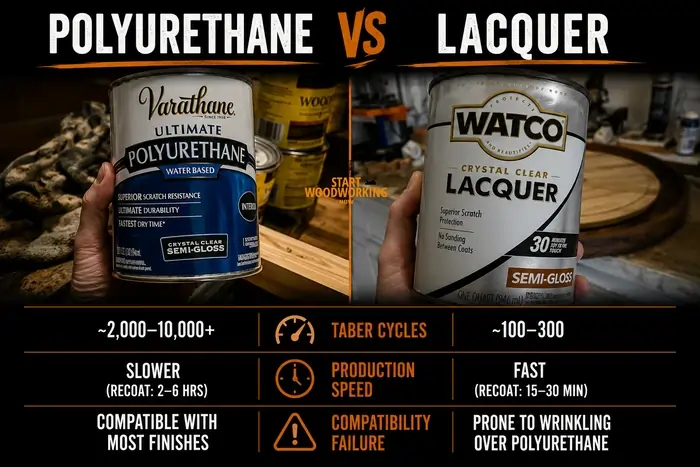
Polyurethane vs Lacquer: Taber Cycles, Production Speed, Compatibility Failure
Most comparisons of polyurethane versus lacquer miss the critical distinction within lacquer itself: nitrocellulose (NC) lacquer and CAB-acrylic lacquer are thermoplastic finishes that re-dissolve in lacquer thinner and re-amalgamate between coats — making them repairable and fast to apply but less durable than polyurethane. Catalyzed lacquer — the finish used in every professional cabinet shop — is thermoset, does not re-amalgamate, and at 400–600 Taber abrasion cycles actually outperforms standard oil-based polyurethane. The answer to “which is more durable” depends entirely on which lacquer you mean.
This guide is part of the complete wood finishing guide. For lacquer definition and types: What Is Lacquer? → For application: How to Apply Lacquer →
For the DIY woodworker choosing between brushable polyurethane and spray lacquer from a hardware store: polyurethane is more durable and more accessible. For the professional cabinet shop choosing between spray systems: catalyzed lacquer dominates because it cures harder than polyurethane in a fraction of the time.
Navigate to your question
→ What is the core difference — cure chemistry? → NC lacquer vs catalyzed lacquer vs polyurethane ↓
→ Which is actually more durable? → Taber cycles — the answer depends on which lacquer ↓
→ Why do professionals use lacquer on cabinets? → Production speed and why every shop uses lacquer ↓
→ Can I apply lacquer over polyurethane? → Compatibility — and why lacquer thinner attacks poly ↓
→ Which should I use for my project? → Decision matrix + yellowing comparison ↓
Compare both against oils, varnish, and hardwax oil on durability, repairability, and five more axes in the finish comparison tool.
What Is the Core Difference Between Polyurethane and Lacquer?
Polyurethane is always thermoset — it cross-links chemically during cure and becomes permanently insoluble. Lacquer is thermoset OR thermoplastic depending on the type — and this distinction changes everything about how the finish behaves.
| Finish | Cure Type | Re-Amalgamates? | Typical User |
|---|---|---|---|
| NC Lacquer | Thermoplastic — solvent evaporation only | Yes — fully | DIY hobbyist, furniture restorer, musical instruments |
| CAB-Acrylic Lacquer | Thermoplastic — solvent evaporation only | Yes — fully | DIY, light species (maple, birch), painted cabinets |
| Catalyzed Lacquer | Thermoset — acid-catalyzed cross-linking | Partially — less than NC | Professional cabinet shops, commercial furniture |
| Oil-Based Polyurethane | Thermoset — oxidative cross-linking | No | DIY hobbyist, floors, furniture requiring maximum durability |
| Water-Based Polyurethane | Thermoset — coalescence + cross-linking | No | DIY, light species, faster dry than OB poly |
Why Every Professional Cabinet Shop Uses Catalyzed Lacquer — Not Polyurethane
Catalyzed lacquer [cures] faster than polyurethane, [achieves] higher abrasion resistance than standard polyurethane, and [applies] by spray in thin, fast-building coats. These three properties together make it the only practical choice for professional production volume — not as a compromise, but as the genuinely superior finish for cabinet applications.
The consumer market push toward polyurethane is driven by accessibility (brushable, available in hardware stores) rather than performance. For a DIY woodworker without spray equipment: polyurethane is the more practical choice. For anyone with spray equipment finishing more than a few pieces: catalyzed lacquer outperforms polyurethane on every production metric.
Which Is More Durable — Polyurethane or Lacquer?
Standard polyurethane (oil-based) is more durable than NC lacquer and CAB-acrylic lacquer. Catalyzed lacquer is more durable than standard polyurethane. The comparison depends entirely on which lacquer you are using.
| Finish | Taber Cycles | Water Resist. | Heat Resist. | Yellowing |
|---|---|---|---|---|
| Catalyzed lacquer | 400–600 | Excellent | Excellent | Minimal (pre-cat) to none (post-cat) |
| Oil-based poly | 300–500 | Excellent | Good (120–150°C) | Yes — alkyd component |
| WB poly / CAB-acrylic | 150–300 | Good | Moderate | None — water-white |
| NC lacquer | 100–250 | Moderate | Moderate | Yes — amber over time |
Polyurethane yellowing is a separate phenomenon from NC lacquer yellowing — the per-mechanism breakdown of why oil-based polyurethane darkens and the aliphatic non-yellowing fix.
Why Do Professionals Use Lacquer on Cabinets Instead of Polyurethane?
Production speed. A 3-coat lacquer finish takes 4–6 hours total elapsed time. A 3-coat oil-based polyurethane finish takes a minimum of 3 days. For a cabinet shop finishing 50 doors in a run, this difference is the difference between completing the job in one day versus three days.
NC/CAB-Acrylic Lacquer — 3 Coats
Touch dry: 15–30 min
Recoat window: 30–60 min
3 coats total time: 2–3 hours spray time
Full cure: 24–48 hours
50 cabinet doors: All 3 coats applied in 1 day
Oil-Based Polyurethane — 3 Coats
Touch dry: 4–6 hours
Recoat window: 24 hours minimum
3 coats total time: 3 days minimum
Full cure: 30 days
50 cabinet doors: Day 1 coat 1, Day 2 coat 2, Day 3 coat 3
Lacquer’s production speed advantage does not come at the cost of quality — catalyzed lacquer at 400–600 Taber cycles outperforms standard polyurethane on durability. The industry-wide adoption of spray lacquer systems in professional cabinet finishing is not a compromise: it is the technically superior system when spray equipment is available.
For the hobbyist without spray equipment, the comparison changes: brushable polyurethane is accessible and produces a durable result; lacquer at quality requires spray. Aerosol can lacquer is available as a middle ground for small projects — it applies the same chemistry as spray lacquer without requiring dedicated equipment but is impractical for large surfaces.
📝Every cabinet shop I have visited uses a catalyzed lacquer or conversion varnish system — not polyurethane. The reason is always the same: you can finish an entire kitchen’s worth of doors in one shift with lacquer. The same job in oil-based polyurethane takes the better part of a week between coats. Water-based poly improves this (4–6 hours between coats) but still cannot match a spray lacquer system for production volume.
Can You Apply Lacquer Over Polyurethane — Or Polyurethane Over Lacquer?
Neither direction works reliably — lacquer and polyurethane should not be combined in the same finish system. The incompatibility runs in both directions for related but different reasons.
If You Have an Unknown Existing Finish — The Solvent Test
Apply solvents to a hidden area and observe the reaction:
Lacquer thinner softens it within 30 seconds → NC or CAB-acrylic lacquer. Can recoat with lacquer safely. Do not apply OB polyurethane.
Lacquer thinner does not soften it but denatured alcohol does → shellac. Can apply dewaxed shellac, lacquer (with care), or poly over it.
Neither lacquer thinner nor denatured alcohol softens it → polyurethane, alkyd varnish, or catalyzed/conversion varnish. Apply new poly or same varnish type only.
When Should You Choose Lacquer and When Should You Choose Polyurethane?
The decision turns on three factors: whether you have spray equipment, whether the project is decorative or high-use, and whether non-yellowing on light wood is a requirement.
Choose Lacquer When
✅ You have spray equipment — lacquer’s production speed and appearance quality are fully realised only with spray application. HVLP spray gun or turbine unit.
✅ Cabinet work and production finishing — multiple pieces require multiple coats. Lacquer completes the job in hours; polyurethane in days.
✅ Non-yellowing on light species — CAB-acrylic lacquer on maple, birch, or painted cabinets stays water-white permanently. Use CAB, not NC.
✅ Invisible spot repair matters — NC lacquer’s re-amalgamation property means scratches can be repaired invisibly. Use NC lacquer (not catalyzed) for this application.
✅ Musical instruments — thin film, fast build, temperature-stable appearance, repairable. NC lacquer is the standard instrument finish.
Choose Polyurethane When
✅ No spray equipment — oil-based polyurethane can be brushed to a high-quality result without spray equipment. Lacquer applied with a brush requires specialist “brushing lacquer” formulations.
✅ Hardwood floors — oil-based polyurethane is the floor finishing standard for the DIY market. NC lacquer is not appropriate for floors.
✅ Maximum durability without catalyzed equipment — if you don’t have spray equipment and access to catalyzed lacquer, oil-based polyurethane at 300–500 Taber cycles is the most durable brushable option.
✅ Outdoor furniture — exterior-formulated polyurethane handles UV and moisture better than standard lacquer formulations. Spar varnish or exterior poly for outdoor applications.
✅ Long maintenance intervals — oil-based polyurethane on furniture requires no maintenance for 10–25 years. NC lacquer should be maintained every 3–5 years.
Lacquer’s repairability is unique among film finishes — for the comparison with shellac which uses the same chemistry but with a different solvent, see the full shellac vs lacquer comparison covering burn-in repair and dewaxed compatibility.
Frequently Asked Questions
Is lacquer more durable than polyurethane?
Depends on the type. NC lacquer (100–250 Taber cycles) is less durable than oil-based polyurethane (300–500 cycles). CAB-acrylic lacquer (150–300 cycles) is comparable to water-based polyurethane. Catalyzed lacquer (400–600 cycles) exceeds standard oil-based polyurethane. The comparison is not a single answer — it requires specifying which lacquer type.
Does oil-based polyurethane yellow?
Yes — oil-based polyurethane contains an alkyd component that yellows under UV light over time, similar to NC lacquer’s yellowing mechanism. On dark wood this can be a pleasant warm enhancement. On maple, birch, or white-painted cabinets, OB poly turns visibly amber within 2–3 years in well-lit spaces. For non-yellowing: water-based polyurethane or CAB-acrylic lacquer.
Can you apply lacquer over polyurethane?
No — NC lacquer thinner (containing MEK, acetone, or toluene) attacks and wrinkles cured polyurethane immediately. Strip the polyurethane entirely before applying any lacquer system. Water-based lacquer over water-based polyurethane (sanded first) is more compatible but should be tested on a hidden area before full application.
Is lacquer good for kitchen cabinets?
Catalyzed lacquer is excellent for kitchen cabinets — it is the professional industry standard. NC lacquer for kitchen cabinets: adequate for lower-use kitchens but NC lacquer’s water sensitivity can become a problem around the sink area over time. For DIY kitchen cabinet refinishing without spray equipment: water-based polyurethane offers better water and abrasion resistance than NC lacquer and is more practical to apply without professional spray equipment.
What is the difference between NC lacquer, CAB-acrylic lacquer, and catalyzed lacquer?
NC (nitrocellulose) lacquer: thermoplastic, re-amalgamates, amber shift over time, 100–250 Taber cycles. Standard for antique restoration, instruments, and DIY woodworking. CAB-acrylic: thermoplastic like NC but water-white — no amber shift. Correct choice for maple, birch, and painted finishes. 150–300 Taber cycles. Catalyzed lacquer: thermoset, does not re-amalgamate, 400–600 Taber cycles. Requires acid catalyst added by applicator. Only practical with spray equipment. Standard in professional cabinet production. Full lacquer type guide →