
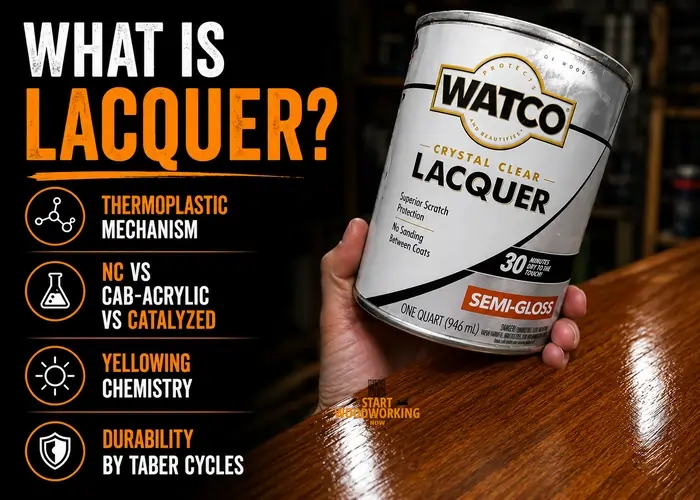
What Is Lacquer? Thermoplastic Mechanism, NC vs CAB-Acrylic vs Catalyzed, Yellowing Chemistry, and Durability by Taber Cycles
Lacquer is a thermoplastic film finish that cures entirely by solvent evaporation — unlike polyurethane and varnish, which cure through chemical cross-linking reactions. The thermoplastic classification is the defining property of lacquer: because cured lacquer remains soluble in its own solvent (lacquer thinner), each new coat partially re-dissolves the previous coat and the two merge into one unified layer. This re-amalgamation produces a chemical bond between coats rather than a mechanical one, which makes lacquer the most repairable common wood finish and the fastest to build on production furniture.
Navigate to your question
→ What exactly is lacquer? → Definition and thermoplastic mechanism ↓
→ NC vs CAB-Acrylic vs Catalyzed — which type? → Types comparison with Taber cycles ↓
→ Why is my lacquer turning yellow? → NC yellowing chemistry explained ↓
→ How durable is lacquer vs polyurethane? → Taber cycle comparison ↓
→ Should I use lacquer or polyurethane? → Decision guide by use case ↓
This guide is part of the complete wood finishing guide. For application protocol, dwell times, and safety: How to Apply Lacquer →
The three types of lacquer used in woodworking — nitrocellulose (NC), CAB-acrylic, and catalyzed lacquer — share the same fast-drying, sprayable character but differ in durability, colour stability over time, and application complexity. Choosing the wrong type for the species or use case produces either yellowing on light-coloured wood or insufficient durability on high-use surfaces.
⚠ Fire and Explosion Risk — Applies to All Solvent-Based Lacquers
Lacquer vapour is explosive at concentrations of 1.0–7.5% in air and is heavier than air — it accumulates on the floor and spreads silently. A single electric motor can ignite it from across the room. Always apply lacquer with maximum ventilation, all electric equipment turned off, and a NIOSH-approved organic vapour (OV) respirator. Water-based lacquer does not carry this risk.
What Is Lacquer and How Does It Differ from Other Wood Finishes?
Lacquer is a solvent-based film finish that dries by solvent evaporation and remains thermoplastic after cure — meaning it can be re-dissolved by the same solvent that originally dissolved it. This distinguishes it from polyurethane and alkyd varnish, which cure by chemical cross-linking and become permanently thermoset — insoluble in any solvent once cured.
The practical consequence of this distinction runs through every aspect of how lacquer behaves on wood:
Lacquer’s ability to re-amalgamate makes scratch repair invisible if done correctly — the wet-sanding protocol for restoring sheen after lacquer scratch repair and polyurethane refinishing applies to both finishes.
📝The re-amalgamation window matters for recoating: within approximately one hour of application, a new coat of NC lacquer partially dissolves the previous coat’s surface and welds chemically. After the previous coat has fully cured (2+ hours), re-amalgamation still occurs but with less physical blending of the films. This means same-day recoating without sanding is possible and reliable; recoating a fully cured lacquer finish does still bond chemically but produces a better surface when lightly sanded first to remove imperfections before the new coat is applied.
What Are the Different Types of Lacquer for Wood?
The three types of lacquer used in woodworking are nitrocellulose (NC), CAB-acrylic, and catalyzed lacquer. All three dry by solvent evaporation and all three re-amalgamate — but their durability, colour stability, and application complexity differ significantly. The choice between them is determined by the species (light or dark), the use case (production furniture or high-use surface), and the application method available.
| Type | Taber Cycles | Yellowing | Re-amalgamates | Best For |
|---|---|---|---|---|
| Nitrocellulose (NC) | 100–250 | Amber shift over time | Yes | Dark-toned species (oak, walnut, cherry); production furniture; instruments; antique restoration |
| CAB-Acrylic | 150–300 | Crystal clear — no yellowing | Yes | Light species (maple, birch); painted cabinets; any application where amber toning is unacceptable |
| Catalyzed Lacquer | 400–600 | Minimal (pre-cat) to none (post-cat) | Partial (less than NC) | Kitchen cabinets, commercial furniture; any application requiring polyurethane-level durability with lacquer application speed |
On light-coloured species like maple and birch where the NC lacquer amber shift is unacceptable, the closest non-yellowing alternative is water-based polyurethane — the complete colour stability comparison between aliphatic polyurethane and the lacquer family explains why.
Catalyzed Lacquer — Pre-Cat vs Post-Cat: The Shelf Life Issue
Pre-catalyzed lacquer has the acid catalyst already added at the factory. Once opened, the container begins slow cross-linking — shelf life is 3–6 months after opening. Using pre-cat lacquer past its shelf life produces a finish that begins cross-linking in the can, altering viscosity and reducing the re-amalgamation capacity. A container that has started to gel — even slightly — must be discarded.
Post-catalyzed lacquer has the acid catalyst added by the applicator immediately before spraying, typically at 2–5% by volume. Over-catalysis (too much acid) produces a film that cross-links too rigidly — it cannot flex with wood movement and crazes within months. Under-catalysis produces a film that never achieves its rated durability. Professional cabinet shops use post-cat for production applications; pre-cat is the standard for smaller shops that cannot use an entire batch within a shift.
Neither pre-cat nor post-cat catalyzed lacquer re-amalgamates as fully as NC or CAB-acrylic — the partial cross-linking from the acid catalyst reduces solubility in lacquer thinner. This means catalyzed lacquer is harder to spot-repair invisibly than NC lacquer.
Why Does Nitrocellulose Lacquer Yellow Over Time?
Nitrocellulose lacquer yellows because the nitro groups (–NO₂) in the cellulose nitrate resin react with UV light through a photooxidation process that produces chromophore groups — molecular structures that absorb visible light in the blue spectrum, causing the film to appear amber-yellow. This is not a surface deposit or staining — it is a chemical change within the resin structure itself.
The rate of yellowing depends on UV exposure — lacquered pieces kept away from direct sunlight yellow slowly over decades, while pieces in strong direct light may show noticeable amber shift within 2–5 years. Indoor fluorescent lighting accelerates yellowing more than incandescent because fluorescent tubes emit UV wavelengths that incandescent bulbs do not.
CAB-acrylic lacquer does not yellow because cellulose acetate butyrate (CAB) contains no nitro groups. The acrylic component also has no chromophore precursors. The result is a film that remains optically clear regardless of UV exposure — which is why CAB-acrylic was developed specifically for maple, birch, and painted furniture where the amber shift of NC lacquer would alter the intended colour.
How Durable Is Lacquer Compared to Polyurethane and Varnish?
Standard NC lacquer is less abrasion-resistant than oil-based polyurethane — NC lacquer rates at 100–250 Taber cycles, while oil-based polyurethane rates at 300–500 Taber cycles. CAB-acrylic improves this to 150–300 cycles. Catalyzed lacquer achieves 400–600 cycles — comparable to or exceeding oil-based polyurethane — through its partial cross-linking mechanism, which produces a harder film than non-catalyzed lacquer.
The durability limitation of NC and CAB-acrylic lacquer is primarily abrasion resistance, not water resistance — a properly applied and cured lacquer film resists brief water contact adequately. The practical implication is that non-catalyzed lacquer is appropriate for furniture that is handled but not heavily abraded (cabinetry, shelving, decorative furniture), while catalyzed lacquer is appropriate for surfaces that receive daily abrasion (kitchen cabinet doors, dining tables, commercial furniture).
The crazing risk of NC lacquer is a different failure mode from low abrasion resistance. Crazing — a network of fine cracks appearing across the lacquer film — occurs when the film cannot flex with the seasonal expansion and contraction of the wood beneath it. NC lacquer is brittle due to its high nitrogen content, making it the most crazing-prone common finish. Wide flat panels (tabletops, cabinet sides) in climates with significant humidity variation are the highest-risk applications for crazing. CAB-acrylic is less brittle and less prone to crazing on the same surfaces.
| Finish | Taber Cycles | Crazing Risk | Spot Repair |
|---|---|---|---|
| Oil-based polyurethane | 300–500 | Low — flexible film | Impossible — sand to bare wood |
| Catalyzed lacquer | 400–600 | Medium | Partial — limited re-amalgamation |
| CAB-acrylic lacquer | 150–300 | Low — less brittle than NC | Full — complete re-amalgamation |
| NC lacquer | 100–250 | High — brittle from nitrogen content | Full — complete re-amalgamation |
| Water-based polyurethane | 150–300 | Low | Impossible — sand to bare wood |
Conversion varnish and post-catalyzed lacquer are the only lacquer-family finishes that pass KCMA kitchen standards — why conversion varnish became the cabinet industry default and the pot life problem that limits DIY use.
When Should You Choose Lacquer Over Polyurethane or Varnish?
Choose lacquer when the primary requirements are fast completion, invisible repairability, or production efficiency — and the use case does not require maximum abrasion resistance. Choose polyurethane when maximum abrasion resistance is the priority and spot repair is not required.
Choose Lacquer When
✅ Multiple pieces need finishing quickly (lacquer recoatable in 30 min, full finish in 2–3 hours)
✅ Invisible spot repair is needed (antique restoration, musical instruments)
✅ Traditional warm-toned furniture on oak, walnut, cherry (NC amber enhancement)
✅ Light-coloured species or painted cabinets where yellowing must be prevented (CAB-acrylic)
Choose Polyurethane Instead When
✅ Maximum abrasion resistance is the priority (dining tables, hardwood floors, stair treads)
✅ You apply with a brush (brush lacquer requires a specialist product — standard lacquer cannot be brushed)
✅ No spray equipment available
✅ Children’s furniture requiring 7-day full cure before use (OB poly) or 4-day (WB poly)
Lacquer’s solvent-evaporation cure makes it incompatible with thermoset finishes beneath it, including polyurethane and varnish — the full compatibility logic for lacquer and polyurethane in the same finishing schedule covers every combination.
📝Lacquer is what I reach for when I want to be done.CAB-acrylic dries by evaporation alone, recoat at thirty minutes, so three coats fit inside a morning while a reactive finish would still be busy cross-linking. And the repairs vanish — fresh lacquer softens the coat beneath it and the two become one layer again. No cured film can do that, ever. The same chemistry sets the ceiling, though, and I found that ceiling the slow way. Nothing sets irreversibly, so heat resistance stays modest and solvents get through. Against oil-based poly the abrasion gap doesn’t show in year one. It shows in year five. Handled surfaces, lacquer. Used surfaces, something harder. A hot mug will tell you which one you built.
Frequently Asked Questions
Is lacquer the same as varnish?
No — lacquer and varnish are fundamentally different in cure chemistry. Lacquer cures by solvent evaporation and remains thermoplastic (re-soluble in lacquer thinner). Varnish and polyurethane cure by chemical cross-linking and become thermoset — permanently insoluble once cured. The practical difference: lacquer re-amalgamates between coats and can be spot-repaired invisibly; varnish and polyurethane cannot. Lacquer also dries 5–10 times faster than varnish and requires spray application; most varnishes can be applied by brush. Full comparison: Varnish vs Lacquer →
Is lacquer waterproof?
Lacquer is water-resistant rather than waterproof. A properly applied and cured lacquer film resists brief water contact — a water glass left on the surface for 30–60 minutes will not leave a ring in most cases. Prolonged water exposure (spills left overnight, surfaces regularly wetted) causes lacquer to blush (turn milky white) or soften. Catalyzed lacquer is more water-resistant than NC lacquer due to its partial cross-linking. For surfaces with regular water exposure (kitchen worktops, bathroom furniture), oil-based polyurethane or catalyzed lacquer provides better protection than non-catalyzed NC or CAB-acrylic.
Can you apply lacquer with a brush?
Not with standard spraying lacquer — it dries within 30–60 seconds of application, far too quickly for a brush to level the film. Brushing lacquer is a separately formulated product with retarder additives that extend the open time to 2–3 minutes — sufficient for brush application. The label must specify “brushing lacquer” or “brushable.” If the label does not specify, the product is formulated for spray only and will produce severe brush marks if brushed. Aerosol can lacquer is a practical middle ground for small work — no spray equipment required, applies evenly, and works the same as spraying lacquer. Complete lacquer application guide →
How long does lacquer last on furniture?
NC lacquer on furniture that is not heavily used: 10–25+ years before visible degradation (yellowing, crazing, or surface softening). NC lacquer on heavily used surfaces: 5–10 years. CAB-acrylic: similar longevity to NC, with the addition that the film stays optically clear rather than yellowing. Catalyzed lacquer: 15–30 years on high-use surfaces due to its cross-linked structure. Longevity is reduced significantly in high-humidity environments or when the lacquer is applied too thinly (under 2 mils dry film). The re-amalgamation property means lacquer can be renewed with a fresh coat that welds into the existing film, extending the finish life indefinitely with maintenance coats.
How do you identify lacquer on an existing piece of furniture?
Apply a small amount of lacquer thinner to a clean cloth and rub a hidden area of the finish firmly. If the finish softens, wrinkles, or dissolves within 30–60 seconds — it is NC or CAB-acrylic lacquer. If the finish resists lacquer thinner but softens with denatured alcohol — it is shellac. If the finish resists both lacquer thinner and denatured alcohol — it is polyurethane, varnish, or catalyzed/conversion varnish. Catalyzed lacquer resists lacquer thinner and is identified by the fact that it does not fully dissolve in any common woodworking solvent — only aggressive solvent blends (Peel Away, methylene chloride) will strip it. Complete finish identification guide →
Lacquer demands a dewaxed shellac sealer beneath it on resin-rich and tannin-rich species — the mechanism by which natural shellac wax causes lacquer delamination and the Zinsser SealCoat solution.
