
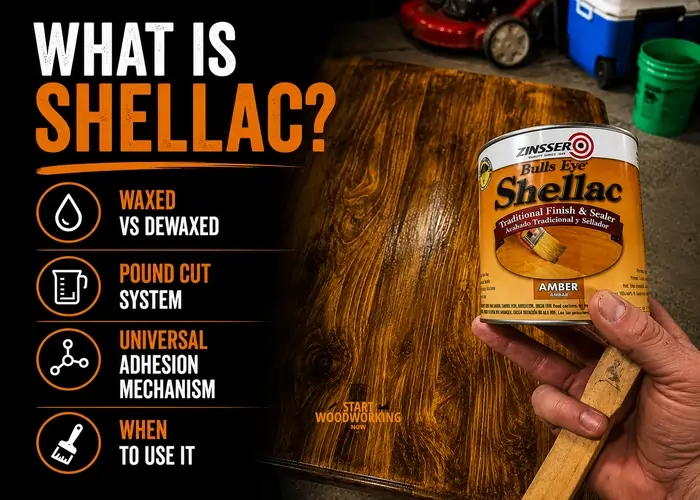
What Is Shellac? Waxed vs Dewaxed, Pound Cut System, Universal Adhesion Mechanism, and When to Use It
Shellac is a natural resin secreted by female lac insects (Kerria lacca) as a protective cocoon for their eggs. Dissolved in denatured alcohol, it produces a wood finish that is thermoplastic — each new coat partially re-dissolves the previous coat and chemically welds to it rather than bonding mechanically. This re-amalgamation property makes shellac the most repairable common wood finish and the only one that builds a film without sanding between coats.
Navigate to your question
→ What is shellac made from? → Lac insect origin and wax content ↓
→ Waxed vs dewaxed — does it matter? → Why waxed shellac blocks polyurethane ↓
→ What is a pound cut? → Pound cut dilutions explained ↓
→ Why does shellac stick to problem surfaces? → Universal adhesion mechanism ↓
→ When should I use shellac? → Use cases and when to avoid ↓
Shellac exists in two forms with fundamentally different properties: waxed shellac (natural resin with wax intact) and dewaxed shellac (wax removed through solvent or acid-base processing). Waxed shellac is a standalone finish — nothing bonds reliably over it. Dewaxed shellac is a universal adhesion primer — it bonds to almost any substrate and accepts almost any topcoat, including polyurethane, lacquer, water-based finishes, and paint. Confusing the two is the most common and most costly shellac mistake.
This article is part of the complete wood finishing guide — covering finish selection, application protocols, and troubleshooting for all finish types and species.
Food-grade shellac — a specific purified formulation recognized by the FDA as safe (GRAS) for use as a food glaze, listed as purified shellac in the FDA’s Substances Added to Food inventory — is used as a coating on candy, fruit, and pharmaceutical tablets. The shiny coating on jelly beans is food-grade shellac.
Standard woodworking shellac products (Zinsser, shellac flakes sold at hardware stores) are NOT the same formulation and are NOT certified for food contact. Do not use woodworking shellac on cutting boards or food-preparation surfaces without explicit food-contact certification on the product label.
⚠ Flammability — Denatured Alcohol Ignition Point: 13°C
Shellac is dissolved in denatured alcohol, which ignites at 13°C — below room temperature in an unheated workshop in winter. No open flames, no sparks, no electric equipment with exposed elements during application. Extinguish pilot lights on water heaters or furnaces in the same room before opening a tin of shellac. Ventilate the workspace. Store shellac tins away from heat sources.
Where Does Shellac Come From and Why Does Natural Shellac Contain Wax?
Shellac is harvested from the branch secretions of female Kerria lacca insects, which colonise certain trees in India and Thailand — primarily fig, acacia, and palas trees. The insects secrete the resin to form a protective tunnel around their eggs and bodies. The wax in natural shellac is not an additive — it is part of the insect’s secretion. The female lac insect secretes resin and wax simultaneously from separate glands; both compounds are present in the raw secretion collected from the tree branches.
Harvesting produces raw sticklac — dried resin attached to tree twigs with insects and debris included. Processing sequence: sticklac is crushed, washed, and heated to separate resin from debris, producing seedlac. Seedlac is further refined by solvent extraction or acid-base processing to produce dewaxed shellac flakes. If no wax removal step is performed, the result is waxed shellac flakes. The final flake colour — from almost-clear platina to deep garnet — depends on the tree species the insects colonised and the harvest season.
📝Shellac is the oldest industrial resin still in commercial use. It predates synthetic finishes by centuries — historical records of shellac use in furniture finishing go back to the Mughal Empire in the 16th century. The French Polish technique, which produces the mirror-like surface on fine antique furniture, uses shellac applied by a pad in thin layers exploiting the re-amalgamation property. When synthetic nitrocellulose lacquer became available in the 1920s, shellac was largely displaced from furniture finishing — but it remained irreplaceable as an adhesion primer and stain blocker, which is the primary role it serves in modern woodworking.
What Is the Difference Between Waxed and Dewaxed Shellac?
Waxed shellac contains 3–5% natural wax from the original insect secretion. Dewaxed shellac has been processed to reduce wax content below 0.5%. This single difference determines topcoat compatibility: waxed shellac prevents adhesion of polyurethane, varnish, and water-based finishes applied over it. Dewaxed shellac accepts all these topcoats. The 0.5% wax threshold is not arbitrary — polyurethane adhesion testing shows reliable bonding when wax content is below 0.5% and systematic failure above 1%.
| Property | Waxed Shellac | Dewaxed Shellac |
|---|---|---|
| Natural wax content | 3–5% | <0.5% |
| Polyurethane over it | Fails — wax prevents adhesion | Adheres reliably |
| Water-based finishes over it | Fails — fish-eye, adhesion failure | Adheres reliably |
| NC lacquer over it | Acceptable — lacquer re-amalgamates | Adheres reliably |
| As standalone final finish | Correct use — rubs out well | Acceptable — slightly harder film |
| Common retail products | Zinsser Bulls Eye Amber (orange can), standard shellac flakes | Zinsser SealCoat, blonde or super-blonde dewaxed flakes |
| Best for | Standalone finish on antiques, French Polish, stain blocker under lacquer only | Universal sealer/primer, stain blocker, odour barrier, adhesion promoter under any topcoat |
Shelf Life — Why Old Shellac Won’t Harden
Shellac dissolved in denatured alcohol has a maximum shelf life of approximately 3 years from the manufacture date. After this threshold, the resin undergoes acid-catalysed ester hydrolysis: the alcohol solvent reacts with the ester linkages in the shellac resin, gradually breaking them down. As hydrolysis progresses, the resin loses the cross-linking capacity required to cure into a hard film. Old shellac applies normally but dries tacky rather than hard — the film never achieves rated hardness regardless of drying time.
Practical test: Apply a drop of shellac from the tin to a piece of scrap glass or metal. Allow 30 minutes. If the drop is still tacky — discard the entire tin, regardless of how little has been used. The entire batch has undergone the same hydrolysis. There is no correction for overaged shellac — it cannot be rejuvenated by adding fresh alcohol or new flakes.
Shellac’s water and alcohol sensitivity makes it the wrong choice for kitchen surfaces; how polyurethane outperforms shellac on moisture resistance and where shellac still beats poly on repairability covers the full comparison.
What Is a Shellac Pound Cut and Why Does It Matter?
Shellac pound cut describes the weight of shellac flakes dissolved in one gallon of denatured alcohol. A 2 lb cut contains 2 pounds of flakes per gallon — a thinner solution that penetrates and seals more deeply with less surface build per coat. A 3 lb cut contains 3 pounds per gallon — thicker, more build per coat, longer drying time. Premixed shellac does not state its pound cut on the label, but it can be estimated: Zinsser Bulls Eye Amber is approximately 3 lb cut, Zinsser SealCoat is approximately 2 lb cut.
Pound cut affects both application behaviour and finishing results. A 3 lb cut applied with a brush produces visible brush marks more readily than a 2 lb cut — the higher resin concentration increases viscosity and reduces levelling time. For French Polish and French Polish-style finishing, a 1–2 lb cut produces the thin, stackable coats required for pad application. For sealing knots and stain bleeding on pine before painting, a 3 lb cut provides more resin per pass and requires fewer coats. For general sealing before any topcoat, 2 lb cut is the standard starting concentration.
| Pound Cut | Mix Ratio (per gallon) | Typical Products | Best Use |
|---|---|---|---|
| 1 lb cut | 1 lb flakes / 1 gal alcohol | DIY mix only | French Polish pad application, wash coat before staining on blotch-risk species |
| 2 lb cut | 2 lb flakes / 1 gal alcohol | Zinsser SealCoat (~2 lb) | Universal sealer / adhesion primer, sealing before any topcoat, odour barrier |
| 3 lb cut | 3 lb flakes / 1 gal alcohol | Zinsser Bulls Eye Amber (~3 lb), Zinsser Bulls Eye Clear (~3 lb) | Knot sealing on pine, stain blocker for heavy tannin bleed, standalone finish |
| Diluting for thinner cut | Add denatured alcohol to existing tin | Any premixed shellac | To thin Zinsser Amber (3 lb) to 2 lb: add 50% additional denatured alcohol by volume |
Shellac Colour Grades and Their Effect on Wood Tone
Shellac comes in five colour grades from the processing stages, each producing a different tonal effect on wood. All grades are available as dewaxed flakes for mixing; only some are available as premixed products.
Platina / Super Blonde
Near-colourless. No tonal shift. Best for pale wood species.
Blonde / Lemon
Very light amber. Slight warmth on light wood.
Orange / Amber
Warm amber. Standard premixed shellac. 1–2 shade darkening.
Garnet
Deep amber-red. Significant darkening. Traditional antique finish.
Button Lac
Very dark. Polymerised during processing. Hardest grade.
Why Does Dewaxed Shellac Stick to Everything Other Finishes Cannot Bond To?
Dewaxed shellac adheres to almost any substrate — bare wood, old finish, wax-contaminated surfaces (if wax is removed first), metal, and even some plastics — because its resin contains free hydroxyl groups and ester linkages that form hydrogen bonds with surface chemistry on almost any material. When the alcohol evaporates and the shellac film cures, these bonds anchor the shellac to the substrate without requiring chemical compatibility. Over the shellac, any topcoat can bond because the shellac surface presents consistent chemistry regardless of what is below it.
This is why dewaxed shellac is the professional solution for finishing problems that have no other remedy. A surface with stain bleed, silicone contamination, water damage, smoke odours, or incompatible previous finishes — none of which can be fixed by sanding alone — can be sealed with dewaxed shellac and then topcoated with any finish as if the substrate were bare wood. The shellac layer converts problem substrate chemistry into predictable, universal substrate chemistry.
When Should You Use Shellac and When Should You Avoid It?
Use dewaxed shellac whenever a finishing problem requires a universal adhesion bridge — between incompatible finishes, over stained or contaminated surfaces, or as a stain and odour blocker before any topcoat. As a standalone final finish, shellac suits antique furniture restoration, musical instruments, and decorative pieces where natural appearance and easy repair matter more than resistance to alcohol or heat. Avoid shellac — even dewaxed — as a final topcoat on any surface that contacts water regularly, heat above 50°C, or any alcohol-based liquid.
| Property | Value | Practical Impact |
|---|---|---|
| Solvent | Denatured alcohol only | Not dissolved by water, mineral spirits, lacquer thinner, or acetone. Only alcohol removes cured shellac. |
| Dry time | 30–45 min touch dry, recoat in 45 min | Fastest-drying common wood finish. Multiple coats possible in one working session. |
| Alcohol resistance | Zero — alcohol re-solubilises cured film | Wine, spirits, perfume, or cleaning products with ethanol will dissolve shellac finish. Not suitable as final coat on dining tables. |
| Heat resistance | Low — softens above 50°C | Hot cups or plates placed directly on shellac-finished surfaces leave impressions. Use heat-resistant topcoat for kitchen and dining surfaces. |
| Repairability | Excellent — re-amalgamates | Fresh shellac chemically welds to cured shellac. No visible repair boundary. Only polyurethane scratch patches are visible; shellac repairs are invisible. |
| VOC content | Variable — depends on concentration (alcohol solvent) | Flammable during application — denatured alcohol ignition point is 13°C. No open flames during application. |
| Shelf life (mixed/premixed) | 3 years maximum from manufacture | Check manufacture date on tin. Old shellac applies but won’t harden — tacky test on scrap confirms usability before starting a project. |
Why Alcohol Destroys Shellac — The Mechanism
Cured shellac film is a network of ester-linked resin molecules. Ethyl alcohol (ethanol) — the same compound in wine, beer, and spirits — re-solubilises this ester network by the same chemistry used to make shellac finish in the first place. A glass of wine placed on a shellac-finished table leaves a ring not because of moisture but because the alcohol in the wine partially dissolves the resin beneath it. The damage is not reversible by drying — the resin has been re-solubilised and redistributed. The only correction is to re-apply shellac to the damaged area — which, because of shellac’s re-amalgamation property, welds invisibly to the surrounding intact film.
The same property that makes shellac infinitely re-coatable also makes it incompatible with most modern topcoats — for the full chemistry of lacquer applied over shellac and why dewaxed is mandatory, see why dewaxed shellac is the only correct base under nitrocellulose lacquer.
Frequently Asked Questions
Is shellac food safe for cutting boards?
Food-grade shellac (confectioner’s glaze, standardised shellac) is FDA-approved as a food coating under 21 CFR Part 184.1. However, standard woodworking shellac (Zinsser, flake shellac) is not the same formulation as food-grade shellac — it may contain non-food-safe alcohol solvents and additives. For cutting boards and food-contact surfaces, use confirmed food-safe products: mineral oil, food-safe tung oil, or specifically food-certified shellac products. Using woodworking shellac on a cutting board is not recommended unless the product label explicitly states food-contact certification.
Can you apply shellac over polyurethane?
Yes — dewaxed shellac adheres over scuffed polyurethane and is commonly used as an intermediate coat to bridge between a polyurethane base and a different topcoat system, or to seal stains on a polyurethane-finished surface before spot repair. Scuff the polyurethane with 220-grit, apply dewaxed shellac, allow 45 min, sand 320-grit, then apply the next finish. Waxed shellac applied over polyurethane will adhere initially but create a wax-contaminated surface that prevents any subsequent topcoat from bonding.
What is French Polish and how is shellac used in it?
French Polish is a finishing technique — not a product — that uses shellac dissolved in denatured alcohol applied by a specialised pad called a muñeca or tampon. The pad is charged with a small amount of 1–1.5 lb cut shellac and moved across the surface in circular or figure-8 patterns, depositing extremely thin layers of shellac with each pass. Because shellac re-amalgamates — each new coat chemically welds to the previous — dozens of thin coats build into a mirror-like film without sanding between coats. French Polish produces the deepest, most optically clear surface of any wood finish, but requires considerable skill and takes hours of pad work to complete on a single surface.
How do you thin shellac to a lower pound cut?
Thin shellac by adding denatured alcohol to the existing solution. To convert 3 lb cut to 2 lb cut: add 50% additional denatured alcohol by volume (for every 100 ml of shellac, add 50 ml of denatured alcohol). To convert 3 lb cut to 1 lb cut: add 200% additional alcohol (for every 100 ml of shellac, add 200 ml of alcohol). Use only denatured alcohol — isopropyl alcohol is a poor solvent for shellac and produces a cloudy, incompletely dissolved solution. Methanol-based denatured alcohol produces the cleanest shellac solution.
How do you remove shellac from wood?
Denatured alcohol removes shellac from wood by re-solubilising the cured resin. Apply denatured alcohol with a cloth, allow 15–30 seconds of contact, and wipe firmly. Repeat until no more resin transfers to a fresh cloth. For thick, built-up shellac: apply generously, allow 1–2 minutes contact, then scrub with a synthetic abrasive pad (not steel wool) to lift the softened resin. Multiple passes with fresh alcohol are required for fully built French Polish. After removal, wipe with a clean cloth dampened in mineral spirits to remove any residual alcohol before recoating.
If your existing shellac has gone tacky and won’t harden, it’s almost certainly expired pre-mixed shellac past its Julian date — the full diagnosis for tacky oil and shellac finishes that never cure.