Shellac vs Polyurethane: Thermoplastic vs Thermoset, Taber Cycles, Burn-In Repair vs Impossible Spot Repair, and Dewaxed-Only Compatibility
Shellac and polyurethane differ in one fundamental property that determines everything else about how they behave: shellac is thermoplastic — it remains soluble in denatured alcohol indefinitely after curing, so every new coat chemically welds into the previous one and every scratch can be repaired invisibly. Polyurethane is thermoset — it cross-links into a permanent, insoluble polymer that cannot be re-dissolved by any common solvent, making it significantly more durable but impossible to repair without sanding back to bare wood.
This single difference — thermoplastic vs thermoset — explains every practical distinction between the two finishes: why shellac scratches more easily but repairs perfectly, why polyurethane resists alcohol and water but shellac does not, and why shellac is the correct choice for antique restoration while polyurethane is the correct choice for daily-use furniture.
Navigate to your question
→ What is the core difference between them? → Thermoplastic vs thermoset explained ↓
→ How much more durable is polyurethane? → Taber cycles and heat resistance values ↓
→ Why can shellac be repaired but polyurethane cannot? → The thermoplastic repair mechanism ↓
→ Can I use shellac under polyurethane? → When it works and when it fails ↓
→ Which should I choose for my project? → Decision matrix by use case ↓
This guide is part of the complete wood finishing guide. For full shellac definition: What Is Shellac? · Application guide: How to Apply Shellac →
Shellac repairs invisibly; polyurethane resists everything. See the full trade-off, and how each compares to other finishes, in the finish comparison tool.
What Is the Fundamental Difference Between Shellac and Polyurethane?
Shellac cures by solvent evaporation only — when the denatured alcohol evaporates, the shellac resin remains as a solid film. But that film remains permanently soluble in alcohol. Polyurethane cures by chemical cross-linking — the polymer chains form permanent covalent bonds that cannot be broken by any solvent after curing.
This thermoplastic/thermoset distinction is not a minor technical detail — it determines which finish is correct for each application. For antique furniture, period restoration, and musical instruments where invisible repair is essential: shellac. For dining tables, floors, kitchen furniture, and any surface receiving daily abrasion: polyurethane.
Applying polyurethane to a piece that will need spot repairs later is a long-term maintenance problem. Applying shellac to a dining table is an abrasion and water resistance problem that will appear within months.
How Much More Durable Is Polyurethane Than Shellac?
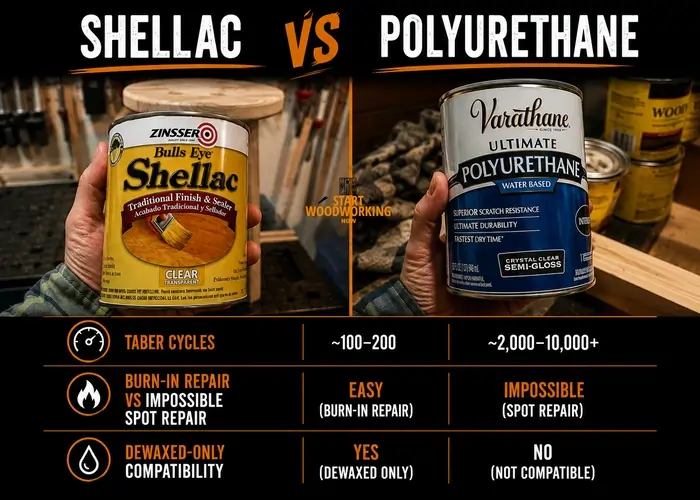
The durability difference is significant and measurable. Shellac rates at approximately 50–150 Taber abrasion cycles. Oil-based polyurethane rates at 300–500 cycles. Water-based polyurethane rates at 150–300 cycles. A Taber cycle simulates one pass of an abrasive wheel — the lower the number, the sooner the finish shows visible wear. Shellac at 50–150 cycles means it is the least abrasion-resistant common film finish by a significant margin.
| Finish | Taber Cycles | Softening Temp | Water Resistance | Alcohol Resistance |
|---|---|---|---|---|
| Shellac | 50–150 | ~70°C (160°F) | Poor — water rings | None — dissolves in ethanol |
| Water-based poly | 150–300 | ~100°C | Good | Resistant |
| Oil-based poly | 300–500 | ~120–150°C | Excellent | Excellent |
Why 70°C Matters — The Hot Mug Problem
Shellac [softens] at approximately 70°C — which is below the temperature of a freshly poured cup of coffee (approximately 80–85°C) and well below boiling water. When a hot mug is placed on a shellac surface, the shellac directly beneath the mug softens. As the surface cools, water vapour from the mug condenses in the softened film, producing a permanent white ring.
Oil-based polyurethane withstands temperatures up to 120–150°C without softening — well above any normal household hot object. This temperature difference is why shellac is not appropriate for kitchen furniture, dining tables, or any surface where hot cups, plates, or pans will be placed.
The Alcohol Sensitivity Spectrum — What Actually Damages Shellac
Competitors say “alcohol dissolves shellac” without specifying which concentrations matter:
Denatured alcohol (95%+): Completely dissolves shellac — this is the shellac solvent. Full damage immediately.
Spirits — whisky, vodka, gin (40–50%): Can damage shellac with extended contact (15+ minutes). Glass left overnight = white ring or softened patch.
Wine (12–15%): Causes damage with prolonged contact. Spill wiped immediately — likely no damage. Spill left 30+ minutes — risk of hazing.
Beer (4–6%): Minimal risk for brief contact. Extended pooling can cause slight hazing on waxed shellac; dewaxed shellac less vulnerable.
Why Can Shellac Be Repaired Invisibly but Polyurethane Cannot?
Shellac repair is invisible because the fresh shellac [re-dissolves] the existing film at the repair site — the two merge into one continuous film with no boundary. Polyurethane repair always has a visible boundary because cured polyurethane cannot be re-dissolved — the fresh poly sits on top of the existing poly as a separate layer, and the transition between the old and new coats is always detectable under raking light.
Shellac’s burn-in repair has no equivalent in polyurethane — but polyurethane scratches can be addressed through wet-sanding and re-coating — the polyurethane scratch repair protocol that minimises sanding through the finish.
Shellac brushes cleanly on large surfaces while polyurethane requires more control over brush marks — the polyurethane brush mark prevention technique using thinning and tipping-off.
📝On a 1920s walnut writing desk I restored, the previous owner had applied water-based polyurethane over the original shellac — which caused the poly to delaminate in patches. Stripping the poly revealed the original shellac partially intact. Rather than replacing with poly, I repaired the shellac using burn-in: fresh orange shellac on each chip and scratch, merged invisibly into the surrounding film. The entire repair took 45 minutes. The same repair in polyurethane would have required stripping the entire top surface and re-finishing from bare wood — a full-day job.
Can You Use Shellac Under Polyurethane — and When Does It Fail?
Dewaxed shellac under polyurethane works reliably and is a professional production technique. Waxed shellac under polyurethane always fails — the wax bloom on the shellac surface prevents polyurethane from bonding, and the poly delaminates within weeks. The distinction between dewaxed and waxed is the single most important detail in shellac-polyurethane compatibility.
Polyurethane over shellac is one-directional compatibility. Shellac over polyurethane does not work — polyurethane is insoluble in alcohol, so shellac cannot bond to cured polyurethane and will peel. Check all finish combinations →
When Should You Choose Shellac and When Should You Choose Polyurethane?
The decision follows directly from the thermoplastic/thermoset distinction: choose the finish whose primary properties match the primary requirements of the surface.
Choose Shellac When
✅ Antique and period furniture restoration — shellac was the standard furniture finish until the 1920s. Restoring an antique with polyurethane introduces an anachronistic, visually distinct finish that changes the character of the piece.
✅ Invisible repairability is essential — musical instruments, fine furniture that will be handled and scratched over decades, heirloom pieces where repair quality matters more than abrasion resistance.
✅ Children’s furniture and nursery items — shellac is FDA-approved as a food and candy coating and is the least toxic film finish. Oil-based polyurethane emits 250–450 g/L VOC; shellac emits near zero.
✅ Fast turnaround required — shellac is recoatable in 30–45 minutes; a complete 3-coat shellac finish can be applied in a single day. Oil-based polyurethane requires 24 hours between coats.
✅ Decorative objects and display furniture — pieces that will be looked at but not heavily used. Shellac’s warm amber tone and fine grain detail preservation are superior to polyurethane’s plastic appearance on figured wood.
Choose Polyurethane When
✅ Dining tables and kitchen furniture — hot plates, spilled wine, daily cleaning. Shellac fails on all three. Oil-based polyurethane handles all three.
✅ Hardwood floors — foot traffic, furniture dragging, regular cleaning. Shellac at 50–150 Taber cycles is not suitable for floors. Oil-based polyurethane at 300–500 cycles is the floor finishing standard.
✅ Bathroom and laundry furniture — high humidity and water exposure. Shellac’s poor water resistance is disqualifying; polyurethane handles moisture well.
✅ Outdoor furniture (under cover) — polyurethane handles temperature variation and occasional moisture; shellac does not survive outdoor conditions.
✅ Long-term durability without maintenance — oil-based polyurethane on furniture lasts 10–25 years without attention. Shellac requires maintenance coats every 2–5 years.
VOC and Safety Comparison
Shellac has near-zero VOC content — the shellac resin itself contributes no volatile organic compounds (denatured alcohol evaporates but shellac solids stay). Shellac is FDA-approved for use on candy and fruit. Oil-based polyurethane: 250–450 g/L VOC — requires good ventilation and an organic vapour respirator during application and for several days after as the finish continues to off-gas. Water-based polyurethane: 50–150 g/L VOC — significantly lower than oil-based but still requires ventilation. For any enclosed space, children’s rooms, or sensitivity to chemical odours: shellac is the safer application choice.
Frequently Asked Questions
Is shellac as durable as polyurethane?
No — the difference is substantial. Shellac rates at 50–150 Taber abrasion cycles; oil-based polyurethane rates at 300–500. Shellac also softens at around 70°C (hot mug contact = white ring) while polyurethane withstands 120–150°C. For decorative and low-use furniture, shellac’s durability is adequate. For daily-use surfaces, it is not sufficient.
Can you apply polyurethane directly over shellac?
Only over dewaxed shellac (Zinsser SealCoat or dewaxed flakes). Sand the shellac lightly with 320-grit, apply polyurethane within 24–48 hours. Over waxed shellac: polyurethane peels within weeks because the wax bloom prevents bonding. If uncertain whether the shellac is waxed or dewaxed: water drop test. Water beads = waxed = do not apply poly. Water wets = dewaxed = safe to apply poly.
Can you apply shellac over polyurethane?
No — this is one-directional compatibility only. Polyurethane is permanently insoluble in alcohol; shellac cannot bond to a thermoset surface. Shellac applied over cured polyurethane will peel because it has no chemical mechanism to adhere — it merely sits on top of an inert surface.
Is shellac good for kitchen cabinets?
For cabinet faces and doors that will see occasional wiping: yes — shellac is a traditional cabinet finish and its quick drying makes it efficient for multiple-component cabinet projects. For surfaces near the cooktop or regularly exposed to cleaning products: no — heat and alcohol sensitivity are disqualifying. Catalyzed lacquer or conversion varnish is the professional kitchen cabinet choice for durability. Water-based polyurethane is an accessible consumer alternative.
Which is better for wood floors — shellac or polyurethane?
Polyurethane, by a large margin. Shellac at 50–150 Taber cycles is not appropriate for floor use — foot traffic and furniture dragging will wear it through within a season. Oil-based polyurethane at 300–500 Taber cycles is the floor finishing standard. Shellac was used on floors historically (pre-1920s) because no better option existed — modern polyurethane completely outperforms it for this application.