
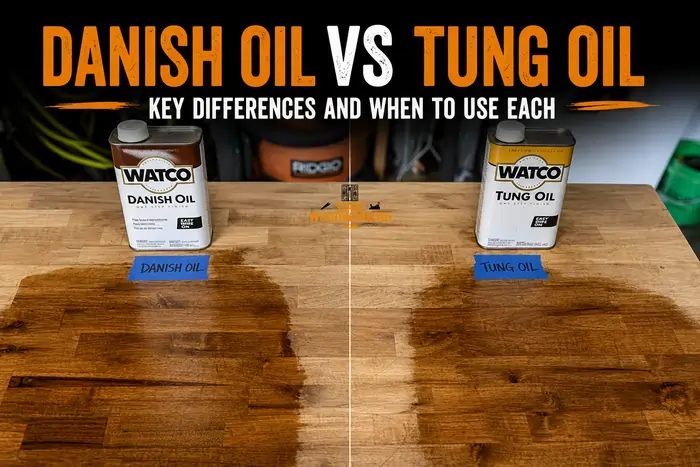
Danish Oil vs Tung Oil — Key Differences and When to Use Each
Danish oil and tung oil are both penetrating oil finishes used on furniture, floors, and woodwork — but they are not equivalent products. Danish oil is a long-oil varnish: a formulated blend of drying oil (approximately 65–70%), alkyd varnish (approximately 30–35%), and metallic driers. Tung oil in its pure form contains no varnish and no driers — it is a single-ingredient drying oil that cures entirely through oxidative polymerization. The varnish component in danish oil produces a slight surface film and satin sheen that pure tung oil does not produce. The metallic driers make danish oil dry in 24–48 hours while pure tung oil requires 5–7 days to become touch-dry.
The choice between them is not simply “which is better” — it depends on which specific properties matter for the application: food safety, drying speed, sheen level, species type, and whether a topcoat will be applied. For most general furniture applications, danish oil is more practical. For food-contact surfaces or applications requiring a truly matte finish, pure tung oil is the correct choice.
This guide is part of the complete wood finishing guide. For full definitions: What Is Danish Oil? · What Is Tung Oil?
Navigate to your question
→ What is the fundamental difference? → Composition and oil-to-varnish ratio ↓
→ Which is more water-resistant? → Surface vs deep penetration comparison ↓
→ Which is better for teak or oily wood? → Species performance and terpene inhibition ↓
→ Can I apply polyurethane over either? → Wait times and topcoat compatibility ↓
→ Which should I use for my project? → Decision matrix by use case ↓
⚠ Spontaneous Combustion — Both Danish Oil and Tung Oil Rags
Both danish oil and tung oil are drying oils that generate heat through oxidative polymerization. Rags saturated with either oil can ignite without external flame. After every application: spread rags flat outdoors on a non-combustible surface until fully dry, or submerge in a sealed metal container filled with water. Never bundle, fold, or leave in a bin.
⚠ Food Safety — Tung Oil Yes, Danish Oil No
100% pure tung oil is food-safe when fully cured (minimum 15 days). Danish oil contains metallic driers (cobalt and manganese naphthenate) — not food-safe regardless of cure time. For cutting boards, wooden utensils, and food-contact surfaces, use only pure tung oil or food-grade mineral oil. Never use danish oil on food-contact surfaces.
What Is the Core Difference Between Danish Oil and Pure Tung Oil?
Danish oil is a penetrating and film-forming hybrid. Pure tung oil is purely penetrating. The distinction matters because the varnish component in danish oil partially builds on the wood surface with each coat, contributing to a slightly harder and more abrasion-resistant finish than pure tung oil. Pure tung oil saturates the wood grain only — it produces no surface film at all. The finish is completely within the wood.
📝Danish oil’s “long oil varnish” classification comes from the oil-to-varnish ratio: any formulation with oil-to-varnish ratio above approximately 2:1 is a long oil varnish. At this ratio, the oil component dominates the cure chemistry and the product penetrates the wood grain first before the varnish component begins to build on the surface. Shorter oil ratios (1:1 or below) produce conventional varnish that sits predominantly on the surface. The long oil ratio of danish oil is exactly why it feels like an oil finish rather than a varnish finish despite containing significant varnish content.
Which Has Better Water Resistance — Danish Oil or Tung Oil?
Neither is absolutely better — they win in different situations. Danish oil has better surface water resistance shortly after application because the varnish component builds a thin protective layer. Pure tung oil has better long-term water resistance at depth because its alpha-eleostearic acid polymer network is denser than the linseed-based polymers in most danish oil formulations.
Pure tung oil’s superiority on water resistance traces back to the conjugated alpha-eleostearic acid in its fatty acid profile — the full conjugated vs non-conjugated fatty acid chemistry that explains all performance gaps between tung and linseed oil.
Practical recommendation by application: For outdoor furniture where a piece will be exposed to rain and periodic wetting — pure tung oil with 5–6 initial coats provides more durable long-term protection with no risk of film failure.
For indoor furniture requiring reliable protection against spills and occasional moisture — danish oil’s faster drying and immediate surface protection is more practical. For boat wood or surfaces with direct and prolonged water contact — pure tung oil is historically the correct choice and remains the better option.
How Do Danish Oil and Tung Oil Perform Differently by Wood Species?
On standard domestic species (oak, walnut, ash, cherry, maple, pine), both danish oil and tung oil produce excellent results — the choice is determined by practical factors (drying time, sheen, food safety) rather than species compatibility. The species-specific differences appear primarily on naturally oily exotic woods and on very open-grain ring-porous species.
| Species | Danish Oil | Pure Tung Oil | Recommendation |
|---|---|---|---|
| Oak, Ash, Walnut | Excellent — 2–3 coats | Excellent — 4–6 coats | Danish oil for efficiency; tung oil for maximum depth |
| Cherry, Maple, Birch | Good — 2–3 coats | Good — 2–4 coats | Either — preference for sheen and drying time |
| Pine, Softwoods | Good — wipe-off within 15–20 min | Good — thin coats essential | Danish oil for faster build; tung oil for matte result |
| Teak, IPE | Requires acetone wipe — metallic driers more sensitive to terpenes | Requires acetone wipe — more forgiving than danish oil | Tung oil preferred — natural polymerization less disrupted by terpenes |
| Rosewood, Cocobolo | Difficult — high terpene content disrupts metallic driers | Possible with rigorous acetone protocol | Tung oil with double acetone wipe — or consider hardwax oil |
Why Tung Oil Is More Forgiving on Oily Species Than Danish Oil
Danish oil contains metallic driers (cobalt and manganese naphthenate) that catalyse the oxidative polymerization reaction. These metallic compounds form stable complexes with the terpenes present in teak, IPE, and rosewood — effectively neutralising some of the driers before they can catalyse the oil cure. The result is a partially inhibited cure even after acetone pre-wipe, because the terpenes regenerate from within the wood and continue to contact the driers after application.
Pure tung oil has no metallic driers to inhibit — its cure relies entirely on the oxygen-driven chain reaction of alpha-eleostearic acid. Terpenes can slow this reaction but cannot neutralise it as completely as they neutralise metallic driers. This is why tung oil + acetone wipe on teak produces a more reliable result than danish oil + acetone wipe on the same species.
Can You Apply Polyurethane Over Danish Oil or Tung Oil?
Yes — but only after full cure, and with different wait times for each. Both danish oil and tung oil outgas solvents as they cure. Applying polyurethane before full cure traps residual solvents under the film, producing a cloudy or soft finish that never fully hardens. Danish oil’s metallic driers mean it reaches safe topcoating state faster than pure tung oil.
| Base | Topcoat | Minimum Wait | Confirm With |
|---|---|---|---|
| Danish oil | Oil-based polyurethane | 7 days | Dry cloth transfer test — zero oil transfer |
| Danish oil | Water-based polyurethane | 14 days + plastic sheet test | Plastic sheet 24h — zero condensation under plastic |
| Pure tung oil | Oil-based polyurethane | 14–21 days | Dry cloth + plastic sheet test both passed |
| Pure tung oil | Water-based polyurethane | 21–30 days minimum | Plastic sheet test — zero condensation after 24h |
Applying pure tung oil requires progressive dilution that’s not needed with danish oil — the step-by-step tung oil application with the saturation test and tacky failure diagnosis.
Danish Oil as a Primer Before Polyurethane — Professional Technique
Applying 1–2 coats of danish oil before a film finish (polyurethane or varnish) is a professional production technique that enhances the final result on porous or ring-porous species. The oil component fills the open grain cells, reducing the amount of film finish that disappears into the grain on the first coat. The varnish component in danish oil builds a partial substrate that film finishes bond to more effectively than bare oily grain.
Result: better first-coat coverage, enhanced figure and grain depth under the film finish, and reduced total film finish consumption. Allow full danish oil cure (7 days minimum, cloth test confirmed) before applying any film finish. This technique works with danish oil; pure tung oil is less effective as a primer because it has no varnish component to build the substrate.
When Should You Use Danish Oil and When Should You Use Tung Oil?
Use tung oil when food safety is required or a completely matte finish is the goal. Use danish oil in every other general woodworking application where faster drying and fewer coats matter more than food contact safety or a natural oil appearance.
Weighing either of these against a film finish like polyurethane or hardwax oil? Line them up on all seven properties in the wood finish comparison tool.
Use Pure Tung Oil When
✅ Food-contact surfaces — cutting boards, wooden utensils, salad bowls, children’s wooden toys. Danish oil is never food-safe.
✅ Truly matte finish required — no sheen at all. Picture frames, decorative carvings, antique-style furniture. Danish oil always produces some satin sheen.
✅ Oily exotic species (teak, IPE, rosewood) — tung oil is more forgiving than danish oil.
✅ Outdoor wood requiring long-term deep penetration — boat wood, garden structures, decking. 5–6 coats of pure tung oil saturate the grain more completely.
✅ Any object with regular prolonged skin contact where metallic drier absorption over years is a concern.
Use Danish Oil When
✅ General indoor furniture — sideboards, bookshelves, coffee tables, bedroom furniture. Danish oil finishes in a day; tung oil takes a week.
✅ Satin sheen preferred — danish oil enhances grain contrast with a warm, semi-gloss depth. More decorative on open-grain species.
✅ Fewer coats is important — danish oil reaches saturation in 2–3 coats on most species; pure tung oil requires 4–6 on open grain.
✅ Using oil as primer before polyurethane — danish oil’s varnish component builds a better substrate for film finishes than pure tung oil.
✅ High-humidity indoor environments — danish oil’s varnish component provides slightly better moisture barrier on freshly finished surfaces.
Weighing either of these against a film finish like polyurethane or hardwax oil? Line them up on all seven properties in the wood finish comparison tool.
Frequently Asked Questions
Can danish oil and tung oil be mixed together?
Technically yes — they are chemically compatible. But there is no practical benefit. Danish oil already contains a drying oil component (which may be tung oil) plus varnish and driers. Adding pure tung oil to danish oil dilutes the drier concentration and extends the drying time without meaningfully changing the finish character. If you want more penetration depth, apply additional coats of danish oil or switch to pure tung oil entirely. Mixing the two produces an unpredictable formulation with no documented performance advantage.
Is danish oil or tung oil better for a dining table?
Neither — polyurethane or hardwax oil is the correct choice for a dining table that receives daily use, hot plates, and spills. Danish oil or pure tung oil alone on a dining table will produce water marks and white rings within weeks of regular use. If you specifically want an oil finish on a dining table, hardwax oil (Rubio Monocoat, Osmo Polyx with carnauba wax topcoat) provides significantly better surface protection than either danish oil or pure tung oil while maintaining the natural oil appearance. If the choice is strictly between danish oil and tung oil for a low-use side table — danish oil’s varnish component provides marginally better surface protection.
Does danish oil contain tung oil?
Some formulations do and some don’t — “danish oil” is a marketing term rather than a defined formulation. The drying oil base in danish oil can be pure tung oil, boiled linseed oil, or a blend of both, depending on the manufacturer. Watco Danish Oil uses a tung/linseed blend. Liberon danish oil uses a linseed base. Because there is no regulatory definition of “danish oil,” the only way to know the exact composition is to read the product’s Technical Data Sheet (TDS), not the label description.
Which oil is better for outdoor furniture — danish oil or tung oil?
For hardwood outdoor furniture on a covered deck or patio with periodic rain exposure — danish oil is practical (3–4 coats, maintenance every 1–2 years). For furniture in direct sun and rain exposure, or for boat wood — pure tung oil with 5–6 initial coats provides more durable long-term protection because it saturates the grain more completely and has no surface film to fail. Neither provides UV protection without additives — on wood in direct sun, choose a product that specifies UV stabilisers (exterior hardwax oil, spar varnish) rather than standard danish oil or pure tung oil.
How do you maintain a surface finished with danish oil or tung oil?
Same process for both: clean the surface with mineral spirits to remove wax, grease, and accumulated surface contamination. Allow to dry completely (30–60 minutes). Apply one thin maintenance coat of the same oil, allow absorption (15–30 minutes), wipe off all excess. No sanding required if the surface is not damaged and has been maintained regularly. If the surface has become dry or dull, a light sand with 320-grit before the maintenance coat opens the pores slightly and improves oil absorption. Maintenance interval: danish oil on indoor furniture every 1–3 years; pure tung oil on outdoor wood every 6–12 months.
Both danish oil and pure tung oil produce penetrating finishes that need periodic refresh on floors — the per-finish floor maintenance schedule covering oil refresh intervals and screen-and-recoat for film finishes.