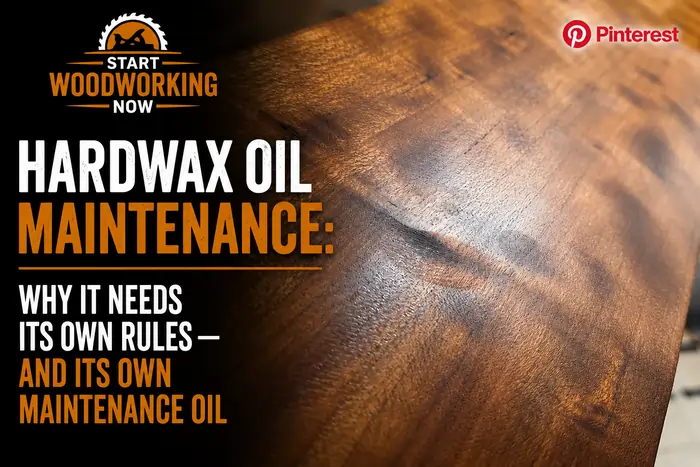
Hardwax Oil Maintenance: Why It Needs Its Own Rules — and Its Own Maintenance Oil
Hardwax oil sits chemically between penetrating oil finishes and film-forming finishes, and its maintenance rules reflect that hybrid position exactly — it needs the periodic re-oiling of a penetrating finish and the surface-layer thinking of a film finish, combined into a routine that’s distinct from either one alone. This is the practical reason manufacturers sell a dedicated “maintenance oil” product separate from their original application formula — a detail that confuses many users who reasonably assume any compatible oil should work for touch-ups, and end up with inconsistent results when it doesn’t.
This article is part of the wood finishing guide — covering finish selection, application, troubleshooting, and finish behaviour over time.
Navigate to your question
→ Why doesn’t hardwax oil maintain like a regular oil or film finish? → The hybrid chemistry that puts it between two maintenance worlds ↓
→ What should I use for daily cleaning? → Correct products and what to avoid ↓
→ How do I refresh it — and why is there a special “maintenance oil”? → Why plain oil isn’t enough and the buffing step ↓
→ Why do my floors get shiny patches in high-traffic areas? → Burnishing — and why it works differently here than on other finishes ↓
→ What mistakes ruin a hardwax oil maintenance routine? → Wrong products, skipped buffing, and the rag safety reminder ↓
Why Hardwax Oil Doesn’t Maintain Like Pure Oil or a Film Finish
Hardwax oil’s hybrid structure — a penetrating drying oil base combined with hard waxes (carnauba, beeswax, paraffin) that deposit as a micro-crystalline surface layer during cure — was established in detail in the film-forming vs penetrating finishes guide covering the hybrid mechanism. The oil component penetrates and polymerises within the wood’s cell structure exactly as in a pure oil finish, providing the dimensional stability and breathing characteristics covered there.
The wax component, however, does not penetrate into the wood — it remains at the surface, filling micro-irregularities and creating a thin, discontinuous protective layer that behaves more like a film finish’s surface barrier than like penetrating oil’s substrate modification.
This means hardwax oil maintenance has two separate components to think about: the oil’s gradual depletion within the wood (addressed the same way as any penetrating oil refresh) and the wax layer’s gradual wear at the surface (which needs its own replenishment, using a different approach than simply applying more of the original oil-and-wax product from scratch).
What to Use for Daily Cleaning
Routine cleaning for hardwax oil floors and furniture uses the same general principles as other finishes — dry dusting or sweeping to remove abrasive grit before it causes micro-scratching, with occasional damp cleaning for grime. The product specificity matters more here than for most finishes, because both overly aggressive cleaners and the wrong type of “gentle” product can cause problems.
Manufacturer-specific cleaning products formulated for hardwax oil (Osmo Wash and Care, Rubio Monocoat Soap, and equivalent product lines from other manufacturers) are formulated with a mild soap base and, in many formulations, a small amount of additional oil that helps maintain the surface between full maintenance cycles. These products are pH-balanced specifically for hardwax oil’s wax-oil surface chemistry rather than for a polymer film, and using them as the routine cleaning product extends the interval needed between full refresh applications.
Avoid products formulated for film finishes (standard hardwood floor cleaners designed for polyurethane) — these are typically formulated to be compatible with a continuous polymer film and may contain ingredients that interact poorly with the discontinuous wax surface layer of hardwax oil, sometimes leaving a hazy residue or interfering with the wax’s water-repellent surface properties over repeated use.
Similarly, avoid ammonia-based or strongly alkaline general household cleaners — while hardwax oil’s wax surface layer is somewhat more chemically resistant than bare penetrating oil due to the wax barrier, repeated alkaline exposure can still affect the wax layer’s integrity over time through a mechanism related to, though less severe than, the crosslink hydrolysis covered for polyurethane in the polyurethane maintenance guide.
How to Refresh Hardwax Oil — and Why a Dedicated Maintenance Oil Exists
The Signal That Refresh Is Due
The same water-bead test used for pure penetrating oil finishes applies here: when water no longer beads and instead darkens the wood at contact, the surface protection has depleted to the point that refresh is needed. For hardwax oil specifically, a secondary visual signal is the appearance of the surface — areas where the wax layer has worn through typically show a slightly duller, sometimes faintly powdery appearance distinct from the smooth, subtle sheen of intact hardwax oil, since the wax component is what provides much of the characteristic surface feel.
Why Plain Mineral Oil or Tung Oil Doesn’t Refresh It Properly
Applying plain mineral oil or pure tung oil to a worn hardwax oil surface replenishes the oil component within the wood but does nothing to restore the worn wax layer at the surface — the result is a surface that may pass the water-bead test temporarily but lacks the original product’s characteristic surface feel, water-repellency at the surface, and the subtle sheen consistency the wax component provides. This is the specific reason manufacturers formulate and sell a separate maintenance oil product: it’s designed to deliver a thin, surface-weighted dose of both oil and wax components calibrated for refreshing an already-established hardwax oil surface, rather than the heavier oil-to-wax ratio and higher total solids content needed for original application from bare wood.
The Refresh Process — Including the Buffing Step
Hardwax Oil Refresh — Step Protocol
Clean thoroughly with a hardwax-oil-specific cleaning product; let the surface dry completely.
Apply maintenance oil thinly — the dedicated product, not the original application formula. Penetrate 10-15 min.
Wipe off excess evenly across the surface.
BUFF — the step that distinguishes hardwax oil. Friction heat redistributes and bonds the wax into the surface. Skipping this gives a weaker, uneven result.
The refresh process follows the general oil refresh sequence — clean the surface thoroughly, apply the maintenance oil thinly and evenly, allow brief penetration time (typically 10–15 minutes, shorter than original application since the surface is already conditioned), then wipe off excess — detailed in general form in the oil finish refresh guide covering the application and wipe-off sequence.
The hardwax-oil-specific addition is a buffing step after wipe-off: using a clean cloth, a buffing pad, or for floors a floor buffer with a white or natural fibre pad, buff the surface with moderate pressure shortly after wiping off excess maintenance oil.
This buffing step generates mild friction heat that helps the wax component redistribute evenly across the surface and bond into the existing wax layer, rather than simply sitting as a thin unworked film that would wear away again quickly.
This mechanical step has no equivalent in plain oil refresh, where there is no wax component to redistribute, and skipping it on a hardwax oil refresh typically produces a less durable, less evenly sheened result even if the oil component itself has been correctly replenished.
Refresh Frequency
Hardwax oil floors in normal residential traffic typically need a maintenance oil refresh annually, similar to pure penetrating oil floors, though high-traffic commercial or heavy-use residential areas may need attention every 6 months. Furniture surfaces with lighter use can often go 1–2 years between maintenance applications.
Spot refresh of specific worn areas — rather than a full surface treatment — is appropriate and effective for localized wear, following the same logic of targeted maintenance covered in the general refresh guide, since hardwax oil’s wax component blends well at the edges of a spot-treated area without showing the harsh boundary line that might be expected.
Burnishing — Why Hardwax Oil Wears Differently Than Other Finishes
The burnishing phenomenon — where surface micro-texture is mechanically polished smooth under repeated traffic, increasing apparent sheen at wear points — was explained in detail for flatting agents in film finishes in the wood finish sheen guide covering the mechanism behind matte floors developing shiny traffic paths. Hardwax oil experiences a related but mechanistically distinct version of this same phenomenon, because of what the wax component actually is.
In a flatted polyurethane, the flatting agent (silica particles) is an inert filler suspended in an otherwise glossy polymer matrix — burnishing wears away an inert additive, revealing the naturally glossier polymer beneath, while the protective film itself remains fully intact regardless of how much the silica particles have been polished down.
In hardwax oil, the wax at the surface is not an inert filler sitting in a separate polymer matrix — it is itself the primary protective surface component, working alongside the penetrating oil rather than as an additive to a different base material. When high-traffic burnishing polishes the wax layer at a wear path, it is mechanically thinning the active protective component itself, not merely revealing a different material underneath.
The practical consequence: burnished, shiny high-traffic areas on a hardwax oil floor are a genuine signal that the wax layer has been mechanically reduced at that specific location and that a maintenance oil refresh (with its buffing step to redistribute fresh wax) is appropriate sooner at those specific spots than the general refresh interval would suggest, even if the rest of the floor still tests well on the water-bead test.
This is a meaningfully different diagnostic signal than burnishing on a flatted polyurethane floor, where the same visual shine increase does not indicate any reduction in the underlying film’s actual protective capacity.
This maintenance profile is the whole argument for hardwax oil, and it is also its trade-off. A surface you can spot-renew without a visible patch is worth more on a floor than a few extra points of hardness — and worth less on a table that takes daily abrasion. Weighed directly in hardwax oil against polyurethane.
Common Mistakes in Hardwax Oil Maintenance
Using the Wrong Maintenance Product
Applying a different manufacturer’s maintenance oil than the one matching the original application product, or substituting plain oil or a generic “wood conditioner,” can produce inconsistent wax compatibility — different manufacturers use different wax blends and ratios, and mixing systems can occasionally produce surface haze or uneven sheen at the boundary between treated and untreated areas. When the original product is known, using the matching manufacturer’s maintenance oil avoids this variable entirely.
Skipping the Buffing Step
As covered above, omitting the buffing step after applying maintenance oil leaves the wax component under-distributed and under-bonded to the existing surface, producing a less durable and less visually consistent refresh than a properly buffed application, even when the correct product has been used.
Treating Hardwax Oil Rags Like Low-Risk Waste
Hardwax oil rags carry the same spontaneous combustion risk as any drying-oil-based finish, because the oil component cures by the identical exothermic oxidative polymerization mechanism regardless of the wax additive — a risk specifically flagged in the oil rag spontaneous combustion guide covering hardwax oil as one of the commonly underappreciated risk products.
The “natural” and “eco-friendly” marketing language common to hardwax oil products has no bearing on this fire risk — maintenance rags must follow the same sealed-can-with-water or flat-outdoor-cure disposal protocol as any other oil-based finishing rag.
Expecting Film-Finish Durability Standards
Hardwax oil provides better water and stain resistance than pure penetrating oil but does not match the chemical and abrasion resistance of a true film-forming thermoset finish like conversion varnish or 2-part polyurethane, covered in the hardwax oil guide covering performance positioning relative to other finish categories.
Expecting hardwax oil to require zero maintenance simply because it markets itself as low-maintenance relative to pure oil finishes sets unrealistic expectations — it still requires the periodic maintenance oil refresh covered in this guide to maintain its protective performance over years of use. The original application protocol that this maintenance routine builds on, including the specific wipe-off timing for hardwax oil’s faster-tacking surface compared to pure oil, is covered in the hardwax oil application guide.
Hardwax oil tolerates more frequent cleaning than most finishes and needs it, because its maintenance coats bond to a clean surface and nothing else — the routine is in routine cleaning for finished wood.
Frequently Asked Questions
Can I use the original Osmo Polyx Oil to maintain a floor instead of buying the maintenance oil?
You can, and it will provide some benefit, but the original application product has a higher solids content designed for building protection from bare wood and is not formulated for the thin, surface-weighted refresh that an already-finished surface needs. The dedicated maintenance oil (Osmo Wax Maintenance Oil or equivalent) is specifically formulated for this refresh role and generally produces a more even, better-bonded result, particularly when paired with the buffing step.
Is hardwax oil low-maintenance compared to polyurethane?
It’s differently maintained rather than simply lower-maintenance. Hardwax oil avoids the screen-and-recoat or full-strip cycle that polyurethane eventually requires, since spot maintenance oil refresh works indefinitely without ever needing to remove the existing finish. However, it requires more frequent attention than polyurethane in normal use — annual maintenance oil application versus polyurethane’s multi-year intervals between any intervention. The trade-off is more frequent light maintenance versus less frequent but more disruptive full maintenance.
Why does my hardwax oil floor have a faint white haze after cleaning?
This is most commonly caused by using a cleaning product not formulated for hardwax oil’s wax-oil surface — particularly cleaners with the wrong pH balance or those designed for polymer film finishes. The haze is typically a reaction at the wax surface layer rather than damage to the underlying oil-impregnated wood. Switching to a manufacturer-specific hardwax oil cleaning product usually resolves this on the next cleaning, and a light maintenance oil refresh with buffing can correct existing haze if it persists.
Do I need to sand before applying maintenance oil to hardwax oil?
No, not for routine maintenance refresh. The maintenance oil is designed to be applied directly over the cleaned, intact existing surface, with the buffing step providing the mechanical action needed to integrate the fresh material rather than requiring abrasive sanding first. Sanding is only necessary if the surface has deep scratches, gouges, or localized wear-through to bare wood that needs levelling before the area can be properly re-treated.