
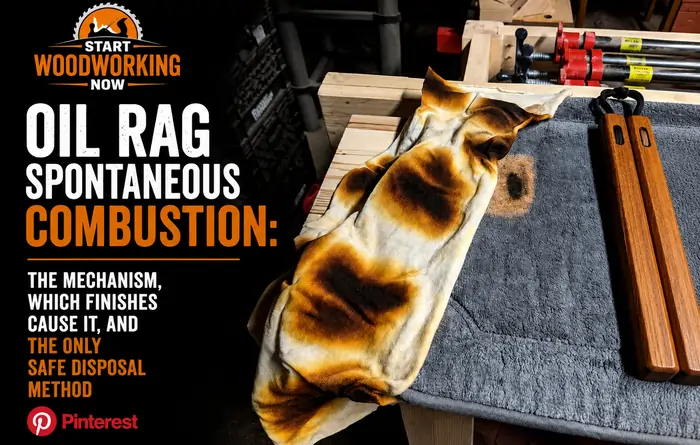
Oil Rag Spontaneous Combustion: The Mechanism, Which Finishes Cause It, and the Only Safe Disposal Method
Oily finishing rags catch fire without any external ignition source because the same chemical reaction that cures the finish on wood generates heat — and in a folded or piled rag, that heat has nowhere to go. This is not a freak accident requiring unusual conditions. A BLO-soaked rag crumpled in a workshop bin can reach self-ignition temperature in three to four hours on a normal summer day. Understanding the mechanism explains both why it happens and why the correct disposal method works.
This article is part of the wood finishing safety guide — covering hazard profiles by finish type, respirator selection, ventilation requirements, and PPE.
⚠ Fire Hazard — No External Ignition Source Required
Rags soaked in drying oil finishes — linseed oil, danish oil, tung oil, hardwax oil, oil-based polyurethane — can reach self-ignition temperature without any external flame or spark. This is not a theoretical risk: spontaneous combustion from finishing rags is a documented cause of structure fires. A single folded rag left in a waste bin can ignite in under four hours at room temperature.
Navigate to your question
→ What is spontaneous combustion in oily rags? → Why finishing rags can ignite without a flame — the short answer ↓
→ How does a rag catch fire by itself — the actual mechanism? → Exothermic oxidative polymerization and thermal runaway ↓
→ Which finishing products create this risk? → Iodine value as risk predictor — and the products people don’t expect ↓
→ How do I dispose of oily rags safely? → The two safe methods — and what not to do ↓
→ Can I keep the rags temporarily before disposal? → Temporary storage protocol when immediate disposal isn’t possible ↓
What Is Spontaneous Combustion in Oily Finishing Rags?
Spontaneous combustion is the ignition of a material from internal heat generation without an external flame, spark, or heat source. In oily finishing rags, the heat source is the oxidative curing reaction of the drying oil in the finish — the same exothermic chemistry that converts a liquid oil finish into a solid polymer film on the surface of wood.
The paradox: the property that makes linseed oil, tung oil, and their derivative finishes useful — the ability to cure and harden by reacting with atmospheric oxygen — is exactly the property that makes their application rags a fire hazard. On a wood surface, the heat generated during cure dissipates harmlessly into the surrounding air and wood mass. In a rag, it does not.
How Do Oily Rags Actually Catch Fire — The Mechanism
The chemical process is oxidative polymerization — the same reaction described in the context of oil finish curing. Drying oils contain unsaturated fatty acids with double bonds that react with atmospheric oxygen. This reaction is exothermic: it releases energy as heat as new carbon-oxygen bonds form and the oil crosslinks into a solid polymer network.
Why a Rag Behaves Differently Than a Wood Surface
On a wood surface, three factors keep the exothermic reaction from building dangerous heat. First, the oil film is thin — typically 0.05–0.2mm — limiting the total reaction mass and total heat output. Second, the wood substrate acts as a heat sink, absorbing generated heat and distributing it through its mass. Third, the large exposed surface area allows convective heat dissipation to the surrounding air.
A crumpled or folded oil-soaked rag eliminates all three of these controls simultaneously. The rag concentrates a large volume of oil in a small, poorly ventilated space. The fabric provides thermal insulation rather than heat-sinking. The geometry reduces surface area available for convective cooling. The result is thermal runaway: as the reaction generates heat, the elevated temperature accelerates the reaction rate (reaction rate roughly doubles per 10°C increase in temperature by the Arrhenius relationship), which generates more heat, which accelerates the reaction further, until self-ignition temperature is reached.
The Temperature Timeline
In a fire-service-supervised test documented on camera, BLO-soaked rags placed in a cardboard box climbed steadily in temperature through the first hour and self-ignited in just over three hours — consistent with the three-to-four-hour window reported across documented real-world cases at warm ambient conditions.
Exact ignition-point temperatures vary between sources and depend heavily on pile size, configuration, and insulation; what peer-reviewed self-heating research (Dlugogorski, Kennedy & Mackie, Fire Safety Science, 2011) demonstrates is how little external heat the reaction needs — their experiments tracked the runaway oxidation regime at oven temperatures of just 80–100°C, far below any flame. In hot summer conditions or near heat sources, the timeline shortens.
The critical insight: this is not a slow smoldering process that gives warning. Once thermal runaway begins, the final phase — from hot-to-touch to open flame — can occur in under 30 minutes, and through most of that phase the rag’s exterior may not feel dangerously hot to a brief touch, because the heat is concentrated in the insulated core of the pile.
Why Cobalt Driers Make BLO Riskier Than Pure Tung Oil
Metallic driers — cobalt, manganese, and zirconium compounds added to BLO, danish oil, and oil-based polyurethane to accelerate oxidative cure — function as catalysts for the same exothermic reaction. Cobalt driers specifically accelerate the initiation step of the oxidative chain reaction, shortening the time to self-ignition compared to the same oil without driers.
This is not just theory: peer-reviewed testing across commercial linseed oil varieties found boiled linseed oil the most reactive of all oils studied, with ICP analysis confirming the cobalt content and kinetic modeling confirming cobalt’s catalytic role in peroxide decomposition (Dlugogorski et al., Fire Safety Science 10, 2011). This is why BLO-soaked rags reach self-ignition faster than pure tung oil rags: the cobalt drier makes the reaction faster and more exothermic in the early oxidation stage.
The iodine value of an oil — a measure of the number of unsaturated carbon double bonds available to react with oxygen — predicts its drying behaviour and its spontaneous combustion potential. Linseed oil has an iodine value of 175–200, the highest of common finishing oils; tung oil runs 155–175; soybean oil approximately 130.
Mineral oil has an iodine value of essentially zero — it contains no unsaturated fatty acids, does not cure by oxidation, and produces no spontaneous combustion risk. The iodine value relationship explains why cooking oils and motor oil rags do not combust spontaneously while finishing oil rags do. The full drying oil chemistry, including the conjugated fatty acid structure of tung oil that drives its superior water resistance, is covered in the tung oil vs linseed oil comparison covering fatty acid chemistry and performance differences.
Which Finishing Products Create Spontaneous Combustion Risk?
The risk is specific to finishes containing drying oils — oils with high iodine values and, in most commercial products, metallic drier packages. The list is broader than most woodworkers assume.
| Product | Contains Drying Oil? | Metallic Driers? | Risk Level | Disposal Protocol |
|---|---|---|---|---|
| Boiled Linseed Oil (BLO) | Yes — linseed (IV 175–200) | Yes — cobalt + manganese | HIGHEST | Sealed metal can with water |
| Danish Oil | Yes — BLO or tung base | Yes — cobalt driers | HIGH | Sealed metal can with water |
| Oil-Based Polyurethane | Yes — alkyd/oil component | Yes | HIGH | Sealed metal can with water |
| Hardwax Oil (Osmo, Rubio) | Yes — sunflower/linseed base | Yes — varies by product | HIGH | Sealed metal can with water |
| Pure Tung Oil | Yes — tung (IV 155–175) | No — undried pure oil | MODERATE | Flat spread outdoors or sealed can |
| Alkyd Varnish / Wiping Varnish | Yes — alkyd resin (oil-based) | Yes | MODERATE–HIGH | Sealed metal can with water |
| NC Lacquer / Shellac | No — solvent-only cure | No | NONE | Standard waste; solvent = HHW |
| Water-Based Polyurethane | No | No | NONE | Standard waste once dry |
Products That Surprise People
-> Hardwax oil (Osmo Polyx, Rubio Monocoat) — these premium floor and furniture finishes are marketed as natural and environmentally friendly, which they are. But “natural” plant-oil base with metallic driers means identical spontaneous combustion risk to any other drying oil finish. The Osmo Polyx SDS specifically lists spontaneous ignition of oily rags as a fire hazard. The application protocol for hardwax oil including rag handling is covered in the hardwax oil application guide covering product-specific wipe-off windows and safety requirements.
-> Wiping varnish and “tung oil finish” products — products sold under names like Minwax Tung Oil Finish, Watco Danish Oil, and similar contain primarily alkyd varnish thinned with mineral spirits — an oil-resin blend with driers. Despite the “tung oil” name, these products cure by exactly the same oxidative mechanism and carry the same rag fire risk as straight BLO. The composition difference between products sold as “tung oil” and actual pure tung oil is detailed in the tung oil vs linseed oil comparison covering product authenticity testing.
-> Lacquer and shellac rags carry no spontaneous combustion risk — these finishes cure by solvent evaporation, not oxidative reaction. A lacquer rag is a fire hazard because of the residual flammable solvent, not because of an exothermic curing reaction. Once the solvent evaporates (typically within 1–2 hours), the cured lacquer film on the rag is no longer a fire risk from that mechanism. The disposal requirement is different: avoid concentrated solvent disposal but no spontaneous combustion protocol needed.
How to Dispose of Oily Finishing Rags Safely
Two methods reliably eliminate the spontaneous combustion risk. Every other approach — including common ones — does not. The methods below match the disposal guidance published by fire and rescue services (East Sussex Fire & Rescue Service — the fire hazards of linseed oil).
⚠ Safe Disposal Protocol — Sealed Metal Can Method
Place rags immediately into a metal container with a tight-fitting metal lid — do not let them sit, even briefly.
Add water until the rags are fully submerged — this displaces oxygen and stops the oxidative reaction entirely.
Seal the lid. Metal only — never plastic, which can melt before water contact stops the reaction.
Take to an HHW facility. Don’t store indefinitely — water can evaporate if the seal is imperfect.
Method 1 — Sealed Metal Container with Water (Immediate, Any Quantity)
Place rags immediately — do not let them sit, even briefly — into a metal container with a tight-fitting metal lid. Add enough water to fully submerge the rags. Seal the lid. The water displaces atmospheric oxygen from contact with the oil-soaked fabric, stopping the oxidative reaction entirely. Without oxygen, oxidative polymerization cannot proceed, no heat is generated, and self-ignition becomes impossible.
The container must be metal, not plastic. Spontaneous combustion generates sufficient heat to melt or deform plastic containers before water contact fully stops the reaction. Galvanised steel paint cans — the type sold at hardware stores for finish storage — are the standard choice. NFPA 30, the flammable and combustible liquids code, specifies metal containers with self-closing lids for oily waste storage in commercial settings.
After sealing, take the container to a hazardous household waste (HHW) facility. Do not leave the sealed can in the workshop indefinitely — the water will eventually evaporate if the seal is imperfect, and the rags remain combustible material requiring proper disposal.
Method 2 — Flat Single-Layer Outdoor Spread (Small Quantities, Good Weather)
Lay rags individually flat — never stacked, never folded — on a non-combustible surface outdoors: concrete, gravel, or metal sheeting. Separate each rag so no contact exists between pieces. Allow to cure completely until rigid and dry — typically 4–8 hours in warm, dry conditions; up to 24 hours in cold or humid weather.
This method works because it restores the conditions that make oil curing safe on a wood surface: thin film, maximum surface area, convective cooling. The exothermic reaction occurs, but the heat dissipates into the surrounding air rather than accumulating. Once the oil is fully cured — the rag stiff and dry — the exothermic reaction is complete and no further combustion risk exists.
Cured rags — fully hardened — can be disposed of in household trash in most jurisdictions. Verify local regulations; some municipalities require HHW disposal for all oily waste regardless of cure state.
What Does Not Work
❌ Piling rags in a bin or bucket
Stacking creates insulation and eliminates convective cooling — the exact conditions for thermal runaway. A plastic waste bin with piled oily rags is a documented fire origin scenario.
❌ Putting them in a paper bag or cardboard box
Paper and cardboard are combustible and provide the same insulating geometry as a pile. The bag itself ignites once the rags reach self-ignition temperature.
❌ Putting them in a plastic bag and sealing it
A sealed plastic bag traps the rags but does not supply water. Oxygen within the sealed bag is sufficient to sustain the oxidative reaction past self-ignition temperature; plastic melts before the bag fails structurally.
❌ “Letting them dry out” overnight in the shop
This is the most dangerous misconception. “Letting them dry” means allowing the oxidative curing process to proceed — the same process that generates the heat. In a folded or piled configuration, drying means the reaction proceeds toward self-ignition. Flat single-layer spread outdoors works; folded “drying” in the shop does not.
Temporary Storage When Immediate Disposal Isn’t Possible
Between the end of a finishing session and access to HHW disposal, rags must be kept in a state where the oxidative reaction cannot generate dangerous heat accumulation. Two approaches are appropriate for temporary storage of up to several days:
Sealed metal can with water is the correct temporary storage method as well as the disposal initiation method. A galvanised steel can with a tight-fitting lid, water-submerged rags, and a sealed lid can safely hold oily rags for days without combustion risk. Keep the can away from heat sources and out of direct sunlight. Do not allow the water to evaporate — check the water level if storing more than 48 hours.
Flat outdoor cure followed by interim storage — if rags are fully cured to stiff and dry, they can be stored in a sealed container without water because the exothermic reaction is complete. The risk is confirming complete cure: a rag that feels dry on the exterior may still be actively curing internally if the oil was applied thickly. When in doubt, treat as uncured and use the sealed-can-with-water method.
The danish oil application guide includes the specific per-coat rag disposal protocol that applies during multi-coat application sessions — including the interim handling between coats when rags accumulate faster than outdoor cure allows. The danish oil application guide covers the wipe-off timing and rag management for each of the three application coats. The same exothermic cure mechanism that drives spontaneous combustion is why danish oil and BLO sometimes fail to dry on the surface — the oil finish not drying mechanism is the same oxidative polymerization process operating normally on wood but disrupted by environmental conditions — covered in the oil finish not drying guide covering the oxygen starvation mechanism and mineral spirits rescue protocol.
The moment this hazard is generated is easy to predict: any job where excess oil gets wiped back. Refreshing a worn oil finish produces exactly that, often several rags at once, and usually at the end of a session when the shop is about to be locked up for the night. The routine, including disposal, is in refreshing an oil finish.
Frequently Asked Questions
How long before an oily rag can spontaneously combust?
BLO-soaked cotton rags in a folded configuration can reach self-ignition temperature in three to four hours at room temperature (20–25°C). At warmer ambient temperatures or near heat sources, the timeline is shorter. Pure tung oil rags without metallic driers take longer — typically six or more hours — but the risk is not eliminated. Do not assume a “short” session means safe rags.
Do paper towels carry the same risk as cotton rags?
Yes. The combustion risk is determined by the oil content and the geometry of the material — not by whether the substrate is cotton, synthetic fabric, or paper. Paper towels soaked in BLO or danish oil and crumpled carry the same spontaneous combustion risk as cotton rags. Treat all oil-soaked absorbent materials with the sealed-can-with-water protocol regardless of material type.
Can I reuse finishing rags?
Only if fully cured to stiff and dry — the exothermic reaction is then complete and no further combustion risk exists. A cured rag can be reused for the same finish without contamination risk. However, cured rags from one finish type should not be reused with an incompatible finish — a BLO-cured rag used to apply shellac will contaminate the shellac with oil residue. In practice, disposable shop towels are safer for most finishing work: eliminate the disposal ambiguity and the contamination risk simultaneously.
Does water-based polyurethane produce spontaneous combustion rags?
No. Water-based polyurethane cures by water evaporation and coalescence of polymer particles — not oxidative polymerization. It contains no drying oil component and no metallic driers. Application rags from water-based poly carry no spontaneous combustion risk and can be disposed of as standard waste once dry. This is one of the practical safety advantages of water-based over oil-based film finishes beyond VOC and inhalation considerations.