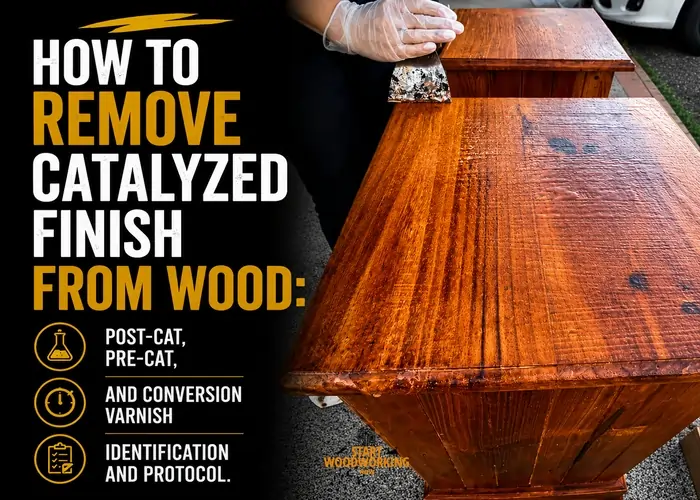
How to Remove Catalyzed Finish from Wood: Post-Cat, Pre-Cat, and Conversion Varnish Identification and Protocol
Catalyzed finishes — post-catalyzed lacquer, pre-catalyzed lacquer, and conversion varnish — cover the majority of professional cabinetry, custom furniture, and commercial woodwork produced post-1980. They are the reason “the stripper didn’t work” for a large proportion of users who have followed every instruction correctly and still see no result after 60 minutes of dwell. The chemical reason is specific: acid catalysis creates cross-linked ether and ester bonds during curing that standard solvents — lacquer thinner, NMP, benzyl alcohol, acetone — cannot dissolve at any practical contact time. These are not weaker-than-polyurethane finishes that just need more time. Conversion varnish (the most cross-linked subtype) resists all common solvents indefinitely. The correct response to a catalyzed finish depends on three variables: which subtype it is (pre-cat responds to extended NMP dwell; post-cat is intermediate; conversion varnish requires either MCl or mechanical removal), whether the goal is complete stripping or simply recoating (liquid deglosser eliminates the need for stripping on sound catalyzed finishes), and whether the surface is solid wood or veneer (veneered furniture with conversion varnish has no practical chemical solution — mechanical scraping or liquid deglosser recoating are the only options).
This guide covers the identification sequence distinguishing catalyzed subtypes from each other and from polyurethane, the chemistry of why standard solvents fail, the infrared pre-heat + NMP method for pre-cat and post-cat, the mechanical card scraper protocol, the MCl protocol where applicable, and the liquid deglosser recoating alternative that solves the problem for most homeowners without stripping at all.
How Do You Remove Catalyzed Finish from Wood?
- First, confirm it is catalyzed — and which subtype. Apply lacquer thinner 30 seconds: zero effect confirms it is not standard lacquer. Apply xylene 60 seconds: zero effect rules out water-based poly. Apply lacquer thinner extended (5 minutes) with light scrubbing: faint tactile softening = post-cat or pre-cat. Zero at 5 minutes = conversion varnish. Scratch test with key: no mark at any pressure = catalyzed (polyurethane leaves a faint mark at sustained pressure).
- Decide: full removal or recoating only? If the finish is sound (not peeling or delaminating) and the goal is applying a new colour, topcoat, or different finish — liquid deglosser (Wilbond, Klean-Strip Liquid Sander) etches the catalyzed surface chemically for adhesion without any stripping. This is the correct approach for 60% of cases. Full stripping is only needed when bare wood is required or the existing finish has structurally failed.
- For pre-cat or post-cat on solid wood: infrared pre-heat + NMP gel. Apply infrared paint remover to the surface at 10–15 cm for 20–30 seconds — this temporarily reduces cross-link density by raising surface temperature to 150–180°C. Immediately apply NMP gel thick (3–4 mm), cover with plastic film, wait 60–90 minutes. The pre-heated finish responds significantly better than cold application alone. Multiple applications needed.
- For conversion varnish on solid wood: mechanical card scraper or MCl. Card scraper held at 85–90 degrees to the surface, pushed along the grain — removes CV by shaving without chemicals, dust, or toxic fumes. Effective on flat surfaces. Or: methylene chloride (MCl) where available, outdoor use only, 45–90 minutes under plastic film. Both approaches followed by sanding 120→180 grit.
- For any catalyzed finish on veneer: liquid deglosser + recoating, or accept the finish as-is. No chemical stripper can remove catalyzed finish from veneer without delamination risk. Card scraper on veneer carries sand-through risk. Liquid deglosser on veneer surface for recoating is the only practical full-coverage option.
→ Confirm finish type: How to Identify Wood Finish — Sequential Solvent Tests
→ Stripper selection: How to Choose a Chemical Stripper
→ Safety: Chemical Stripper Safety Guide — PPE by Ingredient
→ Hub: How to Remove Wood Finishes — Complete Guide
Why Every Standard Stripper Fails on Catalyzed Finishes — The Chemistry
Understanding why standard solvents fail on catalyzed finishes is not academic — it determines whether you keep trying the same approach or switch to the correct one, and saves hours of wasted effort.
Standard lacquer (nitrocellulose, CAB-acrylic) is thermoplastic: the lacquer molecules are held together by weak Van der Waals forces and hydrogen bonds that lacquer thinner disrupts easily, allowing the polymer chains to separate and enter solution. The process is essentially the reverse of application — apply solvent, polymer re-dissolves.
Catalyzed finishes undergo a fundamentally different curing process. An acid catalyst (typically p-toluenesulfonic acid or phosphoric acid) triggers a cross-linking reaction between adjacent polymer chains, forming covalent ether and ester bonds between them.
These cross-links convert a thermoplastic-like material into a three-dimensional polymer network — a thermoset. The cross-links are chemical bonds that solvents cannot simply disrupt: NMP, benzyl alcohol, lacquer thinner, and acetone all lack the chemical mechanism to break ether-ether or ether-ester cross-links under ambient conditions.
Methylene chloride (MCl) works on some catalyzed finishes because its extremely small molecular size (84.93 g/mol) allows it to physically penetrate the cross-linked network and mechanically swell the polymer — not dissolving the cross-links, but expanding the network enough to reduce adhesion to the substrate. On conversion varnish with very high cross-link density, even MCl’s mechanical penetration is limited, requiring extended dwell and multiple applications.
The practical implication: if your standard stripper failed on a finish after 90 minutes of dwell under plastic film at 20°C+, the finish is almost certainly catalyzed. Applying more of the same stripper, extending dwell further, or switching to a different standard stripper will not produce a meaningfully different result.
The Three Catalyzed Finish Subtypes — Identification and Removal Difficulty
Complete Identification Sequence — Distinguish Catalyzed from Polyurethane and Each Other
The identification challenge with catalyzed finishes is that they share the “no solvent reaction” profile with oil-based polyurethane. The extended solvent test and physical tests below distinguish them reliably.
Which Method for Which Scenario?
Complete Protocol — Infrared Pre-Heat + NMP Gel (Pre-Cat and Post-Cat on Solid Wood)
Card Scraper Protocol — Mechanical Removal Without Chemicals
The card scraper is the correct tool for removing catalyzed finish from flat solid wood surfaces when chemical options are limited (veneer risk, MCl unavailability, indoor workspace).
A properly prepared card scraper removes thin shavings of finish and wood simultaneously, producing clean, flat bare wood without chemical fumes, dust (compared to sanding), or toxic exposure. It is absent from every SEO finishing guide and present in every professional finishing manual — the gap between professional knowledge and DIY content is largest here.
Preparing the card scraper
A card scraper that is not properly prepared will not cut — it will skate over the finish without biting. The scraper needs a burr (a tiny hook of steel) on its edge.
To create it: file the edges of the scraper flat and square (90 degrees), then burnish the edge with a hardened steel rod (a burnisher or the back of a chisel) held at 5–10 degrees off perpendicular, pressing firmly and drawing along the edge 3–4 times per side. The resulting burr is what actually cuts the wood and finish.
Scraping technique
Hold the card scraper at 85–90 degrees to the surface — nearly perpendicular, slightly forward of vertical. Apply firm downward pressure with thumbs in the centre and fingertips at the edges. Push forward with the grain direction.
You should see a ribbon or thin shaving forming in front of the scraper — this is correct. If the scraper only produces dust: the angle is too shallow, stand it more upright. If it skates without cutting: the burr is insufficient, re-burnish. Work systematically in strips, overlapping each strip by 1 cm.
Progress and finish
The card scraper removes both finish and a very thin layer of wood uniformly — the result is flat, clean bare wood rather than the uneven result that sanding can produce. After the catalyzed finish is fully removed: sand 120→150→180 grit to remove scraper marks (which follow grain direction and blend easily). Water drop test confirms clean pores before staining or refinishing.
📝Catalysed finishes taught me to ask one question before opening anything:
does this need to be bare wood, or does it just need to be a different
colour?
Conversion varnish barely notices NMP. Ninety minutes under plastic film might give you a little lifting at the door edges. That’s the whole result. The methylene chloride route does work, but now you’re outdoors, in a respirator, with a much longer day in front of you. If the honest answer was “different colour” — and usually it is — there’s a shorter road. De-gloss mechanically, prime with a shellac-based bonder like BIN, topcoat with a decent alkyd. It bonds. It looks the same as a stripped-and-repainted job to anyone who wasn’t there. Stripping earns its cost when bare wood is genuinely the point: a stain change, a clear finish over the grain, a repair hiding underneath. Otherwise you’ve spent three days getting somewhere one day would have taken you.
What Are the Key Specifications for Removing Catalyzed Finish from Wood?
| Entity / Variable | Attribute | Value and Detail |
|---|---|---|
| IR pre-heat before NMP gel application | Why it improves NMP effectiveness on pre-cat and post-cat | Catalyzed lacquer has a glass transition temperature (Tg) of approximately 120–160°C — above this temperature, the cross-linked polymer network becomes temporarily less rigid and slightly more permeable to solvent molecules. Infrared paint remover at 10–15 cm for 20–30 seconds raises the surface to approximately 140–160°C. When NMP gel is applied immediately to the pre-heated surface, the temporarily expanded network allows better initial penetration. As the surface returns to ambient temperature, the NMP is already within the finish film and continues working. This sequence is documented in professional finishing literature (Flexner, Wood Finishing 101) but absent from all DIY guides. |
| Card scraper mechanical removal | Technique for flat solid wood surfaces | A card scraper (high-carbon steel scraper, 0.6–0.8 mm thick, properly burnished) held at 85–90 degrees to the surface — nearly perpendicular — and pushed with the grain direction removes thin layers of catalyzed finish by shaving. The scraper works the finish off by mechanical force rather than chemical dissolution. Produces no dust (fine shavings or ribbons), no chemical fumes, requires zero PPE beyond eye protection. Effective on flat surfaces and gentle curves. Not practical on carved profiles or detailed areas. Requires a properly prepared scraper — a flat unhoned scraper will not cut effectively and will simply skate over the finish. |
| MCl on conversion varnish | Effectiveness and limitations | MCl (methylene chloride, dichloromethane) with its 84.93 g/mol molecular size penetrates the cross-linked CV network mechanically — swelling the polymer and reducing substrate adhesion. Applied 3–4 mm thick under plastic film, 45–90 minutes dwell. On pre-cat and post-cat: typically produces full release in 1–2 applications. On conversion varnish: partial release in first application, 2–3 applications for full removal. Must be used outdoors or with mechanical exhaust ventilation 15+ ACH — never indoors. MCl metabolises to carbon monoxide internally regardless of ventilation. Where MCl is unavailable (US consumer ban 2019, EU consumer restriction 2019): combination of IR pre-heat + NMP gel at extended dwell is the closest alternative for post-cat. |
| Liquid deglosser on catalyzed finish | Mechanism and when to use it | Liquid deglosser (Wilbond, Klean-Strip Liquid Sander, Scotch-Brite Liquid Deglosser) contains surfactants and mild solvents that etch the outermost surface layer of the finish — creating micro-roughness for adhesion without dissolving or removing the finish film. Applied with cloth, 10–15 minutes contact, wiped clean. Works on catalyzed lacquer and conversion varnish — the chemical etch does not depend on dissolving the cross-linked network, only on surface texture modification. Correct when: the finish is sound (not peeling), the goal is recoating (new colour, new topcoat, chalk paint), and bare wood is not required. Bonding agent (Bona Prep, Loba Lobasol) is a similar product specifically developed for hardwood floor applications. |
| Catalyzed finish age and removal difficulty | How cure age affects cross-link density | Pre-cat lacquer from a recently completed piece (under 1 year) is less fully cross-linked than the same product after 5+ years. Cross-linking continues slowly after initial cure as residual catalyst continues reacting. A 1-year-old pre-cat kitchen cabinet will respond better to IR + NMP than the same cabinet after 10 years. Practical implication: if you are working on a piece known to be recently finished (under 2 years), try IR + NMP gel at 90 min before committing to mechanical removal. |
| Veneer with catalyzed finish | Why chemical removal is not practical | Three simultaneous constraints: (1) NMP gel at extended dwell (90–120 min) lifts veneer adhesive — same water carrier risk as on polyurethane removal. (2) Benzyl alcohol at 3–4 hour dwell needed for any effect on post-cat — 4 hours on veneer still risks adhesive softening. (3) MCl on veneer: rapid penetration to substrate level will dissolve PVA adhesive before the finish releases. Card scraper on veneer: extremely high sand-through risk at 0.3–0.6 mm veneer thickness. Result: no practical full-stripping option for veneered furniture with catalyzed finish. Liquid deglosser for recoating, or accept the existing finish, are the realistic options. |
| Tannin species restriction | Iron contamination applies regardless of removal method | Same restriction as all finish removal: no steel wool, no steel scrapers, no steel brushes on oak, walnut, mahogany, cherry. Card scraper is high-carbon steel — technically can cause iron tannate if the freshly exposed wood grain contacts steel. Wipe the card scraper clean frequently and avoid leaving steel shavings on the surface. Use Scotch-Brite grey/white pads for residue removal. Neutralise with mineral spirits wipe after any chemical work on tannin species. |
| Post-removal preparation | Sanding and finish compatibility after catalyzed removal | After mechanical (card scraper) or chemical (MCl + NMP) removal of catalyzed finish: sand 120→150→180 grit, vacuum, tack cloth. Catalyzed finish removal often leaves micro-ridges and uneven areas that require more thorough 120 grit levelling than standard polyurethane removal. Water drop test confirms clean pores before stain or new finish. New finish compatibility: any finish is compatible with bare wood after complete removal. If applying a new catalyzed finish: only spray application works — no DIY brush-on catalyzed products. Most homeowners apply polyurethane or water-based topcoat over the stripped surface. |
Troubleshooting — Why the Removal Is Not Working?
| Symptom | Cause | Fix |
|---|---|---|
| NMP gel at 90 min under plastic: zero result | Conversion varnish — NMP cannot dissolve the high-density cross-linked network. Or pre-cat/post-cat but surface was cold (under 15°C). | Check workspace temperature — minimum 15°C. If temperature adequate and still no response: conversion varnish confirmed. Switch to card scraper or MCl (outdoor only). Or use liquid deglosser for recoating if bare wood is not required. |
| IR + NMP produced partial lifting (40–50%) but incomplete | Normal result for first application on post-cat or pre-cat. The fully-cured cross-linked areas require sequential applications. | Fully scrape what has lifted. Re-apply IR pre-heat to remaining areas. Fresh NMP gel immediately, 60 min dwell. 2–3 applications total is expected on catalyzed finishes. |
| Card scraper skating without cutting | Burr insufficient or scraper angle too shallow. | Re-burnish the scraper edge with a burnisher or chisel back — 3–4 firm strokes at 5–10 degrees off perpendicular. Increase scraper angle to more nearly perpendicular (closer to 90 degrees). |
| Liquid deglosser applied but new paint peeled | Liquid deglosser not compatible with the topcoat applied, or surface not clean before deglossing. Grease or wax on surface prevents deglosser from reaching the finish. | Clean with TSP solution or strong degreaser before any deglosser application. After deglosser: use bonding primer (Zinsser BIN or Bulls Eye 1-2-3) as intermediate layer before paint — bonding primer provides adhesion to difficult surfaces including catalyzed finishes. |
| MCl applied but finish barely responds after 60 min | Conversion varnish with very high cross-link density. MCl has mechanically penetrated but substrate adhesion is extremely strong. | Second and third MCl applications, fully scraping between each. Accept that CV may require 3 applications for full removal. Or combine: MCl for bulk chemical softening followed by card scraper to mechanically remove the partially-weakened film. |
Frequently Asked Questions About Removing Catalyzed Finish from Wood
How do I know if my kitchen cabinets have catalyzed finish?
Three indicators. First: provenance — cabinets from a specialist manufacturer or custom cabinet shop, not painted at home, not IKEA flat-pack. Second: the solvent test — apply lacquer thinner to a hidden hinge area for 30 seconds. No response (no softening, no tackiness) rules out standard lacquer. Apply xylene 60 seconds: no response rules out water-based poly. If both tests produce nothing: catalyzed or oil-based polyurethane. Third: scratch test — press a metal key firmly for 3–5 seconds. No mark = catalyzed (oil-based poly leaves a very faint mark under strong raking light). Positive on all three indicators = catalyzed finish confirmed.
Can I paint over catalyzed finish without stripping it?
Yes — and for most kitchen cabinet repainting projects this is the correct approach. Clean the surface thoroughly with a degreaser, apply liquid deglosser (Wilbond, Klean-Strip Liquid Sander) with a cloth for 10–15 minutes to etch the surface for adhesion, wipe clean, apply a bonding primer (Zinsser BIN shellac primer or Bulls Eye 1-2-3), then the topcoat paint. This approach produces a durable repaint finish without any chemical stripping, sanding, or PPE beyond basic precautions. The catalyzed finish remains as a stable substrate under the new paint system.
Why does my stripper work on some furniture but not others?
The finish type determines whether the stripper has any chemical mechanism to act on it. NMP, benzyl alcohol, lacquer thinner, and acetone all work by dissolving synthetic polymer binders or disrupting thermoplastic film structures. Catalyzed finishes are thermosets — their cross-linked polymer network is chemically resistant to these solvents. If your stripper works on some pieces (those with standard lacquer, polyurethane, or varnish) but not others (those with catalyzed finish), the cause is the finish chemistry of the resistant piece, not the stripper product or your technique.
Summary: Key Values for Removing Catalyzed Finish from Wood
Confirm catalyzed: lacquer thinner 30 sec = zero, xylene 60 sec = zero, key scratch = no mark. Extended thinner 5 min + scrubbing: faint softening = pre-cat/post-cat; zero = conversion varnish. Provenance: specialist cabinetry, custom furniture, marine interior = almost certainly catalyzed.
If goal is recoating (not bare wood): liquid deglosser + bonding primer resolves 60% of cases without any stripping — correct approach for kitchen cabinet repainting. Full removal on pre-cat/post-cat solid wood: IR pre-heat 20–30 sec → NMP gel immediately, 3–4 mm, plastic film, 60–90 min, 2–3 applications.
Full removal on conversion varnish: card scraper on flat surfaces (no chemicals, no PPE, effective), or MCl outdoor protocol. Veneer with catalyzed finish: liquid deglosser for recoating, no practical full-stripping option. Post-removal: mineral spirits wipe + baking soda neutralisation, 24h dry, water drop test, sand 120→150→180.
→ Identify finish type: How to Identify Wood Finish
→ Lacquer (standard): How to Remove Lacquer from Wood
→ Polyurethane: How to Remove Polyurethane from Wood
→ Chemical stripper safety: Chemical Stripper Safety Guide
→ Hub: How to Remove Wood Finishes — Complete Guide