How to Remove Grease from Wood: Absorption, Degreasing, and Sanding Guide
Grease stains on wood penetrate the surface by capillary action — the triglyceride molecules in cooking oil, animal fat, or mechanical grease are drawn into the wood pores by the same mechanism that makes wood absorb any liquid. On sealed wood with an intact finish, grease sits on the finish surface and is removed by degreasing detergent within minutes. On bare, oiled, or worn-finish wood, the grease penetrates the open grain within 5–15 minutes depending on wood porosity, and removal requires a two-stage process: first absorbing the bulk grease from the grain with a dry absorbent material, then extracting the remaining bound grease with a degreasing agent or mineral spirits. Old, fully cured grease that has polymerised in the grain requires sanding to remove completely.
This guide covers the correct method for each combination of grease type, wood finish, and stain age — with exact contact times, product types, and a decision framework so you select the right approach before starting.
How Do You Remove Grease from Wood?
→ For a complete overview of all wood stain and finish removal: How to Remove Wood Finishes and Stains
How Much Time Do You Have Before Grease Permanently Stains Wood?
The absorption timeline determines which removal method is still effective. Once grease has fully penetrated and begun to oxidise in the grain, surface-level degreasing is no longer sufficient and sanding becomes necessary. The table below maps grease stain age to removal difficulty and correct first action.
| Time Since Spill | Grease State | Surface Type | Correct First Action |
|---|---|---|---|
| 0–5 minutes | Liquid — not yet absorbed | Any | Blot with dry paper towel immediately — maximum removal before penetration begins |
| 5–30 minutes | Partially absorbed — surface still wet | Sealed finish | Dish soap + warm water on damp cloth — one wipe removes most grease from sealed surfaces |
| 5–30 minutes | Actively absorbing into grain | Bare or oiled wood | Absorbent powder (flour, cornstarch, talcum) — cover immediately, wait 15–20 min, remove |
| 30 min – 6 hours | Absorbed — surface dried | Sealed finish | Dish soap solution + firm scrub; mineral spirits if soap insufficient |
| 30 min – 6 hours | Absorbed into grain | Bare or oiled wood | Mineral spirits — 5–10 min contact; scrub with stiff brush along grain |
| 6–24 hours | Deep absorption — surface fully dry | Any unsealed wood | Mineral spirits + absorbent powder cycle; 2–3 applications before sanding assessment |
| 24+ hours (old stain) | Partially oxidised — bonded to grain | Any wood | Mineral spirits pre-treatment + sanding from 80 grit; chemical degreasing alone insufficient |
How Do You Choose the Right Grease Removal Method?
The correct method is determined by answering three questions in sequence. Work through this decision framework before selecting any product or technique.
Is a protective finish present on the wood?
Grease is trapped on the film. Use dish soap or degreasing spray. Use mineral spirits for tacky residue. No sanding required.
The surface is porous and grease has likely penetrated the grain. Proceed to Question 2.
How long has the grease been on the surface?
Apply absorbent powder (cornstarch/flour) for 20 mins to wick out oil. Wipe with mineral spirits.
Apply mineral spirits contact cloth for 10 mins. Scrub with stiff brush; repeat once.
Grease has bonded or oxidized. Surface cleaning is likely insufficient. Proceed to Question 3.
Is the grain still discoloured after solvent treatment?
Mechanical removal required. Sand 80 → 120 → 180 grit. Pre-wipe with spirits to prevent sandpaper clogging.
Solvent successful. Wipe clean, allow to dry completely, and re-oil or re-wax to restore the protective barrier.
Which Removal Method Works for Each Type of Grease on Wood?
Not all grease types respond equally to the same removal agent. Cooking oil, animal fat, mechanical grease, and butter have different fatty acid compositions and oxidation rates that affect solubility. The matrix below maps grease type to each removal method’s effectiveness.
| Grease Type | Dish Soap + Water | Absorbent Powder | Mineral Spirits | Sanding (old stains) |
|---|---|---|---|---|
| Cooking oil (vegetable, olive) | ✓ Effective | ✓ Fresh only | ✓ Effective | ✓ Definitive |
| Animal fat (butter, lard, meat drippings) | ✓ Effective | ✓ Fresh only | ✓ Effective | ✓ Definitive |
| Machine / mechanical grease | ✗ Insufficient | ~ Fresh only | ✓ Effective | ✓ Definitive |
| WD-40 / lubricant spray | ✗ Insufficient | ✗ Not effective | ✓ Effective | ✓ Definitive |
| Wax (candle, furniture wax) | ✗ Not effective | ✗ Not effective | ✓ Effective | ✓ Definitive |
| Cosmetic / skin cream | ✓ Effective | ~ Partial | ✓ Effective | ✓ Definitive |
📝 In my workshop, the most common grease scenario I encounter on restoration pieces is cooking oil absorbed into a worn patch of polyurethane on a kitchen table — the finish has degraded in high-use areas and the bare wood is exposed underneath. On those pieces, dish soap handles the sealed areas but the worn spots always need mineral spirits with a stiff brush. Two cycles of mineral spirits usually clean the grain fully if the stain is under 6 hours old.
How Do You Remove Fresh Grease from Wood Using an Absorbent Material?
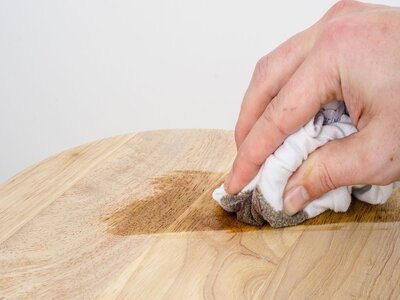
Absorbent materials — flour, cornstarch, talcum powder, or cat litter — remove fresh grease from wood by physical capillary action: the fine particles draw grease out of the wood pores by surface tension, reversing the same mechanism that caused the grease to penetrate in the first place.
This method is only effective on grease that is still liquid or semi-liquid — typically within the first 30 minutes of the spill. On grease that has dried and begun to solidify, absorbent powders have no meaningful effect.
The choice of absorbent material affects coverage and penetration depth. Fine powders — talcum, flour — make better contact with the wood surface and reach into smaller pores than coarser materials like cat litter or sand.
For the finest-grained wood surfaces, talcum powder is the most effective absorbent. For coarser-grained wood with larger visible pores (oak, ash), cat litter reaches into pore channels more effectively than fine powder.
STEP 1 – Cover the entire grease spill with absorbent powder immediately
Pour a generous layer of flour, cornstarch, or talcum powder over the entire grease spill, extending the coverage 2–3 cm beyond the visible stain edge. The powder must cover the grease completely — any uncovered area continues absorbing directly into the wood. Apply immediately after blotting up the surface layer of liquid grease with a dry paper towel.
STEP 2 – Allow 15–20 minutes contact time — do not disturb
Leave the powder undisturbed for 15–20 minutes. During this time the powder draws grease out of the surface wood pores. Do not press the powder into the wood or rub it — pressing forces the grease deeper rather than drawing it out. On warm wood surfaces (outdoor furniture in summer, wood near a heat source), the grease is more fluid and the absorbent works faster — 10 minutes is sufficient at surface temperatures above 25°C.
STEP 3 – Remove the powder and assess
Sweep or vacuum the spent powder away — do not wipe with a cloth, as this smears the grease-saturated powder across the clean surrounding wood. Inspect the stained area: if the powder has darkened uniformly and the wood surface appears lighter, repeat the process with fresh powder.
If the stain remains dark and unchanged after two powder applications, the grease has penetrated below the depth that surface absorption can reach — proceed to the mineral spirits method.
How Do You Remove Grease from Sealed Wood Using Dish Soap or a Degreaser?
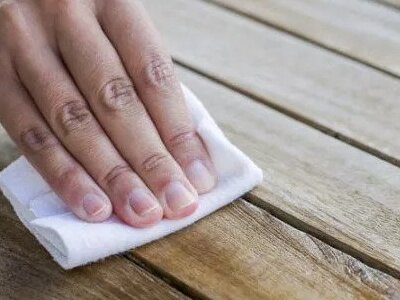
On wood with an intact sealed finish — polyurethane, lacquer, varnish — grease cannot penetrate past the finish film and sits on the surface. Dish soap (washing-up liquid) contains surfactant molecules that surround grease particles and allow them to be rinsed away with water. A 1–2% dish soap solution in warm water is effective on all cooking oils and animal fats on sealed wood surfaces.
STEP 1 – Mix dish soap solution — 1–2% concentration
Add 3–4 drops of dish soap to 250 ml of warm water — approximately 40–45°C. Warmer water improves surfactant activity and softens solidified fat, making removal faster. Do not use boiling water — thermal shock can crack aged lacquer or varnish finishes on antique furniture.
STEP 2 – Apply with a damp cloth — not a saturated one
Dip a clean lint-free cloth in the solution and wring it out until it is damp but not dripping. Excess water on wood surfaces risks raising the grain and causing watermarks, particularly on wax and oil finishes where water is not repelled. Wipe the stained area in the grain direction with firm, even pressure. Replace the cloth with a fresh section as it picks up grease.
STEP 3 – Rinse with clean damp cloth and dry immediately
After the grease is removed, wipe the area with a cloth dampened with clean water to remove soap residue — dish soap residue left on wood attracts dust and leaves a dull film. Dry the surface immediately with a clean dry cloth. Do not allow water to sit on any wood surface, sealed or not.
How Do You Remove Absorbed Grease from Bare or Oiled Wood Using Mineral Spirits?
Mineral spirits is the correct solvent for grease that has absorbed into bare, oiled, or waxed wood — and for all mechanical or petroleum-based greases regardless of surface type.
It dissolves the triglyceride and hydrocarbon chains in grease by like-dissolves-like chemistry, drawing the bound grease out of the wood pores in solution. It is safe on all wood species and all finish types except shellac, which it partially dissolves at extended contact times.
STEP 1 – Apply mineral spirits to a cotton cloth and saturate the stained area
Pour odourless mineral spirits onto a clean cotton cloth and apply it generously to the grease stain, working it into the grain with circular motions to distribute the solvent into the pores. Switch to grain-direction strokes to consolidate the dissolved grease at the surface. Allow 5–10 minutes contact time — this is the minimum needed for the solvent to reach grease absorbed below the surface layer.
STEP 2 – Scrub with a stiff natural-bristle brush
After the contact time, scrub the stained area with a stiff natural-bristle brush in the grain direction. On open-grain woods — oak, ash, walnut — the bristles reach into the pore channels and dislodge grease that the cloth cannot reach.
Replace the cloth frequently as it picks up dissolved grease — a saturated cloth re-deposits grease rather than removing it.
STEP 3 – Repeat and test for residual grease
After the first mineral spirits cycle, wipe the surface with a clean dry cloth and inspect. Press a clean white cloth firmly onto the treated area — any yellow or translucent greasy transfer confirms grease remains in the grain.
Repeat the mineral spirits application for a second cycle. If grease transfer continues after two full cycles, the grease has oxidised and bonded to the wood grain — sanding is required.
How Do You Remove Old or Oxidised Grease from Wood by Sanding?
Grease that has been in wood for more than 24 hours begins to oxidise — the unsaturated fatty acid chains in the oil cross-link with each other and with wood lignin through the same mechanism as linseed oil polymerisation. Once this process is complete, the grease is chemically bonded to the wood fibre and cannot be dissolved by mineral spirits alone. Sanding removes the grease-saturated wood fibre layer physically.
Always apply mineral spirits before sanding old grease stains — the solvent softens the oxidised grease layer and significantly reduces sandpaper clogging on the first pass. Without pre-treatment, 80-grit sandpaper clogs within 3–4 strokes on oxidised grease and must be replaced repeatedly.
- 80 grit — removes the grease-saturated wood fibre layer; reveals clean wood beneath
- 120 grit — removes 80-grit scratch marks; smooths the exposed surface
- 180 grit — final pass; prepares surface for new finish application
After the 80-grit pass, press a clean white cloth dampened with mineral spirits onto the sanded area. No grease transfer on the cloth confirms the stained layer has been fully removed. If transfer occurs, repeat the 80-grit pass before continuing. Sand in the grain direction at all stages. After completion, re-oil or re-wax bare wood surfaces — sanding removes all protective finish and leaves the grain open to new contamination.
How Does Wood Surface Type Affect Grease Removal?
| Surface Type | Grease Behaviour | First Method | Sanding Required? |
|---|---|---|---|
| Polyurethane finish (intact) | Stays on surface — no penetration | Dish soap solution | No — unless finish is worn through |
| Lacquer or varnish finish (intact) | Stays on surface — no penetration | Dish soap solution | No |
| Wax finish (beeswax, paste wax) | Absorbs into wax layer — partial penetration | Mineral spirits + fresh wax coat | Only if grease reached bare wood below wax |
| Oil finish (danish oil, tung oil) | Mixes with oil finish — penetrates grain | Mineral spirits + re-oil after treatment | For old stains only |
| Bare unfinished wood | Full penetration — rate depends on species porosity | Absorbent powder (fresh) or mineral spirits (absorbed) | For stains over 6 hours old |
| Hardwood floor (sealed) | Surface only if seal intact — penetrates at worn areas | Dish soap on sealed areas; mineral spirits on worn spots | Only at worn areas where penetration occurred |
| Outdoor wood (decking, garden furniture) | Deep penetration — UV-dried wood is highly absorbent | Mineral spirits — extended 10–15 min contact | Frequently required on weathered wood |
📝 The worst grease case I’ve dealt with was machine grease on a solid oak workbench — the owner had been using it as a workshop surface and the grease had been there for months. Mineral spirits softened the surface layer but the oxidised core required sanding to 80 grit. The oak pores were visibly darkened even after three mineral spirits applications, which confirmed the oxidised grease had fully bonded to the lignin. After sanding and re-oiling with danish oil, the surface was indistinguishable from the surrounding wood.
Frequently Asked Questions About Removing Grease from Wood
Does dish soap damage wood finishes when used to remove grease?
Dish soap at 1–2% concentration in warm water does not damage intact polyurethane, lacquer, or varnish finishes when used with a damp cloth and rinsed promptly. Extended contact time — leaving a soapy solution to sit on wood for more than a few minutes — can dull wax finishes by emulsifying the wax layer and leave a residue on oil finishes.
On bare wood, soap residue penetrates the open grain and interferes with subsequent finish adhesion if not fully rinsed and dried before refinishing.
Can you remove old grease stains from wood without sanding?
Old grease that has oxidised and cross-linked with wood lignin — typically stains present for more than 24 hours on bare wood — cannot be fully removed without sanding. Two to three mineral spirits applications reduce the stain significantly by dissolving the soluble fraction, but the insoluble oxidised portion remains bonded to the wood fibre and is only removed by physical abrasion.
The mineral spirits pre-treatment before sanding is essential — it reduces the depth of sanding required by softening the partially soluble surface layer first.
Is flour or cat litter more effective for absorbing fresh grease from wood?
Flour is more effective than cat litter on fine-grained or smooth-finished wood surfaces because its smaller particle size makes better contact with the surface and draws grease from shallower pores.
Cat litter is more effective on coarse open-grain wood species — oak, ash, walnut — where the larger granules can reach into the visible pore channels. Cornstarch and talcum powder perform similarly to flour and are preferred on delicate or antique wood surfaces where the coarseness of cat litter could scratch the finish.
What removes machine grease or WD-40 from wood that dish soap cannot?
Machine grease and petroleum-based lubricants like WD-40 contain hydrocarbon chains that dish soap surfactants cannot break down effectively. Mineral spirits is the correct solvent — it dissolves both cooking oils and petroleum-based greases through like-dissolves-like chemistry, making it the universal solvent for all grease types on wood. Apply with a cotton cloth for 5–10 minutes contact time, scrub with a stiff brush, and wipe clean. For particularly heavy machine grease deposits, a second mineral spirits cycle is usually needed before the wood is fully clean.
Summary: Key Values for Removing Grease from Wood
Removing grease from wood requires matching the method to the stain age and wood surface type. Fresh grease on sealed wood responds to dish soap at 1–2% in warm water applied with a damp cloth. Fresh grease on bare or oiled wood requires an absorbent powder — flour, cornstarch, or talcum — applied for 15–20 minutes to draw grease from the open grain, followed by a mineral spirits wipe.
Absorbed grease (30 minutes to 6 hours on bare wood) requires mineral spirits at 5–10 minutes contact time with stiff-brush scrubbing, repeated for up to three cycles. Machine and petroleum-based greases require mineral spirits regardless of surface type — dish soap is ineffective on hydrocarbon chains. Old, oxidised grease bonded to wood lignin requires mineral spirits pre-treatment followed by sanding from 80 to 120 to 180 grit, confirmed clean with a mineral spirits wipe test before refinishing. Re-oil or re-wax bare wood surfaces after any mineral spirits or sanding treatment to restore protection.
→ Related: How to Remove Linseed Oil from Wood
→ Related: How to Remove Oil-Based Stain from Wood
→ Hub: How to Remove Wood Finishes and Stains — Complete Guide