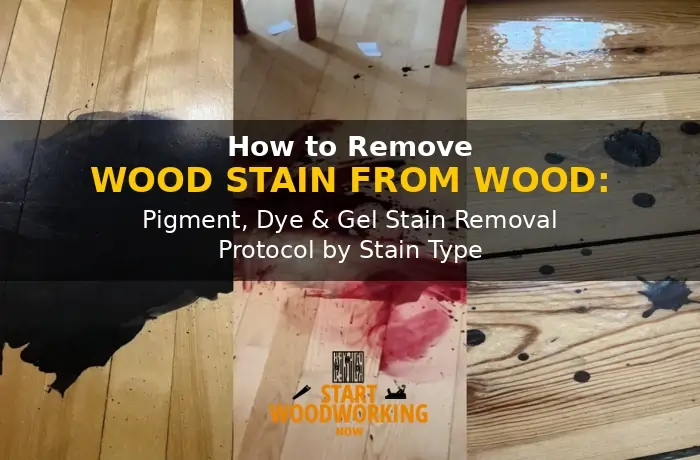
How to Remove Wood Stain from Wood: Pigment Stain, Dye Stain, and Gel Stain Removal Protocol by Stain Type
Wood stain is not a single substance — it exists as three chemically distinct types that respond to completely different removal agents. Pigment stain (Minwax Wood Finish oil-based, most standard stains) consists of mineral pigment particles held in wood pores by a binder resin. Chemical stripper dissolves the binder and releases the pigment; sanding removes residual pigment from open grain. Dye stain (TransTint, Mohawk dye stains, alcohol and water-based aniline dyes) consists of individual colorant molecules bonded chemically to wood cellulose fibres at a molecular level. Chemical stripper has no effect on dye — the molecules are not held by binder but by electrostatic and chemical bonds to the wood itself. Bleaching with chlorine bleach (pool-strength calcium hypochlorite) or two-part wood bleach is the only removal method for dye stains on bare wood. Gel stain (General Finishes Gel Stain, Minwax Gel Stain) is a thickened pigment stain that sits primarily on the wood surface rather than penetrating pores — it responds to mechanical scraping followed by mineral spirits and stripper before sanding. Many commercial stains (Minwax Wood Finish, Watco stains) contain both pigment and dye — requiring both the stripper protocol and the bleach protocol in sequence. The persistent colour that remains after chemical stripping on these products is the dye component, which is unaffected by the stripper.
This guide covers the identification test for each stain type, the complete protocol for pigment stain removal, dye stain bleaching (chlorine and two-part wood bleach), gel stain removal, and the combined protocol for blended commercial stains.
How Do You Remove Wood Stain from Wood?
→ Related: How to Remove Oil-Based Stain from Wood→ Hub: How to Remove Wood Finishes — Complete Guide→ Hub: How to Remove Stains from Wood — Complete Guide
What Are the Three Types of Wood Stain and How Do They Differ Chemically?
The type of colorant determines both how the stain bonds to the wood and which removal agent breaks that bond. Identifying the stain type before starting avoids the most common removal failure: applying chemical stripper to a dye stain and achieving no result because the molecules are bonded directly to wood cellulose, not held by a binder that stripper can dissolve.
How Do You Identify Whether a Wood Stain Is Pigment or Dye Before Removal?
The mineral spirits test identifies the stain type in under 30 seconds on any bare wood surface (after topcoat removal). This test is the critical step that determines which protocol applies — skipping it leads to either hours of ineffective chemical stripping on a dye stain, or the wrong type of bleach applied to a pigment stain.
Mineral Spirits Cloth Identification Test
Remove any clear topcoat first (polyurethane, lacquer, varnish). Apply mineral spirits to a white cotton cloth and wipe the stained surface firmly for 30 seconds in the grain direction. Inspect the cloth.
What Are the Key Specifications for Removing Wood Stain from Wood?
| Entity / Method | Attribute | Value |
|---|---|---|
| Chemical gel stripper (Citristrip) | Application and dwell time on pigment stain | Apply 2–3 mm layer over bare stained wood. Cover with plastic film. Allow 20–30 minutes dwell (citrus-based). Scrape with plastic scraper. Wipe with mineral spirits. 2–3 applications for multiple stain coats. |
| Chemical stripper (methylene chloride) | Dwell time and safety | 10–15 minutes dwell. More aggressive — use outdoors with chemical respirator (not dust mask). Faster result on oil-based pigment stains with alkyd binder. |
| Chemical stripper on dye stain | Effectiveness | Zero. Dye molecules bond directly to wood cellulose — no binder to dissolve. Applying stripper to a pure dye stain produces no colour change regardless of contact time or number of applications. |
| Chlorine bleach (calcium hypochlorite) | Concentration and application | Pool-strength calcium hypochlorite — saturated solution (add crystals to water until no more dissolve). Apply immediately after mixing with brush or cloth to bare wood. Allow overnight. Rinse thoroughly with water. Allow 24 hours drying before assessment. Effective on: organic dyes (acid dyes, direct dyes, basic dyes). NOT effective on pigment, NOT effective on metalised dyes. |
| Chlorine bleach on pigment stain | Effectiveness | None for removing pigment. May lighten the appearance slightly by oxidising any dye component but has no mechanism for dissolving binder or removing pigment particles from pores. |
| Two-part wood bleach | Components and application | Part A: sodium hydroxide (or oxalic acid in some formulations). Part B: hydrogen peroxide (30%). Apply Part A to bare wood, immediately follow with Part B. Allow 1–4 hours. Rinse thoroughly with water, allow 24 hours. Effective on: metalised acid dyes, metal complex dyes, tannin-based discolouration. Also lightens natural wood colour — use only when chlorine bleach is ineffective. |
| Two-part bleach on natural wood colour | Side effect | Lightens natural wood colour significantly — particularly on walnut (strips dark natural tone), cherry (removes natural amber), oak (lightens tannin colour). This may be desirable if objective is to neutralise darkening, but is irreversible. Test on hidden area. |
| Sanding after pigment stain removal | Starting grit and sequence | 80 grit on open-grain species (oak, ash, walnut) where pigment is loaded in pores. 100 grit on close-grain species (maple, cherry) where pigment sits near surface. Progression: 80 → 100 → 120 → 150 → 180 grit. |
| Topcoat removal before stain identification test | Required method by topcoat type | Polyurethane / varnish: chemical gel stripper. Lacquer: lacquer thinner / acetone. Shellac: denatured alcohol. Oil finish: mineral spirits. Topcoat must be fully removed before mineral spirits identification test is valid — testing through intact topcoat gives false results. |
| Minwax Wood Finish (oil-based) | Composition and removal protocol | Contains both pigment and dye. Protocol: (1) remove topcoat with stripper; (2) apply stripper to pigment component, scrape, sand 80–100 grit; (3) if colour persists after sanding, apply chlorine bleach for dye component. Colour remaining after full sanding is dye — not pigment residual. |
| Gel stain removal | Protocol sequence | Step 1: plastic scraper at 30–45 degrees — gel sits on surface. Step 2: mineral spirits cloth — dissolves binder film left after scraping. Step 3: chemical stripper if any colour remains. Step 4: sand 100–120 grit. Less material removal required than liquid pigment stain. |
| Sanding before bleach application | When required | Sanding before bleach on dye stain is counter-productive — removes surface wood fibres but dye has penetrated deeper. Sand to 80–100 grit AFTER bleach treatment is complete and wood is fully dry, to remove fibres raised by the bleaching process and residual surface discolouration. |
| Neutralisation after bleach | Required method and timing | After chlorine bleach: rinse with clean water, allow 24 hours drying. After two-part bleach: neutralise with diluted white vinegar (1:10 in water) applied with cloth, then rinse with clean water, allow 24 hours. Failure to neutralise two-part bleach leaves alkaline residue that prevents new finish adhesion. |
Step 1 — How Do You Remove the Clear Topcoat Before Treating the Stain?
Most stained wood surfaces have a clear topcoat applied over the stain — polyurethane, lacquer, varnish, or shellac. This topcoat must be fully removed before the stain can be treated. Attempting to bleach or strip a stain through an intact topcoat is ineffective — the topcoat physically prevents the removal agent from reaching the stained wood surface. The topcoat removal method depends on the finish type.
| Topcoat Type | Identification | Removal Method |
|---|---|---|
| Polyurethane | Hard, resists fingernail, alcohol and lacquer thinner have no immediate effect | Chemical gel stripper (Citristrip 20–30 min, methylene chloride-based 10–15 min). Scrape, wipe with mineral spirits. |
| Lacquer (nitrocellulose) | Lacquer thinner dissolves surface immediately on cotton swab test | Lacquer thinner or acetone — wipe with cloth, surface dissolves. Multiple wipes for full removal. |
| Shellac | Denatured alcohol dissolves surface on cotton swab test | Denatured alcohol — wipe with cloth. Surface dissolves rapidly. 2–3 passes. |
| Varnish (alkyd) | Resists all solvents; mineral spirits has no visible effect; requires strong chemical stripper | Methylene chloride stripper or gel stripper. 15–20 min dwell. |
| Water-based polyurethane | Slightly more flexible than oil-based; scratch test shows white powder | Gel stripper, 20–30 min dwell. May require 2 applications. |
Do not sand through the topcoat before chemical treatment: Sanding a sealed topcoat surface clogs the sandpaper with fine finish particles and smears the binder into the wood grain, making the subsequent chemical treatment less effective. The correct sequence is always chemical removal of the clear topcoat first → then assess the stain type → then apply the correct stain removal protocol.
How Do You Remove Pigment Stain from Wood?
Pigment stain holds colour in the wood through a binder resin that adheres pigment particles to the wood surface and into pores. Chemical stripper dissolves the binder and releases the pigment; sanding removes pigment particles from open grain where they have lodged mechanically beyond the depth that stripper penetrates.
STEP 1 Apply chemical gel stripper — 20–30 minutes dwell under plastic film
Apply a 2–3 mm layer of chemical gel stripper to the stained bare wood surface. Citrus-based gel (Citristrip) is effective for indoor use and allows extended dwell without evaporating. Cover the stripper layer with plastic film to prevent evaporation and maintain activity for the full dwell period. After 20–30 minutes, the stain should appear bubbled, wrinkled, or softened.
For oil-based pigment stains with alkyd binder (Minwax, Cabot, Varathane), methylene chloride stripper provides faster binder dissolution at 10–15 minutes but requires outdoor use and chemical respirator.
STEP 2 Scrape and wipe — remove loosened pigment and dissolved binder
Scrape the loosened material with a plastic scraper at 30–45 degrees in the grain direction. Collect the scraped material on newspaper. Immediately wipe the surface with mineral spirits on a clean white cloth to remove residual dissolved binder and suspended pigment particles.
The cloth will show significant colour transfer — replace with a fresh section as it saturates. After mineral spirits wiping, the surface colour should be significantly lighter. For heavy applications or multiple coats, repeat the stripper application with a second pass before proceeding to sanding.
STEP 3 Sand 80–100 grit — remove pigment from pores
After stripper and mineral spirits treatment, residual pigment particles remain in the wood pores — particularly on open-grain species (oak, ash, walnut, chestnut) where the pore structure provides significant lodging area for 1–2 micron pigment particles. On these species, start sanding at 80 grit to remove the pore-loaded pigment-stained wood fibre layer.
On close-grain species (maple, cherry, birch) where pigment stain has less pore lodging, start at 100 grit. Progress: 80 or 100 → 120 → 150 → 180 grit. The surface is clear of pigment when sanding dust is uniformly the pale natural colour of the species with no amber or brown tint.
📝 The most instructive pigment stain removal scenario in my workshop was an oak dining table finished with Ronseal Antique Pine oil-based stain under three coats of alkyd varnish. After removing the varnish with methylene chloride stripper, two applications of Citristrip at 25 minutes each, followed by mineral spirits wiping, reduced the colour significantly but left a visible amber tone in the open oak pores. Sanding at 80 grit removed the pore-loaded pigment completely within the first 0.4 mm of wood surface — confirmed by uniformly pale sanding dust and a clean mineral spirits cloth test. The total process was approximately 3 hours for a 1.5 × 0.8 m tabletop.
How Do You Remove Dye Stain from Wood?
Dye stain molecules bond directly to wood cellulose through electrostatic and chemical forces — no binder is involved. Chemical strippers have no mechanism to break these bonds because they target binder resins, not cellulose-dye molecular bonds.
The only removal method is chemical oxidation by bleach, which disrupts the chromophore (the colour-producing part of the dye molecule) and converts it to colourless compounds.
STEP 1 Confirm topcoat is fully removed — apply chlorine bleach to bare wood
Mix a saturated solution of calcium hypochlorite pool powder (add crystals to cold water until no more dissolve). Apply immediately with a brush or cloth across the entire stained surface.
The solution rapidly loses effectiveness once mixed — prepare only what will be used within 30 minutes. Apply generously to ensure full surface saturation. On vertical surfaces, apply multiple thin coats as the solution drips to keep the surface wet for the first 10–15 minutes.
STEP 2 Allow overnight — rinse and assess
Leave the bleach on the surface for a minimum of 8–12 hours. Do not cover with plastic film — chlorine bleach requires air contact to maintain its oxidising action. After the dwell period, rinse thoroughly with clean water.
Allow 24 hours of complete drying (bleached wood absorbs moisture more readily and drying time increases). Assess the colour in natural daylight — artificial light, particularly warm incandescent, can make residual colour appear lighter than it is.
STEP 3 Repeat up to 3 times — then assess for two-part bleach
Most organic dye stains (including TransTint, alcohol-based aniline dyes, and Mohawk dye concentrates) respond to 1–3 chlorine bleach applications. After 3 applications with no further lightening, the remaining colour is either a metalised dye that requires two-part bleach, or it is the natural colour of the wood species (which chlorine bleach does not alter).
To distinguish: compare the colour in an unstained hidden area of the same piece. If the bleached area still appears darker than the unstained wood, residual dye is present — proceed to two-part bleach. If the bleached area matches the unstained area, the dye has been fully removed.
STEP 4 Sand 120–180 grit after bleaching — raise raised grain
Both chlorine and two-part bleach raise the wood grain by swelling the surface fibres with water. After confirmed complete drying (24–48 hours), sand with 120 grit to remove raised fibres and any surface discolouration from the bleaching process. Progress to 150 and 180 grit for finish preparation. The wood is now ready for new stain or finish.
Note: if a new dye stain is to be applied in the same colour family, a lighter bleached tone is the ideal base — the new dye will absorb uniformly into fully bleached wood with no blotch risk from residual old dye competing for dye bonding sites.
📝 The clearest dye stain case I encountered was a mid-century walnut sideboard with a dark espresso tone applied by a previous refinisher using a water-based TransTint dye concentrate. Three applications of gel stripper over two sessions produced visible lightening from the first pass but left a persistent dark brown tone that the mineral spirits cloth test showed as zero transfer — confirming pure dye. Two applications of pool-strength calcium hypochlorite (overnight each) brought the walnut to a medium neutral brown. The natural walnut colour was largely preserved because chlorine bleach targeted only the organic dye molecules, not the natural tannin-based pigmentation of the wood.
How Do You Remove a Blended Commercial Stain Containing Both Pigment and Dye?
The majority of consumer-grade wood stains sold in hardware stores — Minwax Wood Finish, Watco wood stains, Cabot, Varathane, and similar oil-based products — contain both a pigment component and a dye component. This is standard formulation practice: the pigment provides hiding power and fills pores; the dye provides depth, transparency, and vivid colour. Both components are present in the applied stain simultaneously and require both removal protocols in sequence.
The most common situation in removal work is that the user applies chemical stripper, achieves a visible improvement (the pigment component is being removed) but the stain colour persists stubbornly even after three stripper applications and sanding.
This is the dye component — unaffected by stripper — remaining on the wood surface after the pigment has been removed. Without knowing the blended nature of the stain, this situation appears as a complete failure of the chemical stripper, when in reality it has successfully removed one of the two components.
STEP 1 Chemical stripper — remove pigment component and binder
Apply chemical gel stripper to the bare stained wood (after topcoat removal). Allow 20–30 minutes dwell under plastic film. Scrape and wipe with mineral spirits. Repeat 2–3 times. Sand 80–100 grit to remove pore-loaded pigment residual.
At this point the surface appears lighter — the pigment has been removed — but a residual colour tone, particularly in the deeper pores and grain, remains. This remaining colour is the dye component bonded to wood cellulose.
STEP 2 Mineral spirits cloth test after sanding — confirm dye component presence
After sanding to 100 grit, apply mineral spirits to a white cloth and wipe the sanded surface firmly. If the cloth is now clean (no colour transfer), all staining agents have been removed and the wood is ready for new finish.
If the cloth remains clean but the wood surface still shows colour — the colour is dye bonded to wood, confirmed as the dye component of the blended stain. Proceed to bleach protocol.
STEP 3 Chlorine bleach — remove dye component
Apply saturated calcium hypochlorite solution as described in the dye stain protocol. Allow overnight, rinse, dry 24 hours. Assess. For Minwax Wood Finish in standard colours (Early American, Provincial, Dark Walnut), 1–2 chlorine bleach applications typically resolve the dye component.
For darker tones (Ebony, Jacobean) which contain higher dye concentrations, 2–3 applications are typical. After bleaching confirms removal, sand 120–180 grit, neutralise if using two-part bleach, and allow complete drying before new finish.
📝 The blended stain scenario I encounter most frequently in restoration work is Minwax Dark Walnut on pine or oak furniture from the 1980s–2000s. The standard client presentation is: “I applied stripper three times and it’s still dark.” After stripping and 80-grit sanding removes the pigment component, the mineral spirits cloth test shows zero transfer but a medium walnut-brown colour persists — this is invariably the dye component. A single overnight calcium hypochlorite application resolves it on pine (low tannin, shallow dye penetration). On oak, two applications are typically required due to higher tannin content and deeper dye penetration into the ring-porous structure.
Frequently Asked Questions About Removing Wood Stain from Wood
Why won’t chemical stripper remove the wood stain colour?
If chemical stripper reduces but does not eliminate stain colour, or has no effect at all, the remaining colour is almost always the dye component of the stain. Chemical strippers dissolve binder resins that hold pigment particles to the wood surface — they have no mechanism to break the direct chemical and electrostatic bonds between dye molecules and wood cellulose.
Apply the mineral spirits cloth test after stripping: if the cloth shows no colour transfer but the wood is still coloured, the colour is from dye bonded to the wood. Chlorine bleach is the correct next step, not additional applications of stripper.
What is the difference between chlorine bleach and two-part wood bleach for stain removal?
Chlorine bleach (calcium hypochlorite) targets organic dye molecules — it oxidises the chromophore (colour-producing part) of organic acid dyes, direct dyes, and basic aniline dyes, converting them to colourless compounds. It does not alter the natural colour of the wood itself.
Two-part wood bleach (sodium hydroxide followed by hydrogen peroxide) is a stronger oxidising system that targets metalised dyes (professional-grade dyes with metal atoms in the molecule for lightfastness) that are resistant to chlorine. It also alters the natural wood colour significantly — walnut loses its brown tone, cherry loses its amber. Two-part bleach should be used only when chlorine bleach has failed after three applications, because its effect on natural wood colour is irreversible.
Can you remove wood stain by sanding alone?
Sanding alone removes pigment stain from the surface wood fibre layer — it is effective once the topcoat has been removed by chemical means. For open-grain species (oak, ash, chestnut) with heavy pigment loading in pores, sanding to 80–100 grit is required after chemical stripping regardless.
Sanding alone cannot remove dye stain because dye molecules penetrate well below the depth achievable by practical sanding — removing enough wood to reach dye-free fibres would destroy the piece. For dye stain on decorative wood surfaces, bleaching is the only practical method.
How do you know when all the stain has been removed?
After chemical stripping and sanding for pigment stain: sanding dust is uniformly the natural pale colour of the species with no amber, brown, or tinted cast. Apply mineral spirits cloth test — no colour transfer confirms pigment removal.
For dye stain after bleaching: compare treated area to unstained wood on a hidden part of the same piece in natural daylight. If the treated area matches the unstained area, the dye has been removed. If darker — another bleach application is needed. Sand to 120 grit after confirmed removal and assess before applying new finish.
Summary: Key Values for Removing Wood Stain from Wood
Wood stain exists as three chemically distinct types requiring different removal protocols. Pigment stain (mineral particles in binder resin) responds to chemical gel stripper (20–30 minutes dwell, scrape, mineral spirits wipe) followed by sanding 80–100 grit to remove pore-embedded pigment.
Dye stain (colorant molecules bonded to wood cellulose) does not respond to chemical strippers — the only removal method is chlorine bleach (saturated calcium hypochlorite, overnight dwell, 1–3 applications) for organic dyes, or two-part wood bleach for metalised dyes resistant to chlorine.
Most commercial stains (Minwax Wood Finish, Watco) contain both components — chemical stripper removes the pigment component; chlorine bleach removes the persistent dye component remaining after stripping and sanding. The mineral spirits cloth test identifies the stain type before starting: colour transfer = pigment (stripper protocol); no transfer = dye (bleach protocol); partial transfer = blended (both protocols in sequence). The clear topcoat must be removed before any stain treatment and before the identification test is performed.
→ Related: How to Remove Oil-Based Stain from Wood→ Related: How to Bleach Wood→ Related: How to Refinish Wood After Stripping→ Hub: How to Remove Wood Finishes — Complete Guide