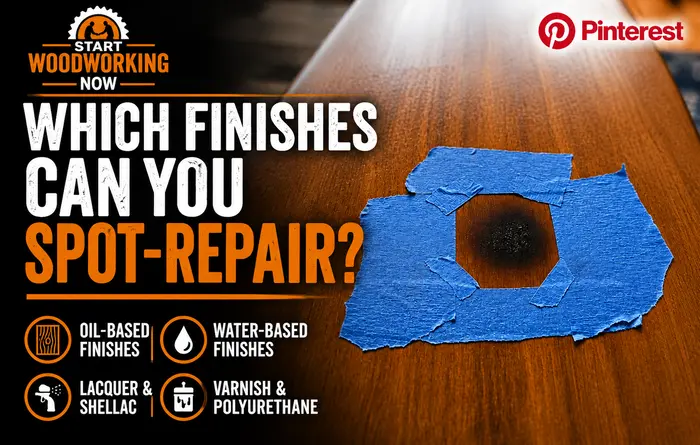
Which Finishes Can You Spot-Repair?
Part of Thermoplastic vs Thermoset Finishes · Wood Finishing Guide → Repairability
Thermoplastic finishes — lacquer and shellac — can be spot-repaired nearly invisibly, because fresh solvent physically re-dissolves the existing film at the repair edges, fusing old and new into one continuous layer. Thermoset finishes — oil-based polyurethane, conversion varnish, crosslinked water-based — cannot do this; a repair sits on top as a separate, mechanically bonded layer with a visible edge.
Why Thermoplastic Finishes Repair Invisibly
Lacquer and shellac never undergo a permanent chemical cross-linking reaction — they stay soluble in their own solvent indefinitely, which means a fresh application physically re-softens and partially re-dissolves the cured film already there, allowing the new material to molecularly fuse with the old rather than just sit on top of it.
This is why a skilled lacquer or French-polish touch-up can blend in with literally no visible boundary — the repair becomes physically continuous with the surrounding finish, not a patch over it. The full reversibility mechanism behind this is in the thermoplastic vs thermoset guide.
Why Thermoset Finishes Can’t Do This
Once a thermoset finish like oil-based polyurethane has cross-linked, that polymer network is permanently set — there’s no solvent that will re-dissolve it back into a liquid state without destroying it, so any new material applied over a repair area can only sit on top as a separate, mechanically adhered layer.
That creates a real physical boundary at the repair edge — a slight ridge, sheen mismatch, or visible line — which is why polyurethane touch-ups are notoriously difficult to make invisible, detailed further in fix scratches in polyurethane.
| Finish | Type | Spot-Repairable? |
|---|---|---|
| Shellac | Thermoplastic | Yes — fuses invisibly |
| Lacquer | Thermoplastic | Yes — fuses invisibly |
| Oil-based poly | Thermoset | No — visible boundary |
| Water-based poly | Thermoset | No — visible boundary |
If you need true repairability as a priority — for furniture that will inevitably get scratched and re-touched over decades — that durability-vs-repairability tradeoff is worth weighing before choosing between shellac, lacquer, or a thermoset topcoat.
Frequently Asked Questions
If polyurethane can’t truly be spot-repaired, what should I do for a scratch?
Blend rather than patch — light buffing and a full-width fresh coat over a larger area minimizes the visible boundary, since you can’t make a true seamless repair.